
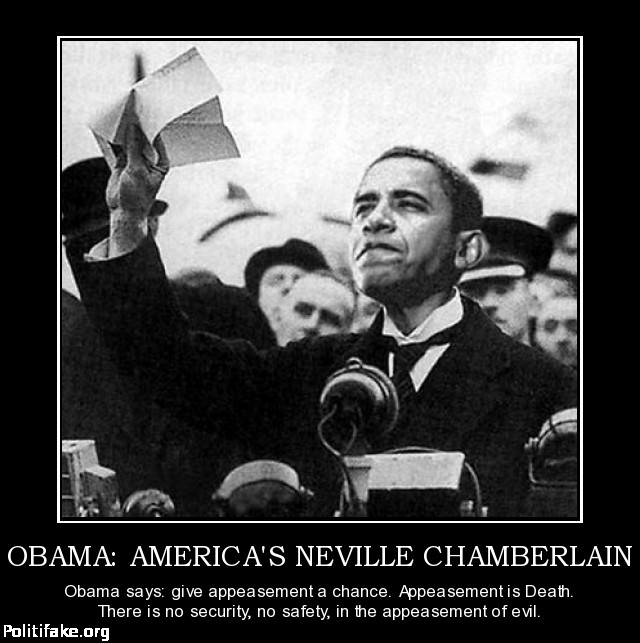
Surprise! Anti-war President blocked 75% of airstrikes on ISIS targets

Neville Chamberlain Obama: peace in our time

Washington Free Beacon reports.

Excerpt:

U.S. military pilots who have returned from the fight against the Islamic State in Iraq are confirming that they were blocked from dropping 75 percent of their ordnance on terror targets because they could not get clearance to launch a strike, according to a leading member of Congress.

Strikes against the Islamic State (also known as ISIS or ISIL) targets are often blocked due to an Obama administration policy to prevent civilian deaths and collateral damage, according to Rep. Ed Royce (R., Calif.), chair of the House Foreign Affairs Committee.

The policy is being blamed for allowing Islamic State militants to gain strength across Iraq and continue waging terrorist strikes throughout the region and beyond, according to Royce and former military leaders who spoke Wednesday about flaws in the U.S. campaign to combat the Islamic State.

“You went 12 full months while ISIS was on the march without the U.S. using that air power and now as the pilots come back to talk to us they say three-quarters of our ordnance we can’t drop, we can’t get clearance even when we have a clear target in front of us,” Royce said. “I don’t understand this strategy at all because this is what has allowed ISIS the advantage and ability to recruit.”

A quick review… here’s an article from earlier this year from the Wall Street Journal, about the low number of air strikes being conducted per day by President Pantywaist:

While it is still too early to proclaim the air campaign against Islamic State a failure, it may be instructive to compare it with other campaigns conducted by the U.S. military since the end of the Cold War that were deemed successes. For instance, during the 43-day Desert Storm air campaign against Saddam Hussein’s forces in 1991, coalition fighters and bombers flew 48,224 strike sorties. This translates to roughly 1,100 sorties a day. Twelve years later, the 31-day air campaign that helped free Iraq from Saddam’s government averaged more than 800 offensive sorties a day.

By contrast, over the past two months U.S. aircraft and a small number of partner forces have conducted 412 total strikes in Iraq and Syria—an average of seven strikes a day. With Islamic State in control of an area approaching 50,000 square miles, it is easy to see why this level of effort has not had much impact on its operations.

Of course, air operations during Desert Storm and Iraqi Freedom were each supported by a massive coalition force on the ground. Thus it may be more appropriate to compare current operations against Islamic State with the 78-day air campaign against Serbian forces and their proxies in 1999, or the 75-day air campaign in Afghanistan that was instrumental in forcing the Taliban out of power in 2001.

Both campaigns relied heavily on partner forces on the ground augmented by a small but significant number of U.S. troops. These air campaigns averaged 138 and 86 strike sorties a day respectively—orders of magnitude greater than the current tempo of operations against Islamic State.

Now, Obama is fond of saying that he is very interested in alternatives to his plans, and in fact, such an alternative exists – from his former top intelligence official:

Writing in Politico, Obama’s former top intelligence official, Mike Vickers, thoroughly dismantled Obama’s ISIS strategy, saying that “by any measure, our strategy in Iraq and Syria is not succeeding, or is not succeeding fast enough.”

Vickers’ credentials on this matter are impeccable. Until earlier this year, he was undersecretary of defense for intelligence, overseeing the NSA and Defense Intelligence Agency. An Army Special Forces veteran, he’s served as a key advisor to four presidents, and was the principal strategist behind the U.S. effort to defeat the Soviet invasion of Afghanistan.

[…]Whereas Obama insists that the attacks against ISIS must be “a long-term campaign,” Vickers explains that “time is not on our side” and that “we are playing a long game, when a more rapid and disruptive strategy is required.”

Vickers says that, contrary to what Obama claims, ISIS “cannot be contained any more than al-Qaida could prior to the Sept. 11, 2001, attacks.”

Obama dismisses ISIS as “killers with fantasies of glory who are very savvy when it comes to social media,” and who “pretend that they are a functioning state.”

Vickers explains that ISIS “is a de facto state. It holds territory, controls population, and funds its operations from resources that it exploits on territory it controls.”

While Obama seems to think that the best we can hope for is to someday “shrink” the territory ISIS controls “to defeat their narrative,” Vickers notes that Obama is needlessly handicapping the military: The “one thing the American military knows how to do is defeating an opposing force trying to hold ground.”

According to Obama, the only alternative to his minimalist ISIS strategy is another Iraq quagmire. Not so, says Vickers. “There are a lot of operational options between what we did in Iraq and what we didn’t do in Libya.”

Vickers says another leg of Obama’s “strategy” — namely that any resolution of the ISIS problem has to involve “a resolution to the Syria situation” — is wrong. On this point, in fact, he is emphatic. “We must not succumb to the false hope that ending the Syrian civil war is the key to defeating ISIS.”

Vickers also rejects joining forces with Russia in this clash.

In his press conference, Obama also complained that he hadn’t seen any “particular strategies that they would suggest that would make a real difference.”

Well, Vickers has one. Follow the model used to defeat the Taliban, and the Soviet army before that, in Afghanistan.

So, suppose there is a Paris-style attack within the United States that is planned and led by Islamic State elements. Will we be able to say that Obama has done everything he could to keep us safe? We have a porous southern border, pulling our forces out of Iraq and Afghanistan, a nearly constant stream of security breaches, massive cuts to defense spending, $140 billion dollars for Iran, cuts in military pay, and military morale at an all-time low. This President has no interest in protecting the American people.

When we get whacked by our enemies, and innocent people die, remember that Obama coddled those same enemies and let them do that to us. He doesn’t think Islamic State is evil, he doesn’t think that America is good, he doesn’t see that it’s his job as defeating evil and protecting Americans from evil.

Does the New Testament book of James undermine salvation by faith alone?

Theology that hits the spot

Are people brought into a right relationship with God because God provides for their salvation, or must we do works in order to earn our place with God in the afterlife?

The Bible is pretty clear that God provides our salvation from our rebellion by himself, all we have to do is accept it.

Look at Romans 3:21-30:

21 But now apart from the Law the righteousness of God has been manifested, being witnessed by the Law and the Prophets,

22 even the righteousness of God through faith in Jesus Christ for all those who believe; for there is no distinction;

23 for all have sinned and fall short of the glory of God,

24 being justified as a gift by His grace through the redemption which is in Christ Jesus;

25 whom God displayed publicly as a propitiation in His blood through faith. This was to demonstrate His righteousness, because in the forbearance of God He passed over the sins previously committed;

26 for the demonstration, I say, of His righteousness at the present time, so that He would be just and the justifier of the one who has faith in Jesus.

27 Where then is boasting? It is excluded. By what kind of law? Of works? No, but by a law of faith.

28 For we maintain that a man is justified by faith apart from works of the Law.

29 Or is God the God of Jews only? Is He not the Godof Gentiles also? Yes, of Gentiles also,

30 since indeed God who will justify the circumcised by faith and the uncircumcised through faith is one.

Here’s theologian R.C. Sproul, to explain a passage from the Bible that seems to contradict the passages that teach that faith alone is sufficient for salvation.

Here’s James 2:18-24:

18 But someone may well say, “You have faith and I have works; show me your faith without the works, and I will show you my faith by my works.”

19 You believe that God is one. You do well; the demons also believe, and shudder.

20 But are you willing to recognize, you foolish fellow, that faith without works is useless?

21 Was not Abraham our father justified by works when he offered up Isaac his son on the altar?

22 You see that faith was working with his works, and as a result of the works, faith was perfected;

23 and the Scripture was fulfilled which says, “And Abraham believed God, and it was reckoned to him as righteousness,” and he was called the friend of God.

24 You see that a man is justified by works and not by faith alone.

Sproul explains the apparent conflict:

What James is saying is this: If a person says he has faith, but he gives no outward evidence of that faith through righteous works, his faith will not justify him. Martin Luther, John Calvin, or John Knox would absolutely agree with James. We are not saved by a profession of faith or by a claim to faith. That faith has to be genuine before the merit of Christ will be imputed to anybody. You can’t just say you have faith. True faith will absolutely and necessarily yield the fruits of obedience and the works of righteousness. Luther was saying that those works don’t add to that person’s justification at the judgment seat of God. But they do justify his claim to faith before the eyes of man. James is saying, not that a man is justified before God by his works, but that his claim to faith is shown to be genuine as he demonstrates the evidence of that claim of faith through his works.

So yes, works are important as a sign to others that you believe what you say you believe, but not important for balancing your sins. Your sins are already paid for by Jesus, what you do in your life doesn’t add or take away anything from that. But I will say that if you can see that a person is spending a great deal of their time performing actions that are consistent with a concern for God’s purposes and reputation, then that’s a good sign that his faith is in good shape. Yes, even if he doesn’t do as much Bible study, devotions, singing and praying as he should. The important thing about actions (works) is that you can look at a person’s life and see evidence that he is taking God seriously – that Jesus is his leader, and that Jesus’ character is informing their decision-making and prioritizing.

Dr. George Yancey: The Nature and Consequences of Christianophobia

Dr. George Yancey did a presentation at the Reasonable Faith group at UT Dallas.

Here’s the lecture: (40 minutes)

About the speaker:

Dr. George Yancey is a Professor of Sociology at the University of North Texas. He is the author of Christian works such as One Body, One Spirit: Principles of Successful Multiracial Churches (InterVarsity Press), Beyond Racial Gridlock: Embracing Mutual Responsibility (InterVarsity Press), co-author of United by Faith: The Multiracial Congregation as an Answer to the Problem of Race (Oxford University Press) and co-author of Transcending Racial Barriers (Oxford University Press). He has also authored several research articles on the topics of interracial marriage and multiracial churches. Along those lines he is also the author of Multiracial Families (Routledge) which explores the current literature on different aspects of interracial families and Neither Jew Nor Gentile (Oxford University Press) which explores racial issues on Protestant college campuses.

His BS and MS are in economics. His PhD is in sociology.

Summary of the lecture:

  • Is discrimination against Christians real?
  • Which groups draw the most animosity?
  • What are the characteristics of those who most oppose conservative Christians?
  • What do cultural progressives think about conservative Christians?
  • Is the animosity against conservative Christians reasonable, or is it hatred / fear?
  • What kinds of stereotypes dominate animosity towards Christians?
  • Does animosity towards Christians affect hiring decisions in academia?
  • Why is the problem of Christianophobia not being addressed?

His latest book is So Many Christians, So Few Lions.

I was thinking about this lecture, and I was thinking, what would I do if I ran into one of these people who were really angry with me and wanted to feed me to lions, gas me, or murder me in other nasty ways. And I guess my only answer would be to speak to them and have them defend their beliefs without allowing them to pigeonhole me with a label. Maybe just focus on one particular issue like media bias or the origin of the universe, and try to focus on evidence rather than state my conclusion. Come to think of it, if you can name people on both sides and give evidence for both sides, that seems to work really well.

The more secular and left-wing the opponent, the more you have to stick with discussing ONLY evidence, and never say your view. So, you can say “how do you work this cosmic microwave background radiation in with your worldview?” but you can’t say, “I’m a conservative evangelical Christian, and you should come to church with me”. The secular progressives seem to be very concerned that Christians vote blindly for political leaders that restrict their freedoms, so again, don’t talk about policies, talk about the reasons on both sides for those policies. For example, do this “what is the morally significant difference between an unborn human and a born human that confers a right to life?” rather than “I’m pro-life and you should be pro-life too, or I’ll put you in jail”.

I have had conversations with people on the secular left who could not name a single reason for any of my beliefs. For example, gun ownership – they had no idea that people own guns for self-defense. Or capital punishment – they had no idea that there is a deterrent effect on other people contemplating violence crimes. They simply cannot express the view of their opponents or the reasons why their opponents hold those views. Maybe that’s partly their fault for being lazy and insular, but it might also be our fault, too, for not knowing the reasons. I know that when I explain the reasons to them (on both sides) and say that this is the evidence that needs to be debated, then they do often calm down. I think that their perception that we are irrational and faith-based scares them.

I think it’s a good idea to become aware of what the research says about secular progressive attitudes towards Christians so that we know how to act around them to avoid setting them off. When you are dealing with people who have this extreme hatred of you, you probably want to chip away at them rather than just be who you are right up front. There doesn’t seem to be a lot of tolerance here, which is so strange coming from the crowd that talks the most about tolerance. We are the only ones who they think it’s ok to fire, fine, imprison, etc.