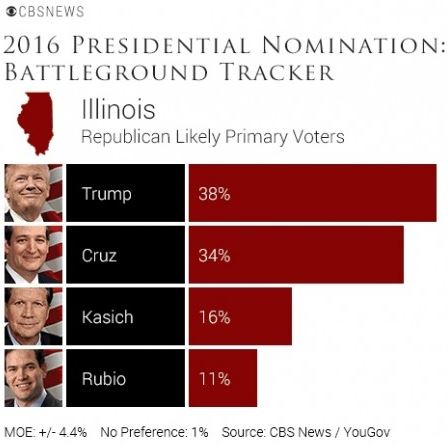
Ted Cruz trails Donald Trump by 4 points in deep blue Illinois

Latest CBS news / YouGov poll has Cruz just behind Trump

Wow, this is unexpected. A new CBS News poll released Sunday has Ted Cruz trailing trailing Donald Trump by 4 points in Illinois.

Excerpt:

Donald Trump keeps his lead in winner-take-all Florida, at 44 percent over Ted Cruz’s 24 percent and Marco Rubio’s 21 percent. In Ohio, Governor John Kasich is tied with Trump 33 percent to 33 percent, in two of the big winner-take-all delegate prizes up on Tuesday.

In Florida, home-state Sen. Marco Rubio has been trying to get traction against Trump, but still trails. Sen. Ted Cruz has overtaken Rubio in Florida. In Illinois Trump also leads, 38 percent to 34 percent over Cruz, who is in striking distance, with Kasich back at 16 percent. The findings across the three states may suggest Cruz is emerging more generally in the minds of many non-Trump voters as the alternative to the frontrunner.

Cruz is in second place in Florida, while Rubio is in third place. I have to think that a poll like this two days before the Florida primary would cause Rubio to drop out and endorse Cruz. Rubio is just trailing by too much to catch Trump.

Red State is reporting that Cruz plans to do FIVE rallies in Illinois on Monday, the final day of campaigning before a number of significant state-level elections on Tuesday.

According Teddy Schleifer of CNN, Ted Cruz’s team has scheduled five separate rallies in Illinois tomorrow as the Senator looks to make one last push in the state. With his surprise second place showing in Michigan, the Cruz team must have seen something in their numbers to think Cruz could do well enough in IL to grab a chunk of delegates away from Donald Trump.

Ted Cruz will rally in:

— Rockford, IL
— Glen Ellyn, IL
— Peoria, IL
— Decatur, IL
— Springfield, IL

— Teddy Schleifer (@teddyschleifer) March 13, 2016

This Tuesday, we’ll see elections from Florida (99), Illinois (69), Missouri (52), North Carolina (72), the Northern Mariana Islands (9) and Ohio (66).

Ted Cruz’s record of conservative achievements

Ted Cruz is also the most qualified candidate running.

Young Conservatives explains his achievements:

  • Graduated valedictorian in 1988 from Second Baptist High School
  • Graduated cum laude from Princeton University in 1992
  • Graduated magna cum laude from Harvard Law School in 1995
  • 1992 U.S. National Debate Champion representing Princeton
  • 1995 World Debating Championship semi-finalist representing Harvard
  • Served a law clerk to Chief Justice William Rehnquist, making him the first Hispanic ever to clerk for a Chief Justice of the United States
  • Served as Solicitor General of Texas from 2003 to 2008, making him the first Hispanic Solicitor General in Texas, the youngest Solicitor General in the entire country and the longest tenure in Texas history
  • Partner at the law firm Morgan, Lewis & Bockius, where he led the firm’s U.S. Supreme Court and national appellate litigation practice
  • Authored over 80 SCOTUS briefs and presented over 40 oral arguments before The Court
  • Adjunct Professor of Law at the University of Texas School of Law in Austin, where he taught U.S. Supreme Court litigation

Smart guy.

Here are the specifically conservative achievements:

  • In the landmark case of District of Columbia v. Heller, Cruz assembled a coalition of 31 states in defense of the principle that the 2nd Amendment guarantees an individual right to keep and bear arms
  • Presented oral arguments before the United States Court of Appeals for the District of Columbia Circuit
  • Defended the Ten Commandments monument on the Texas State Capitol grounds,
  • Defended the recitation of the Pledge of Allegiance in public schools
  • Defended the State of Texas against an attempt by the International Court of Justice to re-open the criminal convictions of 51 murderers on death row throughout the United States

He’s 5 for 9 arguing cases before the Supreme Court. Cruz knows how to convince liberal scholars to come over to his side. That’s what he enjoys – persuading people who disagree with him.

Here’s some of the legislation he introduced:

  • ObamaCare Repeal Act
  • Disarm Criminals and Protect Communities Act
  • Defund Obamacare Act of 2013
  • A bill to amend the National Voter Registration Act of 1993 to permit States to require proof of citizenship for registration to vote in elections for Federal office
  • State Marriage Defense Act of 2014
  • A bill to amend title 18, United States Code, to prohibit the intentional discrimination of a person or organization by an employee of the Internal Revenue Service
  • A bill to prohibit the Department of the Treasury from assigning tax statuses to organizations based on their political beliefs and activities
  • American Energy Renaissance Act of 2014
  • A bill to deny admission to the United States to any representative to the United Nations who has been found to have been engaged in espionage activities or a terrorist activity against the United States and poses a threat to United States national security interests
  • SuperPAC Elimination Act of 2014
  • Free All Speech Act of 2014
  • A bill to prevent the expansion of the Deferred Action for Childhood Arrivals program unlawfully created by Executive memorandum on August 15, 2012
  • Sanction Iran, Safeguard America Act of 2014

And he has gotten more legislation passed than Marco Rubio in the Senate:
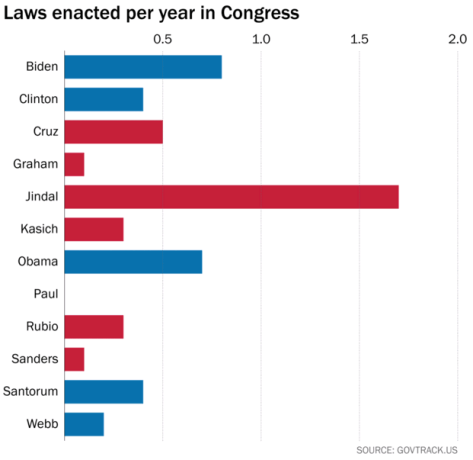
Laws enacted per year in Congress

He has done something to address so many of the things I’ve been writing about on this blog – voter fraud, IRS discriminating against conservatives, etc. I am a Cruz supporter because I like Cruz, not because I oppose Trump and Rubio.

Related posts

Does the Bible say that you should forgive someone who does not repent?

Bible study that hits the spot

Kevin Lewis, a professor of Theology and Law at the conservative Biola University, was asked this question:

Recently, I was reading Dr. Kenneth Bailey’s “Jesus Through Middle Eastern Eyes” (IVP press 2008). When commenting on Matthew 6:12-13, he writes,

“It is a common human assumption that the violator of the rights of others must ask for forgiveness before the wronged party can be expected to accept the apology and grant forgiveness…But Jesus here asks the person wronged to forgive the one responsible for the wrongdoing when when there is no confession of guilt… There is a voice from the cross that echoes across history to all saying ‘Father forgive them for they know not what they do.’ Neither Pilate nor the high priest nor the centurion offered any apology to Jesus, yet he prayed for divine forgiveness…(p.125)”

And here’s some of his response copied with permission from his Facebook note:

First, regarding God and His forgiveness, it is undisputed in orthodox Christian theology that God does not forgive everyone. The doctrine of Hell is a sufficient proof of the lack of universal forgiveness by God.

Next, it is clear that God does not forgive without repentance. This doctrine is taught in a number of texts. For example, in Luke 13:3 Jesus says, “unless you repent, you will all likewise perish.” In Mark 1:15 John the Baptist commands that we must “repent and believe the Gospel.” The connection between repentance and forgiveness of sins (i.e. “salvation”) is seen throughout the Scriptures. For example, in Acts 2:38 repentance is directly connected as a condition for the remission of sins. For additional examples of this connection see Matthew 11:20-24; Luke 24:45-49; Acts 3:19; 8:22; 17:30-31; Romans 2:4-5; II Corinthians 7:10; II Tim. 2:25-26.

So since we are to be imitators of God and forgive in the same way God forgives, we would expect the Scriptures to be consistent, stating that the condition of repentance is required to be fulfilled before believers are required to forgive each other’s sins. It does.

Jesus stated in Luke 17:3, “If your brother sins, rebuke him; and if he repents, forgive him.” Here, the meaning is clear. The word “if” (Grk. ean) introduces the condition for a rebuke and for granting forgiveness. If (subjunctive) a person sins, we must (imperative) rebuke him, and if (subjunctive) he repents, we must (imperative) forgive him. This is as clear a statement as you will find on the subject. Forgiveness is conditioned upon repentance—and this is one of the same criteria that God requires before He forgives sin.

This principle of permitting believers to withhold forgiveness unless the condition of repentance is satisfied is also explicitly seen in Matthew 18:15-17. Compared with the Luke 17:3 text above, the situation is the same. If a brother sins, reprove him; if he listens to you, you have won your brother. Here, the word “reprove” is used rather than “rebuke” and the word “listen” is employed rather than “repent,” but the meaning is virtually identical to Luke 17:3. What we see in Matthew 18 is an escalation of the issue and the result if the person fails to repent (i.e. “listen”). If the person fails to repent, we are to shun him in all appropriate ways (v. 17).

[…]Finally, I would make the case that it is harmful to a person to forgive him without requiring repentance. As seen above, the Bible is clear that sin requires a rebuke. Ignoring sin teaches sinners that sin does not bring consequences. This is harmful to their souls. Continuing to have the benefit of a righteous relationship with another and yet remain in sin against that person results in fostering a habituation of sinful inclinations in their soul, which God says brings about suffering and death.

Moreover, since the ultimate purpose of forgiveness is reconciliation, it is meaningless and harmful to forgive when no reconciliation may be had with the sinner. We cannot “walk together” in a biblical manner in righteous peace when the unrepentant sinner walks in unrighteousness. Necessarily, there is a conflict and a want of shalom. Their soul is headed in a different direction than the believer’s soul; they are walking away from God and we cannot have fellowship with darkness. God has no intimate fellowship with unrepentant people, and that is the model for Christians as well (See Matt. 18).

Regarding personal anger issues commonly raised by Christian psychologists, these types of psychologists unbiblically make unconditional forgiveness a part of therapy. By contrast, however, if a counselee will not forgive after the offending party has truly repented, the counselee sins, and this kind of unforgiveness may be one of the causes of his or her problems. But this is a separate issue from universal and unconditional forgiveness raised above.

Human beings in the image of God may be angry in appropriate ways (Eph.4:26, 31). There is a time to love and a time to hate (Ecclesiastes 3:8). The notion that Christians cannot ever hate, be angry, or lack forgiveness is an unbiblical concept. God Himself is eternally angry with sin, but He is certainly not a psychological basket case. He loves, hates, and is angry in appropriate ways. Our task as believers is to imitate this. Be angry with and hate sin appropriately (Rom. 12:9) and love what good appropriately. For example, righteous anger can evolve beyond the biblical limits to become malice, slander, and bitterness while, to give another example, an appropriate love of food can evolve beyond the biblical limits into gluttony.

I agree with Kevin, and I think it is a helpful tool for people to insist on seeing some sort of repentance and restitution from someone who wrongs you before you trust them again. If they are not even sorry for what they’ve done, and they refuse to explain why what they did is wrong, then they can’t be forgiven, and you can’t trust them again.

I think this is the key passage – Luke 17:3-4:

3 Be on your guard! If your brother sins, rebuke him; and if he repents, forgive him.

4 And if he sins against you seven times a day, and returns to you seven times, saying, ‘I repent,’ forgive him.”

That’s Jesus speaking, there.

Also, I was having a debate with someone who disagrees with all this, and while debating with her, I thought of another example.

Luke 18:9-14:

9 And He also told this parable to some people who trusted in themselves that they were righteous, and viewed others with contempt: 

10 “Two men went up into the temple to pray, one a Pharisee and the other a tax collector. 

11 The Pharisee stood and was praying this to himself: ‘God, I thank You that I am not like other people: swindlers, unjust, adulterers, or even like this tax collector. 

12 I fast twice a week; I pay tithes of all that I get.’ 

13 But the tax collector,standing some distance away, was even unwilling to lift up his eyes to heaven, but was beating his breast, saying, ‘God, be merciful to me, the sinner!’ 

14 I tell you, this man went to his house justified rather than the other; for everyone who exalts himself will be humbled, but he who humbles himself will be exalted.”

So again, no forgiveness without repentance.

Forgiveness is what happens when someone who is sinned against treats the sinner as if he had never sinned. It is not on the balance sheet. It is not brought to mind. It is not held against them in the future. The forgiver trusts the sinner again as if the previous sin had never happened.

In divine (vertical) forgiveness, there is no forgiveness without repentance. There are Bible verses above to show that.

My argument is twofold. First, there is a clear teaching of Jesus explaining the sequence of sin and forgiveness. Repentance precedes forgiveness, between humans (Luke 17:3). The verses cited by the forgive without repentance crowd don’t show the mechanics of how to forgive, they are making the point that if you want God to forgive you, you should forgive others. The parable in Luke 18:9-14 affirms this again – repentance always precedes forgiveness.

Second, we have an obligation to imitate God, and that means imitating the way he forgives those who sin against him. When I raise that with the unconditional forgiveness crowd, they want to insist that there is a difference, that the word “forgive” means different things. I’m not convinced.

Finally, I do think that forgiving someone is obligatory if they sincerely repent, and even if they screw up again and again. So long as the repentance is sincere, (like if there is restitution and a genuine effort to show an understanding how the sin affected the wronged party in writing), then forgiveness should be automatic.

Alan E. Kurschner argues that there is serious textual doubt about the originality of Luke 23:34a, a text used by the pro-unconditional-forgiveness crowd. He has a journal article coming out on it, but a synopsis of his argument is here.

He also wrote this in a comment on this blog:

Second, on Matt 6:15, this is what I have to say. Notice the then-clause: “neither will your Father forgive your sins.” This would require universalism on the Father’s part according to the unconditional interpretation given the first half: “But if you do not forgive others their sins.” Since everyone has wronged the Father is the Father required to forgive everyone even if they are not seeking forgiveness?

So I think the case for the forgiveness being conditional on repentance is pretty strong, especially when serious harm has been caused.

Pastor Matt: What happens when you die?

Lets take a closer look at a puzzle

This post is from Pastor Matt’s blog.

Excerpt:

Michael Bird breaks it all down as follows:

1. Prior to Christ’s ascension, all who died descended to Sheol/Hades, which was divided into two parts, one for the wicked and one for the righteous.

2. At Christ’s ascension, he went into heaven and took with him all of the saints in the paradisal part of Sheol/Hades, while the wicked remain in Sheol/Hades, waiting for judgment.

3. Upon death new covenant believers go to be with Christ in heaven ahead of the general resurrection, while the wicked descend to Sheol/Hades waiting for judgment.

4. Eventually Sheol/Hades will be thrown into hell and all believers will share in the new heavens and new earth.

See Evangelical Theology p. 323.

I’ve featured some debates with Michael Bird before, he is a famous evangelical historian.

It’s important to understand that the Christian view of humans is that we have a material part and a non-material part. When you die, the material part goes into a tomb. The non-material part goes on to be with God, until the day when you get a new resurrection body.

Earlier, I blogged about some philosophical arguments for the existence of souls and some scientific evidence for the existence of souls, and it’s worth looking over in order to move beyond mere opinions. Like it or not, this is the way we are! Not just bodies, but souls.