Did the city of Nazareth exist at the time of the birth of Jesus?

Israeli archaeologist Yardena Alexandre inspects Roman 1st-century pottery found from the city of Nazareth.

A while back, I was discussing a recent debate that a friend attended between an atheist musician named Dan Barker and a Christian with a doctorate in New Testament Studies named Justin Bass.

According to my friend’s report, the atheist questioned the existence of Nazareth, and then went on from there to assert that everything we know about Jesus is legendary.

This is what the atheist’s argument sounds like:

  1. If the New Testament contains reliable history about Jesus, then Nazareth must exist.
  2. Nazareth does not exist.
  3. Therefore, the New Testaments does not contain reliable history about Jesus. (M.T. 1,2)

I was able to find a web site where an atheist was making the claim that Nazareth did not exist at the time of Jesus. So this is not completely outside the realm of mainstream atheism. I doubled checked with two more people who attended the debate that Barker indeed made an argument like the one above.

Two things to say about this 3-step argument. First off, when speaking to atheists, Christians only care about making a case for the resurrection. This is for two reasons. One, our goal is to disprove atheism, and the historical argument for the resurrection is the most evidenced miracle claim in the New Testament. Nazareth is not part of that core of minimal facts about the resurrection of Jesus. Second, it’s possible to be a Christian by accepting a core of Christian dogma (e.g. – the Apostle’s Creed), while remaining agnostic or even skeptical of other things in the Bible. Nazareth is not part of that core of minimal facts that must be affirmed in order to become a Christian.

The problem I have with atheists is that they pick and choose from the Bible according to their own agenda. Every Christian has read basic books on the resurrection by people like Lee Strobel, Michael Licona, William Lane Craig, J. Warner Wallace and so on. This is like table stakes for living a Christian life. We all know how to make a case based off of minimal facts for the resurrection. When Christians get into debates about Jesus, we want to make a case for the core of historical knowledge about him, minimal facts that almost no one disagrees with. But many atheists aren’t like that. They want to pick and choose a few verses out of the Old Testament and the New Testament that they personally find distasteful to them, and then deny the minimal facts about Jesus on that basis. I don’t think that it makes sense to deny evidence for widely-accepted facts by bringing up minor problems that are irrelevant to the well-attested core facts.

But it’s worse than that – we actually DO know that Nazareth existed, and we know it not from some fundamentalist preacher, but from atheist Bart Ehrman.

Ehrman writes in his book:

One supposedly legendary feature of the Gospels commonly discussed by mythicists is that the alleged hometown of Jesus, Nazareth did not exist but is itself a myth. The logic of this argument, which is sometimes advanced with considerable vehemence and force, appears to be that if Christians made up Jesus’ hometown, they probably made him up as well.  I could dispose of this argument fairly easily by pointing out that it is irrelevant.  If Jesus existed, as the evidence suggests, but Nazareth did not, as this assertion claims, then he merely came from somewhere else.  Whether Barack Obama was born in the U.S. or not (for what it is worth, he was) is irrelevant to the question of whether he was born.

Since, however, this argument is so widely favored among mythicists, I want to give it a further look and deeper exploration.  The most recent critic to dispute the existence of Nazareth is René Salm, who has devoted an entire book to the question, called The Myth of Nazareth.  Salm sees this issue as highly significant and relevant to the question of the historicity of Jesus: “Upon that determination [i.e., the existence of Nazareth] depends a great deal, perhaps even the entire edifice of Christendom.”

So that seems like a fair representation of the argument I outlined above.

Bart’s response is long, but here’s part of it:

There are numerous compelling pieces of archaeological evidence that in fact Nazareth did exist in Jesus’ day, and that like other villages and towns in that part of Galilee, it was built on the hillside, near where the later rock-cut kokh tombs were built.  For one thing, archaeologists have excavated a farm connected with the village, and it dates to the time of Jesus.  Salm disputes the finding of the archaeologists who did the excavation (it needs to be remembered, he himself is not an archaeologist but is simply basing his views on what the real archaeologists – all of whom disagree with him — have to say).  For one thing, when archaeologist Yardena Alexandre indicated that 165 coins were found in this excavation, she specified in the report that some of them were late, from the fourteenth or fifteenth centuries.  This suits Salm’s purposes just fine.  But as it turns out, there were among the coins some that date to the Hellenistic, Hasmonean, and early Roman period, that is, the days of Jesus.  Salm objected that this was not in Alexandre’s report, but Alexandre has verbally confirmed (to me personally) that in fact it is the case: there were coins in the collection that date to the time prior to the Jewish uprising.

Aalm also claims that the pottery found on the site that is dated to the time of Jesus is not really from this period, even though he is not an expert on pottery.  Two archaeologists who reply to Salm’s protestations say the following:  “Salm’s personal evaluation of the pottery … reveals his lack of expertise in the area as well as his lack of serious research in the sources.”  They go on to state: “By ignoring or dismissing solid ceramic, numismatic [that is, coins], and literary evidence for Nazareth’s existence during the Late Hellenisitic and Early Roman period, it would appear that the analysis which René Salm includes in his review, and his recent book must, in itself, be relegated to the realm of ‘myth.’”

Read Bart’s whole excerpt from his book in his post.

I did a quick double check on the archaeologist Ehrman mentioned, and found an Associated Press story about another archaelogical discovery made by archaeologists in Nazareth. This time, it’s not the coins, but pottery fragments. The date range on the pottery is 100 before Jesus’ birth to 100 years after Jesus’ birth.

Even though Ehrman is an atheist, I think that he understands how to do history. You can’t be a credentialed historian and throw out the early proclamation of Jesus’ resurrection because of doubts about Old Testament violence. You can’t be a credentialed historian and throw out the conversions of Paul and James because you don’t know whether there was one angel or two angels at the empty tomb. Denying the core facts about Jesus by bringing up concerns about peripheral issues is not a responsible way to investigate the historical Jesus.

School sends sheriff to child’s home to stop him from sharing Bible verses

Anti-marriage gay activists vandalize church

In California, of course.

This is from Todd Starnes, writing at Fox News.

Excerpt:

Mrs. Zavala made it a practice of including a Bible verse and encouraging note in her son’s lunch bag. The boy would tell his friends about the note and read them aloud at the lunch table.

It wasn’t long before children asked for copies of the notes and Mrs. Zavala obliged – including a brief note to explain the daily Bible verse.

On April 18 a teacher called Mrs. Zavala and said her son would no longer be able to share the Bible verses because he was “not allowed to share such things while at school.”

[…]They say the teacher told Mrs. Zavala that her son “could no longer read or share Bible verses or stories at lunch” – citing “separation of church and state.”

So, Mr. and Mrs. Zavala complied with the school’s clearly unconstitutional edict.

But on May 9, the school’s principal decided to implement a complete ban on the Bible verse sharing.

Liberty Counsel alleges the boy was ordered to stop handing out notes because “it was against school policy.” The principal told the boy and his father to move to a public sidewalk. They complied with the principal’s demand.

It would be just a few hours later – when the Zavala family heard a knock at their front door.

“The deputy sheriff said he had been sent by the school,” Liberty Counsel attorney Richard Mast told me. “The deputy went on to tell the parents that the school was worried that someone might be offended by the Bible verses.”

People on the secular left often like to talk about tolerance and diversity, but, they are not tolerant of any views that challenge their own, and they don’t support diversity of opinion. The truth is that they get offended very easily when anyone disagrees with them, because they often take care to isolate themselves from different points of view. And, as the story shows, that can even involve using the force of law to threaten others who disagree with them. It’s very natural for people on the secular left to resort to threats and coercion. You can see it happening all the time with secular groups and groups who promote immorality. They like to use threats and punishments to get their way. It’s very natural to them to stamp out different people and different values.

New study: women who have fewer premarital sex partners have lower risk of divorce

Man helping a woman with proper handgun marksmanship

Brad Wilcox tweeted this article from Family Studies that talks about how the number of pre-marital sex partners that a woman has increases her risk of divorce.

It says:

American sexual behavior is much different than it used to be. Today, most Americans think premarital sex is okay, and will have three or more sexual partners before marrying. What, if anything, does premarital sex have to do with marital stability?

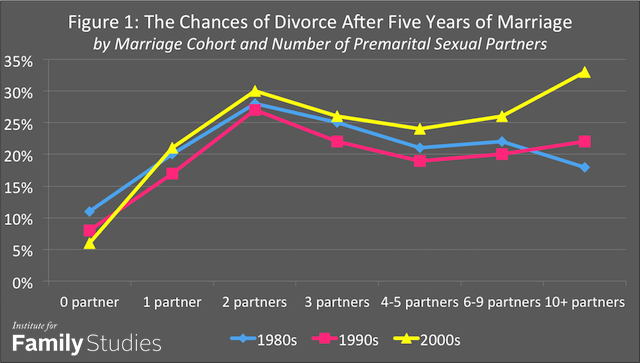
This research brief shows that the relationship between divorce and the number of sexual partners women have prior to marriage is complex. I explore this relationship using data from the three most recent waves of the National Survey of Family Growth (NSFG) collected in 2002, 2006-2010, and 2011-2013. For women marrying since the start of the new millennium:

  • Women with 10 or more partners were the most likely to divorce, but this only became true in recent years;
  • Women with 3-9 partners were less likely to divorce than women with 2 partners; and,
  • Women with 0-1 partners were the least likely to divorce.

Earlier research found that having multiple sex partners prior to marriage could lead to less happy marriages, and often increased the odds of divorce.

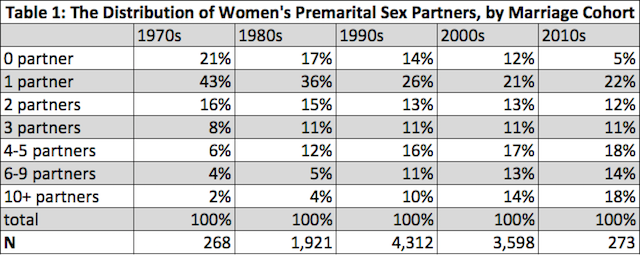
[…]Even more noteworthy has been the decline in the proportion of women who get married having had only one sex partner (in most cases, their future husbands). Forty-three percent of women had just one premarital sex partner in the 1970s.

[…]By the 2010s, only 5 percent of new brides were virgins. At the other end of the distribution, the number of future wives who had ten or more sex partners increased from 2 percent in the 1970s to 14 percent in the 2000s, and then to 18 percent in the 2010s. Overall, American women are far more likely to have had multiple premarital sex partners in recent years (unfortunately, the NSFG doesn’t have full data on men’s premarital sexual behavior, and in any event they recall their own marital histories less reliably than do women).

Here’s the change:

Women have freely chosen to dismiss the Bible and the moral law

And the problem with this, of course, is that more premarital sex partners means a higher risk of divorce:

Even one non-husband premarital sex partner raises risk of divorce

Why is the 2-partner number so high?

In most cases, a woman’s two premarital sex partners include her future husband and one other man. That second sex partner is first-hand proof of a sexual alternative to one’s husband. These sexual experiences convince women that sex outside of wedlock is indeed a possibility. The man involved was likely to have become a partner in the course of a serious relationship—women inclined to hook up will have had more than two premarital partners—thereby emphasizing the seriousness of the alternative.

The woman has an alternative, the woman makes comparisons, the woman has firsthand experience of sex with someone other than her eventual husband. This is not trivial, it should not be dismissed by men who are evaluating marriage candidates.

I was really glad to see Dr. Wilcox tweet this article, because a lot of men’s rights people judge him unfairly for being blindly pro-marriage, as if he doesn’t see the risks to men. No, he sees those risks, and he warns men about them, and he holds women accountable. He is saying to women: if you want your marriage to last, you are responsible to study this research, to say no to your heart, to resist the culture, and to make wise decisions to protect your future husband and children.

Now, many traditional marriage people will tell young men “feminism and the sexual revolution change nothing, go out there and get married to these women anyway”. No one condemns women for their unilateral decision to believe in radical feminism, and their decisions to act against the moral laws by having premarital sex. It’s like the Bible has no authority for men – it can only be used to tell men what to do. I have met pastors and parents who have this double standard that excuses women from everything, and blames and shames men for everything. Even if the men are virgins, they are blamed and shamed by pastors and parents when the woman’s poor choices do not “work out” for her.

The culture is filled with voices who rationalize women who choose to get drunk and hook up with good-looking men, including from the pulpits of churches. Few people are aware of the logical consequences of selfish actions. There is just this view that it is a terrible, horrible thing to stifle the freedom of women to “follow their hearts”. Pastors and Christian parents feel that it is wrong to tell young women that the Bible somehow should act as a brake on their desires to have feelings with a man, and to show off a boyfriend to their friends, and to have fun – to have a good time now, in the moment. I have seen these conversations happening, where grown-ups who claim to be Bible believing Christians condemn men for not manning-up to rescue women in one breath, and then admit that those women should not be shamed or judged for not having any moral compass. It’s enough that the women look pretty – that makes them “Christian”, regardless of their past selfishness. No one cares about the risks that a man will face by having to take on that damage.

Previously, I blogged about how most divorces are initiated by women. If you are a man who has made good decisions with his education and finances, you need to be aware of this research. Although you may think that it’s harmless that the woman you want to marry has had multiple premarital sex partners, it’s not. It will affect her ability to be attracted to you, and to be satisfied by you. According to my friend Dina, previous cohabitations should be treated by men as a previous divorce. And previous divorces make a woman more unstable for marriage – that’s a fact. And divorce is risky for men financially and emotionally – another fact. Men didn’t ask to live in a world where they can lose all their savings, future income, and access to their children should their wives become unhappy and decide to divorce them – but that is the world that men live in.

I would like to see women make better decisions with men before they marry, rather than be influenced by their peers and culture to give themselves to men who are not marriage-minded. Maybe a little skepticism should be shown to “follow your heart”? Women need to understand what they are losing when they choose to have premarital sex.

In my group of friends, the men are aware of the Biblical prohibition on premarital sex. My friends know about the research on marriage, and what it takes to make a marriage work. We don’t follow our hearts, because we do what we know will work to achieve the results we want. We don’t listen to the culture, and we don’t listen to radical feminists. Men generally take an engineering approach to marriage – we want to know what the best practices and tradeoffs are, and then we plan and act to succeed.