Alistair Begg preaches on practicality and initiative in the story of Ruth

Bible study that hits the spot

I finished listening to Alistair Begg’s series on Esther, and I’m now on to his series on Ruth. Sermon #3 stood out to me, because it touches on the important issues of free will vs determinism as well as the two methods of seeking God’s will: mysticism vs wisdom.

The discussion centers around Ruth’s decision to go to the barley fields to work, in order to get something to eat.

The MP3 file is here.

Here is the description:

When we’re facing a future devoid of prospects or possibilities, it’s easy to become overwhelmed and discouraged. Ruth could relate. She was a penniless widow in a foreign land seeking a way to provide for herself and her widowed mother-in-law. Her future was totally dependent upon someone showing her unmerited grace and favor. Instead of giving up, she gives us an example of humility, initiative and faith as she seeks work and sustenance.

As things in the world spin out of control, it’s important to remember that you must always have a plan and be working on that plan. Even when things look very bleak, you have to do something reasonable and practical, and then pray to God for “favor”. That God will do something unexpected that will make your reasonable action bear unexpected fruit.

If you want to listen to sermons #1 and sermon #2 in the series on Ruth, you can find the whole series here. So far, I have listened to 5. The first two were also very good, so if you listen to the first 3, you will definitely benefit. Each one is 35 to 40 minutes.

Are Christians responsible for making plans and making good decisions?

Here’s a wonderful post on decision making and the will of God posted on Neil’s blog. In his post, Neil explains the Biblical model for making good decisions.

Excerpt:

Really short version: Aside from direct and clear personal revelation from God, you don’t have access to his sovereign will when making decisions.  Therefore you must look at other factors.  If it isn’t moral, don’t do it.  If it is moral but not wise, don’t do it.  If it is moral and wise, then use your personal preferences.

Using this model you can end up with a wise and biblical decision, but you have avoided the traps of the “God told me to ____” routine.  People who run around saying that God told them this and that convey a super-spirituality that can leave less mature believers wondering if they really have a relationship with God (i.e., “God doesn’t tell me every little thing to do, so maybe I don’t really know him.”).

He has a helpful picture posted as well:
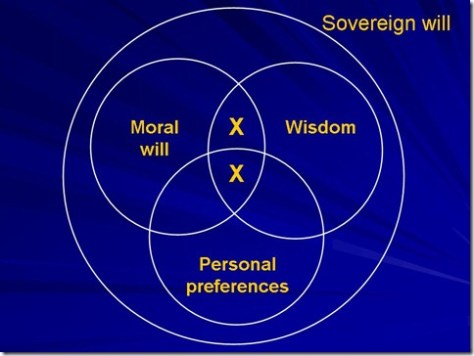
This is actually a very important topic for me, because I like making plans and making good decisions. I like being the quarterback or squad leader of my own life. I like to pick objectives and then make plans to achieve them. (Nothing too exotic, just simple stuff like saving money or reading more books)

Actually, I really oppose the idea that God has a magical fairy tale will for each person that will make them happy and fulfilled. For me, life isn’t like that. I don’t expect God to lead me along like a child at a scavenger hunt. I expect to survey the battlefield where I am and then do something to make a difference. There are lots of things you can do that will please God. Should you focus on your career and sponsor apologetics conferences? Or should you use your spare time preparing Sunday school lessons? There are lots of good things you could do to please God. Your job is to pick the one that will be the most effective. It doesn’t matter if it makes you happy, it only matters if it’s effective and if you are good at it.

Who is Rifleman Dodd?

A while back, I was busily working my way through the U.S. Marine Corps Official Reading List, and I came across a book by C.S. Forester called Rifleman Dodd, or alternatively titled Death to the French. It’s a work of historical fiction that takes place during the Napoleonic wars. The story is about a British marksman named Dodd, who is cut off from his own lines during a withdrawal maneuver. He is subsequently left to fend for himself behind enemy lines. An ordinary man might be full of despair and forget about his mission entirely. But Dodd is no ordinary man. Not only does he find a way to survive by finding food to eat, water to drink and places to sleep, but he also tries to remember his orders and to think about what he can do to advance the cause of his General, the Duke of Wellington.

Here’s an excerpt from a gritty book review:

It’s about a green-coated British infantry rifleman in the Napoleonic Wars, an age when rifles were a novelty and most of the army was red-coated and carried muskets. Private Matthew Dodd gets separated from his regiment during a retreat and finds himself stranded behind enemy (French) lines in Portugal. With the occasional aid of some natives, but mostly on his own, he harasses the French with his rifle and tries to prevent them from building a bridge across the Tagus River. It’s a remarkable tale of survival and solitary achievement, of a rank-and-file soldier who lives by his wits and slowly learns to make plans without orders, and shows leadership qualities and a knowledge of warfare.

I think we’re in the same situation as Dodd.

There is no point in us looking for breadcrumb trails to happiness at this point. That’s not the point of Christianity. The point of Christianity is friendship with God, imitation of Christ, honoring moral obligations, self-sacrificial love for your neighbor (and even your enemies!), and dedication to the truth – whether anyone else likes you or not. It’s not supposed to make you happy, and it’s not necessarily going to be a normal life like everyone else has. Things may not work out the way you’d like them to.

We seem to be making such a big deal about compassion and forgiveness in the Christian life these days – such a big emphasis on our feelings. Almost like we have forgotten that we have obligations to our friend – and his objectives. A relationship doesn’t mean that one person completely disregards the character and goals of the other person and then is automatically granted forgiveness whenever they want it. That’s not a friendship – that’s using someone else for your own ends. Maybe it’s time to remember what this is all about.

Canadian court rules that Christian university cannot uphold Christian moral values

Canada Election 2015: Socialists in red, Communists in Orange, Conservatives in blue

This article about religious liberty in Canada is from Vancouver Sun. (H/T Glenn)

Excerpt:

Ontario’s top court has dismissed an appeal from a private Christian university that forbids sexual intimacy outside heterosexual marriage, denying its proposed law school accreditation in the province.

The ruling from the Ontario Court of Appeal on Wednesday dealt a significant blow to Trinity Western University in a legal battle which pitted freedom of religion against equality rights.

A panel of three appeal court judges found that while the university’s religious freedom had been infringed upon, the institution discriminated against the LGBTQ community.

Trinity Western — which is fighting similar cases at appeal courts in Nova Scotia and British Columbia — expressed disappointment at the ruling, saying it would be taking its fight to the Supreme Court of Canada.

The Ontario case saw the Evangelical Christian institution based in Langley go up against the Law Society of Upper Canada after the regulatory body voted not to accredit the university’s planned law facility.

At the heart of the dispute was Trinity Western’s “community covenant” or code of conduct, which all students are required to agree to.

The key point about the code of conduct is that it doesn’t discriminate against any particular group, e.g. – LGBT. It also forbids excessive drinking and premarital sex by heterosexuals:

It includes requiring students to abstain from gossip, obscene language, prejudice, harassment, lying, cheating, stealing, pornography, drunkenness and sexual intimacy “that violates the sacredness of marriage between a man and a woman.”

Now read this next part carefully. Although there was no legal support for denying a Christian university religious liberty and freedom of association, there was the hurt feelings of the LGBTQ community:

“The part of TWU’s Community Covenant in issue in this appeal is deeply discriminatory to the LGBTQ community, and it hurts,” the appeal court ruling said. “The LSUC’s decision not to accredit TWU was indeed a reasonable conclusion.”

In Canada “it hurts” means the end of human rights like religious liberty and freedom of association. Why? Because the Christian community in Canada has – for decades – voted to increase the size of government at the expense of liberty, in order to get free stuff. It doesn’t matter if the Christians who wanted a Christian university are hurt. Or that the Christian students at TWU are hurt. Only the hurt of the LGBT community matters, and their hurt changes laws, criminalizes dissent and annihilates natural rights. There are no such things as freedom of religion and freedom of conscience in Canada. There never was free speech, either. Anything that might hurt the feelings of left-wing groups has to be made criminal.

I’ll put this as plainly as anyone can: Canadian “Christians” have been voting to transfer wealth and power to a big secular government for years. They wanted government to cover health care, and now the government thinks that health care is providing free sex changes, free IVF and free abortions. Canadian “Christians” wanted their 30 pieces of silver more than they wanted the freedom to act as if the Bible was true in public. It turns out that the more wealth and power that you transfer to a secular government, the more likely they are to abuse that wealth and power in trampling out any ideology that interferes with their buying votes from their favored special interest groups.