
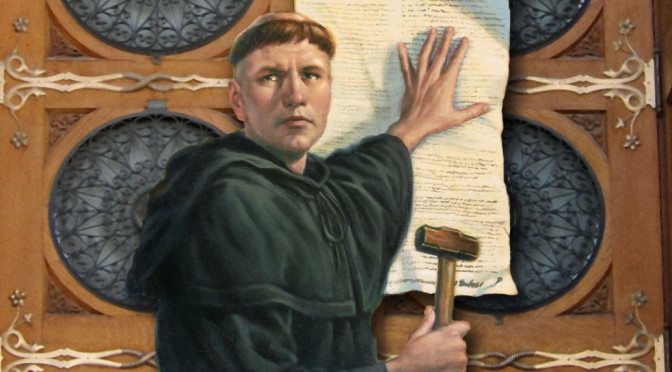
Reformation Day celebrates the supremacy of Scripture and reason in theology

Martin Luther defies the Roman Catholic hierarchy with his 95 Theses

The Ligonier Ministries web site has a summary of the event that kicked off the Reformation.

Excerpt:

On October 31, 1517, Martin Luther tacked up 95 theses on the church door at Wittenberg. With this act, he hoped to provoke a discussion among the scholars about the abuses of the indulgences by the Roman Catholic Church. He was not trying to create a public furor by any means, but within a fortnight, these theses had spread through the country like wildfire. The last thing Luther had in mind was to start some kind of major controversy, but nevertheless major controversy did begin.

From the discussions at Wittenberg, the disputations began to accelerate and escalate. Copies of the theses reached Rome and critical meetings were scheduled with the young monk. In these debates, Luther was maneuvered into proclaiming publicly that he had questions about the infallibility of church councils and also that he thought that it was possible that the pope could err. In 1520 a papal encyclical was issued which condemned Martin Luther as a heretic. Luther burned the document in a public bonfire and his defiance before the church was now a matter of record.

In response, Martin Luther picked up his pen to challenge the entire penitential system of the Roman Catholic Church, which undermined in principle the free remission of sins that is ours in the gospel. By doing so, he was unswervingly advocating his commitment to sola fide, the doctrine of justification by faith alone.

In 1521, Luther was summoned to the Imperial Diet, an authoritative meeting that involved the princes of the church, called by the Emperor of the Holy Roman Empire to be held in the city of Worms in Germany. Luther was an outlaw. For him to appear at the Diet was to risk his very life; therefore, he was given safe conduct by the Emperor to attend. With a few friends, Luther traveled from Wittenberg to Worms. The eyewitnesses of that episode tell us that when Luther’s little covered wagon appeared around the corner of the bend, there were lookouts posted in the church tower at Worms. All the people were agog waiting for the arrival of this notorious person. When Luther’s caravan was sighted, people were throwing their hats in the air, blowing trumpets, and creating all the fanfare of the arrival of the hero. It was the 16th century answer to a ticker-tape parade.

Things, however, became very solemn in a hurry because the next day he appeared before the Diet. His books were stacked on a table in the room, and he was asked and ordered to recant of his writings. This surprised Luther because he thought he was going to have an opportunity to defend his writings; but the only question really of any importance that was asked of him was this: “Are these your writings?” And when he said yes, they said, “Are you ready to recant of them?”

Hollywood has their version of Luther standing there boldly with his fist in the air saying, “Here I stand!” and so on. But instead he dropped his chin on his chest and muttered something that nobody could understand, so they asked him to speak up. “What did you say?” He said, “May I have 24 hours to think about it.” And so Luther was granted a reprieve of 24 hours to return to his room to contemplate the seriousness of this occasion.

The prayer that Luther wrote in that ensuing 24-hour period was one of the most moving prayers I have ever read in my life. In that prayer, Luther cried out for God in his sense of total loneliness fearing that God had abandoned him, and proclaimed, “O Lord, I am Thine, and the cause is Thine, give me the courage to stand.”

And on the morrow, Luther was called once again back to the court and was told to reply to the question. He said to the Diet, “Unless I am convinced by sacred Scripture or by evident reason, I cannot recant, for my conscience is held captive by the Word of God, and to act against conscience is neither right nor safe. Here I stand. I can do no other. God help me.” And with that there was an instant uproar.

The Protestant Reformation emphasizes the responsibility of each person to become familiar with what the Bible teaches for themselves and to make sense of it using the laws of logic for themselves. There is an enormous focus on the individual’s responsibility to puzzle theology out for himself, using the tools available to him: reason, science, Scripture, and history. When doing theology, Protestants do not accept the authority of someone who has a fancy title, fancy hat, fancy robe or fancy staff. Everyone is responsible to read the Bible, read systematic theology, consult history, and determine what the truth is based on evidence, not authority.

The Reformation put forward the famous five Solas: “Sola Scriptura” (Scripture Alone); “Sola Gratia” (Grace Alone); “Sola Fide” (Faith Alone); “Solus Christus” (Christ Alone); and “Soli Deo Gloria” (To God Alone Be Glory). The vertical relationship with God is seen as more important than making people feel good here and now. True beliefs about God are deemed to be more important than being a good social worker. And that’s why Jesus said that the most important commandment is to love God, then secondly, to love your neighbor. It’s important to get that in the right order, because true beliefs about God’s existence, God’s character, and God’s actions in history are the most important things.

The Reformation was the beginning of evangelical Protestantism, which is really the view that the Christian religion ought to be rooted in actual historical events that are documented in the Bible.


Hillary Clinton, the Clinton Foundation, and Russia’s acquisition of American uranium

Hillary Clinton look bored about the deaths of 4 Americans who asked for her help

That headline is sensational, but consider this article by Andy McCarthy in National Review.

It says:

Hillary and her husband, former president Bill Clinton, operated the Clinton Foundation. Ostensibly a charity, the foundation was a de facto fraud scheme to monetize Hillary’s power as secretary of state (among other aspects of the Clintons’ political influence). The scheme involved (a) the exchange of political favors, access, and influence for millions of dollars in donations; (b) the circumvention of campaign-finance laws that prohibit political donations by foreign sources; (c) a vehicle for Mrs. Clinton to shield her State Department e-mail communications from public and congressional scrutiny while she and her husband exploited the fundraising potential of her position; and (d) a means for Clinton insiders to receive private-sector compensation and explore lucrative employment opportunities while drawing taxpayer-funded government salaries.

While the foundation did perform some charitable work, this camouflaged the fact that contributions were substantially diverted to pay lavish salaries and underwrite luxury travel for Clinton insiders. Contributions skyrocketed to $126 million in 2009, the year Mrs. Clinton arrived at Foggy Bottom. Breathtaking sums were “donated” by high-rollers and foreign governments that had crucial business before the State Department. Along with those staggering donations came a spike in speaking opportunities and fees for Bill Clinton. Of course, disproportionate payments and gifts to a spouse are common ways of bribing public officials — which is why, for example, high-ranking government officeholders must reveal their spouses’ income and other asset information on their financial-disclosure forms.

While there are other egregious transactions, the most notorious corruption episode of Secretary Clinton’s tenure involves the State Department’s approval of a deal that surrendered fully one-fifth of the United States’ uranium-mining capacity to Vladimir Putin’s anti-American thugocracy in Russia.

Here are the details about the donations:

In a nutshell, in 2005, under the guise of addressing the incidence of HIV/AIDS in Kazakhstan (where the disease is nearly nonexistent), Bill Clinton helped his Canadian billionaire pal Frank Giustra to convince the ruling despot, Nursultan Nazarbayev (an infamous torturer and human-rights violator), to grant coveted uranium-mining rights to Giustra’s company, Ur-Asia Energy (notwithstanding that it had no background in the highly competitive uranium business). Uranium is a key component of nuclear power, from which the United States derives 20 percent of its total electrical power.

In the months that followed, Giustra gave an astonishing $31.3 million to the Clinton Foundation and pledged $100 million more. With the Kazakh rights secured, Ur-Asia was able to expand its holdings and attract new investors, like Ian Telfer, who also donated $2.35 million to the Clinton Foundation. Ur-Asia merged with Uranium One, a South African company, in a $3.5 billion deal — with Telfer becoming Uranium One’s chairman. The new company proceeded to buy up major uranium assets in the United States.

[…][L]ater, it was announced that Russia’s Rosatom had purchased 17 percent of Uranium One.

Later on:

[…][T]he Russian company sought to acquire a controlling interest in Uranium One. That would mean a takeover not only of the Kazakh mines but of the U.S. uranium assets as well. Such a foreign grab requires approval by the Committee on Foreign Investment in the United States, a powerful government tribunal that the secretary of state sits on and heavily influences. Though she had historically postured as a hawk against foreign acquisitions of American assets with critical national-security implications, Secretary Clinton approved the Russian takeover of Uranium One. During and right after the big-bucks Russian acquisition, Telfer contributed $1.35 million to the Clinton Foundation. Other people with ties to Uranium One appear to have ponied up as much as $5.6 million in donations.

Does this sound unbelievable? Well consider this article from the far left New York Times, of all places.

Excerpt:

The headline in the website Pravda trumpeted President Vladimir V. Putin’s latest coup, its nationalistic fervor recalling an era when its precursor served as the official mouthpiece of the Kremlin: “Russian Nuclear Energy Conquers the World.”

The article, in January 2013, detailed how the Russian atomic energy agency, Rosatom, had taken over a Canadian company with uranium-mining stakes stretching from Central Asia to the American West. The deal made Rosatom one of the world’s largest uranium producers and brought Mr. Putin closer to his goal of controlling much of the global uranium supply chain.

But the untold story behind that story is one that involves not just the Russian president, but also a former American president and a woman who would like to be the next one.

At the heart of the tale are several men, leaders of the Canadian mining industry, who have been major donors to the charitable endeavors of former President Bill Clinton and his family. Members of that group built, financed and eventually sold off to the Russians a company that would become known as Uranium One.

Beyond mines in Kazakhstan that are among the most lucrative in the world, the sale gave the Russians control of one-fifth of all uranium production capacity in the United States. Since uranium is considered a strategic asset, with implications for national security, the deal had to be approved by a committee composed of representatives from a number of United States government agencies. Among the agencies that eventually signed off was the State Department, then headed by Mr. Clinton’s wife, Hillary Rodham Clinton.

As the Russians gradually assumed control of Uranium One in three separate transactions from 2009 to 2013, Canadian records show, a flow of cash made its way to the Clinton Foundation. Uranium One’s chairman used his family foundation to make four donations totaling $2.35 million. Those contributions were not publicly disclosed by the Clintons, despite an agreement Mrs. Clinton had struck with the Obama White House to publicly identify all donors. Other people with ties to the company made donations as well.

And shortly after the Russians announced their intention to acquire a majority stake in Uranium One, Mr. Clinton received $500,000 for a Moscow speech from a Russian investment bank with links to the Kremlin that was promoting Uranium One stock.

That’s what Hillary Clinton did as Secretary of State. I wonder if Democrat voters are paying attention. I wonder if national security is important to them.

Should Christians expect to know God’s will by means of feelings and intuitions?

I have a key that will unlock a puzzling mystery

There are two views on the topic of decision making and the will of God. The view you learn in the church is called “the traditional view”. I call this view the feelings/intuition view. This view that elevates feelings / intuitions to the level of divine communications from God. The more practical view is called “the wisdom view”. I call this view the battlefield commander view. I am a proponent of the wisdom / commander view.

Let’s learn about the two different views:

[The traditional view is] that God has a plan for our lives and that we receive guidance through methods such as “open and closed doors”, “feeling led” and “the still, small, voice”.

[The wisdom view] holds that God does not have an “individual will” for our lives, but rather that all of God’s will can be summed up within two categories, God’s sovereign will and God’s moral will. Basically God’s sovereign will is all the things that god decrees will happen. It is hidden (mostly) from us, and does not play an active part in our decision, although some of it is revealed in the bible. God’s moral will is the part that we must concern ourselves with in making decisions. It is fully revealed in the bible and our decisions must be made within it. We may use wisdom in applying god’s moral will to our lives, or we may be in an area not covered by god’s moral will. We must finally submit in advance to God’s sovereign will, being prepared for him to sovereignty intervene and redirect us through whatever means he wills (see James).

Here’s a bit more from someone else:

Regarding the view that God has a personal will for us individually that we have to discern and find, J.I. Packer says, “The first thing to say is that the idea of guidance is actually a novelty among orthodox evangelicals. It does not go back farther than the last century. Second, it has led people to so much foolish action on the one hand, and so much foolish inaction on the other, as well as puzzlement and heartbreak when the ‘hotline’ to God seems to go silent, that it has to be discredited. Third, it must be said that Scripture gives us no more warrant constantly to expect personal ‘hotline,’ ‘voice-from-the-control-tower’ guidance than to expect new authoritative revelations to come our way for the guidance of the whole church.” (Hot Tub Religion, page 118).

As to the point of the question, how do I make decisions, I attempt to make decisions in light of three factors: God’s moral will, wisdom, and my personal desires. If something is opposed to God’s moral will, then I should obviously flee from it. If it’s not opposed, then I consider the wisdom of the choices. For example, would it be wise for me to marry a woman who loves Jesus, though we have nothing else in common? Probably not. If the options pass the criteria of wisdom, then I’m free to choose how I wish. If I’m offered two jobs, and both are honoring to God, and both would be wise to take, then I’m free to choose the job I would like more. I don’t need to put out a fleece or await some other confirmation from God. If it’s moral and wise, then the only question as to whether or not it will honor Him is my attitude.

Some examples of this model used in the Bible (in theological circles referred to as the Wisdom Model) are in Paul’s planning of a mission to Rome in Romans 1:9-15, 15:22-24, the Jerusalem Council (Acts 15:1-29), and Paul’s instructions for legal disputes (1 Cor 6:3-6).

The best book on this topic is Garry Friesen’s “Decision Making and the Will of God”. In it, you’ll find a full assessment about what the Bible teaches on this topic.

When I am trying to decide what will be effective, I look at Christian scholars, at their papers, books, and public debates. That’s effectiveness because it is addressed to a non-Christian audience in public with the force of reason and evidence. It is persuasion and it is addressed to rational minds. I want to change the minds of people who have a large influence on society on the whole. I don’t think that offering Christianity as life-enhancement or self-help is really “having an influence”. I think that offering Christianity as truth, with support, is “having an influence”.

So let me be clear about what I believe:

  • I don’t think that God normally talks to people directly
  • I don’t believe that life is an Easter egg hunt, filled with clues accessible only to emotion and intuition
  • I don’t believe that God expects people to discover a specific will for their lives using non-rational means
  • I think that people make up their own life plan that is consistent with the Bible
  • The goal of the life plan is to be effective, and there are no other considerations
  • I think that there are many good things a person can do, but that some are more effective than others
  • I think that with respect to the goal of serving God effectively, my happiness is expendable
  • I don’t think that the purpose of doing something for the Lord is to feel good about ourselves
  • I don’t think that people should choose ineffective things to do just because they like them
  • I don’t think that people should choose ineffective things to do just because they are good at them
  • I think people should do hard things that they don’t like – as long as it’s more effective
  • I don’t think that any course of action is as effective as any other – some plans accomplish more
  • I don’t think that life is totally unpredictable and irrational and subjective
  • I think that we can know what is or is not effective by studying and learning about the world
  • I think life is like a battlefield that must be surveyed, understood and acted upon deliberately

I think that every person is the commanding officer of his or her own life, and each person must study everything they can, make a plan that is consistent with the Bible’s moral prescriptions, execute the plan and achieve whatever they can achieve for the Lord. And the goal is not comfort or happy feelings, but real achievements. Not for the purpose of being saved, of course, because salvation is a free gift of God because of what Jesus did on the cross. Life is more like a battle than a vacation resort or a buffet or a shopping center. God’s will for us is not have happy feelings, but that we freely choose to sacrifice ourselves out of obedience and service to him. In my case, that means studying hard things, making money, saving money, and giving money away to good scholars, sponsoring good events and being persuasive to non-Christians. None of this necessarily makes me happy, but it does work to bring glory to God. I cried when I had to learn calculus, because it was so hard. But who cares? The main thing is that I have money now to sponsor Christian speakers or to give books to Christians to read, and God is happy with that.

I think that it is very important to realize that God is not impressed by our not being smart and not being effective. If we have the ability to be smart, then we should be smart, whether it makes us happy or not. If we have the ability to make money, then we should make money, whether it makes us happy or not. If we have the ability have a great influence, then we should have a great influence, whether it makes us happy or not. There will be plenty of time for happiness after we’re dead. But this life is a time of serving, and we should try to serve effectively, whether it makes us happy or not. With respect to God’s purposes in the world, my happiness is expendable.

Whenever someone questions my goals and plans by saying that I am asserting my will over God’s will, the first question I want to ask that person is this: “how do you know what God’s will is?” and “what is your basis for thinking that my plan to serve will not be effective?”. I want to know if I have misunderstood something about the way the world is, or miscalculated in some way. I want someone to look at my calculations and show where they are going to produce a less optimal result for the Lord. That’s the only concern I have – effectiveness for the Lord. Usually what I have found is that the other person wants to make the purpose of life their own happiness, and it makes them happier to choose what to do moment by moment, without having to study anything or make plans. It’s not that they have better goals (for God) or better plans (for God). It’s that they want their goals to be above God, and they don’t want to make plans other than to do whatever makes them happy.

This article by Greg Koukl may be helpful.

And I also found this summary of the Friesen book useful:

In nine parts.