Men on strike: the social changes that caused men to opt out of marriage

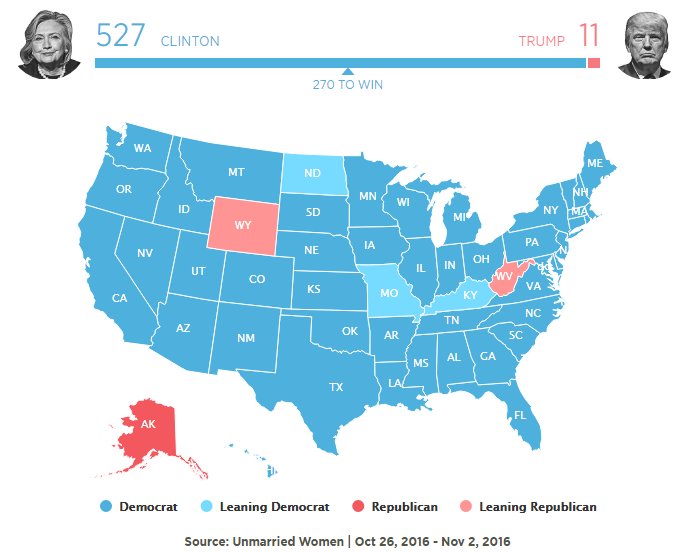
SurveyMonkey election poll cross tabs for unmarried women Nov 2016
SurveyMonkey election poll cross tabs for unmarried women only Nov 2016

I read and enjoyed Dr. Helen Smith’s book “Men on Strike” last year. The book explains a few of the developments that have led to men underperforming in school and in the workplace, and opting out of marriage and fatherhood.

Dr. Helen comes to this problem as a secular libertarian, not as a Christian conservative.

A review of Dr. Helen’s book appeared in Salvo magazine. The review is written by Terrell Clemmons, who has the best Christian worldview of any woman I know – I frequently rely on her advice.

Terrell writes:

While the feminist movement may originally have been about equal respect for both sexes, what it has morphed into, she argues, is female privilege. From rape laws that empower women but not the men they may falsely accuse, to divorce laws tilted in favor of the wife, to the feminization of the U.S. education system, men have become the sex under the gun, while women enjoy the status of a protected class.

But unlike their mothers or grandmothers, men today are not taking to the streets burning their undergarments and shrieking demands (thank God). They’re doing just the opposite, which is far worse. They’re going on strike. The strike zones are manifold:

Higher Education.In addition to the enrollment imbalance, which is approaching a 60/40 ratio of women to men, college has become, in the words of one professor, “a hostile working environment [in which] males increasingly feel emasculated.” Smith quotes a student named John, who had this to say about his college experience: “I had already been cautious around women, having grown up with Tawana Brawley in my backyard and daily stories of sexual harassment; I played it safe and passive every time. But it doesn’t matter. The only way not to lose is to not play. So I’m out.”

Work,including community involvement. With higher female graduation rates and salaries, men today are falling behind their fathers economically and professionally. Consequently, their efforts to prove themselves worthy mates through hard work and higher earnings don’t win female attention the way they used to. Discouraged, too many retreat to a man cave, and inertia sets in from there.

Marriage.Marriage rates are down, and honest men opting out will tell you why. Smith cites a Rutgers University study of single heterosexual men which turned up the top reasons they hadn’t married. They can get sex and the companionship of cohabitation without marriage more easily than in times past, and they don’t want to open themselves up to the risk of divorce and financial loss. It really isn’t that complicated a decision. In fact, it’s often not an actual decision at all. It just happens.

The simplest explanation for the difficulties that boys face in an education system that is dominated by women (teachers and administrators) is discrimination. And in the workplace, the government requires employers to report on male and female head counts, and promote women who are not qualified. I have seen receptionists with tattoos and no college degrees promoted to six-figure manager jobs in companies where I worked.

There is one more which to me was the most surprising one in the book – paternity fraud, and the laws that support paternity fraud:

Take the following cases of nonconsensual insemination: Nathaniel from California, age 15, had sex with 34-year-old Ricci, which, due to his age, was legally considered nonconsensual. Emile from Louisiana was visiting his parents in the hospital when a nurse offered him oral sex, if he wore a condom, which she conveniently offered to dispose of for him afterward. S. F. from Alabama passed out drunk at the home of a female friend and awoke undressed the following morning. In all three cases, including the one involving the minor, a woman got sperm and, nine months later, a child, and the man got ordered by a court of law to pay support for eighteen years.

Less devious, but similarly amiss, are those cases in which a man, having been betrayed by his wife or girlfriend, was nevertheless held financially responsible for a child genetically proven to be another man’s offspring. While not as sensational as sperm-jacking, it is another form of paternity extortion.

In each of those cases, the man was found liable to pay child support – including the case of the 15-year-old boy, who was forced to pay child support to his statutory rapist when he turned 18. This is how the court system works, and more and more men are understanding the risks.

I often encounter “pro-marriage” people while gathering stories for the blog. These pro-marriage people come in two varieties.

On the one end of the spectrum are people like Terrell Clemmons and Jennifer Roback Morse, who understand marriage, but who also understand the social changes that have made marriage unattractive for men. Both Clemmons and Morse have a background in STEM fields, so they are able to understand incentives and tradeoffs. They understand that society has to rollback the changes to education, divorce laws, etc. if they expect men to be interested in marriage again. They understand that men are not just accessories of women, but instead have their own desires, feelings and reasons for marrying.

On the other end of the spectrum are feminist men, who are not able to understand the changing incentives that face men in a world that has evolved under the influence of radical feminism. It is just simpler (less thinking) for these men to accept the radical feminism as a given, and then urge men to “man up”. I think a much better idea would be for the “man up” crowd to realize how marriage has changed, and how the schools and the workplace have changed, then make all of these things more attractive to men. It doesn’t do any good to try to “dare” men into jumping off a cliff. Men aren’t stupid, and they do what is in their own best interests. If the man-up crowd wants younger men to marry, then they need to change the incentives offered to men. And that means changing women first.


Nancy Fitzgerald: making a difference for God with students entering college

C.S. Lewis has some words to live by for you

About a week ago, I wrote a blog post about a column in Salvo magazine written by Terrell Clemmons, which she entitled “Captive No More: The Thoroughly Rational Conversion of Michael Minot“.

What was exciting about that post was how Minot – a lawyer – was able to put his intellect to work as a Christian after his investigation of the evidence was complete.

I found another article by Terrell in Salvo magazine about another person who did an investigation of Christianity. After becoming a Christian, she also put her intellectual ability to work for her new Boss, and she produced an amazing return.

Terrell tells the story of Nancy, who lost her faith as a child when her two-year-old brother died.  Despite letting go of God, she was a very capable student, had a good marriage and led a comfortable life:

Life went on, but for Nancy, the carefree innocence of youth had died, and the emptiness of Stephen’s crib did not compare to the barrenness in her soul. Days turned into years, and she went on to earn three degrees from Indiana University, no thanks to God, whom she managed fairly well to avoid thinking about.

Until the later years of college, that is. Is there really a God or not? she wondered. And what is my purpose in life? She began asking people from all kinds of backgrounds what they believed. Do you go to church? Why? Do you believe in God? Why? This was not a casual survey. It was a serious attempt to get at the truth about reality. It was the “Christians” she found most interesting. And most disappointing. They would acknowledge that they did believe in God, but when pressed to explain why, not a single one could give a reason that made sense to her. Not. A single. One.

“I was raised that way” or “I find comfort in it” simply would not cut it for her, and so she concluded that the whole Christian thing was either a grand hoax or a contrived crutch for weak people. Well, she was not one to be taken in, and she was certainly no weakling. Therefore, life might as well be about her own success and comfort. She decided she would be a nice atheist/humanist. In the unlikely event that there actually was a real God, he probably graded on a curve, anyway. She’d never killed anyone, and she had volunteered to serve at a church brunch once. Surely she would still get “in.”

She married Ed, a med student training to become a heart surgeon, and by age 32, had all the accoutrements of success and comfort: a nice home in the suburbs, four beautiful children, and a housekeeper and nanny to cover daily chores, leaving her free to play golf and enjoy life to her heart’s content.

She wasn’t able to get any answers to her questions from her friends. They seemed to be Christians for the emotional good it did them, or maybe for the community. They had never bothered to do any investigations of the normal questions that non-Christians ask. So, her atheism persisted.

Until one fine day:

When her youngest child reached six months old, she jumped onto an amateur golf tour and took a skinny little Bible with her to the first tournament in Florida. She started reading in the Book of Genesis and right away saw a God who was angry, who didn’t really like people, and who killed a lot of them, primarily by drowning.

“I’m done,” she said when a couple of friends dropped in and asked her what she was reading. “I can’t believe in this God. Drowning. Drowning. Really?”

As it turned out, the friends were Christians, and better-prepared than the average Christian to give her some direction. Oh no, Genesis is not the place to start, they said. She should read the Book of John.

Oh thank goodness. Yes, John is always the first book to read when you are investigating the Bible. It gives you the theistic framework and a report of a miracle that you can investigate using the ordinary tools of history.

What happened next?

God, she prayed, if this is really true, if Jesus Christ really did what this book says he did, then I will believe and trust that he is God and my own personal Savior. She informed him that under no circumstances would she go to Africa as a missionary, and made a few other stipulations. And she still didn’t actually believe it all yet anyway, but a fire had been lit. Golf could wait. She left the tournament and returned home to her family, anxious to begin researching this God and the Bible.

She started by simply writing out questions she needed answers to—questions about God and about this Christian faith, and she discovered that there was a wealth of evidence to support the reliability of the Bible texts. But what really moved her was the Scriptures’ running total of fulfilled prophecies—general prophecies, yes, but the quantity of specific prophecies fulfilled in Jesus Christ was astounding! There was something supernatural about this, no question.

The whole family ended up becoming Christians, including her four children. That’s already pretty good, but she wasn’t done re-prioritizing her life to account for this new information. Because she could see challenges ahead for her children when they got to college.

More:

About ten years later, as her oldest son was preparing to go to college, she asked him, “So what are you going to do if you get a roommate in college like me?”

“What do you mean, Mom?”

“I used to be an atheist,” she said.

To which he responded, “What is that?”

Nancy was floored. Her own son had no clue about her history, and he was clearly unprepared for the university environment.

She set about organizing all her research material into handouts, rounded up a few of her son’s friends, and held a class with six students. They loved it! She didn’t preach to them, but rather interacted with them, and presented solid material using movie clips and other provocative visuals. From that start, her classes grew year by year, until some 150 kids were showing up weekly, with more being turned away for lack of room.

Nancy’s classes may well have stayed confined to her community had it not been for the intervention of Charles Colson, who got wind of this popular class and hopped a plane for a visit. “Nancy, you’ve got to publish this,” he said. “We’ve got to replicate what you’re doing here across America.” Nancy had reservations about ministries, and she definitely did not want to be a “ministry.” But she agreed with his point that “people have to get smarter about their faith.”

Fortunately, he prevailed, and the result became Anchorsaway Worldview Curriculum. “Because kids need anchor points in place when they go away,” says Nancy.

For the rest, you should click through and read Terrell’s article. You’re not going to believe how much of an impact Nancy was able to have on the people who have the most potential influence – college students and young professionals.

If you like the original article, Terrell Clemmons has many more great ones in Salvo magazine. And she has a web site. I promise you nearly everything she writes is very practical. If you like wisdom, you will enjoy her thinking. I think Christian men in particular will find practical wisdom from her writings. Like Nancy, Terrell is having a big influence as well.

But I can’t end this blog post without something else that Terrell wrote about Nancy that I really liked.

This:

She gets frustrated with churches, many of which are not only not helping young people cultivate a grounded faith, but are resistant to her efforts do so on their behalf. Now a grandmother of ten, she could retire. “But Lord, where else would I rather be?” she asks with a charming smile. “I’d take a half-lap around this property, and then come back here ready to work again.”

Ah, wonderful! I also dislike churches! They are mostly awful, and the fideist pastors will fight you tooth and nail to keep apologetics out, so that their emotion-driven flocks don’t have to worry their pretty little heads about evidence. Who cares about evidence? If we didn’t have people like Nancy fighting those battles, where would we be?

It’s really important that you see people like Nancy who have several degrees and a successful life as valuable. It’s people like her who have the biggest influence. Make sure that when college-student-aged Nancy comes to you with questions, that you have the answers to give her. Because we really need everyone to do their part for the Kingdom. This woman had an influence. And more importantly, she had an influence on her own children, protecting them from the peer pressure they would face from non-Christians at college.

Ohio woman shoots intruder after he attacks her in her parents’ home

Guns are for self-defense against criminals

If people only ever read the mainstream media on crime and self-defense issues, they would never learn why people choose to get gun licenses and buy guns. The would only ever learn reasons to ban guns and to disarm law-abiding citizens.

This story was reported in the Washington Free Beacon:

An Ohio woman and her elderly parents are safe while the man who attacked her on Friday is in prison facing several pending charges.

Kim Sinnott of Hamilton, Ohio, was at her parents’ home in the early morning hours of Friday celebrating her father’s 75th birthday when the home’s alarm went off. She and her twin sister Tamie Lesher went to investigate the disturbance.

“About 1:30 a.m. the alarm went off in the house,” Sinnott told Pantagraph. “We noticed the light on in the garage. We saw somebody walking in the garage.”

That’s when the pair came across a man police later identified as 21-year-old Mykale B. Davis. Sinnott pointed her father’s .32 caliber pistol at the man.

“I told him that I had a gun,” she said. “I was standing there looking at him with the gun pointing at him. I told him a hundred times not to come out because I had a gun and that I would shoot and that we were waiting for the cops, that we had the cops on the line right now.”

That’s when the intruder lunged at Sinnott and attempted to wrestle the gun away from her.

“Anything could have happened by just the way he lunged at me, and I had the gun in his face and told him not to come out because I would shoot,” she told the paper. “He probably thought I wouldn’t shoot.”

But Sinnott did shoot the intruder.

“When he grabbed me and pulled me down I was fearing for my life,” she said. “I shot him just for him to let me go. I don’t know if it was in the leg or in the foot. I was scared to death.”

The shot caused the man to flee out of the garage and down the street where police later apprehended him.

[…]Sinnott said the incident has shaken her and her entire family. “God doesn’t give you anything you can’t handle, but I’m about done,” she said.

People who oppose guns typically oppose them because of feelings. Guns are loud and makes me feel scared, they say. But if you actually look at the scientific data, you’ll see that guns do reduce crime rates.

The peer-reviewed research

Whenever I get into discussions about gun control, I always mention two academic books by John R. Lott and Joyce Lee Malcolm.

Here is a paper by Dr. Malcolm that summarizes one of the key points of her book.

Excerpt:

Tracing the history of gun control in the United Kingdom since the late 19th century, this article details how the government has arrogated to itself a monopoly on the right to use force. The consequence has been a tremendous increase in violent crime, and harsh punishment for crime victims who dare to fight back. The article is based on the author’s most recent book, Guns and Violence: The English Experience (Harvard University Press, 2002). Joyce Malcom is professor of history at Bentley College, in Waltham, Massachusetts. She is also author of To Keep and Bear Arms: The Origins of an AngloAmerican Right (Harvard University Press, 1994).

Upon the passage of The Firearms Act (No. 2) in 1997, British Deputy Home Secretary Alun Michael boasted: “Britain now has some of the toughest gun laws in the world.” The Act was second handgun control measure passed that year, imposed a near-complete ban on private ownership of handguns, capping nearly eighty years of increasing firearms restrictions. Driven by an intense public campaign in the wake of the shooting of schoolchildren in Dunblane, Scotland, Parliament had been so zealous to outlaw all privately owned handguns that it rejected proposals to exempt Britain’s Olympic target-shooting team and handicapped target-shooters from the ban.

And the result of the 1997 gun ban:

The result of the ban has been costly. Thousands of weapons were confiscated at great financial cost to the public. Hundreds of thousands of police hours were devoted to the task. But in the six years since the 1997 handgun ban, crimes with the very weapons banned have more than doubled, and firearm crime has increased markedly. In 2002, for the fourth consecutive year, gun crime in England and Wales rose—by 35 percent for all firearms, and by a whopping 46 percent for the banned handguns. Nearly 10,000 firearms offences were committed.

[…]According to Scotland Yard, in the four years from 1991 to 1995 crimes against the person in England‟s inner cities increased by 91 percent. In the four years from 1997 to 2001 the rate of violent crime more than doubled. The UK murder rate for 2002 was the highest for a century.

I think that peer-reviewed studies – from Harvard University, no less – should be useful to those of us who believe in the right of self-defense for law-abiding people. The book by economist John Lott, linked above,compares the crime rates of all U.S. states that have enacted concealed carry laws, and concludes that violent crime rates dropped after law-abiding citizens were allowed to carry legally-owned firearms. That’s the mirror image of Dr. Malcolm’s Harvard study, but both studies affirm the same conclusion – more legal firearm ownership means less crime.

If you still think that guns are somehow bad for reducing crime, why not check out a formal academic debate featuring 3 people on each side of the debate?

If you want to know why the Democrat parts of the United States have such high rates of violence, then you need to look at the enormously high out-of-wedlock birth rates in the Democrat parts of the United States. Having babies before marrying causes fatherless children, and fatherless children are more likely to commit crimes. When Democrats stop paying single mothers money to have fatherless kids, then the crime rates in the Democrat parts of the United States will go down. It’s a personal responsibility issue.