
Trump administration ends 6-week law enforcement sweep with 1,378 arrests

Under new management, the police are back to law enforcement

This was reported by Fox News.

Excerpt:

The Trump administration has concluded a six-week nationwide sweep of suspected gang members with 1,378 arrests — the largest such gang sweep conducted by the U.S. Immigration and Customs Enforcement’s Homeland Security Investigations (HSI) to date.

The operation, which ran from March 26 through May 6, targeted gang members and associates involved in transnational criminal activity, including drug trafficking, weapons smuggling, human smuggling, sex trafficking, murder and racketeering.

[…]According to ICE, of the 1,378 total arrested, 933 were U.S. citizens, and 1,095 were confirmed as gang members or affiliates. Also, 104 of those arrested were affiliated with the dreaded MS-13 gang, eight of whom illegally crossed the border as unaccompanied minors.

[…]During the operation, HSI partnered with other law enforcement agencies to seize more than 200 firearms, narcotics like cocaine, methamphetamine, heroin, fentanyl and marijuana and $491,763 in U.S. currency.

Enforcement actions occurred across the nation, but the greatest activity took place in the Houston, New York City, Atlanta and Newark, N.J., areas.

Fox News also reports that illegal immigration is way down under Trump, even before construction of the new wall.

Excerpt:

After years of surging immigration from Central America, law enforcement in Texas’ Rio Grande Valley are finally seeing some relief, thanks in part to President Trump’s strong rhetoric.

[…]“Since January, we have seen a significant decrease in traffic to the point we’re averaging about 150 alien apprehensions a day,” down from as many as 1,000 a day, according to Deputy Chief Raul Ortiz of the Rio Grande Border Patrol Sector. “A big part of the decrease, I think, has to do with a lot of the discussion about the buildup of infrastructure on the southwest border, more agents along the border and some of the message making its way down to those host countries.”

[…]Previously, Central American immigrants turned themselves in, claimed asylum and were released. 

In most cases, the Obama Administration accommodated the claim by placing the applicant on a court docket with a two- to three-year waiting list. In the meantime, most illegal immigrants were free to work while living with relatives. Some set down roots by getting married or having American-born children.

President Trump promised to end that ’catch and release’ policy, saying “anyone who illegally crosses the border will be detained until they are removed out of our country.”

Apparently that message got through thousands of miles away. 

Traditionally, the Republican party has been the party of law and order, whereas Democrats are the party of leniency and permissiveness. Republicans like self-defense, Democrats don’t. Republicans support victim’s rights, but Democrats want to shorten sentences and release criminals. Republicans think that punishing criminals deters future crime, and Democrats think that criminals are just not responsible for their criminal acts.

Here is a story from February 2013, when Obama was still President.

Fox News reports.

Excerpt:

The Department of Homeland Security has started releasing hundreds of illegal immigrants held in local jails in anticipation of automatic budget cuts, in a move one Arizona sheriff called politically motivated — and dangerous.

Pinal County Sheriff Paul Babeu said Tuesday that Immigration and Customs Enforcement released more than 500 detainees in his county alone over the weekend. A spokesman for Babeu told FoxNews.com that ICE officials have said they plan to release a total of nearly 10,000 illegal immigrants.

The numbers, though, are in dispute. ICE officials said that it’s unclear how many ultimately might be released and that only 303 have been released from four Arizona facilities so far, though all those are in Pinal County. According to ICE, 2,280 detainees are still in custody in those facilities.

Babeu described the move as a “mass budget pardon” and suggested the administration was going to unnecessary lengths to demonstrate the impact of the so-called sequester.

“President Obama would never release 500 criminal illegals to the streets of his hometown, yet he has no problem with releasing them in Arizona. The safety of the public is threatened and the rule of law discarded as a political tactic in this sequester battle,” he said.

An ICE spokeswoman confirmed the plans without specifying how many illegal immigrants might be released.

[…]In Arizona, Babeu slammed the move, painting his community as a victim of gridlock in Washington.

“Clearly, serious criminals are being released to the streets of our local communities by this mass budget pardon. These are illegals that even President Obama wants to deport. This is insane that public safety is sacrificed when it should be the budget priority that’s safeguarded,” he said.

Did any of those criminals who were released go on to commit crimes? Sure. But what do Democrats care about protecting taxpayers from criminals? They always blame the victims of crime, and stand against law-abiding taxpayers.

Bible study: Paul’s continuing effort to disciple the Thessalonians

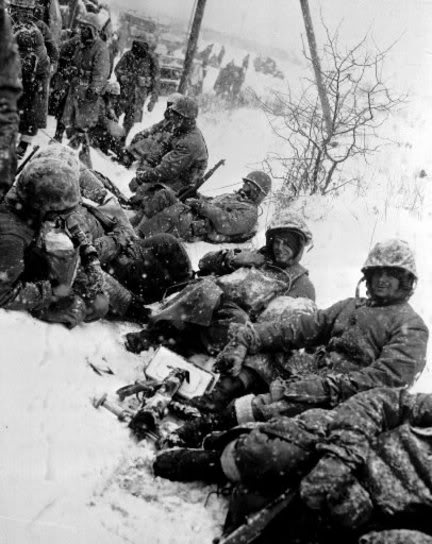
U.S. Marines "The Chosin Few", December 1950
U.S. Marines “The Chosin Few”, Dec. 1950 (Chosin Reservoir, North Korea)

I was asked by my friend Kevin to do more Bible study, and two of the books he asked me to do are 1 Thessalonians and 2 Thessalonians. He had  reason for asking this, and I found out after I sent him my reflections. So, I thought I’d better write these up so that you all get something out of this, too.

Background

You can read more about the author, background and dating of 1st Thessalonians.

You can read more about the author, background and dating of 2nd Thessalonians.

You should read both books, and it’s easy because they are short.

The relevant parts

See if you can guess the point I want to make from what I cite from each book before you read my conclusion.

1 Thessalonians 2:3-12:

3 For our exhortation does not come from error or impurity or by way of deceit;

4 but just as we have been approved by God to be entrusted with the gospel, so we speak, not as pleasing men, but God who examines our hearts.

5 For we never came with flattering speech, as you know, nor with a pretext for greed—God is witness—

6 nor did we seek glory from men, either from you or from others, even though as apostles of Christ we might have asserted our authority.

7 But we proved to be gentle among you,as a nursing mother tenderly cares for her own children.

8 Having so fond an affection for you, we were well-pleased to impart to you not only the gospel of God but also our own lives, because you had become very dear to us.

9 For you recall, brethren, our labor and hardship, how working night and day so as not to be a burden to any of you, we proclaimed to you the gospel of God.

10 You are witnesses, and so is God, how devoutly and uprightly and blamelessly we behaved toward you believers;

11 just as you know how we were exhorting and encouraging and imploring each one of you as a father would his own children,

12 so that you would walk in a manner worthy of the God who calls you into His own kingdom and glory.

1 Thessalonians 2:17-20:

17 But we, brethren, having been taken away from you for a short while—in person, not in spirit—were all the more eager with great desire to see your face.

18 For we wanted to come to you—I, Paul, more than once—and yet Satan hindered us.

19 For who is our hope or joy or crown of exultation? Is it not even you, in the presence of our Lord Jesus at His coming?

20 For you are our glory and joy.

1 Thessalonians 3:1-3,6-13:

1 Therefore when we could endure it no longer, we thought it best to be left behind at Athens alone,

2 and we sent Timothy, our brother and God’s fellow worker in the gospel of Christ, to strengthen and encourage you as to your faith,

3 so that no one would be disturbed by these afflictions; for you yourselves know that we have been destined for this.

6 But now that Timothy has come to us from you, and has brought us good news of your faith and love, and that you always think kindly of us, longing to see us just as we also long to see you,

7 for this reason, brethren, in all our distress and affliction we were comforted about you through your faith;

8 for now we really live, if you stand firm in the Lord.

9 For what thanks can we render to God for you in return for all the joy with which we rejoice before our God on your account,

10 as we night and day keep praying most earnestly that we may see your face, and may complete what is lacking in your faith?

11 Now may our God and Father Himself and Jesus our Lord direct our way to you;

12 and may the Lord cause you to increase and abound in love for one another, and for all people, just as we also do for you;

13 so that He may establish your hearts without blame in holiness before our God and Father at the coming of our Lord Jesus with all His saints.

2 Thessalonians 1:3-4:

3 We ought always to give thanks to God for you, brethren, as is only fitting, because your faith is greatly enlarged, and the love of each one of you toward one another grows ever greater;

4 therefore, we ourselves speak proudly of you among the churches of God for your perseverance and faith in the midst of all your persecutions and afflictions which you endure.

2 Thessalonians 3:6-13:

6 Now we command you, brethren, in the name of our Lord Jesus Christ, that you keep away from every brother who leads an unruly life and not according to the tradition which you received from us.

7 For you yourselves know how you ought to follow our example, because we did not act in an undisciplined manner among you,

8 nor did we eat anyone’s bread without paying for it, but with labor and hardship we kept working night and day so that we would not be a burden to any of you;

9 not because we do not have the right to this, but in order to offer ourselves as a model for you, so that you would follow our example.

10 For even when we were with you, we used to give you this order: if anyone is not willing to work, then he is not to eat, either.

11 For we hear that some among you are leading an undisciplined life, doing no work at all, but acting like busybodies.

12 Now such persons we command and exhort in the Lord Jesus Christ to work in quiet fashion and eat their own bread.

13 But as for you, brethren, do not grow weary of doing good.

OK that’s all I want to quote, now for what I thought about all that.

My thoughts

Well, Kevin wanted me to read this because he thinks that I hover around young Christians a lot and fuss about whether they are going to church, whether they are reading apologetics, whether they are doing their homework, and passing their exams. You would not believe some of the things happening in the lives of my Christians friends! Every day, I hear new things:

  • my dog died
  • my professor is a liberal bully
  • I’m starting university
  • I quit my old job and got a new job
  • I am starting an internship
  • I finished graduate school
  • I’m starting graduate school in September
  • I started putting money into a savings account
  • my grandmother died
  • I missed a final exam
  • I cried in class
  • my boyfriend wants sex or he’ll break up with me
  • I moved into a new house
  • my work hours are being reduced
  • I hate my job
  • I can explain why I want to change careers on Thursday night
  • I can study the Bible with you on Friday night
  • I’ve got baby ducks in my garden
  • the other people on my team aren’t working on our course project

And more. I think Kevin wanted me to know that he was glad that I was meddling in the lives of all of these people, and that it was similar to what Paul does. Paul does not preach to people so that he will think that he is important or clever. He likes to debate and persuade, but he also likes to get involved in people’s lives over the long term. Paul isn’t just swooping by to solicit donations or preen about how great he is and then leave. He actually has an interest in the lives of other Christians. He actually tries to set an example for them of how to live. He wants the people to follow his lead, not follow his words. He always says “do what I do” not “do what I say”. He doesn’t just do a big public event and then forget about the people that he spoke to.

So, my point in this is for you to read the two letters to the Thessalonians closely, and don’t be like these parents, pastors, apologists and celebrities who just speak and leave. Don’t look to the people you have influence over as a source of money or approval. Challenge those people to change, built them up, share with them, give them gifts. Instead of telling them how to live, tell them to follow your example. And watch out for their daily struggles and troubles. Make sure you know who else is influencing them, and have your say to persuade them that your Christian viewpoint is right. Don’t just talk. Don’t appear so perfect like you are high above the others. Instead, make your whole life an example of what you want to convince them of. Show them your plans and goals and sacrifices, let them see your reasoning. And be willing to let them tell you the really dirty details of what they are doing. Don’t be so far above them that you refuse to get down to their level and do what they like to do, so you can spend time with them and really listen.

Debating forgiveness: must a person admit wrongdoing before being forgiven?

Two horses fight it out, may the best horse win!

I was traveling outside the country when this debate came out, so I couldn’t blog about it right away. I’ve now listened to it three times. I liked it so much that I even ordered Chris’ book for Dina. She has listened to the debate, and is currently split between the two debaters. I am in firm agreement with the pastor Chris.

Here’s a link to the debate page on Moody Bible Institute’s “Up For Debate” program with Julie Roys. (H/T Kris)

Details:

Should Christians Forgive No Matter What?

Should Christians forgive someone even if he’s not sorry?  Or does true forgiveness require repentance and a desire to reconcile?  This Saturday, on Up For Debate, Julie Roys will explore this issue with Chris Brauns, a pastor who believes forgiveness requires repentance, and Remy Diederich who believes it does not.

Although I disagree with Remy, I only disagree with him about whether the guilty person must admit guilt and feel remorse and make restitution (depending on the severity of the offense). I agree with him on other things like no revenge, attitude of love, expressing willingness to forgive and be reconciled, etc. I also disagree with Remy on “forgiving God”, which I think is just crazy, because when God is engineering a person’s salvation, he never fails. I think that God is the Great General, and his strategies never fail to achieve the outcomes he desires (while still respecting free will). Whatever suffering or inadequacy or longing that you experience as a Christian is not some sort of mistake, horrible as it may be for you at the time. God is not your cosmic butler, although a lot of people these days seem to think that he is, and then they get disappointed.

Anyway, please listen to that debate and comment on it about who you think is right. I think my view (and Chris’ view) is in the minority in the church, because the church is so utterly dominated by feelings and radical feminism. I think my view (and Chris’ view) is the masculine view – the view that upholds moral standards, sets moral boundaries and defends the rightness of making moral judgments.

Below, I have pasted in some of my other thoughts on forgiveness from a previous post.

I think this is the key passage – Luke 17:3-4:

3 Be on your guard! If your brother sins, rebuke him; and if he repents, forgive him.

4 And if he sins against you seven times a day, and returns to you seven times, saying, ‘I repent,’ forgive him.”

That’s Jesus speaking, there.

Also, I was having a debate with someone who disagrees with all this, and while debating with her, I thought of another example.

Luke 18:9-14:

9 And He also told this parable to some people who trusted in themselves that they were righteous, and viewed others with contempt:

10 “Two men went up into the temple to pray, one a Pharisee and the other a tax collector.

11 The Pharisee stood and was praying this to himself: ‘God, I thank You that I am not like other people: swindlers, unjust, adulterers, or even like this tax collector.

12 I fast twice a week; I pay tithes of all that I get.’

13 But the tax collector,standing some distance away, was even unwilling to lift up his eyes to heaven, but was beating his breast, saying, ‘God, be merciful to me, the sinner!’

14 I tell you, this man went to his house justified rather than the other; for everyone who exalts himself will be humbled, but he who humbles himself will be exalted.”

So again, no forgiveness without repentance.

Forgiveness is what happens when someone who is sinned against treats the sinner as if he had never sinned. It is not on the balance sheet. It is not brought to mind. It is not held against them in the future. The forgiver trusts the sinner again as if the previous sin had never happened.

In divine (vertical) forgiveness, there is no forgiveness without repentance. There are Bible verses above to show that.

My argument is twofold. First, there is a clear teaching of Jesus explaining the sequence of sin and forgiveness. Repentance precedes forgiveness, between humans (Luke 17:3). The verses cited by the forgive without repentance crowd don’t show the mechanics of how to forgive, they are making the point that if you want God to forgive you, you should forgive others. The parable in Luke 18:9-14 affirms this again – repentance always precedes forgiveness.

Second, we have an obligation to imitate God, and that means imitating the way he forgives those who sin against him. When I raise that with the unconditional forgiveness crowd, they want to insist that there is a difference, that the word “forgive” means different things. I’m not convinced.

Finally, I do think that forgiving someone is obligatory if they sincerely repent, and even if they screw up again and again. So long as the repentance is sincere, (like if there is restitution and a genuine effort to show an understanding how the sin affected the wronged party in writing), then forgiveness should be automatic. Depending on how bad the sin is, there maybe be more to do than just say “I’m sorry”. If the repentance is genuine, then I think the person who is sinned against must forgive, if they expect to be forgiven by God for the things they repent of.

Alan E. Kurschner adds one final point about the unconditional forgiveness view. He argues that there is serious textual doubt about the originality of Luke 23:34a, a text used by the pro-unconditional-forgiveness crowd. He has a journal article coming out on it, but a synopsis of his argument is here.

He also wrote this in a comment on this blog:

Second, on Matt 6:15, this is what I have to say. Notice the then-clause: “neither will your Father forgive your sins.” This would require universalism on the Father’s part according to the unconditional interpretation given the first half: “But if you do not forgive others their sins.” Since everyone has wronged the Father is the Father required to forgive everyone even if they are not seeking forgiveness?

So I think the case for the forgiveness being conditional on repentance is pretty strong, especially when serious harm has been caused.