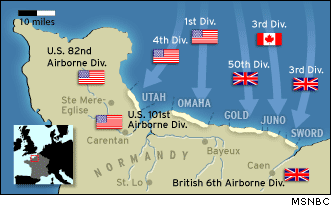
It’s June 6th, today, and it’s the anniversary of D-Day: the Allied invasion of northern France – the beginning of the end of World War 2. One of the most pivotal events of that day was the assault on German gun emplacements by members of the Army Rangers at a fortified position called “Pointe du Hoc”.
President Ronald Reagan recognized the soldiers who attacked Pointe du Hoc back in 1984:
Ronald Reagan also made the case for gratitude and vigilance:
Here’s the hymn that starts to play at the end:
The Boys of Pointe du Hoc
Here’s a summary of the Pointe du Hoc mission:
[Lt. Col. James Earl] Rudder took part in the D-Day landings as Commanding Officer of the United States Army’s 2nd Ranger Battalion. His U.S. Army Rangers stormed the beach at Pointe du Hoc and, under constant enemy fire, scaled 100-foot (30 meter) cliffs to reach and destroy German gun batteries. The battalion’s casualty rate for this perilous mission was greater than 50 percent. Rudder himself was wounded twice during the course of the fighting. In spite of this, they dug in and fought off German counter-attacks for two days until relieved. He and his men helped to successfully establish a beachhead for the Allied forces.
You can watch a three-clip documentary on it, too: part 1, part 2, part 3.
Although initially, the Rangers did not find the guns where they had expected them, they did find them further back behind the cliffs and destroyed them there, removing a threat to the forces that would be landing later.
What does D-Day mean to Christians in particular?
A Christian friend asked me what she should be thinking about when I sent her one of the videos above, and so I wrote her this to explain why I sent her the video:
To make you close your eyes and think in a more practical way about what it means for someone to sacrifice their lives to save you, of course. What it means to look up cliffs at machine guns, barbed wire and mortars raining death on you and to take a rope in your hands and to climb up a sheer cliff, under heavy fire, in order to save generations yet unborn and freedom itself.
To think about a concrete example helps us to be able to appreciate what Christ did for us in giving his life for us so that we could be free of sin, as well.
This is the insight that drives my entire interest in war and military history, in fact.
What does this mean: “Greater love has no man than this, that a man lay down his life for his friends.”
The more you know about D-Day, the more fearful what Jesus did appears, and the more you can be grateful.
Bullets and shrapnel are scary… and so are nails and lashes. Why on Earth would anyone endure either for me? And what should my response be to it?
I think it is helpful to explain Christianity to those who are not yet Christian, and for Christians to fully appreciate what Christianity is all about.
We were in peril. And now we have been saved. But at a cost.
I think that it’s important for Christians to look to history, art, poetry and music to help them to reflect and comprehend the sacrifice that Christ made for us in dying on the cross to protect us from peril. What must the cross have looked like to Jesus? It must have been something like what the Omaha beach looked like to the Americans landing in Normandy. Jesus saw whips, thorns and nails, and the heroes of Normandy saw 88 mm AT guns, 81 mm mortars and MG42 machine guns. How should you feel about people who face death on your behalf? Think about it.
No one has issued a more forceful challenge to Christians to become intellectually engaged than did Charles Malik, former Lebanese ambassador to the United States, in his address at the dedication of the Billy Graham Center in Wheaton, Illinois. Malik emphasized that as Christians we face two tasks in our evangelism: saving the soul and saving the mind, that is to say, not only converting people spiritually, but converting them intellectually as well. And the Church is lagging dangerously behind with regard to this second task. Our churches are filled with people who are spiritually born again, but who still think like non-Christians. Mark his words well:
I must be frank with you: the greatest danger confronting American evangelical Christianity is the danger of anti-intellectualism. The mind in its greatest and deepest reaches is not cared for enough. But intellectual nurture cannot take place apart from profound immersion for a period of years in the history of thought and the spirit. People who are in a hurry to get out of the university and start earning money or serving the church or preaching the gospel have no idea of the infinite value of spending years of leisure conversing with the greatest minds and souls of the past, ripening and sharpening and enlarging their powers of thinking. The result is that the arena of creative thinking is vacated and abdicated to the enemy.
Malik went on to say:
It will take a different spirit altogether to overcome this great danger of anti-intellectualism. For example, I say this different spirit, so far as philosophy alone—the most important domain for thought and intellect—is concerned, must see the tremendous value of spending an entire year doing nothing but poring intensely over the Republic or the Sophist of Plato, or two years over the Metaphysics or the Ethics of Aristotle, or three years over the City of God of Augustine. But if a start is made now on a crash program in this and other domains, it will take at least a century to catch up with the Harvards and Tübingens and the Sorbonnes—and by then where will these universities be?
What Malik clearly saw is the strategic position occupied by the university in shaping Western thought and culture. Indeed, the single most important institution shaping Western society is the university. It is at the university that our future political leaders, our journalists, our lawyers, our teachers, our scientists, our business executives, our artists, will be trained. It is at the university that they will formulate or, more likely, simply absorb the worldview that will shape their lives. And since these are the opinion-makers and leaders who shape our culture, the worldview that they imbibe at the university will be the one that shapes our culture.
And:
The great Princeton theologian J. Gresham Machen warned on the eve of the Fundamentalist Controversy that if the Church loses the intellectual battle in one generation, then evangelism would become immeasurably more difficult in the next:
False ideas are the greatest obstacles to the reception of the gospel. We may preach with all the fervor of a reformer and yet succeed only in winning a straggler here and there, if we permit the whole collective thought of the nation or of the world to be controlled by ideas which, by the resistless force of logic, prevent Christianity from being regarded as anything more than a harmless delusion. Under such circumstances, what God desires us to do is to destroy the obstacle at its root.
The root of the obstacle is to be found in the university, and it is there that it must be attacked. Unfortunately, Machen’s warning went unheeded, and biblical Christianity retreated into the intellectual closets of Fundamentalism, from which it has only recently begun to re-emerge. The war is not yet lost, and it is one which we must not lose: souls of men and women hang in the balance.
This lecture is an excellent opportunity for us all to ask ourselves: what are we doing to influence the university? Do you have a plan?
Many of the strongest people who are now opposed to Christianity raised in two-parent Christian homes, and went to church for a decade before going off to the university. I’m thinking especially of people like Tim Gill, in Colorado. At university (and even increasingly in high school) they turned away from Christianity. All their peers and the adults could not answer their questions. As adults, they were able to get money, power and influence. Many of them are using it against Christ and his kingdom – kicking away the ladder that they climbed to success on. Why is this? Unfortunately, many of us are not willing to do what works – pick up the Lee Strobel books and read them. Especially “The Case for a Creator”.
This is the first debate ever between these two top-ranked scholars. Both Evans and Ehrman are probably 2 of the 10 most recognized historical Jesus scholars.
Dr. Ehrman, is a graduate of Wheaton College (Illinois), Professor Ehrman received both his Masters of Divinity and Ph.D. from Princeton Theological Seminary, where his 1985 doctoral dissertation was awarded magna cum laude. Since then he has published extensively in the fields of New Testament and Early Christianity, having written or edited twenty-one books, numerous scholarly articles, and dozens of book reviews. Among his fields of scholarly expertise are the historical Jesus, the early Christian apocrypha, the apostolic fathers, and the manuscript tradition of the New Testament.
Craig Evans
Dr. Evans received his B.A. degree in History and Philosophy from Claremont McKenna College, his M.Div. degree from Western Baptist Seminary in Portland, Oregon, and his M.A. and Ph.D. degrees in Biblical Studies from Claremont Graduate University in southern California. Author and editor of more than fifty books and hundreds of articles and reviews, Professor Evans has given lectures at Cambridge, Durham, Oxford, Yale, and other universities, colleges, seminaries, and museums, such as the Field Museum in Chicago and the Canadian Museum of Civilization in Ottawa.
Note: This is a very snarky summary, and I am just paraphrasing things to be silly and funny. Reader discretion is advised.
Summary
Snarky things I made up are in italics.
Question 1: are the gospels historically reliable?
Bart Ehrman opening speech:
I used to be an ignorant fundamentalist like you!
but then I went to Princeton, and now I know better
to Craig: are there errors in the Bible
the gospels have some reliable and some unreliable info
only careless readers don’t see contradictions in the gospels
contradictions in the genealogies
contradictions in timing of recognizing Jesus as the Messiah
contradiction about when Jesus died
contradiction about when the stone was rolled away
contradiction about who was at the empty tomb
contradiction about when the disciples went to Galilee
contradictions in minor details means the gospels are unreliable
Craig Evans opening speech:
the question is “do the gospels tell us enough about Jesus for faith?”
the gospels don’t tell us everything, but they tell enough for faith
the extremely early creed in 1 Cor 15:3-7 has an outline of the gospel
it contains the burial, the appearances to eyewitnesses
and it agrees with the early sermons of Peter in Acts 2
the gospels agree with these extremely early summaries
the gospels are based on earlier sources
the gospels are corroborated by the Jewish historian Josephus
Question 2: Do the gospels accurately preserve the teachings of Jesus Christ?
Bart Ehrman
are there any discrepancies in the gospels?
the gospels have things Jesus said, and things he didn’t say
if the Bible is inaccurate in some minor details, then it’s all unreliable
in the latest gospel, John, Jesus calls himself God and sees himself as divine
but these high-Christology statements are not in the synoptics
therefore, Jesus really didn’t say these things
why didn’t the synoptics record these claims to divinity
the author of John changed the words of Jesus and John the Baptist?
Craig Evans
E.P. Sanders (a non-Christian scholar) says we can know what Jesus taught
cites E.P.’s list of Jesus’ core teachings that are agreed on by most scholars
Jesus’ focus was talking about the Kingdom of God – the rule of God
Jesus’ followers were expected to record and understand the words of Jesus
It is permissible for the followers of Jesus to have some editorial license
Question 3: Do the gospels accurately preserve the activities of Jesus Christ?
Bart Ehrman
E.P. Sanders agrees with me that there are discrepancies in the gospels
E.P. Sanders agrees with me that there are mistakes in the gospels
If Jesus’ followers changed his words a little, then we can’t know anything he said
If the author changes the story a little, then the story was changed a lot
If there not 100% accurate, then they’re not accurate at all
contradiction of the ordering of Jesus’ temptations
contradiction of the number of animals Jesus rode into Jerusalem
contradiction of whether Jesus spoke or didn’t speak in some instance
contradiction of what Jesus said on the cross
contradiction of the number of robbers who speak to Jesus
Jesus can only say ONE THING when he’s on the cross
the gospel writers have to be in complete agreement
Craig Evans
E.P. Sanders (non-Christian) lists 7 virtually indisputable facts about Jesus
just because there are discrepancies, doesn’t mean there are no minimal facts
in additional to E.P. Sanders, there are other facts that are widely-accepted
many assertions in the gospels are embarrassing to the author
many liberal scholars think that Jesus was a healer and an exorcist
all scholars agree on the crucifixion
most scholars accept the “King of the Jews” placard placed over the cross
this means that Jesus was viewed by his followers as the Messiah
Question 4: Do the gospels contain eyewitness tradition?
Bart Ehrman
I used to be an ignorant uninformed fundie, like you all
but then I started to study seriously, not like Craig Evans
I changed my mind based on intense research, not peer pressure
My apostasy has nothing to do with the problem of evil and suffering!
I use my brain, and Craig Evans and you fundies don’t use your brains
the gospels don’t claim to be written by eyewitnesses
the titles of the gospels were added later
the gospels don’t claim to be written by the authors attributed to them
the gospels were written anonymously
the gospels only had names attached in 120-140 AD
even if gospels were written by eyewitnesses, they are not always accurate
written 40-60 years after Jesus died
written in Greek, not Aramaic
written in different countries
based on stories that were told and retold and changed over time
Craig Evans
Richard Bauckham says the gospels are largely based on eyewitness accounts
the gospels were written while there were still eyewitnesses alive
the people who met Jesus were there to correct the written accounts
there were many disputes about things in the early church, so if the early church invented sayings, then why not invent sayings of Jesus to resolve the disputes?
there is no evidence of things being invented wholesale by the early church
Pappias says that he talked to Christians who knew the eyewitnesses to Jesus
Question 5: Do archaeologists and historians use the gospels as sources?
Bart Ehrman
archaeologists do not use the gospels, they just dig things up
historians do use gospels
Jesus is not mentioned by any Greek or Roman non-Christian source for 80 years after Jesus’ death
The earliest Jewish source is Josephus, writing 60 years after Jesus’ death
Paul is the earliest source, but says nothing about Jesus’ words and deeds
the earliest sources for words and deeds are the discrepancy-filled gospels
the gospels are based on telling and re-telling of the stories
Craig Evans
James Charlesworth has a 700-book about archaeology and the Bible
the book contains hundreds of references to the four gospels
the four gospels and Acts are viewed as the best sources for archaeologists
they provide accurate information about the way things were
the gospels and Acts helps archaeologists to know where to dig for things
the Biblical sources are early and based on eyewitnesses
the gospels and Acts fit well in the first century culture
the gospels and Acts talk about real events and real places and real customs
the gospels and Acts talk about real buildings and real public figures and real groups
the language of the gospels traces back nicely to Aramaic
the gospels talk about geography and climate
archaeologists discover many things discussed in the gospels
Question 6: Have the gospels been accurately preserved done through the centuries
Bart Ehrman
if God inspired the Bible without error, he should have preserved it without error
but the originals have NOT been preserved without error
so I no longer accept the inerrancy of the autographs (the originals)
we don’t have the originals
we only have copies of copies… of copies… of copies… of copies
and the copiers all made mistakes
the first manuscripts are decades later
and the manuscripts we have are different from one another
the earliest copies have the most mistakes
even if we have many copies, they are late, so we don’t know what the original said
we don’t have early manuscripts
Craig Evans
we know where the discrepancies in the manuscripts are
the discrepancies are marked in your Bible
the discrepancies affect peripheral issues
some discrepancies are supported by other verses
Mark doesn’t have the appearances, but 1 Cor 15 does, and it’s earlier
the errors are things like spelling and grammar errors, typos, etc.
we have fragments that are earlier than the full manuscripts
some early manuscripts have errors, but other early manuscripts are correct
Question 7: Do scribal errors and textual variants significantly impact any teaching of Jesus or any important Christian teaching?
Bart Ehrman
the woman caught in adultery is a late addition
the ending of Mark is a late addition
can we handle snakes or can’t we?
did Jesus sweat blood or didn’t he?
some manuscripts have errors – that should not be allowed by God
some scribes are careless – that should not be allowed by God
we have to have perfect copies of the originals, or I won’t believe!
if God really inspired it, it all has to be perfect! Perfect! I was lied to!!!!
if the snake-handling verse isn’t there, then the whole Bible is lies! Lies!
Craig Evans
no variants impact any teaching of Jesus or significant Christian teaching
the vast majority of the manuscripts agree on 98-99% of the text
often, the theology gives rise to a variant, which is introduced later
variants aren’t central enough to affect any theological doctrines
And then there are concluding speeches by each speaker.
I made this summary based on the video, which is here on Apologetics 315.

 WINTERY KNIGHT