Category Archives: Polemics

A liberal feminist comedian, her beliefs about God and how she formed them

Lets take a closer look at a puzzle

Consider this article written by a liberal ex-Catholic woman whose 7-year-old daughter is an atheist.

First the biography of the author:

Carolyn Castiglia is a New York-based comedian/writer wowing audiences with her stand-up and freestyle rap. You may recognize her hip-hop alter ego Miss CKC from Comedy Central, VH1 and MTV2. Carolyn’s web vids have been nominated for an ECNY Award and featured in two issues of EW magazine. She’s appeared in TONYThe NY PostThe Idiot’s Guide to Jokes and Life & Style. You can find Carolyn’s writing elsewhere online at MarieClaire.com and The Huffington Post.

Look at what she wrote:

I was raised Catholic, and like most people my age who were raised Catholic, I no longer attend church on Sundays. We’re “recovering Catholics.” That’s what so many of us call ourselves. We’re still disgusted with the Church for the way it covered up the sex abuse perpetrated against my generation and roll our eyes at the Church’s stance on things like abortion, gay marriage and women’s rights.

[…]I learned a lot about being a Good Person from the things I heard in church… I wanted to be a Good Person, not just because only Good People go to Heaven. I just liked the idea. The meek shall inherit the Earth. It sounded right. Somehow all this sh*t I’m swallowing now, it’s gonna pay off later.

I’m pretty much agnostic now (sometimes believing more strongly, other times thinking the concept of God is kind of a joke), but I value the way the idea of God has gotten me through the rough patches. And that has been the payoff. Somehow this notion that there is a giant man in the sky with long hair and a big robe who will hug you from heaven if you need it and carry you on the beach when you’ve had one too many wine coolers to walk without falling down and getting sand all up in your bikini has been very comforting to me. The image of Jesus but as God but totally as a bro (a homeboy, if you will), there’s something righteous about it, if you know what I mean.

But the way I imagine God has changed over the years — He’s gone from being a person, a man, to being more of a Thing, a notion. Goodness. The Oneness of the Universe. With something female in there. The energy that keeps the whole thing afloat. God as I know it now when I know it is kind of a cocktail made from a shot of Buddhism, a shot of feminist activism and a splash of ginger ale (because that, my friends, is something you can always count on).

Now the Christians who are reading this will be cringing because we know that these beliefs are not taken out of the Bible. She seems to be speaking more about her opinions rather than what is true. She doesn’t seem to be focused on finding truth, but more on being a “good person” and having God as a crutch to pull out if she falls down while pursuing her own plan.

She’s wrong that “good people” go to Heaven. Only people who accept Jesus as their leader (Lord) and accept his death as a sacrifice for their rebellion against God (Savior) are resurrected to eternal life. If she is a relativist, then I guess what she means by being a “good person” is that she thinks of herself as good and that the people around her think of her as good. However, the main purpose of Christianity is not to be a good person, or to have people like you or to be happy and comforted.  The main goal of Christian living is to puzzle about the truth about God’s existence and character, and then to re-prioritize your life based on who Jesus is and what Jesus has done for us. So the focus in Christianity is on truth, and that’s what her church should have taught her from a young age. And we are the ones who must read the Bible, we must not rely on someone else to do it for us.

But there is more to her story – her child has been affected by her problematic views of Christianity and God.

She writes:

My daughter, on the other hand, at the ripe old age of 7, is convinced that there is no God. Not even a god. Yup, my kid’s an atheist. And she pretty much has been since she was 5.

It’s not for lack of exposure to God or god or even gods and spirituality, because she has attended Church and church and a UU “church” and it has made no impact. We’ve prayed together. I talk about God sometimes, in a good way. When I asked her recently why she doesn’t believe in God she told me, succinctly, “Because I know too much about science!”

Is it a good idea to take scientific advice from a 7-year-old child? I think that we should instead prefer to learn from scholars who research and debate issues in science and religion, and then teach the child based on what we have learned. This is why it was so important to emphasize how people arrive at true beliefs in the church. If she had done the work herself to arrive at true beliefs, then she would know what to say to her child’s presumptuousness.

More:

The other night over dinner my daughter looked up at me and said, “Who created the Earth?” And I said, “Well, some people believe that God created the Earth, and some people believe that nature is a creation unto itself.” My daughter replied, “I think nature is a creation unto itself.” I said, “You know, you’re pretty staunch about the fact that there is no God.” And she told me, “Well, I don’t think he exists. If he does, he’s a ghost, and that’s weird. I just don’t believe it. You know, there are Universes beyond our Universe. Once you get outside the Milky Way galaxy, there’s a lot more stuff out there.”

Wow. When I was 7 I didn’t know there was a world outside my town.

So the universe created itself? How could it create itself? It would have to have existed in order to do anything, including create. So it would have to have existed… before it began to exist. That’s a contradiction, and so it cannot be true. Funny how kids decide whether God exists or not without knowing what they are talking about. It’s the parents’ job to be able to guide the discussion, not just sit there.

She continues:

Oh sure, my mother thinks raising a child without religion is dangerous. “I understand you don’t think she needs God now, Carolyn. But you gotta give her religion so it’s there for her when she needs it later.” When the shit hits the fan, when everything falls apart. When you realize there is no one but God you can trust.

See, here is where she needs someone to point out that it’s not God’s job to help you through crises or make you happy. No one who reads the Bible thinks that God is our cosmic butler. We know from reading the Bible that he has purposes that are different from our purpose to be happy.

Can atheists help themselves to objective morality on atheism?

A conflict of worldviews

Here’s Dr. William Lane Craig explaining why atheists can’t help themselves to objective morality, given a worldview of atheism:

He presents 3 reasons why in the video, all of which are also discussed in his Defenders class:

The mention of Plato brings to mind another possible atheistic response to the first premise of the moral argument that if God does not exist, then objective moral values and duties do not exist. Plato thought that the Good just exists as a sort of self-subsistent idea, as an entity in and of itself. Indeed, it is the most real thing in reality. The Good simply exists. If you find this difficult to grasp, join the company! Nevertheless, that is what Plato believed. Later Christian thinkers, like Augustine, equated Plato’s Good with the nature of God. God’s nature is the Good, and so it was anchored in a concrete object, namely, God. But for Plato, at least, the Good just sort of existed on its own as a kind of self-existent idea.

Some atheists might say that moral values, like Justice, Mercy, Love, and Forbearance, just exist all on their own as sort of abstract moral objects. They have no other foundation; they just exist. We can call this view Atheistic Moral Platonism. According to this view, moral values are not grounded in God. They just exist all on their own.

Unintelligibility of Atheistic Moral Platonism

What might we say by way of response to Atheistic Moral Platonism? Let me make three responses. First, it seems to me that this view is just unintelligible. I simply don’t understand what it means. What does it mean, for example, to say that the moral value Justice just exists? I understand what it means to say that a person is just or that some action is just, but what does it even mean to say that in the absence of any persons or any objects at all, that Justice just exists? It is hard to understand even what this means. Moral values seem to be properties of persons, and so it is hard to understand how Justice can just exist as a sort of abstraction.

Lack of Moral Obligation on Atheistic Moral Platonism

Secondly, a major weakness of this view is that it provides no basis for objective moral duties. Let’s suppose, for the sake of argument, that moral values like Justice, Love, Forbearance, and Tolerance just exist on their own. Why would that lay any sort of moral obligation upon me? Why would the existence of this realm of ideas make it my duty to be, say, merciful or loving? Who or what lays such an obligation upon me? Why would I have the moral duty to be merciful or loving? Notice that on this view moral vices like Greed, Hatred, and Selfishness presumably also exist as abstractions. In the absence of any moral law giver, what obligates me to align my life with one set of these abstract ideas rather than with some other set of abstract ideas? There just doesn’t seem to be any basis at all for moral duty in this view. In the absence of a moral law giver, Atheistic Moral Platonism lacks any basis for moral obligation.

Improbability of Atheistic Moral Platonism

Finally, thirdly, it is fantastically improbable that the blind evolutionary process should spit forth exactly those kinds of creatures that align with the existence of this realm of abstract values.1 Remember that they have no relationship with each other at all. The natural realm and this abstract moral realm are completely separate. And yet, lo and behold, the natural realm has by chance alone evolved exactly those kind of creatures whose lives align with these moral duties and values. This seems to be an incredible coincidence when you think about it. It is almost as if the moral realm knew that we were coming! I think it is a far more plausible view to say that both the natural realm and the moral realm are under the sovereignty of a divine being, who is both the creator of natural laws that govern the physical universe and whose commands constitute the moral laws that govern our ethical duties. This is a more coherent view of reality. Theism is a more coherent view because these two realms of reality don’t fall apart in this disjointed way. They are both under the sovereignty of a single natural and moral law giver.

For those three reasons, Atheistic Moral Platonism is a less plausible view than theistic based ethics such as I have been defending.

And now, I must be mean to the atheists, because I think this me too nonsense is just ridiculous, desperate intellectual dishonesty.

I remember having a conversation with one of my IT project managers who was an atheist, and she asked me what I thought would happen to dogs when they died. I said “well they don’t have an afterlife so they just rot away when we bury them and get eaten by worms”. She was aghast and said “no they don’t, they go to Heaven”. That was just her wishful thinking, there. And that’s what morality on atheism is: wishful thinking. It’s just an appearance package that gets bolted on absolute meaninglessness and hedonism. And even if the atheist tries to make traditional decisions in their own lives, they typically push for full-on dismantling of Judeo-Christian values, especially in the sexual realm. And that spills over into abortion, divorce, same-sex marriage and government restraints on free speech, conscience and religious liberty.

Dear atheists: you cannot duct tape morality onto nihilism and have it be rational. We know you’re doing it to feel good about yourselves and to appear normal instead of wearing your nihilism openly. But your faked morality is not even close to the morality of theists, and especially not of Christian theists. Christians go against their self-interest because we imitate the self-sacrificial love of Christ, who gave himself as a ransom to save others. That makes no sense on an atheistic worldview, since this life is all you have, and there is no afterlife where your actions are in the context of a relationship with that self-sacrificial Son of God. In any case, free will doesn’t exist on atheism, so that means no moral choices regardless. These are the common sense implications of atheist first principles, and in fact that’s what you hear expressed from the finest atheist scholars: no free will, no right and wrong, no life after death.

If you want to see what atheists really think about morality, then take a look at this post featuring Matt Dillahunty, where he is asked to condemn the Holocaust as objectively wrong, and he refuses to do it. That’s intellectually consistent atheist morality right there. If the universe is an accident, and human beings evolved by accident, then there is way things ought to be, and no way we ought to act. And no one is there is no ongoing two-way relationship for our conduct to be part of, anyway. On atheism, human beings will die out individually and collectively in the heat death of the universe. Once the heat death of the universe arrives, there will be no one left to care how we lived after we’re dead – there is no one waiting for us who cares how we act towards him and towards others. Atheists can arbitrarily put any limits they want on their actions, based on what makes them feel good, and what makes people like them, perhaps taking account the arbitrary customs and conventions of the time and place they find themselves in. But it’s delusional and irrational make-believe for atheists to claim that morality is rational on their worldview.

Positive arguments for Christian theism

How the WMAP satellite confirmed nucleosynthesis predictions and falsified atheism

Christianity and the progress of science

Prior to certain scientific discoveries, most people thought that the universe had always been here, and no need to ask who or what may have caused it. But today, that’s all changed. Today, the standard model of the origin of the universe is that all the matter and energy in the universe came into being in an event scientists call “The Big Bang”. At the creation event, space and time themselves began to exist, and there is no material reality that preceded them.

So a couple of quotes to show that.

An initial cosmological singularity… forms a past temporal extremity to the universe. We cannot continue physical reasoning, or even the concept of spacetime, through such an extremity… On this view the big bang represents the creation event; the creation not only of all the matter and energy in the universe, but also of spacetime itself.

Source: P. C. W. Davies, “Spacetime Singularities in Cosmology,” in The Study of Time III, ed. J. T. Fraser (Berlin: Springer Verlag ).

And another quote:

[A]lmost everyone now believes that the universe, and time itself, had a beginning at the big bang.

Source: Stephen Hawking and Roger Penrose, The Nature of Space and Time, The Isaac Newton Institute Series of Lectures (Princeton, N. J.: Princeton University Press, 1996), p. 20.

So, there are several scientific discoveries that led scientists to accept the creation event, and one of the most interesting and famous is the discovery of how elements heavier than hydrogen were formed.

Nucleosynthesis: forming heavier elements by fusion

Here’s the history of how that discovery happened, from the National Aeronautics and Space Administration (NASA) web site:

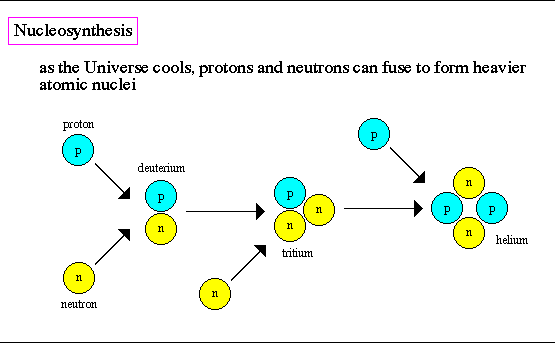
The term nucleosynthesis refers to the formation of heavier elements, atomic nuclei with many protons and neutrons, from the fusion of lighter elements. The Big Bang theory predicts that the early universe was a very hot place. One second after the Big Bang, the temperature of the universe was roughly 10 billion degrees and was filled with a sea of neutrons, protons, electrons, anti-electrons (positrons), photons and neutrinos. As the universe cooled, the neutrons either decayed into protons and electrons or combined with protons to make deuterium (an isotope of hydrogen). During the first three minutes of the universe, most of the deuterium combined to make helium. Trace amounts of lithium were also produced at this time. This process of light element formation in the early universe is called “Big Bang nucleosynthesis” (BBN).

The creation hypothesis predicts that there will be specific amounts of these light elements formed as the universe cools down. Do the predictions match with observations?

Yes they do:

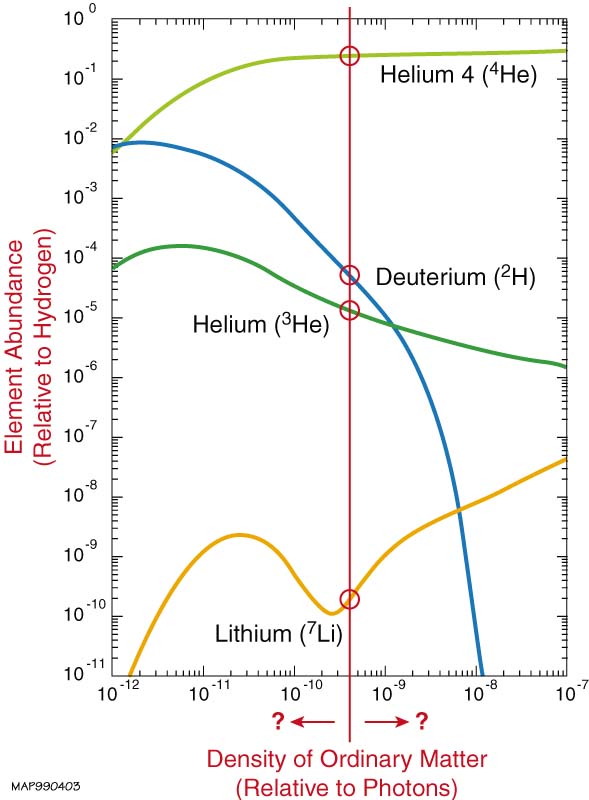
The predicted abundance of deuterium, helium and lithium depends on the density of ordinary matter in the early universe, as shown in the figure at left. These results indicate that the yield of helium is relatively insensitive to the abundance of ordinary matter, above a certain threshold. We generically expect about 24% of the ordinary matter in the universe to be helium produced in the Big Bang. This is in very good agreement with observations and is another major triumph for the Big Bang theory.

Moreover, WMAP satellite measurements of mass density agree with our observations of these light element abundances.

Here are the observations from the WMAP satellite:

Scientific observations match predictions

And here is how those WMAP measurements confirm the Big Bang creation event:

However, the Big Bang model can be tested further. Given a precise measurement of the abundance of ordinary matter, the predicted abundances of the other light elements becomes highly constrained. The WMAP satellite is able to directly measure the ordinary matter density and finds a value of 4.6% (±0.2%), indicated by the vertical red line in the graph. This leads to predicted abundances shown by the circles in the graph, which are in good agreement with observed abundances. This is an important and detailed test of nucleosynthesis and is further evidence in support of the Big Bang theory. 

“An important and detailed test”.

For completeness, we should learn how elements heavier than these light elements are formed:

Elements heavier than lithium are all synthesized in stars. During the late stages of stellar evolution, massive stars burn helium to carbon, oxygen, silicon, sulfur, and iron. Elements heavier than iron are produced in two ways: in the outer envelopes of super-giant stars and in the explosion of a supernovae. All carbon-based life on Earth is literally composed of stardust.

That’s a wonderful thing to tell a young lady when you are on a date: “your body is made of stardust”. In fact, as I have argued before, this star formation, which creates the elements necessary for intelligent life, can only be built if the fundamental constants and quantities in the universe are finely-tuned.

Now, you would think that atheists would be happy to find observations that confirm the origin of the universe out of nothing, but they are not. Actually, they are in denial.

Here’s a statement from the Secular Humanist Manifesto, which explains what atheists believe about the universe:

Religious humanists regard the universe as self-existing and not created.

For a couple of examples of how atheistic scientists respond to the evidence for a cosmic beginning, you can check out this post, where we get responses from cosmologist Lawrence Krauss, and physical chemist Peter Atkins.

You cannot have the creation of the universe be true AND a self-existing, eternal universe ALSO be true. Someone has to be wrong. Either the science is wrong, or the atheist manifesto is wrong. I know where I stand.

Positive arguments for Christian theism