
Category Archives: Polemics

Minimum wage: doing what feels good doesn’t produce good results

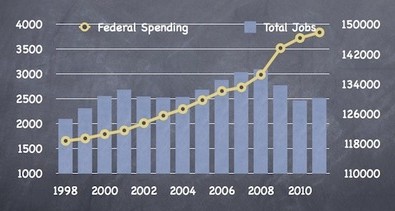
Government Spending Vs Jobs

From Investors Business Daily.

Excerpt:

How amusing to watch Democrats wring their hands over what they can do to get businesses to create jobs, when one of the biggest job killers is the minimum wage they keep hiking.

Recall that it was Democrats who raised the federal wage floor a whopping $2.10 an hour in the middle of the recession. The record 41% increase has led to record unemployment among young people, especially black teens.

Congress started ratcheting up the minimum wage from $5.15 an hour in mid-2007, arguing it would help abate poverty. But retailers looking to slash costs eliminated low-skilled, entry-level jobs rather than pay the mandated increases.

Now 1.5 million fewer teens are working. Last year’s unemployment rate for workers ages 16 to 19 shot up to 26% from 2007’s 15%.

As for black teens, their joblessness soared to a record 43% after the final raise to $7.25 took effect in mid-2009. It helped put more than half of young black men out of work — a first.

The president proposes cranking the minimum wage even higher to $9.50. Then he wants to raise it every year thereafter as a “living wage” indexed to inflation.

Yes, this is the problem that happens when you elect someone who knows nothing whatsoever about economics. And when I say nothing, I mean he is in disagreement with virtually all economists across the ideological spectrum.

Moderate economist Gregory Mankiw of Harvard University lists the policies that are accepted by virtually all economists.

Here’s Greg’s list, together with the percentage of economists who agree:

  1. A ceiling on rents reduces the quantity and quality of housing available. (93%)
  2. Tariffs and import quotas usually reduce general economic welfare. (93%)
  3. Flexible and floating exchange rates offer an effective international monetary arrangement. (90%)
  4. Fiscal policy (e.g., tax cut and/or government expenditure increase) has a significant stimulative impact on a less than fully employed economy. (90%)
  5. The United States should not restrict employers from outsourcing work to foreign countries. (90%)
  6. The United States should eliminate agricultural subsidies. (85%)
  7. Local and state governments should eliminate subsidies to professional sports franchises. (85%)
  8. If the federal budget is to be balanced, it should be done over the business cycle rather than yearly. (85%)
  9. The gap between Social Security funds and expenditures will become unsustainably large within the next fifty years if current policies remain unchanged. (85%)
  10. Cash payments increase the welfare of recipients to a greater degree than do transfers-in-kind of equal cash value. (84%)
  11. A large federal budget deficit has an adverse effect on the economy. (83%)
  12. A minimum wage increases unemployment among young and unskilled workers. (79%)
  13. The government should restructure the welfare system along the lines of a “negative income tax.” (79%)
  14. Effluent taxes and marketable pollution permits represent a better approach to pollution control than imposition of pollution ceilings. (78%)

From CNBC, we get this article showing that any increase in the minimum wage will raise the unemployment rate for young people.

Excerpt:

A quarter of teenagers were jobless in March, representing a surprising increase from February, even as the unemployment rate for the rest of the population decreased.

This figure may only get worse if budget-strapped states raise the minimum wage, and it could also be a sign of greater structural damage underlying our economy, analysts said.

The unemployment rate for 16- to 19-year olds jumped back up to 24.5 percent in March, up from 23.9 percent the prior month, according to the latest jobs data from the Labor Department.

[…]“Even when comprehending that teen employment is volatile in nature, the data that exists serves up some shock and awe,” said Brian Sozzi, a retail research analyst with Wall Street Strategies, in a note Wednesday. “If these (wage) increases do go through, the prospect for teen employment will remain grim as employers search for workers with advanced skills to fill positions.”

Twelve states, including Illinois and Pennsylvania, are considering a hike in the minimum wage. While this has been the subject of a long-running debate, many economists and analysts say raising this pay bar may cause more teen layoffs, even as it helps teens who manage to stay employed make more.

“Minimum wage increases over the past few years has definitely made it worse,” said Peter Boockvar, chief equities strategist at Miller Tabak. “In fact, there should be zero minimum wage for teenagers, or at most, something much less than the current rate.”

Teens typically are the first to be fired and the last to be hired back in a normal economic cycle, so this rate can be considered a kind of leading indicator of employment.

A new study shows that only 25% of teens will be able to find jobs this summer. And Obama thinks that this number is apparently too high. He wants to lower it by raising the price that must be paid by employers who would like to hire younger workers.

You can find out more about how raising the minimum wage increases unemployment from this comprehensive, 50-year, government study.

Excerpt:

Summary of Research on the Minimum Wage

* The minimum wage reduces employment.

Currie and Fallick (1993), Gallasch (1975), Gardner (1981), Peterson (1957), Peterson and Stewart (1969).

* The minimum wage reduces employment more among teenagers than adults.

Adie (1973); Brown, Gilroy and Kohen (1981a, 1981b); Fleisher (1981); Hammermesh (1982); Meyer and Wise (1981, 1983a); Minimum Wage Study Commission (1981); Neumark and Wascher (1992); Ragan (1977); Vandenbrink (1987); Welch (1974, 1978); Welch and Cunningham (1978).

* The minimum wage reduces employment most among black teenage males.

Al-Salam, Quester, and Welch (1981), Iden (1980), Mincer (1976), Moore (1971), Ragan (1977), Williams (1977a, 1977b).

* The minimum wage helped South African whites at the expense of blacks.

Bauer (1959).

* The minimum wage hurts blacks generally.

Behrman, Sickles and Taubman (1983); Linneman (1982).

* The minimum wage hurts the unskilled.

Krumm (1981).

* The minimum wage hurts low wage workers.

Brozen (1962), Cox and Oaxaca (1986), Gordon (1981).

* The minimum wage hurts low wage workers particularly during cyclical downturns.

Kosters and Welch (1972), Welch (1974).

* The minimum wage reduces average earnings of young workers.Meyer and Wise (1983b).

* The minimum wage reduces employment in low-wage industries, such as retailing.Cotterman (1981), Douty (1960), Fleisher (1981), Hammermesh (1981), Peterson (1981).

* The minimum wage causes employers to cut back on training.Hashimoto (1981, 1982), Leighton and Mincer (1981), Ragan (1981).

* The minimum wage encourages employers to install labor-saving devices.Trapani and Moroney (1981).

* The minimum wage increases the number of people on welfare.Brandon (1995), Leffler (1978).

* The minimum wage hurts the poor generally.

Stigler (1946).

* The minimum wage does little to reduce poverty.

Bonilla (1992), Brown (1988), Johnson and Browning (1983), Kohen and Gilroy (1981), Parsons (1980), Smith and Vavrichek (1987).

* The minimum wage helps unions.Linneman (1982), Cox and Oaxaca (1982).

* The minimum wage increases teenage crime rates.Hashimoto (1987), Phillips (1981).

* The minimum wage encourages employers to hire illegal aliens.

Beranek (1982).

* Few workers are permanently stuck at the minimum wage.

Brozen (1969), Smith and Vavrichek (1992).

* The minimum wage has reduced employment in foreign countries.Canada: Forrest (1982); Chile: Corbo (1981); Costa Rica: Gregory (1981); France: Rosa (1981).

This is why it is important for voters to understand economics. When you raise the price of labor, fewer employers will purchase labor. Supply and demand.
Can the Episcopalian church commit apostasy and still survive?

Here’s an interesting article from BeliefNet. (You have to click through all 4 pages to get it all, and it’s worth it)

Excerpt:

The headlines coming out of the Episcopal Church’s annual U.S. convention are stunning — endorsement of cross-dressing clergy, blessing same-sex marriage, the sale of their headquarters since they can’t afford to maintain it.

The American branch of the Church of England, founded when the Vatican balked at permitting King Henry VIII to continue annulling marriages to any wife who failed to bear him sons, is in trouble.

Somehow slipping out of the headlines is a harsh reality that the denomination has been deserted in droves by an angry or ambivalent membership. Six prominent bishops are ready to take their large dioceses out of the American church and align with conservative Anglican groups in Africa and South America.

Let’s see some of the bad news:

Membership has dropped so dramatically that today there are 20 times more Baptists than Episcopalians. U.S. Catholics out-number the Episcopal Church 33-to-1. There are more Jews than Episcopalians. Twice as many Mormons as Episcopalians. Even the little African Methodist Episcopal denomination — founded in in 1787 — has passed the Episcopalians.

Among the old mainstream denominations reporting to the National Council of Churches, the Episcopal Church suffered the worst loss of membership from 1992-2002 — plunging from 3.4 million members to 2.3 million for a 32 percent loss. In the NCC’s 2012 yearbook, the Episcopal Church admitted another 2.71 percent annual membership loss.

They elected Katharine Jefferts Schori as their presiding bishop. According to the article, she mocks traditional Christian doctrines like creation, incarnation and the Trinity, and she tells everyone in the audience that they are becoming God.

“Jefferts Schori leaves a wide wake of destruction behind with this sermon: the eternal triune God has been torn down, human beings are to boldly claim our place as God, and the sacraments of the Eucharist and Baptism have been turned into things our hands make. In other words, Jefferts Schori accepts that now humanity, animals and God are one undifferentiated blob.

More:

“Yesterday,” reports Angela O’Brien from the convention, “the House of Bishops of the Episcopalian Church approved a new provisional blessing for gay unions, while the full General Convention voted in favor of general acceptance for transgender clergy.

“Some Episcopalian bishops spoke out against the resolution on ame-sex blessings. Bishop Bauerschmidt, of the Episcopal Diocese of Tennessee, urged the bishops to defeat the resolution.

[…]A few years ago, the annual national Episcopal convention overwhelmingly refused even to consider a resolution affirming that Jesus Christ is Lord.

[…]At this year’s convention, David Virtue reported: “In all the talk about same sex this and transgender that, there is absolutely no talk about sin. A psychologist friend of mine opined that talk of ‘sin’ here would be considered psychologically damaging and offensive to a lot of people, especially gays, so it is off the radar screen. ‘No sin, please; we’re Episcopalians.’

Another interesting editorial by Ross Douthat appeared in the New York Times yesterday, discussing this same issue.

Excerpt:

IN 1998, John Shelby Spong, then the reliably controversial Episcopal bishop of Newark, published a book entitled “Why Christianity Must Change or Die.” Spong was a uniquely radical figure — during his career, he dismissed almost every element of traditional Christian faith as so much superstition — but most recent leaders of the Episcopal Church have shared his premise. Thus their church has spent the last several decades changing and then changing some more, from a sedate pillar of the WASP establishment into one of the most self-consciously progressive Christian bodies in the United States.

As a result, today the Episcopal Church looks roughly how Roman Catholicism would look if Pope Benedict XVI suddenly adopted every reform ever urged on the Vatican by liberal pundits and theologians. It still has priests and bishops, altars and stained-glass windows. But it is flexible to the point of indifference on dogma, friendly to sexual liberation in almost every form, willing to blend Christianity with other faiths, and eager to downplay theology entirely in favor of secular political causes.

Yet instead of attracting a younger, more open-minded demographic with these changes, the Episcopal Church’s dying has proceeded apace. Last week, while the church’s House of Bishops was approving a rite to bless same-sex unions, Episcopalian church attendance figures for 2000-10 circulated in the religion blogosphere. They showed something between a decline and a collapse: In the last decade, average Sunday attendance dropped 23 percent, and not a single Episcopal diocese in the country saw churchgoing increase.

[…]Practically every denomination — Methodist, Lutheran, Presbyterian — that has tried to adapt itself to contemporary liberal values has seen an Episcopal-style plunge in church attendance. Within the Catholic Church, too, the most progressive-minded religious orders have often failed to generate the vocations necessary to sustain themselves.

Both religious and secular liberals have been loath to recognize this crisis. Leaders of liberal churches have alternated between a Monty Python-esque “it’s just a flesh wound!” bravado and a weird self-righteousness about their looming extinction. (In a 2006 interview, the Episcopal Church’s presiding bishop explained that her communion’s members valued “the stewardship of the earth” too highly to reproduce themselves.)

I know that some Lutheran (LCMS, LCWS) and Presbyterian (PCA) are still relatively conservative, but those other denominations like United Church of Christ, ELCA Lutherans and PCUSA Presbyterians have, in my opinion, abandoned orthodoxy.

Obama says that small business owners didn’t build their own businesses

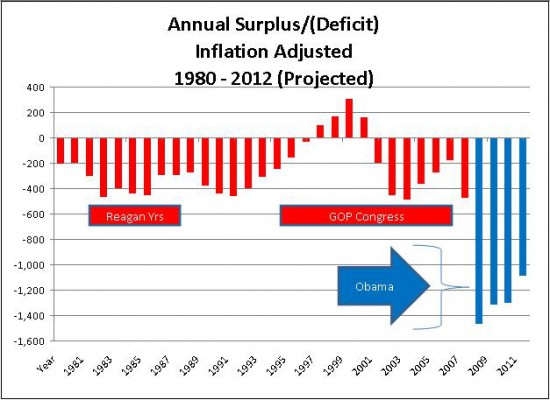
Barack Obama: Budget Deficits
He feels comfortable spending other people’s money: why?

It’s right on the White House web site, cached on National Review:

. . .There are a lot of wealthy, successful Americans who agree with me — because they want to give something back. They know they didn’t — look, if you’ve been successful, you didn’t get there on your own. You didn’t get there on your own. I’m always struck by people who think, well, it must be because I was just so smart. There are a lot of smart people out there. It must be because I worked harder than everybody else. Let me tell you something — there are a whole bunch of hardworking people out there. (Applause.)

If you were successful, somebody along the line gave you some help. There was a great teacher somewhere in your life. Somebody helped to create this unbelievable American system that we have that allowed you to thrive. Somebody invested in roads and bridges. If you’ve got a business — you didn’t build that. Somebody else made that happen.

The Internet didn’t get invented on its own. Government research created the Internet so that all the companies could make money off the Internet. The point is, is that when we succeed, we succeed because of our individual initiative, but also because we do things together. There are some things, just like fighting fires, we don’t do on our own. I mean, imagine if everybody had their own fire service. That would be a hard way to organize fighting fires. . .

See, that’s why Obama is so confident about talking the money earned by businesses owners and their employees. You don’t really run your own business, Obama does. He is the one who puts in the 70 hour weeks and takes the risks and borrows money from family. When I was working 70 hour weeks in IT start-ups, that wasn’t me working those hours, that was Obama. That’s why he’s entitled to tax me so much. He was actually working weekends to earn my salary. He has a right to my salary, because I didn’t really earn it.

FLASHBACK: Obama says that limited government and capitalism have never worked