Category Archives: Polemics

Justin Bass fact-checks Dan Barker’s debate performance

Two Rams butting heads: may the best ram win!

I read this post from Justin Bass, PhD about his recent debate with Dan Barker on the historical Jesus. Bass takes a look at Barker’s arguments in his written work, as well as his performance in the debates.

First, Barker does not quote any mainstream historians, he only cites people like G.A. Wells (a professor of German language), Barbara G. Walker (an expert in knitting), and other people on the radical fringe:

In writing on Jesus and Christianity, Dan cites only these other sources: John Remsburg, J. M. Robertson, W. B. Smith, Barbara Walker, G. A. Wells, Randall Helms, John Allegro, Hugh Schonfield, Earl Doherty, Robert Price and Richard Carrier. A review of their credentials quickly reveal that the majority of them are inadequate sources for Jesus and early Christianity.

[…]That was very honest of Dan to admit that he erred in using Walker as a source, but why did Dan not cite anywhere in his books James Dunn, E. P. Sanders, John P. Meier, N. T. Wright, Paula Fredricksen, Dale Allison, Martin Hengel, Richard Bauckham, or really any of the other 6000+ scholars professionally teaching in relevant subjects of early Christianity?

One thing is for sure – with a list of clowns like that, Barker is not interested in truth, but just interested in believing whatever suits his emotional needs.

The rest of the Bass essay covers these topics:

  1. Did Nazareth Exist during the Lifetime of Jesus?
  2. Josephus and Tacitus on Jesus
  3. Did Paul Believe Jesus’ Resurrection was Physical or Spiritual?
  4. The 500 Eyewitnesses
  5. “Contradictions” in the Resurrection Accounts
  6. Dan’s One Alternative Explanation (for the minimal facts)
  7. Even if Jesus rose from the dead, Dan would still not accept Him as his Lord

You might remember that I already blogged about Dan Barker’s crazy view that Nazareth did not exist at the time of Jesus, and the archaeological discoveries that falsify his view.

Let’s just look at one of other ones in the list. I think this is the craziest one of all – Dan Barker’s explanation for the minimal facts:

Bass writes:

I presented 7 facts concerning the historical Jesus and the rise of the Christian movement in the first century in my opening statement that are agreed upon by all full-time teaching scholars in the Western world (6000+) whether in Classics, History, or in Early Christianity. And I argued that the best explanation of these 7 facts is that Jesus of Nazareth rose bodily from the dead and therefore is Lord of all.

Throughout the night, Dan only gave one possible alternative explanation that would, even if true, explain only one of my 7 facts. He admitted before he shared this explanation that the hallucination hypothesis (which is the leading alternative explanation among NT scholars today) is “weak.” Instead, Dan proposed a theory found first in the writings of Robert Price. You can watch the clip above, but Dan essentially argues that because Peter felt so bad about his denial of Jesus after his death, he had an experience that convinced him Jesus was still alive. But as I said in the debate this in no way answers why someone like Paul would become a follower of Jesus and I pressed Dan for evidence for this theory and he gave none.

Ultimately, this was just something Robert Price just made up out of thin air and Dan is carrying on Price’s imagination.

How the heck are you supposed to get Paul to exchange his comfortable life as a zealous, respected Pharisee for his life as a Christian missionary based on Peter feeling guilty? Paul was trying to kill Peter – he isn’t interested in Peter’s supposed feelings of guilt. No one – and I mean no one – doubts that Paul was a zealous Pharisee who thought that he saw a post-mortem appearance of Jesus. That is the only way to explain his complete change of mind. In fact, the Peter-grief theory does not explain the empty tomb. It does not explain the post-mortem appearances to Paul, James and others, and it does not explain the early belief in the resurrection that emerged in Jerusalem. It’s a ridiculous theory, and the only way to believe it is by insulating yourself from the evidence.

Atheist Jerry Coyne explains why morality is impossible for atheists

Sherlock Holmes and John Watson about to do philosophy

Let’s review what you need in your worldview in order to have a rationally grounded system of morality.

You need 5 things:

1) Objective moral values

There needs to be a way to distinguish what is good from what is bad. For example, the moral standard might specify that being kind to children is good, but torturing them for fun is bad. If the standard is purely subjective, then people could believe anything and each person would be justified in doing right in their own eyes. Even a “social contract” is just based on people’s opinions. So we need a standard that applies regardless of what people’s individual and collective opinions are.

2) Objective moral duties

Moral duties (moral obligations) refer to the actions that are obligatory based on the moral values defined in 1). Suppose we spot you 1) as an atheist. Why are you obligated to do the good thing, rather than the bad thing? To whom is this obligation owed? Why is rational for you to limit your actions based upon this obligation when it is against your self-interest? Why let other people’s expectations decide what is good for you, especially if you can avoid the consequences of their disapproval?

3) Moral accountability

Suppose we spot you 1) and 2) as an atheist. What difference does it make to you if you just go ahead and disregard your moral obligations to whomever? Is there any reward or punishment for your choice to do right or do wrong? What’s in it for you?

4) Free will

In order for agents to make free moral choices, they must be able to act or abstain from acting by exercising their free will. If there is no free will, then moral choices are impossible. If there are no moral choices, then no one can be held responsible for anything they do. If there is no moral responsibility, then there can be no praise and blame. But then it becomes impossible to praise any action as good or evil.

5) Ultimate significance

Finally, beyond the concept of reward and punishment in 3), we can also ask the question “what does it matter?”. Suppose you do live a good life and you get a reward: 1000 chocolate sundaes. And when you’ve finished eating them, you die for real and that’s the end. In other words, the reward is satisfying, but not really meaningful, ultimately. It’s hard to see how moral actions can be meaningful, ultimately, unless their consequences last on into the future.

Theism rationally grounds all 5 of these. Atheism cannot ground any of them.

Let’s take a look at #4: free will and see how atheism deals with that.

Atheism and free will?

Here’s prominent atheist Jerry Coyne’s editorial in USA Today to explain why atheists can’t ground free will.

Excerpt:

And that’s what neurobiology is telling us: Our brains are simply meat computers that, like real computers, are programmed by our genes and experiences to convert an array of inputs into a predetermined output. Recent experiments involving brain scans show that when a subject “decides” to push a button on the left or right side of a computer, the choice can be predicted by brain activity at least seven seconds before the subject is consciously aware of having made it. (These studies use crude imaging techniques based on blood flow, and I suspect that future understanding of the brain will allow us to predict many of our decisions far earlier than seven seconds in advance.) “Decisions” made like that aren’t conscious ones. And if our choices are unconscious, with some determined well before the moment we think we’ve made them, then we don’t have free will in any meaningful sense.

If you don’t have free will, then you can’t make moral choices, and you can’t be held morally responsible. No free will means no morality.

Here are some more atheists to explain how atheists view morality.

William Provine says atheists have no free will, no moral accountability and no moral significance:

Let me summarize my views on what modern evolutionary biology tells us loud and clear — and these are basically Darwin’s views. There are no gods, no purposes, and no goal-directed forces of any kind. There is no life after death. When I die, I am absolutely certain that I am going to be dead. That’s the end of me. There is no ultimate foundation for ethics, no ultimate meaning in life, and no free will for humans, either.

Richard Dawkins says atheists have no objective moral standards:

In a universe of blind physical forces and genetic replication, some people are going to get hurt, other people are going to get lucky, and you won’t find any rhyme or reason in it, or any justice. The universe that we observe has precisely the properties we should expect if there is, at bottom, no design, no purpose, no evil and no good, nothing but blind, pitiless indifference… DNA neither knows nor cares. DNA just is. And we dance to its music. (Richard Dawkins, River Out of Eden: A Darwinian View of Life (1995))

When village atheists talk about how they can be moral without God, it’s important to ask them to justify the minimum requirements for rational morality. Atheists may act inconsistently with their worldview, believing in free will, expecting praise and blame for complying with the arbitrary standards of their peer group, etc. But there is nothing more to morality on atheism that imitating the herd – at least when the herd is around to watch them. And when the herd loses its Judeo-Christian foundation – watch out. That’s when the real atheism comes out, and you can see it on display in the Planned Parenthood videos. When God disappears from a society, anything is permissible.

How the WMAP satellite confirmed nucleosynthesis predictions and falsified atheism

Apologetics and the progress of science

Prior to certain scientific discoveries, most people thought that the universe had always been here, and no need to ask who or what may have caused it. But today, that’s all changed. Today, the standard model of the origin of the universe is that all the matter and energy in the universe came into being in an event scientists call “The Big Bang”. At the creation event, space and time themselves began to exist, and there is no material reality that preceded them.

So a couple of quotes to show that.

An initial cosmological singularity… forms a past temporal extremity to the universe. We cannot continue physical reasoning, or even the concept of spacetime, through such an extremity… On this view the big bang represents the creation event; the creation not only of all the matter and energy in the universe, but also of spacetime itself.

Source: P. C. W. Davies, “Spacetime Singularities in Cosmology,” in The Study of Time III, ed. J. T. Fraser (Berlin: Springer Verlag ).

And another quote:

[A]lmost everyone now believes that the universe, and time itself, had a beginning at the big bang.

Source: Stephen Hawking and Roger Penrose, The Nature of Space and Time, The Isaac Newton Institute Series of Lectures (Princeton, N. J.: Princeton University Press, 1996), p. 20.

So, there are several scientific discoveries that led scientists to accept the creation event, and one of the most interesting and famous is the discovery of how elements heavier than hydrogen were formed.

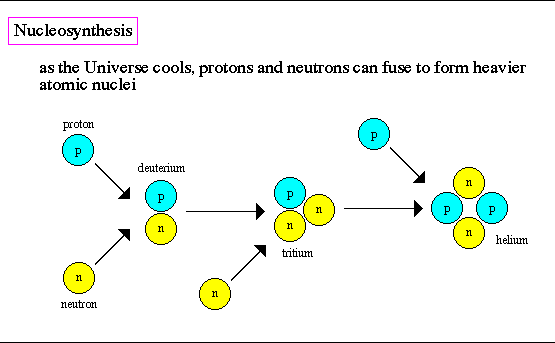
Nucleosynthesis: forming heavier elements by fusion

(Source)

Here’s the history of how that discovery happened, from the National Aeronautics and Space Administration (NASA) web site:

The term nucleosynthesis refers to the formation of heavier elements, atomic nuclei with many protons and neutrons, from the fusion of lighter elements. The Big Bang theory predicts that the early universe was a very hot place. One second after the Big Bang, the temperature of the universe was roughly 10 billion degrees and was filled with a sea of neutrons, protons, electrons, anti-electrons (positrons), photons and neutrinos. As the universe cooled, the neutrons either decayed into protons and electrons or combined with protons to make deuterium (an isotope of hydrogen). During the first three minutes of the universe, most of the deuterium combined to make helium. Trace amounts of lithium were also produced at this time. This process of light element formation in the early universe is called “Big Bang nucleosynthesis” (BBN).

The creation hypothesis predicts that there will be specific amounts of these light elements formed as the universe cools down. Do the predictions match with observations?

Yes they do:

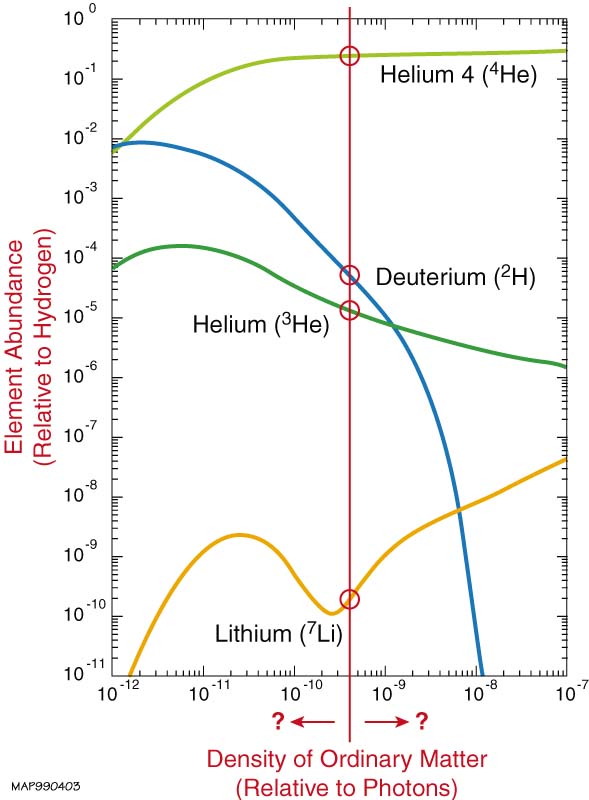
The predicted abundance of deuterium, helium and lithium depends on the density of ordinary matter in the early universe, as shown in the figure at left. These results indicate that the yield of helium is relatively insensitive to the abundance of ordinary matter, above a certain threshold. We generically expect about 24% of the ordinary matter in the universe to be helium produced in the Big Bang. This is in very good agreement with observations and is another major triumph for the Big Bang theory.

Moreover, WMAP satellite measurements of mass density agree with our observations of these light element abundances.

Here are the observations from the WMAP satellite:

Scientific observations match predictions

(Source)

And here is how those WMAP measurements confirm the Big Bang creation event:

However, the Big Bang model can be tested further. Given a precise measurement of the abundance of ordinary matter, the predicted abundances of the other light elements becomes highly constrained. The WMAP satellite is able to directly measure the ordinary matter density and finds a value of 4.6% (±0.2%), indicated by the vertical red line in the graph. This leads to predicted abundances shown by the circles in the graph, which are in good agreement with observed abundances. This is an important and detailed test of nucleosynthesis and is further evidence in support of the Big Bang theory. 

“An important and detailed test”.

For completeness, we should learn how elements heavier than these light elements are formed:

Elements heavier than lithium are all synthesized in stars. During the late stages of stellar evolution, massive stars burn helium to carbon, oxygen, silicon, sulfur, and iron. Elements heavier than iron are produced in two ways: in the outer envelopes of super-giant stars and in the explosion of a supernovae. All carbon-based life on Earth is literally composed of stardust.

That’s a wonderful thing to tell a young lady when you are on a date: “your body is made of stardust”. In fact, as I have argued before, this star formation, which creates the elements necessary for intelligent life, can only be built if the fundamental constants and quantities in the universe are finely-tuned.

Now, you would think that atheists would be happy to find observations that confirm the origin of the universe out of nothing, but they are not. Actually, they are in denial.

Here’s a statement from the Secular Humanist Manifesto, which explains what atheists believe about the universe:

Religious humanists regard the universe as self-existing and not created.

For a couple of examples of how atheistic scientists respond to the evidence for a cosmic beginning, you can check out this post, where we get responses from cosmologist Lawrence Krauss, and physical chemist Peter Atkins.

You cannot have the creation of the universe be true AND a self-existing, eternal universe ALSO be true. Someone has to be wrong. Either the science is wrong, or the atheist manifesto is wrong. I know where I stand.

Positive arguments for Christian theism