Category Archives: Polemics

Did the city of Nazareth exist at the time of the birth of Jesus?

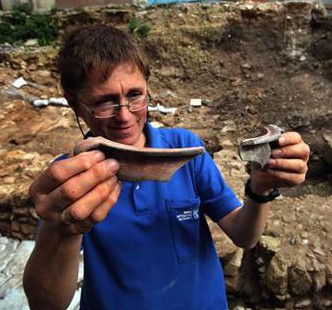
Israeli archaeologist Yardena Alexandre inspects Roman 1st-century pottery found from the city of Nazareth.

A while back, I was discussing a recent debate that a friend attended between an atheist musician named Dan Barker and a Christian with a doctorate in New Testament Studies named Justin Bass.

According to my friend’s report, the atheist questioned the existence of Nazareth, and then went on from there to assert that everything we know about Jesus is legendary.

This is what the atheist’s argument sounds like:

  1. If the New Testament contains reliable history about Jesus, then Nazareth must exist.
  2. Nazareth does not exist.
  3. Therefore, the New Testaments does not contain reliable history about Jesus. (M.T. 1,2)

I was able to find a web site where an atheist was making the claim that Nazareth did not exist at the time of Jesus. So this is not completely outside the realm of mainstream atheism. I doubled checked with two more people who attended the debate that Barker indeed made an argument like the one above.

Two things to say about this 3-step argument. First off, when speaking to atheists, Christians only care about making a case for the resurrection. This is for two reasons. One, our goal is to disprove atheism, and the historical argument for the resurrection is the most evidenced miracle claim in the New Testament. Nazareth is not part of that core of minimal facts about the resurrection of Jesus. Second, it’s possible to be a Christian by accepting a core of Christian dogma (e.g. – the Apostle’s Creed), while remaining agnostic or even skeptical of other things in the Bible. Nazareth is not part of that core of minimal facts that must be affirmed in order to become a Christian.

The problem I have with atheists is that they pick and choose from the Bible according to their own agenda. Every Christian has read basic books on the resurrection by people like Lee Strobel, Michael Licona, William Lane Craig, J. Warner Wallace and so on. This is like table stakes for living a Christian life. We all know how to make a case based off of minimal facts for the resurrection. When Christians get into debates about Jesus, we want to make a case for the core of historical knowledge about him, minimal facts that almost no one disagrees with. But many atheists aren’t like that. They want to pick and choose a few verses out of the Old Testament and the New Testament that they personally find distasteful to them, and then deny the minimal facts about Jesus on that basis. I don’t think that it makes sense to deny evidence for widely-accepted facts by bringing up minor problems that are irrelevant to the well-attested core facts.

But it’s worse than that – we actually DO know that Nazareth existed, and we know it not from some fundamentalist preacher, but from atheist Bart Ehrman.

Ehrman writes in his book:

One supposedly legendary feature of the Gospels commonly discussed by mythicists is that the alleged hometown of Jesus, Nazareth did not exist but is itself a myth. The logic of this argument, which is sometimes advanced with considerable vehemence and force, appears to be that if Christians made up Jesus’ hometown, they probably made him up as well.  I could dispose of this argument fairly easily by pointing out that it is irrelevant.  If Jesus existed, as the evidence suggests, but Nazareth did not, as this assertion claims, then he merely came from somewhere else.  Whether Barack Obama was born in the U.S. or not (for what it is worth, he was) is irrelevant to the question of whether he was born.

Since, however, this argument is so widely favored among mythicists, I want to give it a further look and deeper exploration.  The most recent critic to dispute the existence of Nazareth is René Salm, who has devoted an entire book to the question, called The Myth of Nazareth.  Salm sees this issue as highly significant and relevant to the question of the historicity of Jesus: “Upon that determination [i.e., the existence of Nazareth] depends a great deal, perhaps even the entire edifice of Christendom.”

So that seems like a fair representation of the argument I outlined above.

Bart’s response is long, but here’s part of it:

There are numerous compelling pieces of archaeological evidence that in fact Nazareth did exist in Jesus’ day, and that like other villages and towns in that part of Galilee, it was built on the hillside, near where the later rock-cut kokh tombs were built.  For one thing, archaeologists have excavated a farm connected with the village, and it dates to the time of Jesus.  Salm disputes the finding of the archaeologists who did the excavation (it needs to be remembered, he himself is not an archaeologist but is simply basing his views on what the real archaeologists – all of whom disagree with him — have to say).  For one thing, when archaeologist Yardena Alexandre indicated that 165 coins were found in this excavation, she specified in the report that some of them were late, from the fourteenth or fifteenth centuries.  This suits Salm’s purposes just fine.  But as it turns out, there were among the coins some that date to the Hellenistic, Hasmonean, and early Roman period, that is, the days of Jesus.  Salm objected that this was not in Alexandre’s report, but Alexandre has verbally confirmed (to me personally) that in fact it is the case: there were coins in the collection that date to the time prior to the Jewish uprising.

Aalm also claims that the pottery found on the site that is dated to the time of Jesus is not really from this period, even though he is not an expert on pottery.  Two archaeologists who reply to Salm’s protestations say the following:  “Salm’s personal evaluation of the pottery … reveals his lack of expertise in the area as well as his lack of serious research in the sources.”  They go on to state: “By ignoring or dismissing solid ceramic, numismatic [that is, coins], and literary evidence for Nazareth’s existence during the Late Hellenisitic and Early Roman period, it would appear that the analysis which René Salm includes in his review, and his recent book must, in itself, be relegated to the realm of ‘myth.’”

Read Bart’s whole excerpt from his book in his post.

I did a quick double check on the archaeologist Ehrman mentioned, and found an Associated Press story about another archaelogical discovery made by archaeologists in Nazareth. This time, it’s not the coins, but pottery fragments. The date range on the pottery is 100 before Jesus’ birth to 100 years after Jesus’ birth.

Even though Ehrman is an atheist, I think that he understands how to do history. You can’t be a credentialed historian and throw out the early proclamation of Jesus’ resurrection because of doubts about Old Testament violence. You can’t be a credentialed historian and throw out the conversions of Paul and James because you don’t know whether there was one angel or two angels at the empty tomb. Denying the core facts about Jesus by bringing up concerns about peripheral issues is not a responsible way to investigate the historical Jesus.

Thomas Sowell: does affirmative action help minorities to get ahead?

Economist Thomas Sowell
Economist Thomas Sowell – the best economist in the world

My favorite economist, Thomas Sowell has an article in Investors Business Daily that explains what affirmative action really does to minorities.

Excerpt:

Affirmative action is supposed to benefit black and other minority students admitted with lower academic qualifications than some white students who are rejected.

[…]Despite much media spin, the issue is not whether blacks in general should be admitted to higher-ranked or lower-ranked institutions.

The issue is whether a given black student, with given academic qualifications, should be admitted to a college or university where he would not be admitted if he were white.

Much research over the years has confirmed… that admitting black students to institutions for which their academic preparation is not sufficient can be making them worse off instead of better off.

I became painfully aware of this problem more than 40 years ago when I was teaching at Cornell University and discovered that half the black students there were on some form of academic probation.

These students were not stupid or uneducable. On the contrary, the average black student at Cornell at that time scored at the 75th percentile on scholastic tests. Their academic qualifications were better than those of three-quarters of all American students who took those tests.

Why were they in trouble at Cornell, then? Because the average Cornell student in the liberal arts college at that time scored at the 99th percentile. The classes taught there — including mine — moved at a speed geared to the verbal and mathematical level of the top one percent of American students.

The average white student would have been wiped out at Cornell. But the average white student was unlikely to be admitted to Cornell in the first place. Nor was a white student who scored at the 75th percentile.

That was a “favor” reserved for black students. This “favor” turned black students who would have been successful at most American colleges and universities into failures at Cornell.

None of this was peculiar to Cornell. Black students who scored at the 90th percentile in math had serious problems trying to keep up at MIT, where other students scored somewhere within the top 99th percentile.

Nearly one-fourth of these black students with stellar qualifications in math failed to graduate from MIT, and those who did graduate were concentrated in the bottom tenth of the class.

There were other fine engineering schools around the country where those same students could have learned more, when taught at a normal pace, than at a breakneck speed geared to students with extremely rare abilities in math.

[…]Mismatching students with educational institutions is a formula for needless failures.

The book “Mismatch” by Sander and Taylor is a first-rate study of the hard facts. It shows, for example, that the academic performances of black and Hispanic students rose substantially after affirmative action admissions policies were banned in the University of California system.

Instead of failing at Berkeley or UCLA, these minority students were now graduating from other UC campuses. They were graduating at a higher rate, with higher grades, and now more often in challenging fields like math, science and technology.

[…]Does the actual fate of minority students not matter to the left as much as their symbolic presence on a campus?

Now, you might ask yourself on what basis Sowell makes all these assertions, so here are a few of his academic publications about affirmative action, which are state-of-the-art:

Now, I was recently talking to a friend who has empirically false views on a number of topics. He is opposed to capital punishment, opposed to gun ownership, supports affirmative action, and so on. When I ask him why he believes these things, he doesn’t point to any evidence. I offered to give him studies showing that capital punishment has a deterrent effect on crime, that concealed carry laws reduce violent crime rates, that affirmative action laws harm minorities, etc.

If we really want to help minorities, we have to do what makes sense according the evidence. We have to aim to do good, not just feel good.

Is the Bible’s definition of faith opposed to logic and evidence?

Bible study that hits the spot
Theology that hits the spot

Probably the biggest misconception that I encounter when defending the faith is the mistaken notion of what faith is. Today we are going to get to the bottom of what the Bible says faith is, once and for all. This post will be useful to Christians and atheists, alike.

What is faith according to the Bible?

I am going to reference this article from apologist Greg Koukl of Stand to Reason in my explanation.

Koukl cites three Biblical examples to support the idea that faith is not blind leap-of-faith wishing, but is based on evidence.

  1. Moses went out into the wilderness and he had that first encounter with the burning bush, and God gave him the directive to go back to Egypt and let his people go. Moses said, Yeah, right. What’s going to happen when they say, why should we believe you, Moses?God said, See that staff? Throw it down.Moses threw it down and it turned into a serpent.God said, See that serpent? Pick it up.And he picked it up and it turned back into a staff.God said, Now you take that and do that before the Jewish people and you do that before Pharaoh. And you do this number with the hail, and the frogs, and turning the Nile River into blood. You put the sun out. You do a bunch of other tricks to get their attention.And then comes this phrase: “So that they might know that there is a God in Israel.”
  2. [I]n Mark 2 you see Jesus preaching in a house, and you know the story where they take the roof off and let the paralytic down through the roof. Jesus said, “Your sins are forgiven.” And people get bugged because how can anyone forgive sins but God alone?Jesus understood what they were thinking and He said this: What’s harder to say, your sins are forgiven, or to rise, take up your pallet and go home?Now, I’ll tell you what would be harder for me to say : Arise, take up your pallet and go home. I can walk into any Bible study and say your sins are forgiven and nobody is going to know if I know what I am talking about or not. But if I lay hands on somebody in a wheelchair and I say, Take up your wheelchair and go home, and they sit there, I look pretty dumb because everyone knows nothing happened.But Jesus adds this. He says, “In order that you may know that the Son of Man has the power and authority to forgive sins, I say to you, arise, take up your pallet and go home.” And he got up and he got out. Notice the phrase “In order that you may know”. Same message, right?
  3. Move over to the Book of Acts. First sermon after Pentecost. Peter was up in front of this massive crowd. He was talking about the resurrection to which he was an eyewitness. He talked about fulfilled prophecy. He talked about the miraculous tongues and the miraculous manifestation of being able to speak in a language you don’t know. Do you think this is physical evidence to those people? I think so. Pretty powerful.Peter tells them, These men are not drunk as it seems, but rather this is a fulfillment of prophecy. David spoke of this. Jesus got out of the grave, and we saw him, and we proclaim this to you.Do you know how he ends his sermon? It’s really great. Acts 2:36. I’ve been a Christian 20 years and I didn’t see this until about a year ago. This is for all of those who think that if you can know it for sure, you can’t exercise faith in it. Here is what Peter said. Acts 2:36, “Therefore let all the house of Israel know for certain that God has made him both Lord and Christ, Messiah, this Jesus whom you crucified.” There it is again. “Know for certain.”

What is faith according to Bible-based theologians?

I am going to reference this article from theologian C. Michael Patton of Parchment and Pen in my explanation.

Patton explains that according to Reformation (conservative, Bible-based) theologians, faith has 3 parts:

  1. notitia – This is the basic informational foundation of our faith. It is best expressed by the word content. Faith, according to the Reformers must have content. You cannot have faith in nothing. There must be some referential propositional truth to which the faith points. The proposition “Christ rose from the grave,” for example, is a necessary information base that Christians must have.
  2. assensus – This is the assent or confidence that we have that the notitia is correct… This involves evidence which leads to the conviction of the truthfulness of the proposition… This involves intellectual assent and persuasion based upon critical thought… assensus… says, “I am persuaded to believe that Christ rose from the grave.”
  3. fiducia – This is the “resting” in the information based upon a conviction of its truthfulness. Fiducia is best expressed by the English word “trust.”… Fiducia is the personal subjective act of the will to take the final step. It is important to note that while fiducia goes beyond or transcends the intellect, it is built upon its foundation.

So, Biblical faith is really trust. Trust(3) can only occur after intellectual assent(2), based on evidence and thought. Intellectual assent(2) can only occur after the propositional information(1) is known.

The church today accepts 1 and 3, but denies 2. I call this “fideism” or “blind faith”. Ironically, activist atheists, (the New Atheists), also believe that faith is blind. The postmodern “emergent church” denies 1 and 2. A person could accept 1 and 2 but deny 3 by not re-prioritizing their life based on what they know to be true.

How do beliefs form, according to Christian philosophers?

I am going to reference a portion of chapter 3 of J.P. Moreland’s “Love Your God With All Your Mind” (i.e. – LYGWYM).

J.P. Moreland explains how beliefs form and how you can change them.

  1. Today, people are inclined to think that the sincerity and fervency of one’s beliefs are more important than the content… Nothing could be further from the truth… As far as reality is concerned, what matters is not whether I like a belief or how sincere I am in believing it but whether or not the belief is true. I am responsible for what I believe and, I might add, for what I refuse to believe because the content of what I do or do not believe makes a tremendous difference to what I become and how I act.
  2. A belief’s strength is the degree to which you are convinced the belief is true. As you gain ,evidence and support for a belief, its strength grows for you… The more certain you are of a belief… the more you rely on it as a basis for action.

But the most important point of the article is that your beliefs are not under the control of your will.

…Scripture holds us responsible for our beliefs since it commands us to embrace certain beliefs and warns us of the consequences of accepting other beliefs. On the other hand, experience teaches us that we cannot choose or change our beliefs by direct effort.

For example, if someone offered you $10,000 to believe right now that a pink elephant was sitting next to you, you could not really choose to believe this… If I want to change my beliefs about something, I can embark on a course of study in which I choose to think regularly about certain things, read certain pieces of evidence and argument, and try to find problems with evidence raised against the belief in question.

…by choosing to undertake a course of study… I can put myself in a position to undergo a change in… my beliefs… And… my character and behavior… will be transformed by these belief changes.

I think definition of faith is important, because atheists seemed to want to substitute their own definition of faith as blind belief for this Biblical definition, but there is no evidence for their view that faith is belief without evidence. I think this might be another case of projection by atheists. Blind faith is how they arrive at their views, so they are trying to push it onto us. But the Bible is clearly opposed to it.

Positive arguments for Christian theism