
Category Archives: News

Trump picks a scholarly originalist to replace Scalia on the Supreme Court

Trump picks a strict constructionist for Supreme Court vacancy
Trump picks a strict constructionist (originalist) for Supreme Court vacancy

There were three main candidates: Pryor had the most conservative record and a few red flags, Hardiman was the “stealth” candidate, and Gorsuch was the scholarly originalist.

Tump picked the scholarly originalist.

The Federalist explains:

Tonight, President Trump rewarded social conservatives and delivered on his campaign promise by nominating Neil Gorsuch, a Circuit Judge of the United States Court of Appeals for the 10th Circuit, to the United States Supreme Court.

[…]Gorsuch, 49, was appointed to the 10th Circuit in 2006 by George W. Bush. His nomination generated little controversy, and he was confirmed with a voice vote by the U.S. Senate. A graduate of Columbia, Harvard Law, and Oxford, he is praised for his eloquent legal prose, intellectual gifts, and is heralded by conservatives for his textualist and orginalist interpretations of the Constitution. It is no surprise that his appointment fills the vacuum left by Justice Antonin Scalia’s death.

Gorsuch has garnered significant praise from Robert P. George, the McCormick Professor of Jurisprudence at Princeton University and arguably the nation’s most influential social conservative intellectual. On Facebook, George issued the following praise for Gorsuch: “He would be a superb Supreme Court justice. He is intellectually extremely gifted and is deeply committed to the (actual) Constitution and the rule of law. He will not manufacture ‘rights’ or read things into the Constitution that aren’t there or read things out of the Constitution that are.” In social conservative circles, a Robert George endorsement is sufficient alone to merit support for Gorsuch.

This I really like – he’s a Protestant like me:

A member of the Anglican communion (who would become the only Protestant on the Supreme Court), Gorsuch studied under eminent legal philosopher, natural lawyer, and ethicist John Finnis at Oxford. Anyone familiar with Finnis’ work will understand the resounding alignment his work has with social conservative pillars, particularly around issues of human dignity and sexual ethics.

The only Protestant on the bench, in a majority Protestant country. It’s about time!

I’m not sure how to align SCOTUSBlog, but I think of them as center-left. Here’s what they think of the nominee:

With perhaps one notable area of disagreement, Judge Gorsuch’s prominent decisions bear the comparison out. For one thing, the great compliment that Gorsuch’s legal writing is in a class with Scalia’s is deserved: Gorsuch’s opinions are exceptionally clear and routinely entertaining; he is an unusual pleasure to read, and it is always plain exactly what he thinks and why. Like Scalia, Gorsuch also seems to have a set of judicial/ideological commitments apart from his personal policy preferences that drive his decision-making. He is an ardent textualist (like Scalia); he believes criminal laws should be clear and interpreted in favor of defendants even if that hurts government prosecutions (like Scalia); he is skeptical of efforts to purge religious expression from public spaces (like Scalia); he is highly dubious of legislative history (like Scalia); and he is less than enamored of the dormant commerce clause (like Scalia).

He’s like Scalia, and that’s what we want, (although Clarence Thomas is my favorite Supreme Court Justice).

Here’s Gorsuch’s view of legislating from the bench, in an article he wrote for National Review in 2005:

This overweening addiction to the courtroom as the place to debate social policy is bad for the country and bad for the judiciary. In the legislative arena, especially when the country is closely divided, compromises tend to be the rule the day. But when judges rule this or that policy unconstitutional, there’s little room for compromise: One side must win, the other must lose. In constitutional litigation, too, experiments and pilot programs–real-world laboratories in which ideas can be assessed on the results they produce–are not possible. Ideas are tested only in the abstract world of legal briefs and lawyers arguments. As a society, we lose the benefit of the give-and-take of the political process and the flexibility of social experimentation that only the elected branches can provide.

He doesn’t like judicial activism, he wants legislators to legislate. It’s about time we got a judge who believes in interpreting the Constitution instead of legislating from the bench. All we had for the last eight years was affirmative action picks who legislated from the bench, instead abiding by the plain meaning of the laws.

National Review also reports that religious liberty is an area of strength for him:

In two high-profile religious-liberty cases, Gorsuch voted to hold that the Obama administration had violated the Religious Freedom Restoration Act by refusing to exempt religious employers from a requirement to cover contraceptives in their insurance plans. In neither case, though, will it be easy for opponents to portray his decisions as evidence of social-conservative zealotry.

He concurred in a decision freeing the Hobby Lobby chain from the contraceptive mandate. Its evangelical owners considered some of the contraceptives they were forced to cover to be abortifacients, and objected to them for that reason. A narrow 5-4 majority of the Supreme Court affirmed that decision. Gorsuch joined a dissent arguing that the Little Sisters of the Poor, a group of Catholic nuns, had shown that the Obama administration’s fines for noncompliance with the mandate amounted to a substantial burden on the exercise of their faith — one of the preconditions for getting protection under the Religious Freedom Restoration Act. The Supreme Court unanimously vacated the decision from which Gorsuch had dissented.

Gorsuch’s solicitude for religious liberty has not been confined to cases involving abortion, contraception, or conservative Christians. In the less well-known Yellowbear v. Lampert, Gorsuch ruled that the Religious Land Use and Institutionalized Persons Act meant that a Native American prisoner had to have access to his prison’s sweat lodge.

Religious liberty is my core value – the thing I care the most about. It’s important to me that the nominee have a record on the issue I care about the most.

I think that next time we get a SCOTUS nominee, if we get 60 or more Republican senators in the Senate after the 2018 mid-terms, we’ll get the very conservative Pryor. Which would basically make Trump’s presidency great for conservatives. It’s very important to get these picks right. This was the right pick for 52 Republican senators in the Senate, and Pryor is the right pick when we have 60 Republican senators in the Senate. So get ready for 2018.

UPDATE: Ben Shapiro says that Pryor has some red flags, and that Gorsuch was the best pick. He calls it a home run, and even wore the red MAGA hat on his podcast, for being wrong. So Trump chose the best person.

Trump signs executive order to eliminate job-killing regulations on small businesses

Trump signs good executive action = GOOD TRUMP

It’s Tuesday, so I guess it’s time for another executive order. Is it “Good Trump” or “Bad Trump” this time?

Yesterday, the Daily Signal reported this:

President Donald Trump signed an executive order Monday aimed at slashing regulations on American small businesses.

The order will expand regulatory review with the goal of dramatically peeling back federal regulations. The order is the Trump administration’s first step in repealing two regulations for every new regulation put forth, CNBC reports.

The measure also sets a $0 budget for new regulations in 2017, and a cap on the cost of any new regulations going forward. Once in effect, it will require federal agencies to propose any new regulatory rules to the White House for official review.

[…]By signing the order, Trump is following through on his campaign promise to put a moratorium on any new regulations when he takes office. Trump also promised to end “all unnecessary regulations” imposed on the energy industry and to “dismantle” the 2,300-page Dodd-Frank Wall Street Reform and Consumer Protection Act.

It’s good Trump!

Last week, there was another executive order designed to halt pending regulations.

The Washington Free Beacon reports that so far, Trump has halted $181 Billion (with a B) in regulatory costs:

In one of his first acts as president, Donald Trump effectively halted nearly $200 billion worth of regulations, according to a new analysis.

President Trump has taken aggressive action to curb regulations in his first week, promising to cut 75 percent or “maybe more,” and signing an executive order Monday to cut two regulations from the books when every new rule is introduced.

The first move came in the form of a memo to all federal agencies from Chief of Staff Reince Priebus, freezing all recently finalized and pending regulations. The American Action Forum, a center-right policy institute, found the action resulted in stopping rules that would cost the economy $181 billion.

Getting rid of regulations is important, because it frees up small businesses to put more resources on expanding and job creation. Most jobs are created by small businesses, and they are definitely complaining more lately about being overregulated.

Small businesses and regulations

The American Enterprise Institute explains:

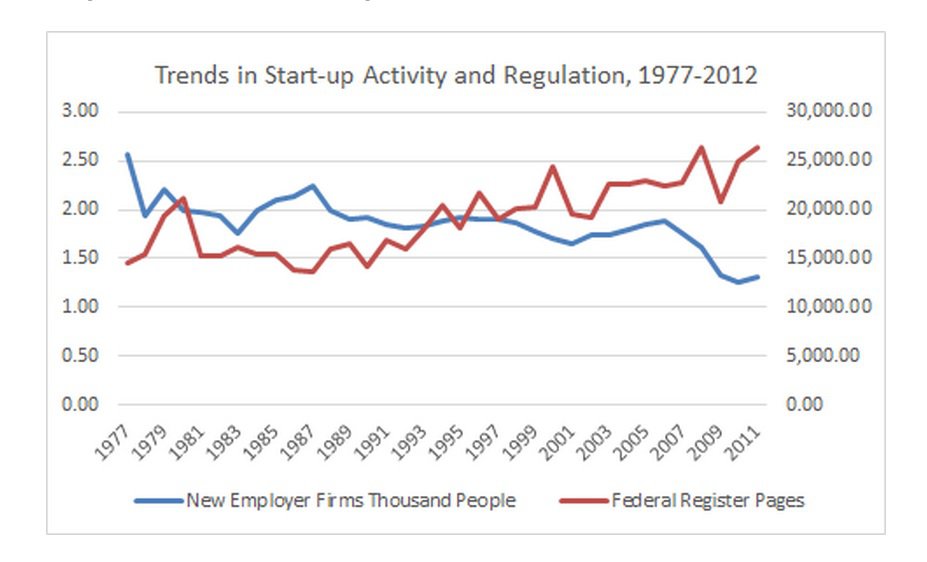
Startups have been on the decline for 30 years, and I have written frequently on some of the possible reasons. One big open question: To what extent is government regulation playing a role in that decline? A blog post by Scott Shane, professor of Entrepreneurial Studies at Case Western Reserve University, offers a few data points that suggest rules and red tape could be hindering business formation. He notes, for instance, small business owners are complaining more about regulation than they have in the past — twice as much as in the 1980s, for instance. And this:

Over the past three-and-a-half decades, federal regulation has been rising, while new business creation has been falling, as the chart above indicates. Researchers at the Ewing Marion Kauffman Foundation, the Hudson Institute, the Hoover Institution and the Heritage Foundation believe the pattern is more than a coincidence. The per capita rate of new employer business creation and number of rules pages in the Federal Register — a common measure of the scope of federal regulation — correlate -0.67 over the 1977 to 2012 period. Similarly, the per capita rate of business creation and the number of pages in the Code of Federal Regulation — another frequently used estimate of government rulemaking — correlate -0.78 over the same period. (A correlation of 1.00 means that two numbers move in perfect concert.)

Correlation may not prove correlation, but it can provide a helpful lead on where to look for the problem.

Trump’s focus seems to be to get job creation started again by lifting the tax and regulatory burdens on those who create jobs. That’s a very different focus than his predecessor.

Stop telling women that God will give them a husband later if they delay marriage now

Man helping a woman with proper handgun marksmanship

Dalrock blogged a splendid post about people who claim that there is a shortage of “good men”. He says that if there really were a shortage of good men, then people who want women to actually get married would be telling women not to delay marriage, but to instead get serious about marrying early, when their ability to attract a man is at its peak.

Dalrock writes:

We can see the same pattern in Dr. John Piper’s recent post Why Are Women More Eager Missionaries?*  Piper explains that missionary work has become a pink ghetto:

…the actual situation among most evangelical faith missions is that between 80–85% of all single missionaries are women. It is a rare thing, like two out of every ten, for a single man to make missions his life’s vocation, which results in the overall statistics being that one-third of those in evangelical world missions are married men, one-third are married women, and 80 percent of the last third are single women. Which means that something just less than two-thirds of the total missionary force are women.

Piper’s main concern with the post however is not that there aren’t enough single men doing missionary work, but that women who choose this field aren’t marrying as they would like.  Piper complains that the problem for husband hunting missionary women is really an exacerbated version of the same problem all Christian women have, and that is an overall lack of marriageable Christian men…

I’ll save you the quotation of Piper, but his reason why missionary women struggle to find husbands is – SHOCK! – that Christian men refuse to man up. I.e – Piper believes that there are not enough marriage-ready, marriage-minded men.

More:

But if Piper actually believed… that there was a severe shortage of husband material men, he would focus his attention on helping the women reading navigate this incredibly difficult situation.  Overseas mission work may feel empowering for young women, but (according to Piper) single women going into the mission field are greatly handicapping their prospects in an already bleak field.  His advice to young women would be to choose which was truly more important to them, being a missionary or finding a husband.

If Piper really believed that there were a shortage of marriage-minded, marriage-capable Christian men, then Piper would be counseling women who genuinely want to marry to make marriage a priority when they are younger, prettier and more fertile. Some women say that they want to get married “some day”, but the truth is that they want fun and thrills until they get tired of it, and they just expect a suitable man to show up right when they need one – even if the things a man wants in a woman are all gone.

So who is to blame if missionary women can’t find husbands?

Piper even tells a story which would be a perfect way to teach this lesson.  He describes a single woman named Gladys Aylward who went to a place where she found no marriageable men, and then blamed single men for not following her and proposing marriage:

“Miss Aylward talked to the Lord about her singleness. She was a no-nonsense woman in very direct and straightforward ways and she asked God to call a man from England, send him straight out to China, straight to where she was, and have him propose to me.” I can’t forget the next line. Elisabeth Elliot said, “With a look of even deeper intensity, she shook her little bony finger in my face and said, ‘Elisabeth, I believe God answers prayer. And he called him.’” And here there was a brief pause of intense whisper. She said, “‘He called him, and he never came.’”

Now, that experience, I would guess, is not unique to Gladys Aylward.

If Piper really believed that Christian husbands were scarce, he would be sharing this anecdote to warn young women of the foolishness of moving away from the pool of men they hope to choose a husband from and then expecting God to send the man of their choosing across the world to propose.  If we were in a culture of scarcity of good men, this would be the obvious lesson from this story.  But we live in an age with unshakable confidence that good men are not only available all around us, but will always be abundant.  If Piper believed that the husband Miss Aylward was praying for was surrounded by real life English women eager to win him as a husband, this story wouldn’t be complaining about why he didn’t drop everything, fly to China, and propose to a woman he had never met.  If Piper believed that the man was sought after as a husband in England, he would be pointing out the foolishness of Miss Aylward flying off to China and then wondering why a man she had never met didn’t show up to propose once she decided she wanted to marry.

Now to be fair, in Miss Aylward’s case, she almost certainly did a lot more good as a missionary than she would have achieved with a marriage. She was not pursuing fun and thrills, she really was making a difference. Still, it was neither rational nor prudent to think that the odds of meeting a Christian man were very good in China. She either needed to accept that being a missionary in a secular country meant not marrying, or she needed to focus on marriage first when she was attractive to men as a life partner. (Many women are propositioned for sex as they age, but few of them are asked to marry) As homeschooling mom “That Mom” points out on her blog, having an influence through marriage and parenting is not compatible with the irresponsible thrill-seeking hedonism championed by impractical pastors like Francis Chan.

But some missionaries really are delaying marriage for frivolous reasons. The 33-year-old missionary woman I know keeps telling all her advisers that she wants to get married “some day”. Her last two boyfriends were both penniless students in their late 20s, who had never worked a full-time job in their entire lives. She feels that there is no need to prepare herself for the roles of wife and mother, either. Her negative $20,000 net worth? No problem. The 5-year gap in her resume? No problem. Her chorus of advisers tell her that God will give her a husband right on cue. A husband who won’t insist that a wife have chastity, sobriety, self-control, financial responsibility, beauty or fertility.

What men want in a wife and mother apparently has no importance whatsoever to women today. And women have no appreciation of how investing in a husband early causes him to be loyal to her when she is older. Women think that a husband will show up when she is ready, and be loyal to her even though she was absent during the hardships of the first decade of his career. Fun and thrills in your 20s are more important than helping a man through the difficult battles of his early career. Just show up when you are 35 -unchaste, wrinkly and infertile – and reap the rewards of his unassisted earning and saving.

Why do men like John Piper mislead women about the feasibility of their emotion-driven plans? Answer: because they fear women’s reactions to disagreement. Men are easier to criticize than women, because men are trained to take it, and not to show their emotions. Practically speaking, whenever a woman anoints her emotions as God speaking to her, her plan almost never works out. But it takes courage to tell a woman to make plans with her mind, instead of with her feelings.

I expect women today to disrespect male advisers, even those with proven ability, because we live in an age of radical feminism where even Christian women who deny feminism act as if they were radical feminists. But it’s not just men who are disrespected. Many women don’t even respect older women with proven ability (See Titus 2:3-5). They just block experts out and find advisers with no proven ability, but who agree with them.

By the way, for an explanation of why men prefer not to be missionaries, read this post on Deeper Strength blog.