Category Archives: News

All six Democrat senators running for president in 2020 vote against bill to ban infanticide

Wil Trump remember how Democrats voted during his re-election campaign?

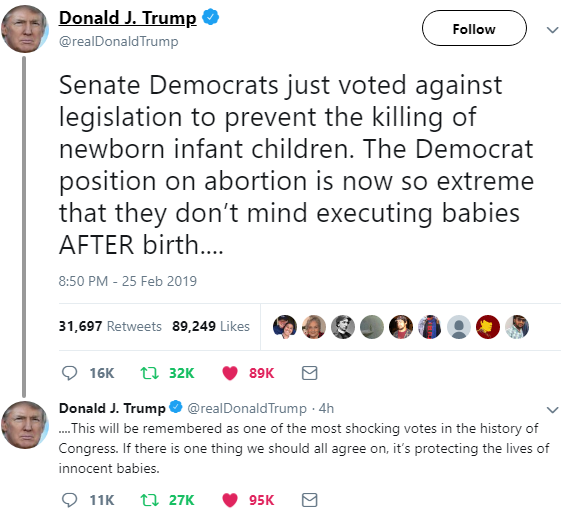
Republicans introduced a bill in the Senate to require that doctors must provide medical care to babies BORN ALIVE during an abortion. There were 50 Republicans present for the vote. All 50 supported the bill. But 44 out 47 Democrats present voted for infanticide, including 6 who are running for President in 2020.

Here’s how McConnell introduced the bill: (H/T Pulpit & Pen)

But first, in a few hours the Senate will vote on advancing a straight-forward piece of legislation to protect newborn babies.

This legislation is simple. It would simply require that medical professionals give the standard care and treatment to newborn babies who have survived an attempted abortion as any other newborn baby would receive in any other circumstances.

It isnt about new restrictions on abortion. It isn’t about changing options available to women. It’s just about recognizing that a newborn baby is a newborn baby, period.

This Bill would make clear that in the United States of American, in the year 2019, the medical professionals on-hand when a baby is born alive need to maintain their basic ethical and professional responsibilities to that newborn.

It would make sure our laws reflect the fact that the human rights of newborn boys and girls are innate. They don’t come and go based on whatever the circumstances. If that medical professional comes face-to-face with a baby who’s been born alive, they are looking at a human being with human rights, period.

So how did it go? Well, all the Republicans in the Senate voted for it. And none of them voted against it. The bill failed, though. It failed because 44 Democrat senators voted against it, and it needs 60 votes to pass.

What I think is interesting from a strategic point of view is that 6 of the 44 senators who voted against it are running for President.

Here are the 6, maybe 7, Democrat senators running for President:

  • Cory Booker
  • Kirsten Gillibrand
  • Kamala Harris
  • Amy Klobuchar
  • Elizabeth Warren
  • Bernie Sanders
  • Sherrod Brown (maybe)

If one of those candidates ends up being the Democrat nominee, Trump will be able to use their vote on this infanticide bill in debates and in election ads.

And it’s not just these Democrat Presidential candidates – infanticide is now the mainstream view of most Democrat politicians.

Life News reports that more states are introducing legislation to remove all restrictions on abortion:

New York, Vermont, New Mexico and now Rhode Island politicians are pushing radical pro-abortion legislation that could legalize the killing of unborn babies for basically any reason up to birth in their states.

Earlier this week, Rhode Island lawmakers introduced legislation to keep abortion legal and unrestricted if the U.S. Supreme Court overturns Roe v. Wade, the AP reports.

It was just New York, Virginia, Rhode Island, New Mexico and Vermont at the end of January.

But in February, Illinois can be added to the list:

“The Democratic supermajority’s proposals now pending in the Illinois General Assembly are the most pro-abortion legislative measures of their type in the country,” said Peter Breen, Vice President and Senior Counsel for the Thomas More Society, and former Illinois House Minority Floor Leader. “The barbaric procedures promoted by this legislation are nothing short of infanticide. These bills go well beyond the recent New York law and would turn Illinois into a third-trimester abortion destination and an underage abortion haven.”

Will Democrat voters get on board with infanticide? I think some of their liberal special interest groups will. But think about how independents supported Trump’s opposition to infanticide in his State of the Union speech. I think that the Democrats are being forced to move their party too far to the left to win another election. All it takes is for pro-lifers to introduce legislation, have them vote on it, and then make the appropriate election ads.

No one can win a presidential by appealing only to their base. It comes down to who wins the independents. Trump is now the moderate candidate on social issues. The Democrats are pro-abortion extremists. They won’t win a majority of independents in a general election. They’ve just slid too far to the left.

Are Mormon doctrines supported by philosophy, science and history?

A conflict of worldviews

This post presents evidence against Mormonism/LDS in three main areas. The first is in the area of science. The second is in the area of philosophy. And the third is in the area of history.

The scientific evidence

First, let’s take a look at what the founder of Mormonism, Joseph Smith, believes about the origin of the universe:

“The elements are eternal. That which had a beggining will surely have an end; take a ring, it is without beggining or end – cut it for a beggining place and at the same time you have an ending place.” (“Scriptural Teachings of the Prophet Joseph Smith”, p. 205)

“Now, the word create came from the word baurau which does not mean to create out of nothing; it means to organize; the same as a man would organize materials and build a ship. Hence, we infer that God had materials to organize the world out of chaos – chaotic matter, which is element, and in which dwells all the glory. Element had an existance from the time he had. The pure principles of element are principles which can never be destroyed; they may be organized and re-organized, but not destroyed. They had no beggining, and can have no end.”
(“Scriptural Teachings of the Prophet Joseph Smith”, p. 395)

A Mormon scholar named Blake Ostler summarizes the Mormon view in a Mormon theological journal:

“In contrast to the self-sufficient and solitary absolute who creates ex nihilo (out of nothing), the Mormon God did not bring into being the ultimate constituents of the cosmos — neither its fundamental matter nor the space/time matrix which defines it. Hence, unlike the Necessary Being of classical theology who alone could not not exist and on which all else is contingent for existence, the personal God of Mormonism confronts uncreated realities which exist of metaphysical necessity. Such realities include inherently self-directing selves (intelligences), primordial elements (mass/energy), the natural laws which structure reality, and moral principles grounded in the intrinsic value of selves and the requirements for growth and happiness.” (Blake Ostler, “The Mormon Concept of God,” Dialogue: A Journal of Mormon Thought 17 (Summer 1984):65-93)

So, Mormons believe in an eternally existing universe, such that matter was never created out of nothing, and will never be destroyed. But this is at odds with modern cosmology.

The Big Bang cosmology is the most widely accepted cosmology of the day. It denies the past eternality of the universe. This peer-reviewed paper in an astrophysics journal explains. (full text here)

Excerpt:

The standard Big Bang model thus describes a universe which is not eternal in the past, but which came into being a finite time ago. Moreover,–and this deserves underscoring–the origin it posits is an absolute origin ex nihilo. For not only all matter and energy, but space and time themselves come into being at the initial cosmological singularity. As Barrow and Tipler emphasize, “At this singularity, space and time came into existence; literally nothing existed before the singularity, so, if the Universe originated at such a singularity, we would truly have a creation ex nihilo.”

[…]On such a model the universe originates ex nihilo in the sense that at the initial singularity it is true that There is no earlier space-time point or it is false that Something existed prior to the singularity.

Christian cosmology requires such a creation out of nothing, but this is clearly incompatible with what Mormons believe about the universe. The claims about the universe made by the two religions are in disagreement, and we can test empirically to see who is right, using science.

Philosophical problems

Always Have a Reason contrasts two concepts of God in Mormonism: Monarchotheism and Polytheism. It turns out that Mormonism is actually a polytheistic religion, like Hinduism. In Mormonism, humans can become God and then be God of their own planet. So there are many Gods in Mormonism, not just one.

Excerpt:

[T]he notion that there are innumerable contingent “primal intelligences” is central to this Mormon concept of god (P+M, 201; Beckwith and Parrish, 101). That there is more than one god is attested in the Pearl of Great Price, particularly Abraham 4-5. This Mormon concept has the gods positioned to move “primal intelligences along the path to godhood” (Beckwith and Parrish, 114). Among these gods are other gods which were once humans, including God the Father. Brigham Young wrote, “our Father in Heaven was begotten on a previous heavenly world by His Father, and again, He was begotten by a still more ancient Father, and so on…” (Brigham Young, The Seer, 132, quoted in Beckwith and Parrish, 106).

[…]The logic of the Mormon polytheistic concept of God entails that there is an infinite number of gods. To see this, it must be noted that each god him/herself was helped on the path to godhood by another god. There is, therefore, an infinite regress of gods, each aided on his/her path to godhood by a previous god. There is no termination in this series. Now because this entails an actually infinite collection of gods, the Mormon polytheistic concept of deity must deal with all the paradoxes which come with actually existing infinities…

The idea of counting up to an actual infinite number of things by addition (it doesn’t matter what kind of thing it is) is problematic. See here.

More:

Finally, it seems polytheistic Mormonism has a difficulty at its heart–namely the infinite regress of deity.

[…]Each god relies upon a former god, which itself relies upon a former god, forever. Certainly, this is an incoherence at the core of this concept of deity, for it provides no explanation for the existence of the gods, nor does it explain the existence of the universe.

Now let’s see the historical evidence against Mormonism.

The historical evidence

J. Warner Wallace explains how the “Book of Abraham”, a part of the Mormon Scriptures, faces historical difficulties.

The Book of Abraham papyri are not as old as claimed:

Mormon prophets and teachers have always maintained that the papyri that was purchased by Joseph Smith was the actual papyri that was created and written by Abraham. In fact, early believers were told that the papyri were the writings of Abraham.

[…]There is little doubt that the earliest of leaders and witnesses believed and maintained that these papyri were, in fact the very scrolls upon which Abraham and Joseph wrote. These papyri were considered to be the original scrolls until they were later recovered in 1966. After discovering the original papyri, scientists, linguists, archeologists and investigators (both Mormon and non-Mormon) examined them and came to agree that the papyri are far too young to have been written by Abraham. They are approximately 1500 to 2000 years too late, dating from anywhere between 500 B.C. (John A. Wilson, Dialogue: A Journal of Mormon Thought, Summer 1968, p. 70.) and 60 A.D. If they papyri had never been discovered, this truth would never have come to light. Today, however, we know the truth, and the truth contradicts the statements of the earliest Mormon leaders and witnesses.

The Book of Abraham papyri do not claim what Joseph Smith said:

In addition to this, the existing papyri simply don’t say anything that would place them in the era related to 2000BC in ancient Egypt. The content of the papyri would at least help verify the dating of the document, even if the content had been transcribed or copied from an earlier document. But the papyri simply tell us about an ancient burial ritual and prayers that are consistent with Egyptian culture in 500BC. Nothing in the papyri hints specifically or exclusively to a time in history in which Abraham would have lived.

So there is a clear difference hear between the Bible and Mormonism, when it comes to historical verification.

N.T. Wright: what is the best explanation for the early belief in a bodily resurrection?

Let's investigate the historical facts
Let’s investigate the historical facts

Here’s a lecture from N.T. Wright, whose multi-volume case for the historicity of the bodily resurrection of Jesus seems to be getting a lot of respect from the other side, (although I strongly disagree with his economic and political views, which are progressive). Wright has taught at Cambridge University, Oxford University, Duke University, McGill University, and lectured on dozens of prestigious campuses around the world. He’s published 40 books.

Here’s a video of his case for the resurrection:

You can read an article similar to the lecture here.

N.T. Wright’s historical case for the bodily resurrection of Jesus

Wright basically argues that the resurrection cannot have been a myth invented by the early Christian community, because the idea of the Messiah dying and being bodily resurrected to eternal life was completely unexpected in Jewish theology, and therefore would not have been fabricated.

In Judaism, when people die, they stay dead. At the most, they might re-appear as apparitions, or be resuscitated to life for a while, but then die again later. There was no concept of the bodily resurrection to eternal life of a single person, especially of the Messiah, prior to the general resurrection of all the righteous dead on judgment day.

Wright’s case for the resurrection has 3 parts:

  • The Jewish theological beliefs of the early Christian community underwent 7 mutations that are inexplicable apart from the bodily resurrection of Jesus
  • The empty tomb
  • The post-mortem appearances of Jesus to individuals and groups, friends and foes

Here’s the outline of Wright’s case:

The Christian claim from the beginning was that the question of Jesus’s resurrection was a question, not of the internal mental and spiritual states of his followers a few days after his crucifixion, but about something that had happened in the real, public world.

This “something” left not only an empty tomb, but a broken loaf at Emmaus and footprints in the sand by the lake among its physical mementoes. It also left his followers with a lot of explaining to do, but with a transformed worldview which is only explicable on the assumption that something really did happen, even though it stretched their existing worldviews to breaking point.

What I want to do here is to examine this early Christian claim, to ask what can be said about it historically, and to enquire, more particularly, what sort of “believing” we are talking about when we ask whether we – whether “we” be scientists or historians or mathematicians or theologians – can “believe” that which “the resurrection” actually refers to.

And here are the 7 mutations:

  1. Christian theology of the afterlife mutates from multiples views (Judaism) to a single view: resurrection (Christianity). When you die, your soul goes off to wait in Sheol. On judgment day, the righteous dead get new resurrection bodies, identical to Jesus’ resurrection body.
  2. The relative importance of the doctrine of resurrection changes from being peripheral (Judaism) to central (Christianity).
  3. The idea of what the resurrection would be like goes from multiple views (Judaism) to a single view: an incorruptible, spiritually-oriented body composed of the material of the previous corruptible body (Christianity).
  4. The timing of the resurrection changes from judgment day (Judaism) to a split between the resurrection of the Messiah right now and the resurrection of the rest of the righteous on judgment day (Christianity).
  5. There is a new view of eschatology as collaboration with God to transform the world.
  6. There is a new metaphorical concept of resurrection, referred to as being “born-again”.
  7. There is a new association of the concept of resurrection to the Messiah. (The Messiah was not even supposed to die, and he certainly wasn’t supposed to rise again from the dead in a resurrected body!)

There are also other historical puzzles that are solved by postulating a bodily resurrection of Jesus.

  1. Jewish people thought that the Messiah was not supposed to die. Although there were lots of (warrior) Messiahs running around at the time, whenever they got killed, their followers would abandon them. Why didn’t Jesus’ followers abandon him when he died?
  2. If the early Christian church wanted to communicate that Jesus was special, despite his shameful death on the cross, they would have made up a story using the existing Jewish concept of exaltation. Applying the concept of bodily resurrection to a dead Messiah would be a radical departure from Jewish theology, when an invented exaltation was already available to do the job.
  3. The early church became extremely reckless about sickness and death, taking care of people with communicable diseases and testifying about their faith in the face of torture and execution. Why did they scorn sickness and death?
  4. The gospels, especially Mark, do not contain any embellishments and “theology historicized”. If they were made-up, there would have been events that had some connection to theological concepts. But the narratives are instead bare-bones: “Guy dies public death. People encounter same guy alive later.” Plain vanilla narrative.
  5. The story of the women who were the first witnesses to the empty tomb cannot have been invented, because the testimony of women was inadmissible under almost all circumstances at that time. If the story were invented, they would have invented male discoverers of the tomb. Female discovers would have hampered conversion efforts.
  6. There are almost no legendary embellishments in the gospels, while there are plenty in the later gnostic forgeries. No crowds of singing angels, no talking crosses, and no booming voices from the clouds.
  7. There is no mention of the future hope of the general resurrection, which I guess they thought was imminent anyway.

To conclude, Wright makes the argument that the best explanation of all of these changes in theology and practice is that God raised Jesus (bodily) from the dead. There is simply no way that this community would have made up the single resurrection of the Messiah – who wasn’t even supposed to die – and then put themselves on the line for that belief.

And remember, the belief in a resurrected Jesus was something that the earliest witnesses could really assess, because they were the ones who saw him killed and then walking around again after his death. They were able to confirm or deny their belief in the resurrection of Jesus based on their own personal experiences with the object of those beliefs.