UK police can’t investigate sex-trafficking because it’s racist
I’ve blogged before about many of the different sex-trafficking rings run by men of Middle Eastern origin in the UK. The UK is a socialist country where the government has been taken over by “compassion” as the core value. As a result, the leaders are anxious to expose their citizens to higher taxes and crime as they take in more and more low-skilled immigrants from the Middle East.
Six men have each been jailed for up to 15 years over the rape of young girls in Huddersfield, West Yorkshire.
Usman Ali, 34, Gul Riaz, 43, Banaras Hussain, 39, Abdul Majid, 36, and two others who could not be named for legal purposes were jailed for a combined 55-and-a-half years on Wednesday.
They were found guilty of a total of nine counts of rape and two counts of indecent assault of two girls in the Huddersfield area between 1995 and 2011.
The victims… were aged 13 and 14 when the “insidious and persistent” abuse began…
It was the sixth trial related to West Yorkshire Police’s Operation Tendersea investigation – a probe into child grooming gangs in Huddersfield.
A total of 34 men have been convicted in the investigation, with prison sentences now totalling 377-and-a-half years.
As you know, about a dozen similar gangs have been found in the UK. What’s interesting is that the same UK police force that investigates offensive speech on social media isn’t interested in prosecuting older men who rape teenage girls and traffic them to other men. That’s because the same political correctness / compassion that makes offensive free speech bad also makes sex-trafficking by Middle Eastern men good. It would be racism to charge these men for raping teens.
And there won’t be any change in these priorities.
The government is refusing to release official research on the characteristics of grooming gangs, claiming it is not in the “public interest”.
Survivors accused ministers of making “empty promises”, while a man who prosecuted abusers in Rochdale called for the Home Office to “show some courage and publish” its findings.
It comes after The Independent revealed that almost 19,000 suspected child sexual exploitation victims were identified by local authorities in just one year, sparking renewed calls for prevention efforts.
Sajid Javid promised the review as home secretary in July 2018, pledging that there would be “no no-go areas of inquiry”.
“I will not let cultural or political sensitivities get in the way of understanding the problem and doing something about it,” he said at the time.
“We know that in these recent high profile cases, where people convicted have been disproportionately from a Pakistani background.
“I’ve instructed my officials to explore the particular contexts and characteristics of these types of gangs.”
But the government has made no further announcements on the review following Mr Javid’s move to the Treasury last year.
Oh well. I guess 19,000 victims of child sexual exploitation is no big deal to the Labour Party politicians who arranged for the immigration of the men who raped them. But look on the bright side! At least these low-skilled immigrants vote overwhelmingly for socialism. So there’s that.
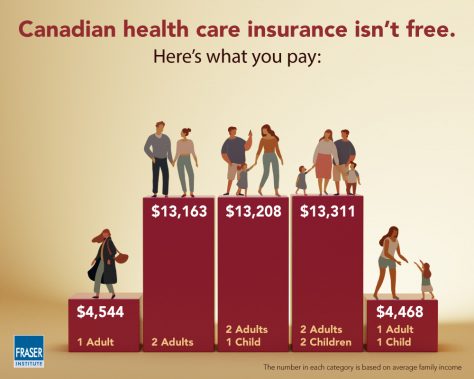
Price of healthcare per Canadian household (Source: Fraser Institute)
I post a lot of research from Canada’s Fraser Institute, but they are not the only think tank that publishes research on the efficiency and costs of single payer health care in Canada. This time, I found a report from the Heritage Foundation, where they go over quality of care, taxes, out of pocket costs, coverage, rationing, waiting lists, staff shortages, substandard equipment, and outdated drugs.
Canadians pay slightly less in out of pocket costs:
The OECD calculates that Canadians spend 1.6 percent of GDP on out-of-pocket health spending, compared to 1.9 percent in the U.S.
[…]While these numbers are very close, they are actually getting closer. Since 1970, U.S. out-of-pocket spending as a percentage of total medical spending has been falling steadily, from 33 percent in 1970 to about 10 percent in 2017.19
Meanwhile, Canadian out-of-pocket spending has been falling much slower, so that by 2016 it totaled 15 percent of total medical spending—a higher proportion than in the U.S.20
As a result, Statistics Canada warned in early 2020 that the percentage of Canadians experiencing large out-of-pocket burdens is growing, writing that “[b]etween 1998 and 2009…the percentage of households spending more than 10% of their total after-tax income on health care rose by 56%.”
Canadians pay more in federal and state taxes:
Federal taxation excluding social security contributions, then, comes to 28 percent of GDP in Canada, compared to just 19 percent in the U.S.—meaning 51 percent more.
[…]This excess taxation is largely a result of health spending, which has bloated provincial budgets to nearly three times the taxes of U.S. states.
Provincial taxes have grown to nearly the same level as federal taxation. Meanwhile, provincial health costs have risen to fully 37 percent of provincial budgets in 2016—up from 33 percent in 1993 – —and range as high as 42 percent.
Canada’s Fraser Institute has estimated this excess tax burden from public health costs at roughly $9,000 for a household of two adults with or without children or $750 per month in additional taxes.
When I wanted an MRI I was scheduled the same week
Canadians wait far longer for treatment than Americans:
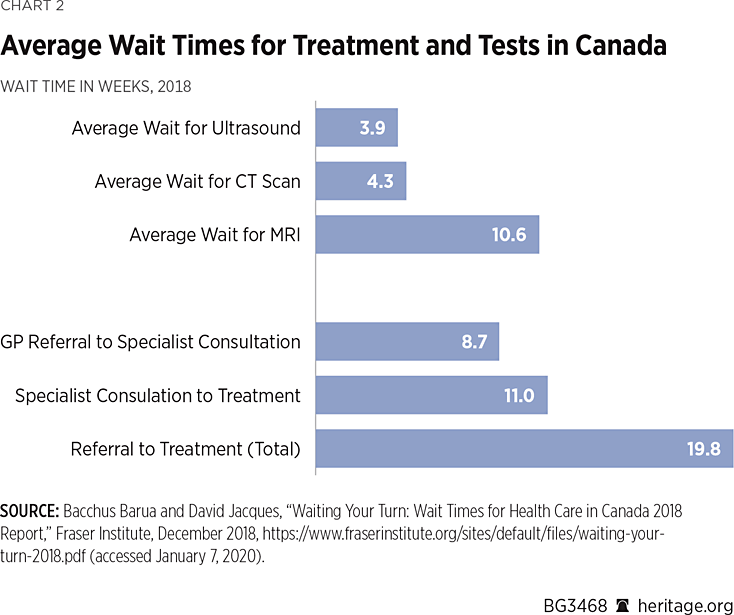
Medical waiting times have become a national crisis in Canada, and continue to worsen. The average wait time for medically necessary treatment between referral from a general practitioner and a consultation with a specialist was 8.7 weeks in 2018, 136 percent longer than in 1993. Patients then have to wait again between seeing the specialist and the actual treatment, another 11 weeks on average, 97 percent longer than in 1993.
From referral to treatment, then, it takes an average of 19.8 weeks (see Chart 2) to be treated, in addition to the original wait to see the family doctor in the first place—this for “medically necessary” treatment, not cosmetic surgery.
In contrast, nearly 77 percent of Americans are treated within four weeks of referral, and only 6 percent of Americans report waiting more than two months to see a specialist.
As for appointments, a 2017 survey of American physicians in the 15 largest U.S. cities found that it took just 24 days on average to schedule a new-patient physician appointment, including 11 days for an orthopedic surgeon and 21 days for a cardiologist.
As a result of these long waits, by one recent estimate, at any given moment, over one million Canadians—3 percent of the entire population—are waiting for a medical treatment.
These lists can average six months, and often much longer in rural areas, which tend to suffer from doctor shortages so severe that many do not even have a family doctor. Overall, 15 percent of Canadians did not have a regular health care provider in 2017.
The shortages ripple through the system; one doctor in Ontario called in a referral to the local hospital, only to be told there was a four-and-a-half year wait to see a neurologist.
In Canada, people die or become inoperable on waiting lists:
A Montreal man was finally called for his long-delayed urgent surgery two months after he had died. One 16-year-old boy in British Columbia waited three years for an “urgent” surgery, during which time his condition deteriorated so much that he became a paraplegic.
Canadians have to travel abroad to countries with functioning health care systems in order to be treated:
These cases are, unfortunately, not isolated; a survey of specialists found that average wait times exceed what is deemed clinically “reasonable” for fully 72 percent of conditions in Canada. The situation continues to worsen every year: In 1994, the average gap between clinically reasonable delay and actual delay was only four days, and by 2018 had grown to 23 days.
[…]With one million waiting, many Canadians turn in desperation to U.S. health care—the very system some U.S. policymakers propose to transform. In 2017 alone, Canadians made 217,500 trips to other countries for health care, of which 52,500 were to the U.S., paying out of pocket to skip the waiting.
While the average employer-sponsored private insurance plan in Canada covers between 10,000 and 12,000 drugs, most public plans in Canada only cover 4,000. Canada has 35 percent fewer acute care beds than the U.S., and only one-fourth as many magnetic resonance imaging (MRI) units per capita—indeed, it has fewer MRI units per capita than Turkey, Chile, or Latvia.
[…]Some common treatments are simply unavailable to Canadians. For new pharmaceuticals, for example, Canada’s policy of forcing down prices so that American consumers essentially pay for Canada’s research and development has led to years-long delays for Canadian patients.
[…]Cutting corners on facilities and using outdated drugs show up in Canadian mortality rates. Thirty-day in-hospital mortality rates in Canada are 20 percent higher than in the U.S. for heart attacks, and nearly three times the U.S. level for strokes. Cancer age-standardized mortality is 10 percent higher in Canada than in the U.S.—despite far healthier lifestyles.
[…]When it comes to personnel, Canada underspends on medical staff and doctors, ranking 29th out of 33 among high-income countries for doctors per 1,000 population, accounting for a large part of those wait times. Canada has half as many specialist physicians per capita as the U.S.
[…]With such shortages and waiting lists, Canadian emergency rooms are packed. So packed that Canadians sometimes just give up and go home. Of Canadian ER visitors who are seen, 29 percent report wait times of over four hours, three times the U.S. level.
[…]Canadian seniors are 65 percent more likely to have visited the emergency room (ER) four or more times in the past year than American seniors.
Ultimately, nearly 5 percent of Canadian ER visitors end up leaving without ever being treated, giving up on a medical system that is perennially “free” but out of stock at the moment. In one study at two ERs in Alberta, 14 of the 498 walkaways were subsequently hospitalized, and one died within the week.
And keep in mind how things work in a single payer system. You pay up front through your taxes. The harder you work, the more you pay into the system. When you want treatment, you just get in line behind people who never paid one dime into the system – like all those low-skill refugees that Canada imports from Middle Eastern countries to build up the socialist voting bloc.
Female judge (Clinton appointee) rules that man violate his conscience
U.S. District Judge Susan Dlott ruled that professor Nicholas Meriwether had use the preferred pronouns of students instead of the ones that match biological reality.
In a three-page order last week that mostly recited the background of the professor’s First Amendment lawsuit against the taxpayer-funded institution’s compelled-speech policy, the jurist conclusorily alleged that “the manner by which he addressed” a transgender student was not protected speech.
He is being forced to used preferred pronouns, and he is banned from telling anyone that he is being forced:
The Ohio university didn’t just order Meriwether to address transgender student Alena Bruening (left), a biological male, as a woman, but banned the professor from even telling students that he was being compelled to use the student’s preferred pronouns.
The female judge Susan Dlott took the advice of another female judge Karen Litkovitz, who put her own female feelings and intuitions above the law:
Judge Dlott accepted a lengthy “report and recommendation” issued last fall by Magistrate Judge Karen Litkovitz, who determined his practice of addressing students was “pursuant to his official duties as a public employee,” not as a citizen.
Litkovitz had to explain away contrary rulings by her own federal appeals court, the 6th Circuit, to find that gender identity is not a “public concern” whose discussion is covered by the First Amendment in the classroom context.
The student allegedly threatened the professor, but the female dean Roberta Milliken did not think that this was anything to be concerned about, and in fact blamed the male professor for agitating the transgender student:
Bruening allegedly threatened Meriwether, prompting him to ask for security personnel to be near his next class and to report the incident to the dean of students. Roberta Milliken, dean of the College of Arts & Sciences, blamed Meriwether for the incident, he said.
People sometimes ask me what I would do if I met a very good woman. Wouldn’t I marry her? And the answer to that is NO, not because of her, but because of the kind of world that’s been created by brainwashing millions of leftist women to hate men and despise good men who lead.
In my experience, most women don’t form their worldviews by reading non-fiction on their own, and then standing up for their beliefs in discussions. The women I meet mostly read fiction and romance novels. And they form their beliefs just by finding out what will make them feel good and be liked. Most women adapt to the people around them. And in college, that means a lot of atheism, drinking, promiscuity, left-wing activism, etc. And then these damaged leftist women are pushed by affirmative action into positions of power, where they are allowed to rule over men of conscience. These are the women who become teachers, professors, judges, administrators, politicians, etc.
All you have to do is take a look at what women do to men in the universities, the divorce courts, the human rights tribunals, etc. They love to disregard the law and impose their “compassion” on men who are trying to act according to their conscience. It gives them joy to seize the reins of a mans life and compel him to act against his conscience, and then to ban him from expressing what has been done to him, so that others will be warned.
The only rational solution to this change in society is avoid women in general, and rule out marriage entirely. It’s fine to be friends with women who do have a conservative Christian worldview and who are respectful of men. But you can’t get married and start a family in a world where the bitter promiscuous man-hating progressive women are in power. You have to hold on to your ability to walk away from anything that violates your conscience. One day, women who want to get married may start to actively shame the drunken promiscuity, atheism, and socialism of their female peers. At that point, maybe I’ll reconsider.