Prior to certain scientific discoveries, most people thought that the universe had always been here, and no need to ask who or what may have caused it. But today, that’s all changed. Today, the standard model of the origin of the universe is that all the matter and energy in the universe came into being in an event scientists call “The Big Bang”. At the creation event, space and time themselves began to exist, and there is no material reality that preceded them.
So a couple of quotes to show that.
An initial cosmological singularity… forms a past temporal extremity to the universe. We cannot continue physical reasoning, or even the concept of spacetime, through such an extremity… On this view the big bang represents the creation event; the creation not only of all the matter and energy in the universe, but also of spacetime itself.
Source: P. C. W. Davies, “Spacetime Singularities in Cosmology,” in The Study of Time III, ed. J. T. Fraser (Berlin: Springer Verlag ).
And another quote:
[A]lmost everyone now believes that the universe, and time itself, had a beginning at the big bang.
Source: Stephen Hawking and Roger Penrose, The Nature of Space and Time, The Isaac Newton Institute Series of Lectures (Princeton, N. J.: Princeton University Press, 1996), p. 20.
So, there are several scientific discoveries that led scientists to accept the creation event, and one of the most interesting and famous is the discovery of how elements heavier than hydrogen were formed.
Nucleosynthesis: forming heavier elements by fusion
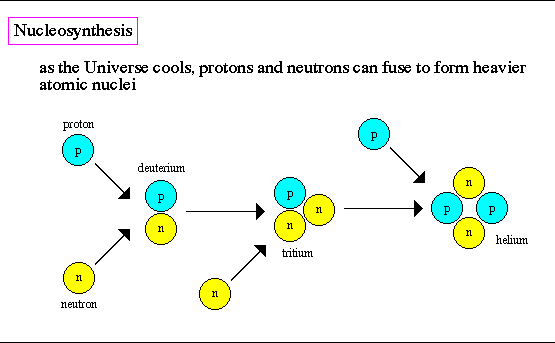
The term nucleosynthesis refers to the formation of heavier elements, atomic nuclei with many protons and neutrons, from the fusion of lighter elements. The Big Bang theory predicts that the early universe was a very hot place. One second after the Big Bang, the temperature of the universe was roughly 10 billion degrees and was filled with a sea of neutrons, protons, electrons, anti-electrons (positrons), photons and neutrinos. As the universe cooled, the neutrons either decayed into protons and electrons or combined with protons to make deuterium (an isotope of hydrogen). During the first three minutes of the universe, most of the deuterium combined to make helium. Trace amounts of lithium were also produced at this time. This process of light element formation in the early universe is called “Big Bang nucleosynthesis” (BBN).
The creation hypothesis predicts that there will be specific amounts of these light elements formed as the universe cools down. Do the predictions match with observations?
Yes they do:
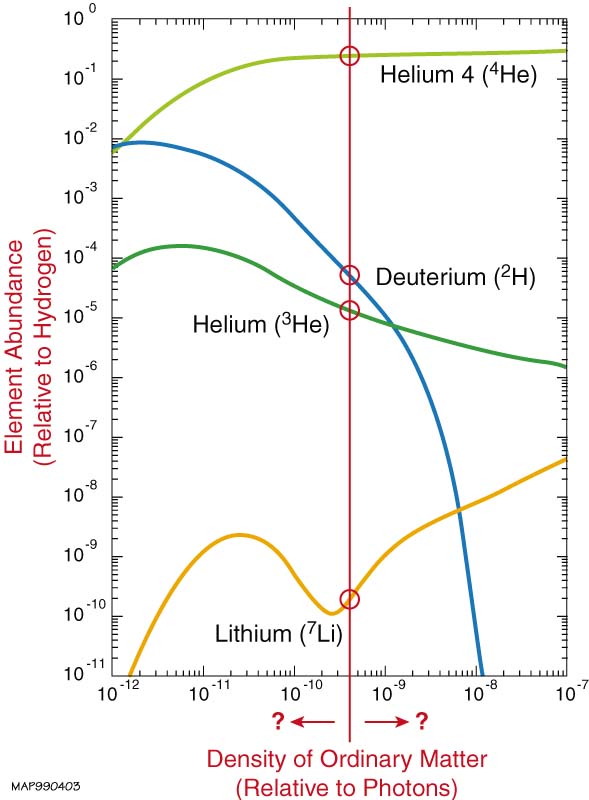
The predicted abundance of deuterium, helium and lithium depends on the density of ordinary matter in the early universe, as shown in the figure at left. These results indicate that the yield of helium is relatively insensitive to the abundance of ordinary matter, above a certain threshold. We generically expect about 24% of the ordinary matter in the universe to be helium produced in the Big Bang. This is in very good agreement with observations and is another major triumph for the Big Bang theory.
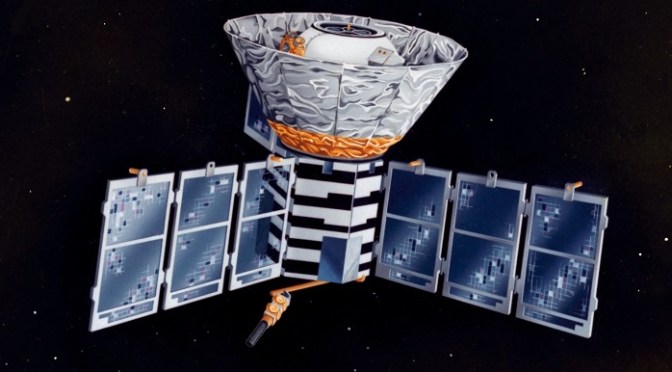
Moreover, WMAP satellite measurements of mass density agree with our observations of these light element abundances.
Here are the observations from the WMAP satellite:
Scientific observations match predictions
And here is how those WMAP measurements confirm the Big Bang creation event:
However, the Big Bang model can be tested further. Given a precise measurement of the abundance of ordinary matter, the predicted abundances of the other light elements becomes highly constrained. The WMAP satellite is able to directly measure the ordinary matter density and finds a value of 4.6% (±0.2%), indicated by the vertical red line in the graph. This leads to predicted abundances shown by the circles in the graph, which are in good agreement with observed abundances. This is an important and detailed test of nucleosynthesis and is further evidence in support of the Big Bang theory.
“An important and detailed test”.
For completeness, we should learn how elements heavier than these light elements are formed:
Elements heavier than lithium are all synthesized in stars. During the late stages of stellar evolution, massive stars burn helium to carbon, oxygen, silicon, sulfur, and iron. Elements heavier than iron are produced in two ways: in the outer envelopes of super-giant stars and in the explosion of a supernovae. All carbon-based life on Earth is literally composed of stardust.
That’s a wonderful thing to tell a young lady when you are on a date: “your body is made of stardust”. In fact, as I have argued before, this star formation, which creates the elements necessary for intelligent life, can only be built if the fundamental constants and quantities in the universe are finely-tuned.
Now, you would think that atheists would be happy to find observations that confirm the origin of the universe out of nothing, but they are not. Actually, they are in denial.
Here’s a statement from the Secular Humanist Manifesto, which explains what atheists believe about the universe:
Religious humanists regard the universe as self-existing and not created.
For a couple of examples of how atheistic scientists respond to the evidence for a cosmic beginning, you can check out this post, where we get responses from cosmologist Lawrence Krauss, and physical chemist Peter Atkins.
You cannot have the creation of the universe be true AND a self-existing, eternal universe ALSO be true. Someone has to be wrong. Either the science is wrong, or the atheist manifesto is wrong. I know where I stand.
Prior to certain scientific discoveries, most people thought that the universe had always been here, and no need to ask who or what may have caused it. But today, that’s all changed. Today, the standard model of the origin of the universe is that all the matter and energy in the universe came into being in an event scientists call “The Big Bang”. At the creation event, space and time themselves began to exist, and there is no material reality that preceded them.
So a couple of quotes to show that.
An initial cosmological singularity… forms a past temporal extremity to the universe. We cannot continue physical reasoning, or even the concept of spacetime, through such an extremity… On this view the big bang represents the creation event; the creation not only of all the matter and energy in the universe, but also of spacetime itself.
Source: P. C. W. Davies, “Spacetime Singularities in Cosmology,” in The Study of Time III, ed. J. T. Fraser (Berlin: Springer Verlag ).
And another quote:
[A]lmost everyone now believes that the universe, and time itself, had a beginning at the big bang.
Source: Stephen Hawking and Roger Penrose, The Nature of Space and Time, The Isaac Newton Institute Series of Lectures (Princeton, N. J.: Princeton University Press, 1996), p. 20.
So, there are several scientific discoveries that led scientists to accept the creation event, and one of the most interesting and famous is the discovery of the cosmic microwave background radiation.
Bell Labs radio astronomers Arno Penzias and Robert Wilson were using a large horn antenna in 1964 and 1965 to map signals from the Milky Way, when they serendipitously discovered the CMB. As written in the citation, “This unexpected discovery, offering strong evidence that the universe began with the Big Bang, ushered in experimental cosmology.” Penzias and Wilson shared the Nobel Prize in Physics in 1978 in honor of their findings.
The CMB is “noise” leftover from the creation of the Universe. The microwave radiation is only 3 degrees above Absolute Zero or -270 degrees C,1 and is uniformly perceptible from all directions. Its presence demonstrates that that our universe began in an extremely hot and violent explosion, called the Big Bang, 13.7 billion years ago.
In 1960, Bell Labs built a 20-foot horn-shaped antenna in Holmdel, NJ to be used with an early satellite system called Echo. The intention was to collect and amplify radio signals to send them across long distances, but within a few years, another satellite was launched and Echo became obsolete.2
With the antenna no longer tied to commercial applications, it was now free for research. Penzias and Wilson jumped at the chance to use it to analyze radio signals from the spaces between galaxies.3 But when they began to employ it, they encountered a persistent “noise” of microwaves that came from every direction. If they were to conduct experiments with the antenna, they would have to find a way to remove the static.
Penzias and Wilson tested everything they could think of to rule out the source of the radiation racket. They knew it wasn’t radiation from the Milky Way or extraterrestrial radio sources. They pointed the antenna towards New York City to rule out “urban interference”, and did analysis to dismiss possible military testing from their list.4
Then they found droppings of pigeons nesting in the antenna. They cleaned out the mess and tried removing the birds and discouraging them from roosting, but they kept flying back. “To get rid of them, we finally found the most humane thing was to get a shot gun…and at very close range [we] just killed them instantly. It’s not something I’m happy about, but that seemed like the only way out of our dilemma,” said Penzias.5 “And so the pigeons left with a smaller bang, but the noise remained, coming from every direction.”6
At the same time, the two astronomers learned that Princeton University physicist Robert Dicke had predicted that if the Big Bang had occurred, there would be low level radiation found throughout the universe. Dicke was about to design an experiment to test this hypothesis when he was contacted by Penzias. Upon hearing of Penzias’ and Wilson’s discovery, Dicke turned to his laboratory colleagues and said “well boys, we’ve been scooped.”7
Although both groups published their results in Astrophysical Journal Letters, only Penzias and Wilson received the Nobel Prize for the discovery of the CMB.
The horn antenna was designated a National Historic Landmark in 1990. Its significance in fostering a new appreciation for the field of cosmology and a better understanding of our origins can be summed up by the following: “Scientists have labeled the discovery [of the CMB] the greatest scientific discovery of the 20th century.”8
It’s the greatest scientific discovery of the 20th century.
In the New York Times, Arno Penzias commented on his discovery – the greatest discovery of the 20th century – so:
The best data we have [concerning the Big Bang] are exactly what I would have predicted, had I nothing to go on but the five books of Moses, the Psalms, the bible as a whole.
Just one problem with the greatest scientific discovery of the 20th century: atheists don’t accept it. Why not?
Here’s a statement from the Secular Humanist Manifesto, which explains what atheists believe about the universe:
Religious humanists regard the universe as self-existing and not created.
For a couple of examples of how atheistic scientists respond to the evidence for a cosmic beginning, you can check out this post, where we get responses from cosmologist Lawrence Krauss, and physical chemist Peter Atkins.
You cannot have the creation of the universe be true AND a self-existing, eternal universe ALSO be true. Someone has to be wrong. Either the science is wrong, or the atheist manifesto is wrong. I know where I stand.
I like to collect studies on my blog so that I can always find them when I get into a debate. One of the things I like to argue against is recreational premarital sex. It’s pretty hard to argue this with non-Christians if all you are going to do is quote the Bible. But you can make a pretty good case that will win you the argument from studies, and so I keep a nice collection of studies to use.
Oral contraceptives raise the risk of depression, according to a new international study that surveyed more than 264,000 women. Teenagers were at the highest risk, with a 130 percent higher risk of depression in women who started using birth control as adolescents, compared to a 92 percent higher risk among those who started as adults.
The study provides conclusive results to a growing body of research linking oral birth control with the use of anti-depressants, depression diagnoses, and depressive symptoms.
While adult users saw a decrease to more normal risk after using “the pill” for more than two years or getting off the pill, teenage users were still at increased risk even after stopping usage.
Very interesting. I clicked on the link to the study and made sure it was peer-reviewed. It was. So what do we learn from this?
Well, this is not the first time I am hearing about the emotional and mental problems with birth control pills. So, I think the lesson here is to definitely do your research first, so that you don’t get involved with things that will cause you problems later. The woman who told me about had tried to go on them, but she immediately noticed how much it changed her moods, and she went off them. I think it caused her some problems in her life, because she ended up taking 5 years to complete her degree, instead of the normal for. So, using these things could really cost you.
Now you might be wondering about other birth control methods, and the team that did this study has a plan for future work:
This study only examined combination birth control pills, but researchers plan to study other contraceptive options.
“In a future study, we plan to examine different formulations and methods of administration. Our ambition in comparing different contraceptive methods is to give women even more information to help them [m]ake well-informed decisions about their contraceptive options,” Johansson said.
The article also notes (with links, which I removed):
In other studies, birth control methods have also been linked to increased risk of heart attack and stroke, blood clots, breast cancer, and cervical cancer.
Despite significant evidence of risk, researchers still insist that birth control is safe to use…
Normally, I am pretty hard on women on this blog. I feel like they make way too many decisions by following the crowd, instead of thinking about what they want in the long-term, and then making decisions that are likely to get those results – whatever anyone else thinks. I think that women need to be smarter than that, and instead of forming their views by peer pressure, they need to form their views based on truth. And truth is not on the bottom shelf.
I see women getting taught all about sexual topics by public school teachers, entertainers, athletes, celebrities, etc. It makes no sense to me. These people are insulated from real life, for one reason or another. And then I see Planned Parenthood going into the schools and teaching children about birth control and sex. They make money by getting these kids to become sexual active and then pay them to get abortions. Young women cannot trust women their own age to know about studies. They can’t trust teachers with degrees in English. They can’t trust celebrities, entertainers and athletes – they probably cannot even read, much less read studies. Women have to do their own research and make their own plans that work for them.
Today women are being taught from preschool to college and beyond, that they need to use their “young years” to seek happiness by playing the field with tall, hot men who give them tingles. They are told to delay marriage (boring) and children (demanding) for as long as possible, in order to have no-commitment sex with the hottest men they can get. Somehow, having sex with a lot of hot men is thought to raise the value of the woman. It builds her self-esteem, or something. This is objectively stupid behavior. But this is why they jump all over birth control, because it helps them to do stupid things that they’ve been told to do. They don’t even know the long-term effects of the behavior they’re doing. It’s monkey-see, monkey-do. The blind leading the blind.
So, I think it’s good for us as grown-ups to point them towards the data that they should know about. They can certainly ignore it, and go with their feelings. But some of them will prefer to get the real truth about how the world works, and those are the ones we need to reach. They should at least have a choice to make.
By the way, I’m not saying that it’s a bad idea to give someone a Bible. I got one when I was young, and that worked for me. But for people who ask questions, you need to have the studies ready. Always be ready for anyone who asks you questions about why you believe what you believe.