Category Archives: News

Draft EPA study: fracking does not cause pollution of drinking water

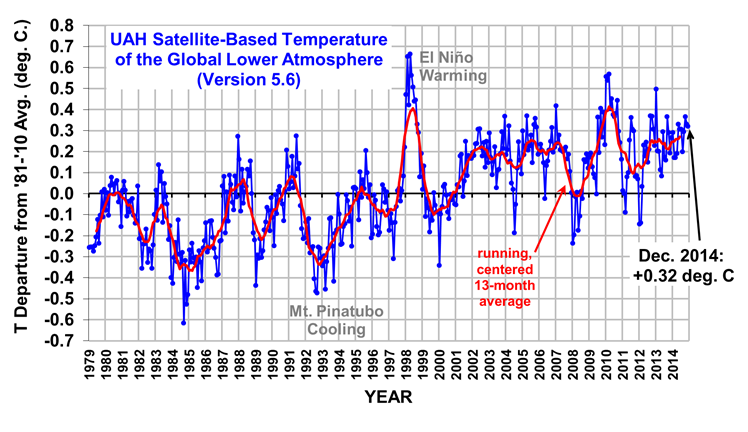
UAH Global Temperature up to 2014

This is reported in the radically leftist National Public Radio, of all places.

Excerpt:

The Environmental Protection Agency says it finds no evidence that hydraulic fracturing — better known as fracking — has led to widespread pollution of drinking water. The oil industry and its backers welcome the long-awaited study while environmental groups criticize it.

“We found the hydraulic fracturing activities in the United States are carried out in a way that has not led to widespread systemic impacts on drinking water resources,” says Tom Burke, Science Advisor and Deputy Assistant Administrator of EPA’s Office of Research and Development. “In fact, the number of documented impacts to drinking water resources is relatively low when compared to the number of fractured wells,” he adds.

The EPA’s draft assessment was conducted at the request of Congress. “It is the most complete compilation of scientific data to date,” says Burke, “including over 950 sources of information, published papers, numerous technical reports, information from stakeholders and peer-reviewed EPA scientific reports.”

Fracking has allowed drillers to tap oil and natural gas reserves once thought off-limits deep underground. That has led to drilling booms across the country and boosted the country’s oil and natural gas production significantly. But environmental groups have long argued fracking comes with a cost to the environment, especially to water. Those groups have called for stronger regulations and even bans on fracking altogether.

[…]The American Petroleum Institute says the conclusions echo what the oil industry has argued all along. “Hydraulic fracturing is being done safely under the strong environmental stewardship of state regulators and industry best practices,” says Erik Milito, API upstream group director.

Acknowledging the potential vulnerabilities outlined in the EPA report, Milito says, “Continuous safety improvements have been an ongoing part of hydraulic fracturing for 65 years.”

Indeed. This is not the first time that the radically leftist EPA has cleared the fracking industry, either. I blogged about the last one for Dimock, Pennsylvania.

Here’s an excerpt from the EPA press release that exonerates fracking:

 The U.S. Environmental Protection Agency announced today that it has completed its sampling of private drinking water wells in Dimock, Pa. Data previously supplied to the agency by residents, the Pennsylvania Department of Environmental Protection and Cabot Oil and Gas Exploration had indicated the potential for elevated levels of water contaminants in wells, and following requests by residents EPA took steps to sample water in the area to ensure there were not elevated levels of contaminants. Based on the outcome of that sampling, EPA has determined that there are not levels of contaminants present that would require additional action by the Agency.

[…]Overall during the sampling in Dimock, EPA found hazardous substances, specifically arsenic, barium or manganese, all of which are also naturally occurring substances, in well water at five homes at levels that could present a health concern. In all cases the residents have now or will have their own treatment systems that can reduce concentrations of those hazardous substances to acceptable levels at the tap. EPA has provided the residents with all of their sampling results and has no further plans to conduct additional drinking water sampling in Dimock.

So, if you want to worry about fracking, it will have to be because of something other than facts.
New report: IRS used hundreds of lawyers to hide IRS persecution of conservatives

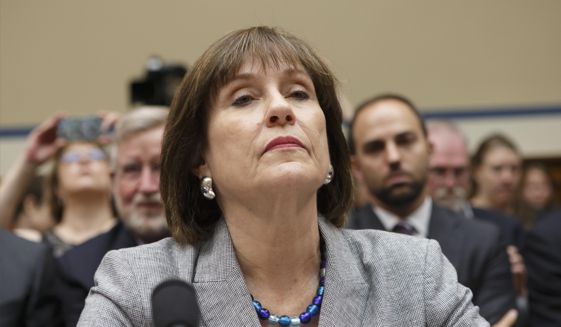
IRS Chief Fascist Lois Lerner

This is from the Washington Times. (H/T ECM)

Excerpt:

The IRS’s director of privacy, governmental liaison and disclosure division testified Wednesday that the tax agency set up a special team with hundreds of lawyers to handle the probe into whether Tea Party groups were targeted, but repeatedly said she had no idea how it operated.

Mary Howard, who also works as the head Freedom of Information Act officer in the IRS, told the House Committee on Oversight and Government Reform that once the “special project team” was created and operational, she never saw requests for information.

“My understanding was that it started soon after the request came from Congress and other investigators asking for documents around this whole issue,” which she surmised meant around spring of 2013.

Asked who was on the team, she said: “My first hand knowledge of that is none.” But she did say the Chief Council of the IRS — one of only two political appointees in the IRS; the other is the commissioner — was on the “special project team,” as were “hundreds of attorneys.”

She said her office did not interact with the White House, but asked whether the “special project team” did, said: “I have no personal knowledge of how that team acted except that I know they amassed hundreds of attorneys to go through the documents and redact them.” 

[…]Congress held Lerner in contempt after she claimed she did not know about the targeting, but then later took the Fifth Amendment to avoid answering questions. She was never prosecuted by the Justice Department, but two dozen House members want new Attorney General Loretta Lynch to pursue charges.

Just to be clear – “go through the documents and redact them” means conceal information from Congressional oversight.

This is the very definition of a cover-up. As if we did not have enough scandals in this administration already. We must be up to about a dozen Watergates already.

The ACLJ notes that this is not the first shifty behaviour from the IRS lawyers – delaying the applications of Tea Party groups for years:

According to multiple IRS attorneys in D.C., including tax law specialist Carter Hull, who oversaw the review of the Tea Party cases, Lois Lerner, former Director at the Exempt Organizations Division, and her top advisor directed that certain Tea Party applications as part of a “test” group be sent to her office and IRS Chief Counsel for review in the winter of 2010-2011.

Chief Counsel’s office, after months more of delay, then demanded Mr. Hull make further inquiries of the Tea Party.  According to the testimony, it was Chief Counsel’s office that was demanding to know more information about the conservative groups’ activities “right before the [2010] election period.  In other words, immediately before.”

In addition, the testimony indicates that the Chief Counsel’s office was heavily involved in preparing a template for handling these cases, something Mr. Hull testified was impractical “because these organizations, all of them are different.  A template wouldn’t work.”  Yet, as he testified, a template was prepared by someone in Chief Counsel’s office in conjunction with other tax law specialists.  Even more disturbing he testified that after three years, IRS Chief Counsel’s office had not made a determination about these “test” Tea Party cases, even though in 2011, Mr. Hull had all the information he needed to make a recommendation as to their request for tax-exempt status.

The ACLJ has an ongoing lawsuit on behalf of many of the conservative / pro-life / Christian groups that were targeted by the IRS. It’s times like this where I wonder what my friend the evangelical woman who voted twice for Obama would say. She is the one who is for environmentalism and big government, you remember. Well, there’s your big government right there, Jessica. Surprise! They don’t like Christians or conservatives.

New study: most Americans have not saved enough for their retirement

Building a castle isn't easy - it takes work
Building a castle isn’t easy – it takes work

This story is from CNBC, and I hope it causes you young people to count the cost of your plans.

It says:

A new GAO analysis finds that among households with members aged 55 or older, nearly 29 percent have neither retirement savings nor a traditional pension plan.

“There hasn’t been a significant increase in wages, people have student loans and other debt, and many are continuing to struggle financially,” said Charles Jeszeck, the GAO’s director of education, workforce and income security, which analyzed the Federal Reserve’s 2013 Survey of Consumer Finances to come up with its estimates. “We aren’t surprised that people have not saved a lot for retirement.”

Even among those who do have retirement savings, their nest eggs are small. The agency found the median amount of those savings is about $104,000 for households with members between 55 and 64 years old and $148,000 for households with members 65 to 74 years old. That’s equivalent to an inflation-protected annuity of $310 and $649 per month, respectively, according to the GAO.

Americans underestimate how much money is needed in order to retire:

Estimates about the size and scope of the retirement savings problem vary widely, the GAO found. In addition to examining the Survey of Consumer Finances, it reviewed nine studies conducted between 2006 and 2015 by a variety of organizations, including academics, benefits consultant Aon Hewitt, the Employee Benefit Research Institute (EBRI) and the Investment Company Institute. Based on these reports, it concluded that one-third to two-thirds of workers are at risk of falling short of their retirement savings targets, in part because of the range of assumptions about how much income is required in retirement.

Given that we have been inflating the currency and running low interest rates for the last few years, any savings you have will buy less than they buy today.

Here’s another really key point:

The research that the GAO examined consistently showed that people aged 55 to 64 are less confident about their retirement and plan to work longer to afford retirement. However, a 2012 study by the EBRI found that about half of retirees said they retired earlier than planned because of health problems, changes at their workplace or having to care for a spouse or another family member. This suggests “that many workers may be overestimating their future retirement income and savings,” wrote GAO researchers.

Got that? When young people make plans about the future, they underestimate the risks and overestimate their own abilities.

Don't rely on Social Security, young snowflakes
Don’t rely on Social Security, precious little snowflakes

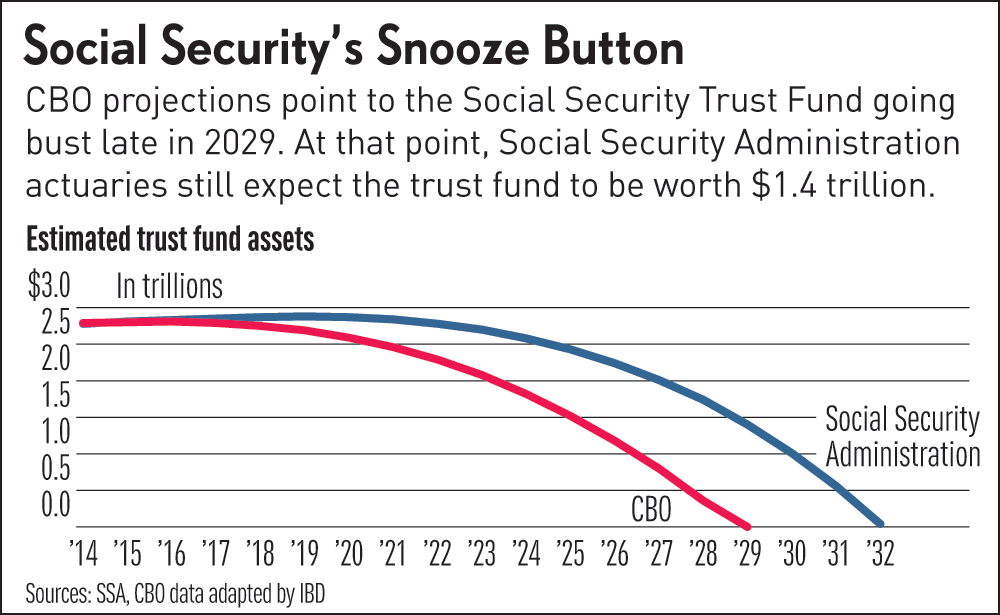
Investors Business Daily has been posting a lot about Social Security, and they are saying that payouts are going to be dropping sooner than you think.

Look:

Every year, the Social Security Administration releases its Trustees Report, which projects the program’s solvency — how much it will take in, how much it will pay out and how long the “trust fund” can cover revenue gaps — over the next 75 years.

The latest report says that Social Security can meet its financial obligations for about 18 more years. After that, the trust fund will be exhausted, and payroll taxes won’t cover nearly all the benefit costs.

That’s bad enough. But a new study by researchers at Harvard and Dartmouth shows that this day of reckoning will almost certainly come far sooner than that.

The authors compare previous Trustees Report forecasts about life expectancy, fertility rates and other variables to actual results. They found that these forecasts have grown increasingly unreliable.

Worse, since 2000 “the direction of the biases are all in the same direction, making the Social Security trust funds look healthier than they turned out to be.”

For example, Social Security has been consistency underestimating life expectancy, which means that people are living and collecting benefits for longer than predicted. Underestimating life expectancy by just 1.3 years leads to 150,000 more people collecting benefits than predicted, the researchers note.

The Trustees Report has also overestimated the nation’s fertility rate. In 2010, for example, 315,000 fewer children were born than predicted. This error makes the population look younger, which in turn makes Social Security’s financial outlook seem healthier.

Likewise, the report has consistently overestimated the Trust Fund’s assets and solvency.

Many of these forecasts are so bad that the actual results are often worse than the report’s “worst case” scenario, which currently has the program becoming insolvent in just 14 years.

Don’t be depending on Social Security if you are under 50 – it’s not going to be there for you, even though you’re going to be paying into it.

When young people imagine what the future will be like, they almost always underestimate the things that can go wrong. They are so optimistic and inexperienced, that they simply can’t conceive of the possible setbacks, and calculate the probabilities of these occurring. The best way to get around this is to talk to someone who is good at doing what you are trying to do. When I was training as a software engineer, I actually had to take classes in software design to learn how to identify unexpected scenarios. This is because engineers start off the same as everyone else – optimistic. We have to train ourselves to identify dependencies and risks. This is how you design software – by thinking not just of common usage scenarios, but also unexpected disaster scenarios, like power failures and data transmission interruptions and database failures. When it comes to earning and saving money, don’t talk to your inexperienced young friends. Talk to someone a little older who has already been through it, and who is doing a good job at it.