Category Archives: News

ADF offers advice on SCOTUS marriage redefinition ruling

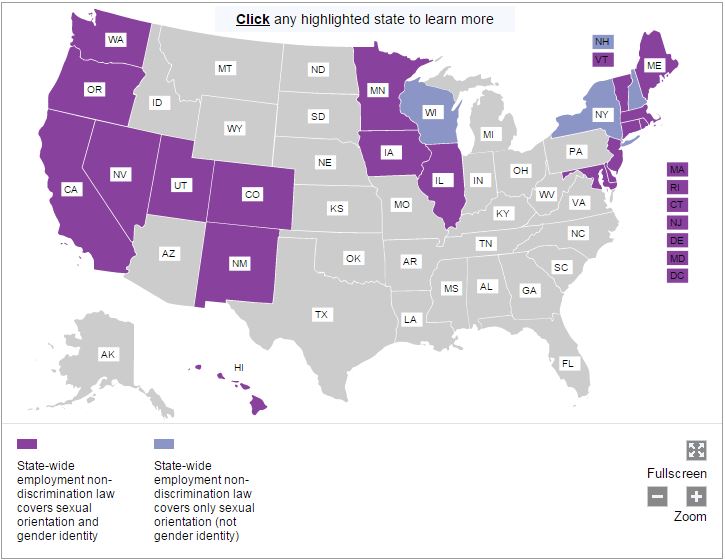
States with non-discrimination laws

(Source: ACLU)

Erik Stanley of the Alliance Defending Freedom offers advice to churches on how to respond to the Supreme Court’s decision to redefine marriage to remove the gender requirement.

He says:

[…][T]he greatest threat for churches lies in the application of the Court’s decision to believers who live in jurisdictions covered by so-called “non-discrimination” laws and ordinances. Everywhere that marriage has been redefined in the last several years has seen an awakening of non-discrimination laws that prohibit discrimination in employment, housing, or places of public accommodation on the basis of sexual orientation or gender identity. These laws are peppered throughout the states and local governments and are a linchpin of the sexual revolution’s broader legal and political strategy: to establish non-discrimination laws at all levels throughout the country and to to “ensure that religion is not used as an excuse to discriminate.”

In coming days, the threat from these non-discrimination laws will materialize in numerous ways as same-sex couples marry. But there are proactive steps your church can take to protect itself.

I put the map from the ACLU above. I think that’s what he is talking about when he says non-discrimination states. Keep in mind that the ACLU supported redefining marriage, and opposes religious liberty.

Erik’s article covers 3 areas:

  1. Church’s statement of faith
  2. Pastors officiating same-sex marriage ceremonies
  3. Church’s facility usage policy

Part 3) was the most interesting to me:

3. Churches should ensure their facilities usage policies are revised to allow only uses consistent with the church’s religious beliefs.

In the wake of the Supreme Court ruling, some churches may be approached by same-sex couples seeking to be married in the church facility. Churches should not feel as if they have to close their doors to the community just to prevent wedding ceremonies with which they disagree. Churches must continue to be a welcoming presence in the community and can do so through updating or revising their facility usage policy. The key point is to tie usage of the church’s facility to the statement of faith and religious beliefs of the church. And then to make clear that uses inconsistent with those religious beliefs will not be allowed. Alliance Defending Freedom has a sample facilities usage policy available in our Protecting Your Ministry manual.

So you update your statement of faith, and then tie usage of the the facility to that statement of faith. Simple.

I took a quick look at the booklet, and it also talked about tying employment within the church and church membership to the statement of faith.

Denny Burk summarizes those:

2. Religious Employment Criteria

Your church can best avail itself of the First Amendment’s protection in employee disputes if you create and faithfully enforce religious employment criteria for every employee. That requires churches to do at least two things: (1) require all employees and volunteers to sign a statement affirming the church’s statement of faith and standards of conduct, and (2) create written job descriptions for every employee and volunteer position.


4. Formal Membership Policy

If your church does not have a membership policy, you need to change that. Biblically, this should already be a priority for your church. You need to specify what the requirements for membership are, how one joins, how one resigns, and the procedures for church discipline. If all of this isn’t spelled out up front, your church could be exposed (see ADF guide pp. 17-18).

So what to make of this? Well, the ADF is an organization that I admire and trust. I cannot abide Christians who do not want to understand the details of what is happening with religious liberty in their country. The ADF has first class lawyers from the top law schools, and they defend religious liberty at every level of our justice system, up to and including the Supreme Court. If you want to help your church protect itself from prosecution, then you must point them to the ADF booklet linked above.

And this is especially true if you are in one of those states in the map above. In looking over the map, I noticed that much of the trouble we have been having with Christian businesses getting sued are in states that have these laws… Oregon, Washington, New Mexico, New York, and so on. Pay attention to that map and make decisions about where to live accordingly.

Supreme Court legislates from the bench to save Obamacare, again!

Obamacare premium increases by state
Obamacare premium increases by state (click for larger image)

Ben Shapiro who is a Harvard Law grad has a good summary of Thursday’s awful Supreme Court decision.

He writes:

On Thursday, the Supreme Court released its long-awaited decision on Obamacare’s IRS subsidies under federal health insurance exchanges. And, as expected, the Court rewrote the statute to help President Obama’s signature law.

[…]In King v. Burwell, four citizens sued over Obamacare, alleging that they had been forced to purchase health insurance; they said that the federal health exchange set up in Virginia in absence of a state-created health exchange under Obamacare did not count as a “state exchange” for purposes of the statute, making it illegal for them to receive federal subsidies for their health insurance. Without the subsidies, they would no longer be required to purchase health insurance, since it would be too expensive.

Now, Obamacare’s language is quite clear: it states that only those who buy insurance via state-run health exchanges may receive federal subsidies. This provision was purposefully designed to incentivize states to set up their own exchanges, in order that politicians could take credit for making health insurance more widely available with the help of the federal government. When states turned down the opportunity to set up such exchanges, the scheme collapsed. Or at least it would have, had not President Obama’s IRS casually rewritten the law, and provided federal health insurance subsidies via the federal health exchanges in violation of both the letter and spirit of the law.

Basically, the Supreme Court judges interpreted “an exchange established by the State” to mean “an exchange established by the State or the Federal Government“. If you think that’s a substantial mistake, you’re right. It’s a complete fabrication, and it amounts to writing legislation on-the-fly to save Obama’s law.

Shapiro again:

Roberts utilized the following logic, direct from the insane asylum:

[W]e must determine whether a Federal Ex- change is “established by the State” for purposes of Section 36B. At the outset, it might seem that a Federal Exchange cannot fulfill this requirement. After all, the Act defines “State” to mean “each of the 50 States and the District of Columbia”—a definition that does not include the Federal Government. 42 U. S. C. §18024(d). But when read in context, “with a view to [its] place in the overall statutory scheme,” the meaning of the phrase “established by the State” is not so clear.

Then, for page after dreadful page, Roberts and the Court majority torture the statute, declaring that if it floats, state exchanges will be deemed federal exchanges, and if it sinks, federal exchanges will be declared state exchanges.

Apparently, the plain meaning of the text is not so clear to our nine black-robed oligarchs.

Ben quotes Justice Scalia’s dissent:

The Court holds that when the Patient Protection and Affordable Care Act says “Exchange established by the State” it means “Exchange established by the State or the Federal Government.” That is of course quite absurd, and the Court’s 21 pages of explanation make it no less so…. Words no longer have meaning if an Exchange that is not established by a State is “established by the State.” It is hard to come up with a clearer way to limit tax credits to state Exchanges than to use the words “established by the State.” And it is hard to come up with a reason to include the words “by the State” other than the purpose of limiting credits to state Exchanges.

Investors Business Daily says that Obamacare is running into financial struggles. So it’s not just that you can’t keep your doctor, you can’t keep your health plan, and you have to pay thousands more for health insurance. Now we find out that the rosy fiscal projections for the cost of the law were false.

Looks like we are going to be stuck with Obamacare until we get a Republican President. I think that as more people who get their health care through their employers start to feel the premium pain that self-employed people have already felt. That may be useful for the 2016 election, especially since Hillary has already thrown her support behind Obamacare. Maybe when people are paying double what they used to pay for half as much coverage, then they’ll understand why we do not want government involved in the health care industry.

Is it better to be liked than respected?

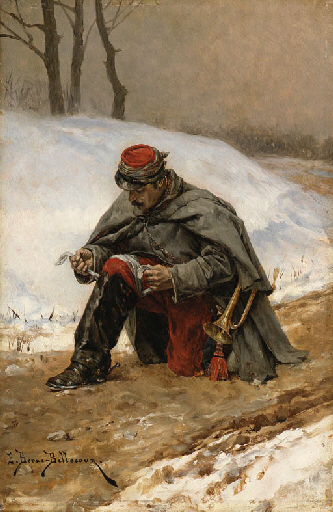
Étienne Prosper Berne-Bellecour - The wounded soldier
Étienne Prosper Berne-Bellecour – The wounded soldier

As soon as I saw the title of this post from Cold Case Christianity, I knew it would be significant to me.

J. Warner Wallace writes:

Popularity often requires agreement. It’s easy to like people who hold the same opinions and values. It’s not really surprising, therefore, that many of us, in an effort to be liked, try to find a way to come to agreement with the people around us. And that’s where the trouble usually starts. There are two ways to form agreement:

1. Influence others toward our position, or
2. Simply embrace the positions of others

We can try to move them toward us, or we can simply move toward them. One of these strategies will ensure our likability but the other is the path to respect.

[…]We want our kids to influence others rather than allow their friends to influence them, don’t we? While it may be easy to embrace the beliefs of others to gain approval, we know the courageous path requires us to point others to the truth, even when it’s inconvenient or unpopular. It’s time for the Church to take this second path. We’ve spent far too much time trying to become like the world in order to win its acceptance, rather than having the moral courage to make the case for what we believe. Only this second way will win the respect of those around us. I want to hear people say, “Jim, I don’t agree with you at all, but I respect the fact that you’ve tried to be thoughtful about your position and you were kind to me along the way.” That’s the kind of reaction I’m looking for.

Recently, I had to make a hard choice about whether to agree with someone else, or tell her the truth. I found myself discussing education, career and finances with a young lady. I was telling her about the likely consequences of some of the choices that she was making that were related to one of the two areas that I actually know something about. (The other area is apologetics, and she already knows lots about that)

I gave her some advice based on my understanding of these things – from my experience. There was no doubt that when it came to these areas, I had more experience than she did, and more results to show for my past decisions in those areas. But I could feel her slipping away the more evidence I showed her. She preferred to listen to people who agreed with what her feelings were telling her. Eventually, I lost her. But there was nothing else I could do. I spoke the truth based on what I knew and experienced myself in those areas. I wouldn’t have given her advice in many other areas where she knew much more than I did – just in this one, where I actually knew what I was talking about.

Fortunately other young people do take my advice in those areas, and it does work out well for them. But for me to tell them what they don’t want to hear does take courage. And sometimes, you end up losing someone close who just doesn’t believe that you know what you are talking about. So I would say that telling the truth and pointing to evidence does not always get you respect for what you know about. It gives you a chance of being respected.

By the way, I could still be proven wrong with that lady I was advising. It’s happened before. I think I told her the truth, and I hope one day she will see that.