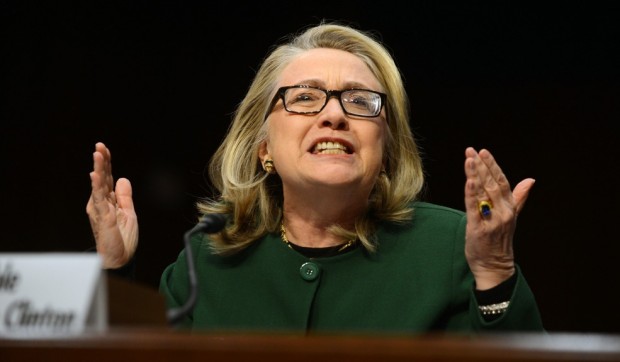
What difference does national security make? Rules do not apply to Queen Hillary!
This article from the leftist Associated Press was posted at The Stream, and it’s sure to be the big story today.
Excerpt:
Hillary Rodham Clinton relented Tuesday to months of demands she relinquish the personal email server she used while secretary of state, directing the device be given to the Justice Department.
The decision advances the investigation into the Democratic presidential front-runner’s use of a private email account as the nation’s top diplomat, and whether classified information was improperly sent via and stored on the home-brew email server she ran from her house in suburban New York City.
There were classified e-mails:
Republicans jumped on Tuesday’s decision to change course, as well as the additional disclosure that two emails that traversed Clinton’s personal system were subsequently given one of the government’s highest classification ratings.
[…]Word that Clinton had relented on giving up possession of the server came as Republican Sen. Chuck Grassley of Iowa said two emails that traversed Clinton’s personal system were deemed “Top Secret, Sensitive Compartmented Information” — a rating that is among the government’s highest classifications. Grassley said the inspector general of the nation’s intelligence community had reported the new details about the higher classification to Congress on Tuesday.
“Secretary Clinton’s previous statements that she possessed no classified information were patently untrue,” House Speaker John Boehner said in a statement. “Her mishandling of classified information must be fully investigated.”
[…]The inspector general for the intelligence community had told Congress that potentially hundreds of classified emails are among the cache that Clinton provided to the State Department.
No evidence that encryption was used:
There is no evidence she used encryption to shield the emails or her personal server from foreign intelligence services or other potentially prying eyes.
The classified emails stored on former Secretary of State Hillary Clinton’s private server contained information from five U.S. intelligence agencies and included material related to the fatal 2012 Benghazi attacks, McClatchy has learned.
Of the five classified emails, the one known to be connected to Benghazi was among 296 emails made public in May by the State Department. Intelligence community officials have determined it was improperly released.
[…]While campaigning for the 2016 Democratic presidential nomination, Clinton has repeatedly denied she ever sent or received classified information.
I know she is running for the White House, but I actually expect to see her in the Big House (i.e. – PRISON) come January 2017.
An intriguing study involving walking stick insects led by the University of Sheffield in England and the University of Colorado Boulder shows how natural selection, the engine of evolution, can also impede the formation of new species.
The team studied a plant-eating stick insect species from California called Timema cristinae known for its cryptic camouflage that allows it to hide from hungry birds, said CU-Boulder Assistant Professor Samuel Flaxman. T. cristinae comes in several different types — one is green and blends in with the broad green leaves of a particular shrub species, while a second green variant sports a white, vertical stripe that helps disguise it on a different species of shrub with narrow, needle-like leaves.
While Darwinian natural selection has begun pushing the two green forms of walking sticks down separate paths that could lead to the formation of two new species, the team found that a third melanistic, or brown variation of T. cristinae appears to be thwarting the process, said Flaxman. The brown version is known to successfully camouflage itself among the stems of both shrub species inhabited by its green brethren, he said.
Using field investigations, laboratory genetics, modern genome sequencing and computer simulations, the team concluded the brown version of T. cristinae is shuttling enough genes between the green stick insects living on different shrubs to prevent strong divergent adaptation and speciation. The brown variant of the walking stick species also is favored by natural selection because it has a slight advantage in mate selection and a stronger resistance to fungal infections than its green counterparts.
“This is one of the best demonstrations we know of regarding the counteractive effects of natural selection on speciation,” said Flaxman of CU-Boulder’s Department of Ecology and Evolutionary Biology, second author on the new study. “We show how the brown population essentially carries genes back and forth between the green populations, acting as a genetic bridge that causes a slowdown in divergence.”
A paper on the subject appeared in a recent issue of the journal Current Biology.
[…]“This movement of genes between environments slows down the genetic divergence of these stick insect populations, impeding the formation of new species,” said Aaron Comeault, a former CU-Boulder graduate student and lead study author who conducted the research while at the University of Sheffield.
So, in the past I had read that natural selection can act as a stabilizing force in nature – keeping the organism operating within a type. This study seems to be confirmation of that. But there are other problems with generating macro-evolutionary change.
Also related to the problem raised by the study is this problem of genetic drift, which also works against the preservation of beneficial mutations.
Evolutionary biologists often assume that once mutations produce a functionally advantageous trait, it will easily spread (become “fixed”) throughout a population by natural selection. For example, imagine a population of brown-haired foxes that lives in a snowy region. One fox is born with a mutation that turns its fur coat white, rather than brown. This fox now has an advantage in hunting prey and escaping predators, because its white fur provides it with camouflage. The white fox survives, passing its genes on to its offspring, which are also adept at surviving and reproducing. Over time, the white-haired trait spreads throughout the population.
This is how it’s supposed to work — in theory. In the real world, however, merely generating a functionally advantageous trait does not guarantee it will persist, or become fixed. For example, what if by chance the white fox trips, breaks a leg, and gets eaten by a predator — never passing on its genes? Random forces or events can prevent a trait from spreading through a population, even if it provides an advantage. These random forces are lumped together under the name “genetic drift.” When biologists run the mathematics of natural selection, they find that unless a trait gives an extremely strong selective advantage, genetic drift will tend to overwhelm the force of selection and prevent adaptations from gaining a foothold in a population.
This underappreciated problem has been recognized by some evolutionary scientists who are skeptical of the ability of natural selection to drive the evolutionary process. One of those scientists is Michael Lynch, an evolutionary biologist at Indiana University, who writes that “random genetic drift can impose a strong barrier to the advancement of molecular refinements by adaptive processes.”2 He notes that the effect of drift is “encouraging the fixation of mildly deleterious mutations and discouraging the promotion of beneficial mutations.”3
I guess the point of this is that if someone wants to convince you that macro-evolution is possible through the mechanisms of random mutation and natural selection, then they have some work to do. And it’s more work than just asserting that it happened.
People who are technical may benefit from reading Michael Behe’s book “The Edge of Evolution”, which studies how likely it is to get several positive adaptations in a row within a reasonable period of time.
UPDATE: A biologist friend tells me that “whether natural selection is driving speciation or preventing it, in neither case is it explaining how these organisms came to be in the first place. It only explains how existing organisms interact with their environment. And this can be explained at least as well through intelligent design as through naturalistic processes.” She also says that natural selection can drive speciation, but still within a kind.
The two-hour political extravaganza pulled in 24 million viewers according to initial Nielsen ratings numbers – breaking the all-time record for a non-sports cable event.
[…]A good comparison here: the largest audience that any debate drew in the 2012 election was 7.6 million.
[…]And about that coverage on Thursday: Of the two-hour broadcast, the candidates collectively spoke for one hour and eight minutes total. Mr. Trump spoke for 10 minutes, 32 seconds, with Jeb Bush in second place at eight minutes, 32 seconds – this according to University of Minnesota political professor Eric Ostermeier, who tallied it all up with a stop watch and a spreadsheet.
[…]Trump and Bush were the only two candidates who reached — and exceeded — that mark,” the professor adds. “They received more than their equal share of speaking time while the rest of the field was shortchanged.”
In third place was Mike Huckabee at 6:40 followed by Sen. Ted Cruz (6:39), Ohio Gov.John Kasich (6:31), Ben Carson (6:23), Sen. Marco Rubio (6:22), New Jersey Gov. Chris Christie (6:10), Wisconsin Gov. Scott Walker (5:51), and in last place, Sen. Rand Paul (5:10).
The Fox News moderators spoke for 32 minutes – taking up about a third of the total on-camera dialogue.
The Fox News moderators spoke for 32 minutes. They should have spoken for 10 minutes total, and in fact I saw them say that they only intended to speak for 10 minutes, just after the early debate for second-tier candidates.
Conservative Mark Levin was not please with the Fox News moderators’ performance.
He says:
Lawyer, constitutional scholar, best selling author, and conservative talk radio host Mark Levin, in an interview on theBreitbart News Saturday radio program, expressed outrage at the Thursday night GOP presidential debate hosted by Fox News.
Levin asserted, “I think that we were all duped. The fact of the matter is that this was a ratings gambit.”
[…]Levin claims that “We the people” were overlooked in the debate, and the event became a media spectacle with more emphasis on the show’s moderators than on discussing the important issues that face America.
[…]Bannon observed that the debate reeked of “opposition research” and had a definite “adversarial” tone with the questions they asked Trump and others. Levin agreed and recounted that the question they asked Wisconsin Governor Scott Walker about abortion seemed prosecutorial in nature.
It’s not just that the speaking time was unfair, and actually favored the moderators, it’s that the moderators’ questions were almost entirely tabloid-style gotcha questions:
Levin described the debate as a failure to address the two hundred trillion that America faces in unfunded liabilities, the bankruptcy of the Social Security system, the fact that Medicare and Medicaid are on the brink of collapse, that our educational system costs a trillion dollars a year and is a “complete failure,” our immigration policy is a disaster, the EPA is destroying our economic system, and that our Constitution is being undermined. Levin rebuked Fox for wasting time on “pardon the phrase—trumped up stuff. To me it is such an outrage what took place. And it was planned. The questions were planned. I am very troubled by it too.”
I think Megyn Kelly in particular was a lousy moderator, and just approached the debate as a way to attract attention to herself. She was a disgrace. People say Fox News is conservative, but they were anything but conservative during the second debate. They were in it for themselves, and the Republican Party suffered. I might as well have been watching CNN, or even MSNBC.