Now, you would think that when a 32-year-old woman is shot and killed by an illegal immigrant in a sanctuary city, that politicians would get serious about protecting law-abiding taxpayers from illegal immigrants who have a criminal record.
Well, the leftist Washington Post reports that the Republicans are serious about it, but the Democrats are not.
Look:
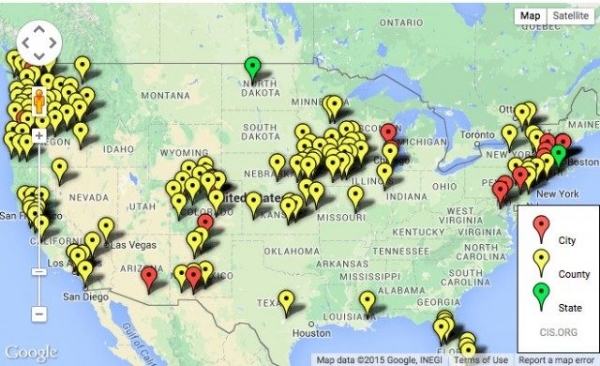
Senate Democrats blocked legislation Tuesday that would crack down on local governments that refuse to fully cooperate with federal immigration authorities in order to protect illegal immigrants from deportation.
The bill targeting so-called “sanctuary cities” failed in a 54 to 45 procedural vote. Sixty votes were necessary to advance the bill, which would block such jurisdictions from collecting some federal grants and would toughen criminal sentences for illegal immigrants who are convicted of a serious crime after being repeatedly deported.
The House approved a similar bill in July, weeks after an illegal immigrant allegedly shot and killed 32-year-old Kate Steinle on a San Francisco pier, touching off a national firestorm about the immigration policies of that city and others like it who argue that threats of deportation make it harder to police immigrant communities.
Steinle’s death continues to reverberate on Capitol Hill.
“The city of San Francisco is proudly a sanctuary city. They say to illegal immigrants across the country and across the world, ‘Come to San Francisco. We will protect you from federal immigration laws,’” Sen. Ted Cruz (R-Texas) said Tuesday on the Senate floor. “These policies are inexcusable.”
Meanwhile, The Hill reports that the Obama White House also threatened to veto the bill, should it pass the Senate:
The White House on Tuesday threatened to veto a Republican bill that cuts off federal funding for so-called sanctuary cities that refuse to help the government crack down on illegal immigration.
Interesting. So, on the one hand, the Democrats are very opposed to Kim Davis refusing to sign marriage certificates for gay couples, because that makes the gay couple feel bad. But, if an entire city wants to break federal law, and that makes someone like Kate Steinle DEAD, that’s OK with them. That doesn’t seem fair to me. Laws exist to protect the public, and that’s why they need to be enforced. We can have an expanded guest worker program for people who can get with an employer to come here and work. But there’s no excuse for allowing illegal immigrants with criminal convictions to live in sanctuary cities, where they can commit more crimes.
Sanders is perhaps best known in political life for his efforts to champion the middle class, saying that in order to bridge the widening wealth and income inequality gap in America, the country needs a revamped tax policy that forces Wall Street, big corporations, millionaires and billionaires –like Trump – to pay up – and doesn’t impose further taxes on the middle and working class.
However, when pressed by Stephanopoulos about whether the proposed Senate tax legislation he backs, which would use a payroll tax to fund a mandate for 12 weeks of paid family and medical leave from all U.S. employers, Sander confirmed that the bill would require taxing all citizens -– not just the top 1 percent.
“[The payroll tax] would hit everyone –- yeah, it would. But it would mean we would join the rest of the industrialized world and make sure that when a mom has a baby she can in fact stay home with that baby for three months, rather than going back to work at the end of one week,” Sanders said.
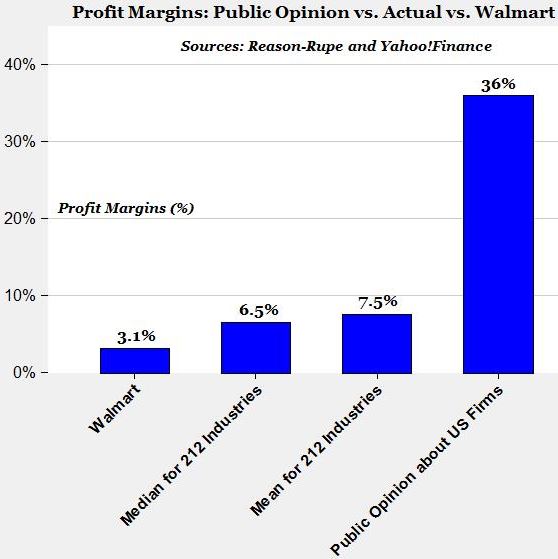
What most Democrats (all?) don’t understand, is that when you tax the rich, the costs filter down to consumers and employees. If a company is making a 5% profit (and Wal-mart makes a 3% profit), then slapping even a 5% tax increase on them will cause layoffs, outsourcing and other repercussions. We have a serious problem in this country with economic illiteracy – a widespread lack of familiarity with how the private sector works, and how jobs are created. For one thing, the public thinks that the average profit margin of companies is over 32%, when it fact it is much lower.
Public perceptions of corporate profit margins
So the real question is, how much does Bernie Sanders want to spend, and pass on to “the rich”? Because if it’s more than a 1% or 2% increase in corporate taxes, we are all – all of us – going to feel the burn. And it’s not going to a slight increase to our payroll taxes, it’s going to be a huge number of people losing their jobs, and the prices of consumer goods and services rising to pay for the new taxes.
How much does all this Bernie Sanders spending cost?
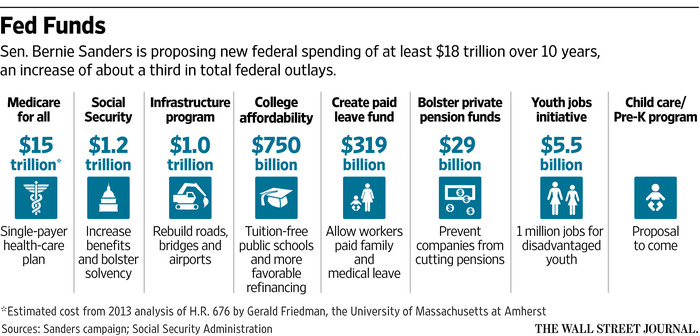
The Wall Street Journal – which knows something about business and economics – has done an analysis of how much the socialist agenda of Bernie Sanders will cost. The final price tag? $18 trillion dollars!
Read it:
Sen. Bernie Sanders, whose liberal call to action has propelled his long-shot presidential campaign, is proposing an array of new programs that would amount to the largest peacetime expansion of government in modern American history.
In all, he backs at least $18 trillion in new spending over a decade, according to a tally by The Wall Street Journal, a sum that alarms conservatives and gives even many Democrats pause. Mr. Sanders sees the money as going to essential government services at a time of increasing strain on the middle class.
[…]To pay for it, Mr. Sanders, a Vermont independent running for the Democratic nomination, has so far detailed tax increases that could bring in as much as $6.5 trillion over 10 years, according to his staff.
A campaign aide said additional tax proposals would be offered to offset the cost of some, and possibly all, of his health program. A Democratic proposal for such a “single-payer” health plan, now in Congress, would be funded in part through a new payroll tax on employers and workers, with the trade-off being that employers would no longer have to pay for or arrange their workers’ insurance.
His “Medicare for All” single-payer health plan alone would cost roughly $15 trillion over a decade.
He wants the government to provide “universal” child care and pre-kindergarten programs, along with free tuition at any public college, and proposes spending an additional $1 trillion on infrastructure and expanding Social Security by $1.2 trillion. Add up just these and a few other items on Sanders’ list, and price tag tops $18 trillion over a decade.
[…]And this doesn’t count the massive costs of mandates and regulations Sanders wants to impose on businesses, such as a $15 minimum wage, plus mandatory paid medical leave, vacations and sick days.
He’d also make it far easier for unions to organize.
Keep in mind that when Obama became president, the national debt was about $8 trillion. Now it’s $18.5 trillion, thanks to the Democrats. And if Bernie Sanders is elected, it will go to over $36.5 trillion. This is what Bernie Sanders expects to solve by “taxing the rich”. And Hillary Clinton expects to get the money for her spending from “taxing the wealthy”, as she said in the CNN debate. Do the rich have enough money lying around for the Democrats to confiscate?
Can we pay for it by “taxing the rich”?
A while back, the libertarian Cato Institute had an article talking about who would pay for Obama’s $1 trillion health care plan. They asked whether Obama could pay for it by “taxing the rich”.
The answer is no:
Funding the new health-care plan on the backs of households making $200,000 or more per year would require permanently increasing their annual total tax payments by about 50 percent. So, for example, a household that currently pays $50,000 in federal income taxes would need to pay another $25,000. Remember, however, that Social Security and Medicare already face enormous shortfalls. Shoring up these programs — another Obama campaign promise — would require collecting 328 percent more tax revenue from the rich. No, we didn’t forget a decimal point: That is three hundred and twenty-eight percent.
And what follows from taxing the rich?
[…]A major tax increase causes the tax capacity of the rich to shrink gradually as two factors kick in. First, many of the households falling into Obama’s “rich” definition are married couples in which both partners are working professionals. When tax rates rise, the lower-earning spouses in these couples tend to work less. Often, they quit work entirely. Second, many of the “rich” are budding entrepreneurs and small-business owners. They finance their operations using their own after-tax income, or with after-tax resources from family and friends. Small-business innovation is the fuel for long-term economic growth. In fact, many of the largest companies in the United States today were either small or nonexistent just 25 years ago. Killing small business kills the American economy.
The rich in France abandoned France in droves when the socialist Francois Hollande passed a 75% top income tax rate. Why do Democrat voters think that this would not happen here? We have to learn economics by watching what happens after the policies are enacted, in other times and places. Higher taxes on the rich cause them to produce less, lowering tax revenues.
I myself have been planning to stop working within the next 5 years, exactly because I can see that the Democrat voters are taking us in the direction of massive taxes on employment. I don’t intend to be working when that happens. If enough people respond to higher tax rates like me, the Democrats are going to have an even bigger problem paying for their spending promises.
I try to keep up with elections in the US, UK, Canada, Australia and New Zealand, so I know that there is a Canadian election today. I want to encourage all my Canadian readers to vote, and to help me answer your concerns about Stephen Harper, I have an absolutely marvelous post from Catholic writer Denyse O’Leary.
She writes:
Why are traditional religious communities dying?
[…][I]n a secular society, religious traditions are usually mediated through private institutions. Each decline in the importance of such institutions shuts off a passage to the life beyond that they mediate.
A child can grow up in a religious home today and discover that there are really only two players that matter: himself and big government. The only mediator and advocate is his entitlement card.
As he loses all interest in traditional spiritual life, he discovers the true faith of the progressive society:
Government controls more and more important stuff, and free association controls less and less. Government grants “freedom” to indulge oneself, of course, but that is almost a sacrament, and one that tends to weaken the citizen.
The transformation does not happen all at once, but by degrees. Recently, I was informed by a woman who considers herself a Catholic that abortion and euthanasia are mere “boutique issues,” compared to the awful things Stephen Harper is doing.
Just take in her basic idea for a moment:
The fundamental duty of government is to protect and advance human lives, but progressives know that their real business is currying favour with the growing numbers of fashionable identity groups. Increasingly, such groups will finance their advances on the public dollar. Some of the largesse may come from stripping traditional religious people and institutions of their property (possibly also in fines for non-compliance with some secularist belief). Most people we run into in the plaza will just be “nice” about the whole thing, no matter what is happening.
How do Christians respond?
Much as I sympathize, bracing for storms to come, I think Christians are mainly victims of ourselves.
Consider the excuses I hear (I am talking about legitimate Christian ones, not fundamentally anti-Christian ones, like the “boutique issue” claim above):
* “But Harper did nothing about abortion!”
Oh, for heaven’s sakes! As someone who dealt at close quarters with the abortion lobby for decades, I know they will gladly shut down free speech and freedom of conscience altogether to gain their ends. The euthanasia people will likely do the same. Until their fangs are drawn, nothing can really be done. Harper knows that drawing their fangs will be a serious struggle. And if you are not in it for the fight of your life, don’t interfere by demanding useless demonstrations of loyalty. Other parties will advance and cement their interests more than Harper’s will.
* “A spell of persecution would do us good”
Why is it always Western Christians who think this, not the Middle Eastern Christian and Yazidi girls sold into sex slavery, partly a result of the policy choices of progressive government? Reality check: Persecution causes the worst of human nature to flourish in our own communities as well as the best. Most communities cannot handle the strain. Do any of the Seven Churches of Asia exist today? Even one? Why is that?
[…]What should we do? It will take decades to send progressivism to its deserved reward. I will start by voting for the only party that is not actually hostile to our traditional values (like the right to live, and to speak freely).
[…]We need to grow up and stop funding, and voting for our enemies, and making excuses for anti-Christian bigots. (All the while making pathetic scolding noises.) If we need to change our bank accounts, our votes, our alumni donor policies, we do it individually because that is the responsible thing for an individual Christian adult to do.
And you don’t have to take her word for it, you can just look over to Europe and see how things are going in left-turning countries that embrace social justice. It’s a Christianity-killer.
What accounts for cross-national variation in religiosity as measured by church attendance and non-religious rates? Examining answers from both secularization theory and the religious economy perspective, we assert that cross-national variation in religious participation is a function of government welfare spending and provide a theory that links macro-sociological outcomes with individual rationality. Churches historically have provided social welfare. As governments gradually assume many of these welfare functions, individuals with elastic preferences for spiritual goods will reduce their level of participation since the desired welfare goods can be obtained from secular sources. Cross-national data on welfare spending and religious participation show a strong negative relationship between these two variables after controlling for other aspects of modernization.
Kudos to Denyse for understanding what is happening in her country. At least one Canadian Christian understands the relationship between the Christian church’s influence and the size of government.
Voter Guide
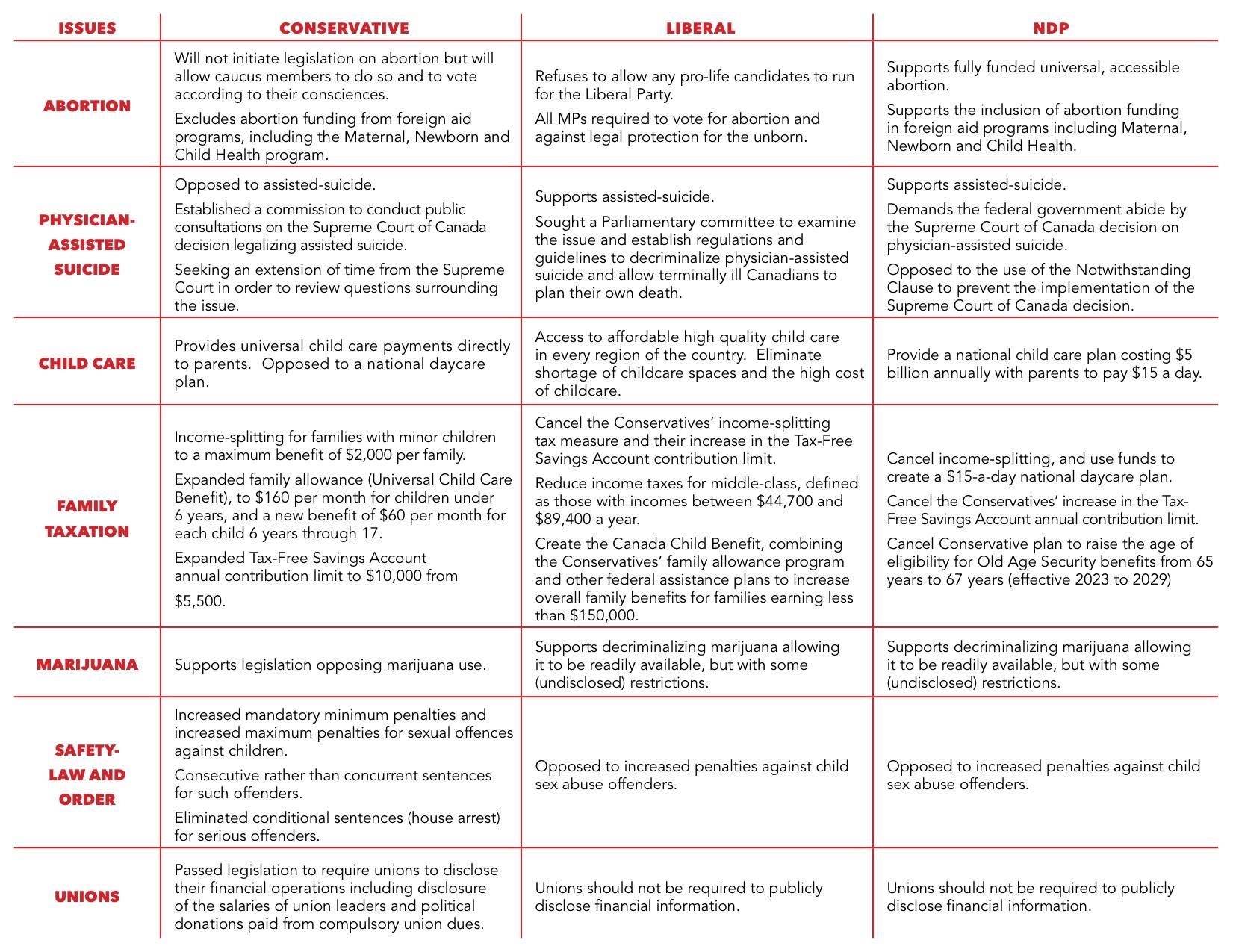
By the way, here is a voter guide to the positions of the 3 parties that will be of interest to voters:
Voter Guide (click for much larger image)
It was posted by my Canadian friend Coralie. She follows these things quite closely.
Notice that both the leftist parties want to get rid of income splitting and tax-free savings accounts. Income-splitting for seniors allows one spouse to retire, and the income of the working spouse is split with the non-working spouse, so they pay less taxes. Families with young children also are eligible for income splitting, which is a boon to stay-at-home moms. And the tax-free savings account is like a ROTH IRA, except better – you can pull out all the tax-free gains at any time, for any reason, and the gains are NEVER taxed. We have nothing like that in the USA. It has changed the character of Canadians to value saving over spending, making them more responsible and independent from government. TFSAs are how you change the character of a nation.
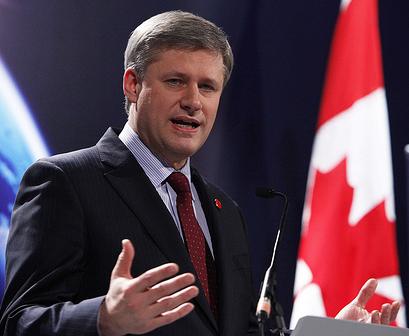
Why vote for Stephen Harper?
My Canadian friend McKenzie is conservative now, but she was not always, and I remember her asking me a while back to explain what conservatives stand for. Well, I found an article that re-caps what Stephen Harper has achieved in the last 9 years. The article lists 100 accomplishments, with links to each one.
Here are some that stuck out to me:
Adoption Expense Tax Credit increased — from a one-time $13,100 to 15,000 in 2014
Age of Consent Legislation — raised from 14 to 16 effective May 1, 2008
Beyond the Border Agreement with the U.S. — passed in late 2011, on perimeter security co-operation
Canada Apprentice Loan Program — up to $4000 for those registered in any Red Seals apprenticeship training announced in January 2015
Canada/EU Trade Agreement — although ratification still required, an `End of Negotiations`Agreement signed on September 26, 2014
Canadian Wheat Board Monopoly Ends — Bill C18 removed the CWB’s monopoly regarding decisions made by many Western farmers to market their wheat
Columbia Free Trade Agreement — went into force on August 15th, 2011
Consumer Product Safety Act — came into effect June 20, 2011 to ensure manufacturers do not market dangerous products
Corporate Tax Rate — reduced from 18% to 16.5% effective January 2012, with another 1.5% reduction in 2012 to 15%
Corrupt Regimes Act (C-61) – allows Canada to act upon the request of a foreign state to freeze the assets that their former leaders and members of their entourage, including family members, senior officials and associates, may have placed in Canadian financial institutions
Employment Insurance Premiums Reduced — in the fall of 2014 by 15% for to encourage small businesses to hire
Exploited Persons Act — legislation that received Royal Assent to protect against drug, organized or prostitution type of crime
Express Entry Immigration into Canada Program — when skilled immigrants to Canada will get quick entry so that they can contribute to economy
Fairness at the Pumps Act (C-14) – protects Canadian consumers from inaccurate measurements when purchasing gasoline effective August 2014
Family Caregiver Tax Credit — Bill C-13 established a new $2000 tax credit on December 15, 2011 to help families dealing with challenging medical expenses
Family Income Splitting — families with children under 18 will be allowed to split income beginning in 2014 up to $50,000 with credit capped at $2000.00
Federal Infrastructure Plan — longest long-term plan in Canadian history supporting projects that enhance economic growth, job creation and productivity
Free Trade Agreement — signed on July 2, 2009 — between Iceland, Liechtenstein, Norway and Switzerland
Gun Registry Scrapped — as the legislation passed Third Reading
GST /HST– Goods & Services Tax Cut — From 7% to 6% and then to 5%
Honduras Free Trade Agreement — completed and signed on November 5th, 2013 and will enter into force on June 19, 2014
Income Splitting for Canadian Seniors — a change to the Income Tax Act for pensioners starting in 2006
Jordan Free Trade Agreement — went into force on October 1st, 2012
Kid’s sport tax credit — up to $500 per child
Mission Against ISIL extended March 30, 2015 — to aid the people of Iraq and Syria
Ombudsman for Victims of Crime — Established
Panama Free Trade Agreement — went into force on April 1st, 2013
Peru – Canada Free Trade Agreement — adopted by Parliament June 18, 2009
Protecting Victims from Sexual Offenders — signed on December 15, 2010 to protect children against sexual predators
Safe Streets & Communities Act — passed March June 13, 2012 to protect children and communities against terrorism
South Korea Free Trade Agreement Signed on September 22, 2014 — 1st Asia Pacific Agreement with final legislative steps for full implementation on November 26, 2014
Tax cuts made 160 Times — since the Conservatives took office in 2006
Tax Free Savings Account with an initial annual limit of $5500.00 — which was raised to $10,000 in April 2015 budget
Taxpayers Bill of Rights
Taxpayers Ombudsman
Temporary Foreign Workers Program — reforms made so that Canadians are hired first
Universal Child Care Benefit — in 2006 $1,200.00 per year for every child under age six
Universal Child Care Benefit Enhancement — effective January 1st, 2015, beginning July 1st, 2015, parents will receive $160.00 per child per month up to age six and $60.00 for each child aged 6 to 17
Victims Bill of Rights — Bill C-32 passed on June 18th, 2014
It’s important to know what you are voting for, not just what you are voting against.