Category Archives: News

Surprise! Anti-war President blocked 75% of airstrikes on ISIS targets

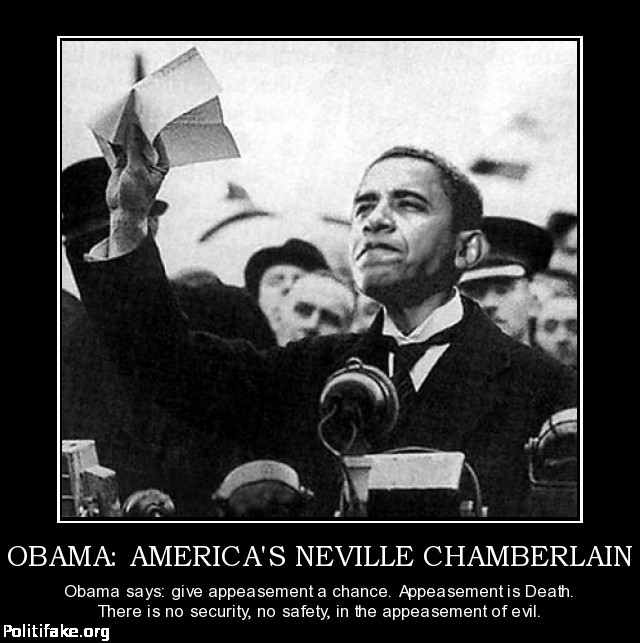
Neville Chamberlain Obama: peace in our time

Washington Free Beacon reports.

Excerpt:

U.S. military pilots who have returned from the fight against the Islamic State in Iraq are confirming that they were blocked from dropping 75 percent of their ordnance on terror targets because they could not get clearance to launch a strike, according to a leading member of Congress.

Strikes against the Islamic State (also known as ISIS or ISIL) targets are often blocked due to an Obama administration policy to prevent civilian deaths and collateral damage, according to Rep. Ed Royce (R., Calif.), chair of the House Foreign Affairs Committee.

The policy is being blamed for allowing Islamic State militants to gain strength across Iraq and continue waging terrorist strikes throughout the region and beyond, according to Royce and former military leaders who spoke Wednesday about flaws in the U.S. campaign to combat the Islamic State.

“You went 12 full months while ISIS was on the march without the U.S. using that air power and now as the pilots come back to talk to us they say three-quarters of our ordnance we can’t drop, we can’t get clearance even when we have a clear target in front of us,” Royce said. “I don’t understand this strategy at all because this is what has allowed ISIS the advantage and ability to recruit.”

A quick review… here’s an article from earlier this year from the Wall Street Journal, about the low number of air strikes being conducted per day by President Pantywaist:

While it is still too early to proclaim the air campaign against Islamic State a failure, it may be instructive to compare it with other campaigns conducted by the U.S. military since the end of the Cold War that were deemed successes. For instance, during the 43-day Desert Storm air campaign against Saddam Hussein’s forces in 1991, coalition fighters and bombers flew 48,224 strike sorties. This translates to roughly 1,100 sorties a day. Twelve years later, the 31-day air campaign that helped free Iraq from Saddam’s government averaged more than 800 offensive sorties a day.

By contrast, over the past two months U.S. aircraft and a small number of partner forces have conducted 412 total strikes in Iraq and Syria—an average of seven strikes a day. With Islamic State in control of an area approaching 50,000 square miles, it is easy to see why this level of effort has not had much impact on its operations.

Of course, air operations during Desert Storm and Iraqi Freedom were each supported by a massive coalition force on the ground. Thus it may be more appropriate to compare current operations against Islamic State with the 78-day air campaign against Serbian forces and their proxies in 1999, or the 75-day air campaign in Afghanistan that was instrumental in forcing the Taliban out of power in 2001.

Both campaigns relied heavily on partner forces on the ground augmented by a small but significant number of U.S. troops. These air campaigns averaged 138 and 86 strike sorties a day respectively—orders of magnitude greater than the current tempo of operations against Islamic State.

Now, Obama is fond of saying that he is very interested in alternatives to his plans, and in fact, such an alternative exists – from his former top intelligence official:

Writing in Politico, Obama’s former top intelligence official, Mike Vickers, thoroughly dismantled Obama’s ISIS strategy, saying that “by any measure, our strategy in Iraq and Syria is not succeeding, or is not succeeding fast enough.”

Vickers’ credentials on this matter are impeccable. Until earlier this year, he was undersecretary of defense for intelligence, overseeing the NSA and Defense Intelligence Agency. An Army Special Forces veteran, he’s served as a key advisor to four presidents, and was the principal strategist behind the U.S. effort to defeat the Soviet invasion of Afghanistan.

[…]Whereas Obama insists that the attacks against ISIS must be “a long-term campaign,” Vickers explains that “time is not on our side” and that “we are playing a long game, when a more rapid and disruptive strategy is required.”

Vickers says that, contrary to what Obama claims, ISIS “cannot be contained any more than al-Qaida could prior to the Sept. 11, 2001, attacks.”

Obama dismisses ISIS as “killers with fantasies of glory who are very savvy when it comes to social media,” and who “pretend that they are a functioning state.”

Vickers explains that ISIS “is a de facto state. It holds territory, controls population, and funds its operations from resources that it exploits on territory it controls.”

While Obama seems to think that the best we can hope for is to someday “shrink” the territory ISIS controls “to defeat their narrative,” Vickers notes that Obama is needlessly handicapping the military: The “one thing the American military knows how to do is defeating an opposing force trying to hold ground.”

According to Obama, the only alternative to his minimalist ISIS strategy is another Iraq quagmire. Not so, says Vickers. “There are a lot of operational options between what we did in Iraq and what we didn’t do in Libya.”

Vickers says another leg of Obama’s “strategy” — namely that any resolution of the ISIS problem has to involve “a resolution to the Syria situation” — is wrong. On this point, in fact, he is emphatic. “We must not succumb to the false hope that ending the Syrian civil war is the key to defeating ISIS.”

Vickers also rejects joining forces with Russia in this clash.

In his press conference, Obama also complained that he hadn’t seen any “particular strategies that they would suggest that would make a real difference.”

Well, Vickers has one. Follow the model used to defeat the Taliban, and the Soviet army before that, in Afghanistan.

So, suppose there is a Paris-style attack within the United States that is planned and led by Islamic State elements. Will we be able to say that Obama has done everything he could to keep us safe? We have a porous southern border, pulling our forces out of Iraq and Afghanistan, a nearly constant stream of security breaches, massive cuts to defense spending, $140 billion dollars for Iran, cuts in military pay, and military morale at an all-time low. This President has no interest in protecting the American people.

When we get whacked by our enemies, and innocent people die, remember that Obama coddled those same enemies and let them do that to us. He doesn’t think Islamic State is evil, he doesn’t think that America is good, he doesn’t see that it’s his job as defeating evil and protecting Americans from evil.

Wayne Grudem debates Richard Glover on the Bible, poverty and foreign aid

Two horses fight it out, may the best horse win!

A great episode of the Unbelievable podcast. This is a great debate. I really enjoyed it. All three speakers were excellent putting forward their points. It’s nice to hear an American voice, a British voice and an Australian voice debating an important issue. HIGHLY RECOMMENDED.

Details:

Wayne Grudem is a theologian known for his conservative approach to both doctrine and economics. His new book “The Poverty of Nations: A Sustainable Solution” (co-authored with economist Barry Asmus) makes the case that pouring aid into developing countries is a failed strategy. Grudem debates whether the Bible supports free market, capitalist economics with Australian economist and theologian Richard Glover who wrote a critique of the book for the Australian Bible Society.

 The MP3 file is here.

Summary:

Grudem:

  • The Bible speaks to all of life, including economics, stewardship, government
  • The study of economics helps us to understand how to take care of the poor
  • My job is to apply the teachings of the Bible to all of life

Brierley:

  • What’s your thesis in the book?

Grudem:

  • A good system is one where the poor have the opportunity to earn and save from their labor
  • Book is a response to a Kenyan couple Grudem met at a London conference on business and Christianity
  • Book is not concerned with how individuals and groups can do charity to help the poor
  • Our church already does that and we support individuals and groups doing charity
  • The book is concerned with how should nations be transformed in order to grow economically
  • What should the laws, policies and cultural beliefs of a nation be in order for it to not be poor?
  • The book lists factors that have moved nations from poverty to prosperity in different times and places
  • The thesis of the book is this: government should set their people free to be able to produce more
  • We advocate freedom in economics: freedom to work, freedom to save, freedom to start businesses
  • We believe that this free enterprise view is consistent with the Bible in a number of places
  • E.g. – private property is good for prosperity (thou shall not steal) but forbidden by communism

Brierley:

  • What about the church sharing in communities in Acts 2 and Acts 4?

Grudem:

  • That is not redistribution of wealth among individuals and businesses by a secular government
  • Those passages showed that there was voluntary sharing among Christians, which is not communism

Brierley:

  • What’s wrong with Grudem’s book?

Glover:

  • The book emphasizes the Bible and the goal is to help the poor in poor countries
  • Criticism 1: the book doesn’t engage with non-free-market perspectives on economics
  • Criticism 2: the book doesn’t survey all that the Bible says about economics

Brierly:

  • For 1) what is one of the views that is not considered?

Glover:

  • Jeffrey Sachs says that nations need a leg up before they can grow economically
  • Ha-Joon Chang says that free enterprise was not how the wealthy nations became wealthy

Grudem:

  • We do engage with other points of view, especially Jeffrey Sachs in the book
  • The trouble with leftist views on economic development is that it does not work in practice
  • NO COUNTRY has even been lifted out of poverty by foreign aid
  • He says we don’t cite enough from the wisdom literature: we have 64 citations in the index
  • He says we don’t cite enough from the gospels: we have 42 citations in the index
  • He says we don’t cite enough from the epistles: we cite 22 of 27 epistles in the index
  • Some economists won’t criticize cultural and moral values that hurt prosperity
  • As Christians, we think that moral and cultural values are part of the problem that needs solving

Brierley:

  • What about foreign aid?

Grudem:

  • Foreign aid doesn’t help: a lot of the money goes into government and rulers can be corrupt
  • Instead of encouraging people to start businesses, it tells people to go into government to get aid money
  • Economists (lists 3) are saying that foreign aid entrenches corrupt government in power, does no good

Brierley:

  • If it’s not working, should we keep doing it?

Glover:

  • When there is an immediate need, we should do it, even if it is not a long-term solution: we need both

Brierley:

  • Should we stop foreign aid completely?

Grudem:

  • Voluntary charitable giving from individuals and churches to help poor countries is good
  • Me and my co-author are both active on our church board that helps poor countries with urgent needs
  • Food and doctors are urgent needs, and we should help, but it doesn’t lift countries out of poverty
  • We need a long-term solution that helps poor countries produce their own food and doctors
  • We are criticizing 1) government to government aid and 2) IMF/World bank to government aid
  • We have had pushback because 500,000 people make a living from this foreign aid industry
  • No country has ever been lifted out of poverty into sustainable prosperity
  • That’s the definition of insanity: continuing to do the same thing that has never worked

Brierley:

  • Does the Bible support free enterprise as a way of creating sustainable prosperity?

Glover:

  • When I said the Bible was absent from his book, absent was a bad choice of words
  • But the hundreds of references he listed were not dealth with *in depth*
  • In the Scriptures, God is the one who provides (e.g. – in Ephesians, Sermon on the Mount)
  • The Bible is less focused on his people making money, and more focus on sharing basics, like food
  • Secular governments should just take it from people who have food and give it to hungry people
  • In 2 Cor 8-9, Paul talks about voluntary sharing so everyone will be equal

Brierley:

  • Does 2 Cor 8-9 undermine the free enterprise system you champion in the book?

Grudem:

  • The sharing in the Bible solves cases of urgent need, it does not lift countries from poverty to sustainable prosperity
  • Some older translations say “equality” in 2 Cor 8:13-14, but newer translations (e.g. – ESV) say “fairness”
  • The Greek word is translated as “fairly” the only other place it appears in the NT (Col 4:1), in every translation
  • God uses the means of human work and productivity to provide (daily bread is baked, doesn’t just fall from Heaven)
  • In general, there’s no provision in Scripture for a person to be dependent on donations for their entire lives
  • God promises Israel fields and mountains to tend and mine, but prosperity is from work, not depending on others

Brierley:

  • Does the Bible support this focus on work?

Grudem:

  • Working is highly praised in Scripture, (lists Bible passages that favor work over dependency)
  • Countries that were exposed to this notion of work and productivity have been more prosperous

Glover:

  • Jeffrey Sachs and other development economists don’t say you can be prosperous through dependence
  • They say that it is a necessary part of leading to nations out of poverty into poverty

Grudem:

  • It’s never worked. What nation has become prosperous through foreign aid?

Glover:

  • There are lots of nations, especially in Africa, where foreign aid has helped lift them out of poverty

Grudem:

  • Name one country in Africa where foreign aud has lifted them out of poverty into sustainable prosperity

Glover:

  • I can’t think of one right now.

Grudem:

  • Our book contains a map of Africa and we looked at every nation’s per capita income
  • No nation has been able to rise out of poverty through dependence on foreign aid
  • The only close one is Botswana, but they have abundant freedoms, Christian morals, less corrupt government
  • So Botswana is the best case and they became prosperous through becoming productive, not foreign aid

Brierley:

  • Is he right to say that charity is a short-term solution, but that it’s not good long-term for prosperity?

Glover:

  • Yes, and work is a very important focus in the Scriptures as he says.
  • But since the Fall work has been much harder, and may not have the outcomes that we would like

Grudem:

  • I also believe in emergency aid for when catastrophies happen, like floods and famines
  • But dependence on foreign aid enriches corrupt rulers and does not create the productivity that leads to sustained prosperity

Brierley:

  • Can foreign aid be used to give poor nations a leg up on becoming prosperous?

Grudem:

  • Dambisa Moyo, Oxford-educated economist from Zambia, says stop the aid, it’s doing more harm than good
  • Jeffrey Sachs’ view is that foreign aid hasn’t worked yet, but just keep trying a bit more
  • What works: limited government, rule of law, fair courts, documented property rights, low taxes, stable currency
  • People are creative and want to work, we just have to get government out of the way and let people work, earn and save

Brierley:

  • Is this free enterprise system supported by the Bible?

Glover:

  • The wealthy nations of the world did not become wealthy through productive work and free enterprise policies
  • Ha-Joon Chang: free enterprise policies have never brought a country from poverty to wealth
  • E.g. – wealth is created through tariffs (not by innovating and by economic freedom?)

Grudem:

  • I’ve read Ha-Joon Chang’s book, and his examples are very selective and limited
  • Index of Economic Freedom: the freest countries are the most prosperous, the least free countries are the most poor
  • When you look at macro data, instead of very selective examples, the free enterprise system is best for prosperity

Glover:

  • The book doesn’t do enough to engage with leftist economists (he doesn’t say which ones)
  • Just because nations who are free are rich, doesn’t mean freedom causes productivity
  • There are parts of the Bible that doesn’t support the free enterprise system (he names none)

Grudem:

  • The Bible is focused on work not dependency, and charity not government redistribution
  • The best way to help the poor in other countries is by encouraging work and productivity

Pro-lifers need to vote wisely, or they may strengthen abortion

Canada Election 2015: Socialists in red, Communists in Orange, Conservatives in blue

Here is an article written by a Canadian named Mike Schouten in Life News.

He wrote this prior to the Canadian federal election:

The de facto position of Thomas Mulcair and Stephen Harper is, in principle, no different. When questioned directly by Trudeau last Friday, Harper said the same as he has been saying for years, “My position for 10 years has been I don’t intend to re-open this debate.”

As yet, all three leaders have a realistic shot at making 24 Sussex their home after the October 19 election. And all three continue to treat pre-born children as a political liability.

Messrs. Harper, Mulcair and Trudeau are without excuse. If elected, it is their duty to enact laws for the benefit of all Canadians. Their complete disregard for the human rights of any children in the womb effectually means that they are complicit in the deaths of 100,000 members of the human family every year.

In effect Stephen Harper, Thomas Mulcair and Justin Trudeau all support sex-selective abortion. They care less about the fact that girls are targeted for abortion much more frequently than boys. Their refusal to act is a sign that they endorse this misogynistic practice in Canada.

All three leaders also support late-term abortion. They show no regard for the reality that every year thousands of babies lose their lives by being aborted in the latter stages of pregnancy, after the stage when children of the same age are born, survive outside of the womb, and live productive lives as Canadian citizens.

Now, I can understand why Schouten is frustrated. But what he is saying above is going to have one of two effects on pro-life voters. Either pro-lifers will stay home and not vote, since there are no differences between the parties on the abortion issue, or they will waste their vote on a third-party candidate who cannot win.

During Harper’s tenure as prime minister, abortion was never expanded, because Harper never made pushing leftward on social issues a priority. In fact, one could argue that his tax credits for married couples encouraged people to marry, which tends to push down the number of abortions. Married couples are better equipped to welcome into the world an unborn child, because there are two people, not just one. But Schouten did not  foresee that things could actually get worse under a Liberal or NDP prime minister. He just didn’t understand how radical the pro-abortion left really is compared to the center-right.

Then what happened?

Here is an article from Life Site News explaining what happened when Harper lost to the Liberal Party leader Justin Trudeau, who also happens to be an extremist on abortion:

Canada’s new health minister promises to “equalize” access to abortion, especially for women living in rural areas, but won’t give specifics. However, the Abortion Rights Coalition of Canada has supplied LifeSiteNews a long shopping list for addressing the “problem.”

The ARCC wants more surgical time for abortions in rural hospitals, elimination of conscientious objection by pro-life doctors, screening out of pro-life ob-gyns at medical school, full funding for pharmaceutical abortion through so-called “emergency contraceptives,” and withholding of  federal funding to New Brunswick and Prince Edward Island if these provinces don’t remove remaining restrictions on abortions.

Canada’s new health minister, Jane Philpott, made her comments in a written response to a query from the CBC, stating, “We know that abortion services remain patchy in parts of the country, and that rural women in particular face barriers to access. Our government will examine ways to better equalize access for all Canadian women.”

Responded the WeNeedALaw organization: “We could translate Minister Philpott’s statement like this: ‘It is completely unacceptable that pre-born children are killed with greater ease in Canada’s urban centres than in rural communities.’”

“Seriously? Of all the problems an aging demographic poses for our top-notch health care system the first thing the Liberals want to do is make it easier for pre-born babies to be dismembered, decapitated and disembowelled?” they asked.

The CBC identified the what they deemed the most obvious culprit in limiting access: successive Prince Edward Island governments who have tried to balance pro-life and pro-abortion interests by funding abortions while sending the women out-of-province to have them.

But P.E.I. pro-lifer Randy Anchikoski also told LifeSiteNews the abortion issue is a distraction from the province’s real problems. “We have a big debt and aging population with all sorts of medical problems they face such as heart ailments and cancer. We have fewer women of childbearing age every year. From which part of our health budget is the money for an abortion clinic supposed to come?”

New Brunswick also restricts abortions, still insisting that they be done in hospitals, but it dropped a second regulation that they be approved by two doctors as medically necessary late last year.

Joyce Arthur, the executive director of the Abortion Rights Coalition of Canada, has put the two recalcitrant provinces at the top of her list of measures to “equalize” abortion access across Canada, calling on the federal government to, “arbitrate to resolve access/funding issues, and if the provinces still don’t comply, withhold federal transfer payments.”

As far as the problems allegedly facing rural women wanting abortions, pro-life leaders say this a familiar theme the pro-abortion forces use to push for measures such as pharmaceutical abortions and so-called “web cam” abortions.

[…]As well, the Abortion Rights Coalition of Canada wants medical schools to “screen out anti-choice medical students before they enter the Family Planning program or Obstetrics/Gynecology specialty” because their “inability to fulfill job requirements should make them ineligible.”

[…]Arthur’s wish list also includes a bonus system to attract abortion-doing doctors to rural areas, and the elimination of conscientious objection by pro-life doctors and nurses, requiring doctors at least to refer patients requiring abortions.

You might remember that I blogged about a Canadian pro-lifer a month ago who predicted that ALL of this was going to happen if Trudeau won. I told her how her predictions had come true, and in response she told me about the words of an American pro-lifer who we often feature on this blog who says this about Schouten’s problem:

Let me state it plainly: If you are pro-life and intend on casting a “conscience vote” for a third party candidate, you might as well be voting for the “pro-choice party.” It will have the same ultimate impact on the safety of the unborn. Voting pro-life principles isn’t always voting for a pro-life candidate; a principled vote might mean voting for the viable option that will either advance the pro-life cause better or hurt it the least.

If you sleep more comfortably at night because you’ve voted your principles, then I believe your conscience is well-intended, though misinformed. You’ve chosen to make a moral statement instead of choosing to have a moral impact.

As one pundit put it, it’s better to have a second class fireman than a first class arsonist. There is no victory or honor in voting for the first-class fireman who had no chance of winning when, in the end, your “conscience vote” actually allowed the arsonist get elected.

American pro-lifers know that Democrats are always looking to overturn the many state-level restrictions on abortion… there is always a reason to keep the left out of power, even if the right drags their feet on social issues. The left can always make things worse than they are. It’s never a good idea to tell pro-life voters anything that will cause them to stay home on election day. They need to get out there and vote for the most pro-life party – no two parties are exactly equal on the abortion issue.

If you want to read more about how pro-lifers ought to vote, you can read this article by Scott Klusendorf of the Life Training Institute. And you can read about the pro-life strategy of the clever Canadian pro-lifer who predicted all of these things here. It’s called “Save the Storks”.