Category Archives: News

Ted Cruz’s panel of foreign policy advisers represent diverse perspectives

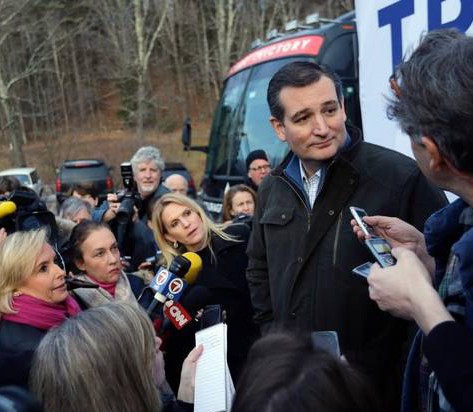
Ted Cruz meets voters at a campaign event

Well, I sometimes listen to the Hugh Hewitt show, and since foreign policy is his thing, I get to hear pretty much every foreign policy point of view there is. Imagine how surprised I am to find that practically everyone that Hugh has on as a guest is on Cruz’s foreign policy advisory panel.

This article from NewsMax explains:

Republican presidential candidate Ted Cruz unveiled his national security team, which includes former Assistant Secretary of State Elliott Abrams, former Missouri Sen. Jim Talent and former U.S. Attorney Andrew McCarthy.

[…]Abrams, who served Presidents Ronald Reagan and George W. Bush, praised the senator’s support for Israel, saying that “he has made it clear that he believes a strong Israel is America’s key ally and asset in the Middle East.

“He understands the power relationships in that region and he will put an end to the tensions of the Obama years that have weakened the U.S.-Israel alliance,” Abrams added. “He is very clearly the most pro-Israel candidate in the race today.”

Other members of Cruz’s team include:

  • Stewart Baker, former assistant secretary for policy at the Department of Health and Human Serves and general counsel of the National Security Agency.
  • Ilan Berman, vice president of the American Foreign Policy Council.
  • Retired Army Lt. General William Boykin, executive vice president of the Family Research Council.
  • Fred Fleitz, a former Central Intelligence Agency analyst.
  • Randy Fort, who has served in senior intelligence positions in the Reagan, George H.W. Bush and George W. Bush administrations.
  • Frank Gaffney Jr., president and CEO of the Center for Security Policy.
  • Nile Gardiner, a former aide to British Prime Minister Margaret Thatcher.
  • Mike Gonzalez, a senior fellow at the Heritage Foundation.
  • Katharine Gorka, president of the Council on Global Security.
  • Steven Groves, a senior research Fellow at the Heritage Foundation.
  • Mary Habeck, a visiting scholar at the American Enterprise Institute.
  • Kristofer Harrison, a co-founder of the China Beige Book who once served in the George W. Bush White House.
  • Jerry Hendrix, a retired Navy captain.
  • Michael Ledeen, an author who serves at the Foundation for the Defense of Democracies.
  • Clare Lopez, a vice president at the Center for Security Policy.
  • Robert O’Brien, a partner at the Larson O’Brien LLP law firm in Los Angeles.
  • Michael Pillsbury, who was a Reagan campaign advisor in 1980.
  • Charles Stimson, the senior legal fellow and manager of National Security Law Program at the Heritage Foundation.
  • Daniel Vajdich, a senior fellow at the Atlantic Council.
  • Christian Whiton, a former State Department senior advisor in the Bush administration.

My favorite guys on that panel are Frank Gaffney, Andrew McCarthy, Nile Gardiner, William Boykin and Michael Ledeen. Gaffney is probably the most hawkish of all of them, so I was surprised that Cruz put him in there. I always thought that Cruz was more libertarian on foreign policy than I am. And maybe he is, but he put all my favorite hawkish guys on his panel anyway. I don’t know the specific people they listed from the Heritage Foundation, but it is my favorite think tank, so they have to be good. And I see someone named Mary Habeck from the American Enterprise Institute – my second favorite think tank. My favorite defense analyst from AEI is Mackenzie Eaglen, but they didn’t pick her, oh well.

This article from the radically leftist Bloomberg View notes that Cruz has a whole ton of moderate conservative voices on his foreign policy advisor panel to balance out the hawks that I like so much.

It says:

[…]Cruz’s team includes former officials who reject Gaffney’s broad view that any Muslim who believes in Sharia law by definition believes in a totalitarian and violent ideology at war with America.

“We’re at war with a coalition of radical Islamists and radical secularists. It’s not all one thing, nor is Islam all one thing,” Michael Ledeen, a former Reagan administration official and a Cruz campaign adviser, told me.

Jim Talent, a former Missouri Republican senator who was a key adviser to Romney in 2008 and 2012, is signed up for the Cruz team. So is Mary Habeck, a former staffer on George W. Bush’s national security council, who is an expert on jihadi organizations and has warned against demonizing the entire religion of Islam.

Another Cruz adviser, Elliott Abrams, helped craft Bush’s policy to empower moderate Muslims in the Middle East against radicals. He told me he feels much the same way as Habeck. “It’s now 15 years since 9/11, and I think it’s obvious that Muslim citizens in the U.S. and Muslim leaders abroad have an absolutely critical role to play in fighting jihadis and other Muslim extremists,” Abrams said. “This is partly a battle within Islam that they are going to have fight and win. Alienating these potential allies is the kind of foolish policy that the Obama administration has engaged in when it comes to Arab states that are our allies.”

Victoria Coates, who has been Cruz’s main adviser on national security since he came to the Senate, told me this tension on the policy team “is by design and not an accident.” She added: “Both Frank and Elliott are people I went out of my way to set up meetings with the Senator. He has met with both of them individually for years.”

[…]His new team of national security advisers, in this respect, has something for everyone.

I think this balanced approach matches Cruz’s approach in other areas. He isn’t looking for mediocre people who are loyal to him above all. He has hawkish people in his panel, but he also has respected moderates. I have heard Andrew McCarthy, Michael Ledeen and Jim Talent on Hugh Hewitt’s show many times. Victoria Coates is highly respected by everyone when it comes to foreign policy. The moderate people are the best at putting forward their view, just as Gaffney is the best at putting forward the hawkish view. Cruz’s approach will lead to good discussions, which will lead to smart policies. We certainly can do a lot better than the Obama administration’s “screw up then cover up” approach.

In contrast to Cruz, who does have good advisers on foreign policy, we are hearing this from Trump:

He says: “I’m speaking with myself, I have a very good brain”. That might for for Scrabble or balancing your check book, but we are talking about foreign policy and national security, here.

Related posts

Man uses legally-owned concealed carry handgun to prevent robbery

Guns are for self-defense against criminals

Another in my series of posts to help non-Americans understand why Americans are passionate about the Second Amendment to the Constitution and the right to bear arms.

The news story is from the Washington Free Beacon:

A good samaritan saved a 7-11 clerk on Sunday by shooting a hatchet-wielding man who had attacked the store.

A 60-year-old man with a valid concealed carry license was drinking his morning coffee when a masked man, later identified as 43-year-old Steven Blacktongue, entered the convenience store and began attacking the clerk, Kuldeep Singh. The attacker slashed Singh across the stomach several times without saying a word. At that point the concealed carrier drew his firearm and shot Blacktongue, killing him.

Police said that the concealed carried did nothing wrong and ended up saving lives.

“This could have been disastrous. Had this [customer] not shot, who knows what would’ve happened,” King County Sergeant Cindi West told KIRO. “We might have a dead clerk right now and instead, we have a dead bad guy. We do not see any wrongdoing on the part of the customer.”

“In fact, he probably saved lives in this case.”

Singh said he feared for his life during the attack and is glad to be alive. A friend of his, who also works at the convenience store, told the news station that the concealed carrier was a “good guy” for intervening and stopping the attack. The concealed carrier was not expected to face any charges.

Here’s the news report from KIRO 7 News:

This happened in ultra-leftist King County, Washington, of all places. I’m surprised they even let law-abiding people who pass a background check carry firearms, there. But at least this story leaves no doubt about why concealed carry permits exist.

Merrick Garland and the Second Amendment

This might be a useful story to send to Obama’s latest Supreme Court nominee – a radically leftist who opposes the second amendment.

Washington Free Beacon again:

Merrick Garland, President Obama’s nominee to replace Supreme Court Justice Antonin Scalia, has a record of opposing gun rights as a federal judge, which includes a vote to undo a landmark gun rights ruling.

Garland was one of four judges who voted to rehear the case of Parker v. District of Columbia with a full ten-judge panel after a smaller panel struck down the District of Columbia’s total ban on handguns. Garland’s vote for this en banc hearing indicates that he may believe the decision to strike down the city’s gun ban was mistaken.

The other six judges on the appeals court voted not to rehear the case, and the Supreme Court went on to rule in District of Columbia v. Heller that the Second Amendment guarantees an individual’s right to bear arms in the case.

So, he’s a radical on gun control, well outside the mainstream.

As usual, we end all second amendment posts with an examination of the peer-reviewed literature on gun ownership and rates of violent crime. This evidence is not generally understood by people on the left, who tend to be guided more by emotions and peer approval than evidence when forming their views on controversial issues.

The peer-reviewed research

Whenever I get into discussions about gun control, I always mention two academic books by John R. Lott and Joyce Lee Malcolm.

Here is a paper by Dr. Malcolm that summarizes one of the key points of her book.

Excerpt:

Tracing the history of gun control in the United Kingdom since the late 19th century, this article details how the government has arrogated to itself a monopoly on the right to use force. The consequence has been a tremendous increase in violent crime, and harsh punishment for crime victims who dare to fight back. The article is based on the author’s most recent book, Guns and Violence: The English Experience (Harvard University Press, 2002). Joyce Malcom is professor of history at Bentley College, in Waltham, Massachusetts. She is also author of To Keep and Bear Arms: The Origins of an AngloAmerican Right (Harvard University Press, 1994).

Upon the passage of The Firearms Act (No. 2) in 1997, British Deputy Home Secretary Alun Michael boasted: “Britain now has some of the toughest gun laws in the world.” The Act was second handgun control measure passed that year, imposed a near-complete ban on private ownership of handguns, capping nearly eighty years of increasing firearms restrictions. Driven by an intense public campaign in the wake of the shooting of schoolchildren in Dunblane, Scotland, Parliament had been so zealous to outlaw all privately owned handguns that it rejected proposals to exempt Britain’s Olympic target-shooting team and handicapped target-shooters from the ban.

And the result of the 1997 gun ban:

The result of the ban has been costly. Thousands of weapons were confiscated at great financial cost to the public. Hundreds of thousands of police hours were devoted to the task. But in the six years since the 1997 handgun ban, crimes with the very weapons banned have more than doubled, and firearm crime has increased markedly. In 2002, for the fourth consecutive year, gun crime in England and Wales rose—by 35 percent for all firearms, and by a whopping 46 percent for the banned handguns. Nearly 10,000 firearms offences were committed.

[…]According to Scotland Yard, in the four years from 1991 to 1995 crimes against the person in England‟s inner cities increased by 91 percent. In the four years from 1997 to 2001 the rate of violent crime more than doubled. The UK murder rate for 2002 was the highest for a century.

I think that peer-reviewed studies – from Harvard University, no less – should be useful to those of us who believe in the right of self-defense for law-abiding people. The book by economist John Lott, linked above,compares the crime rates of all U.S. states that have enacted concealed carry laws, and concludes that violent crime rates dropped after law-abiding citizens were allowed to carry legally-owned firearms. That’s the mirror image of Dr. Malcolm’s Harvard study, but both studies affirm the same conclusion – more legal firearm ownership means less crime.

Purdue University proposes alternative to student loans: income sharing

My friend Terrell sent this article to me from the Lafayette Journal & Courier. It talks about a change to Purdue’s student assistance program that will help students to think twice about what they are majoring it, and whether it will pay off.

Excerpt:

Purdue University is close to bringing income share agreements to campus by the next academic year.

Purdue Research Foundation is finalizing a contract with a partner firm that will fund student tuition in return for a percentage of income for several years after graduation, Brian Edelman, PRF’s chief financial officer, said Tuesday.

Purdue announced in August it was seeking a partner to launch the agreements as an alternative to student loans. The university received seven “expressions of interest” and narrowed the search down to one finalist, although Edelman said it’s too early to identify the firm and how the partnership might work.

But more details about how Purdue might implement the alternative have come available. PRF will complete a sample term sheet in the next few weeks and begin planning with a pilot of 100-300 students as early as this spring, Edelman said. Those students could receive funding for the entire 2016-17 year.

During a University Senate meeting Monday, Edel estimated what a contract might look like for students: A $10,000 investment might cost 3 percent to 5 percent of income for five to seven years. An individual earning $48,500 a year — the median income among college graduates in 2013, according to the National Center for Education Statistics — would be on the hook for as little as $7,275 or as much as $16,975, depending on the terms.

This part made me laugh:

Other faculty members expressed concern that such agreements might favor STEM or business students, who typically have higher incomes and better job prospects after graduation, and steer the university and faculty toward producing graduates who earn more income.

Well of course the faculty don’t want students to think about getting a return on their degree – because then most of them would be out of a job! College education only makes sense if you can get a return on your investment. In theory, you could study anything and get a return on your investment. In practice, you’re better off with STEM degrees – lower post-graduation unemployment, and better starting and median salaries.

Look:

Starting and Mid-Career salaries by profession (click for larger image)

I love this idea by Purdue, it will really help students to think about what they are studying, and that is good for taxpayers, because something tells me that we are going to get the bill for the $1 trillion in outstanding student loans.