Regular churchgoers, married people or those who enjoy harmonious social ties are most satisfied with their love life. This also goes for people who are currently in love or who experience the commitment and sexual desire of their partners, says Félix Neto and Maria da Conceição Pinto of the Universidade do Porto in Portugal. Their findings, published in an article in Springer’s journal Applied Research in Quality of Life, look at the influences on love life satisfaction throughout one’s adult life.
The researchers associate love with the desire to enter into, maintain, or expand a close, connected, and ongoing relationship with another person. In turn, love life satisfaction is a purely subjective, overall measurement of someone’s actual enjoyment of love. To investigate the factors that influence this across various age groups, 1,284 adult Portuguese women and men ranging between 18 and 90 years old were asked to evaluate and weigh specific facets of their own love lives by using the Satisfaction With Love Life Scale.
[…]While education does not impact a person’s love life satisfaction, religious involvement does. The finding that believers and regular churchgoers are positive about their love lives is in line with previous studies that associate religious involvement with better mental health and greater satisfaction with life and sexual relationships in general.
Previously, I blogged about a study reported in USA Today, which showed that people who attend church have lower divorce rates than those who don’t attend church.
Excerpt:
It’s been proclaimed from pulpits and blogs for years — Christians divorce as much as everyone else in America.
But some scholars and family activists are questioning the oft-cited statistics, saying Christians who attend church regularly are more likely to remain wed.
[…]The various findings on religion and divorce hinge on what kind of Christians are being discussed.
Wright combed through the General Social Survey, a vast demographic study conducted by the National Opinion Research Center at the University of Chicago, and found that Christians, like adherents of other religions, have a divorce rate of about 42%. The rate among religiously unaffiliated Americans is 50%.
When Wright examined the statistics on evangelicals, he found worship attendance has a big influence on the numbers. Six in 10 evangelicals who never attend had been divorced or separated, compared to just 38% of weekly attendees.
[…]Brad Wilcox, director of the National Marriage Project at the University of Virginia, agrees there’s been some confusion.
“You do hear, both in Christian and non-Christian circles, that Christians are no different from anyone else when it comes to divorce and that is not true if you are focusing on Christians who are regular church attendees,” he said.
Wilcox’s analysis of the National Survey of Families and Households has found that Americans who attend religious services several times a month were about 35% less likely to divorce than those with no religious affiliation.
Nominal conservative Protestants, on the other hand, were 20% more likely to divorce than the religiously unaffiliated.
“There’s something about being a nominal ‘Christian’ that is linked to a lot of negative outcomes when it comes to family life,” Wilcox said.
Whenever I talk to atheists about marital satisfaction and marital stability, they always tell me these myths about how atheists divorce less and are happier in their marriages than religious people. But when I ask them for studies, they don’t have any, or they start to talk about the Discovery Channel or Star Trek or something. It’s like they believe things without any evidence at all. Meanwhile, one also has to note that atheists have much lower rates of marriage than church-attending believers.
Now clearly, there are going to be atheists with great marriages that never break up. But individual cases do not overturn peer-reviewed research studies. The fact is that marriage is an institution that is soaked through with moral values and moral obligations. If you think that morality is just arbitrary customs and conventions that vary by time and place, as is logically consistent with atheism, then the odds are that you won’t be able to stay married for long – if you even get married at all.
I’m just going to go through a few links so that we get the complete picture of the connection between Donald Trump and his good friend David Pecker, and Pecker’s trashy tabloid publication.
Former Donald Trump allies like Fox News and NBC have been taking shots at the presidential hopeful since his bid began — but he has at least one staunch media ally.
Industry insiders tell us Trump is “very close” with David Pecker, head of The National Enquirer and CEO and chairman of American Media, which means the outlet is unlikely to dig too deeply into his personal life as he campaigns.
[…]“Trump is a big friend of Pecker,” says our insider.
[…]Our source says that with Trump “protected” by the tabloid, “Some of the staff are furious. Trump’s such fertile ground, and it drives them crazy to not only be staying away from it, but running puff pieces for him.”
Trump and Pecker have certainly been known to scratch each other’s backs.
This week’s Enquirer features a piece under the screaming red banner: “Charismatic billionaire Donald Trump writes exclusively for the Enquirer.” In the column, entitled “America is being laughed at … and things must change!” Trump outlines his qualifications for the White House, including the fact that in his view, wife Melania “would make a terrific first lady!”
In 2010, Trump tweeted, “David Pecker would be a brilliant choice as CEO of TIME Magazine — nobody could bring it back like David!”
New York Magazine also notes the connection between Trump and David Pecker of the National Enquirer, in an article from October 2015, when Carson and Trump were fighting for the lead i the GOP primary.
Excerpt:
[…][A]s Carson overtakes Trump as the GOP front-runner, it appears Trump is getting help from a media outlet known for ending presidential candidacies: the National Enquirer. Earlier this month, the Enquirer published a cover story on Carson headlined “Bungling Surgeon Ben Carson Left Sponge in Patient’s Brain!” The article called Carson a “White House wannabe” and claimed he “brandished a scalpel like a meat cleaver!” It went on to quote angry former patients saying he botched surgeries that left them disfigured and in pain; one patient who sued Carson said he forgot to remove a surgical sponge from her brain after a procedure. “His presidential campaign should be dead on arrival!” Enquirer reporter Sharon Churcher wrote.
[…][Their source] also said that Trump’s campaign was a source for the article: “His campaign provided information that was used,” he explained. A Trump friend said that in the days leading up to the article’s publication Trump was telling people that Carson “had a lot of medical malpractice suits” and “almost killed a guy.”
[…]Whether or not Trump has been a source for the Enquirer, his friendship with Pecker has paid dividends. At key moments during the GOP primary the Enquirer has helped boost Trump’s campaign by attacking his rivals and fawning over him. Two weeks after Trump launched his campaign in mid-June, the Enquirer reported that Jeb Bush was “involved in the drug trade in Florida” in the ’80s and that, as governor, he was plagued by “sleazy cheating scandals … [with a] Playboy Bunny turned lawyer.” In September, the Enquirer published an unflattering photograph of Bush’s adult daughter apparently taking cigarette breaks at her office. The article hit just days after Jeb told Americans they needed to work longer hours.
Carly Fiorina has also been slimed. After the former Hewlett-Packard CEO bested Trump at the second GOP debate last month, the Enquirer ran an article headlined “Homewrecker Carly Fiorina Lied About Druggie Daughter.” The article attacked one of Fiorina’s best moments at the debate: her emotional account of her daughter’s struggle with drug addiction. “The National Enquirer has exclusively learned that Lori Ann Fiorina, who died in October 2009, was in fact Carly’s stepdaughter,” the tabloid reported. “She was brought up not by Carly but by her biological mom, Patricia Fiorina, whose marriage allegedly was wrecked by the 61-year-old White House hopeful who is determined to knock Donald Trump from his superior front-runner status!”
[…]Meanwhile, Trump has been exclusively celebrated in the Enquirer’s pages. As talk of a Trump candidacy heated up last winter, the tabloid published an article headlined “Trump’s the One!” that reported him leading in the polls. In September, the Enquirer published a three-part series by Trump himself under the headline “The Man Behind the Legend!”
Trump’s scandal-filled personal life would be yuge! for the supermarket tabloid, but to the Enquirer, it seems, friendship is forever.
They certainly are very good friends.
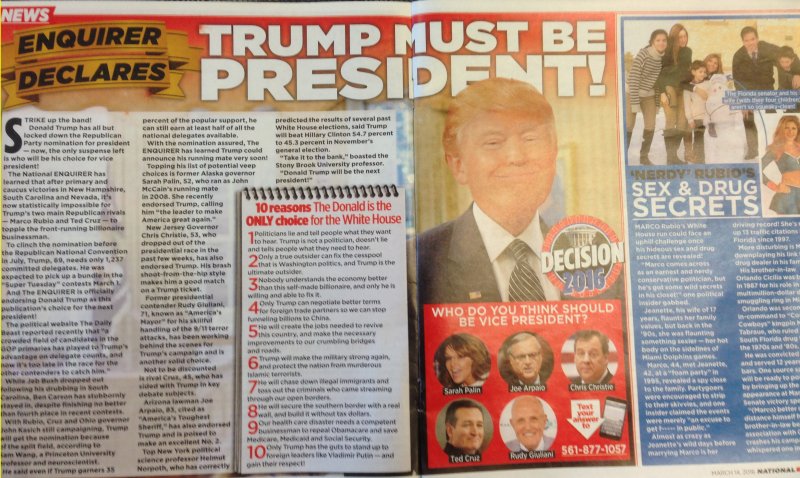
National Enquirer: “Trump Must Be President!”, and Rubio has sex & drug secrets
The Daily Beast notes that Trump has also been endorsed by the National Enquirer.
Excerpt:
The full endorsement… includes a list of “10 reasons The Donald is the ONLY choice for the White House.”
[…]Along with conservative website Breitbart, the Enquirer often reads like a political ally of Team Trump. And if it sounds like that endorsement was authored by Trump’s friends, that is because, well, it sort of was.
[…]Meanwhile, Trump’s other political enemies, such as Carly Fiorina, Marco Rubio, Ted Cruz (called “Boozin’ Ted” by the tabloid), and Jeb Bush have been absolutely savaged in the pages of the Enquirer. The supermarket tabloid reported that Bush, as governor of Florida, was embroiled in “sleazy cheating scandals…[with a] Playboy Bunny turned lawyer,” a rumor Bush had publicly denied over a decade ago.
[…]The unvarnished look at, say, Rubio has consisted of the Florida senator’s alleged past attendance at “gay [foam] parties” (the “Rubio is gay!” conspiracy theory is emerging asthe next big meme within certain pro-Trump and far-right communities), and a story on “NERDY” Marco Rubio’s “SEX & DRUG SECRETS.” The latter ran directly to the right of the publication’s recent endorsement of The Donald (pictured above).
[…]Trump became a National Enquirer contributor in August, writing an op-ed on his greatness. (It would not be the last time the Enquirer would bear his byline.)
Trump writes articles for the National Enquirer? Hmmmn. I wonder if he writes anonymous articles for the National Enquirer that insinuate nasty things about Ted Cruz, but have no evidence or statements from witnesses.
And along came a smear
I ask that because there is a National Enquirer story out now that smears Ted Cruz.
Here is Ted Cruz’s response to the National Enquirer story:
Everyone has to decide who to believe on their own.
Ron Fournier and Chuck Todd
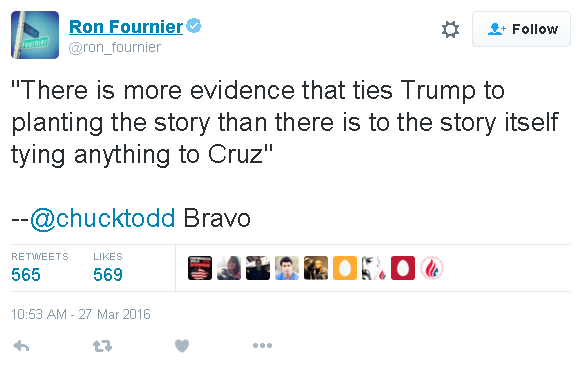
I was surprised to see this tweet from Ron Fournier, who is a person on the far left who gets respect from conservatives like me:
Ron Fournier of National Journal re-tweets Chuch Todd and says “Bravo”
Yesterday on Meet The Press Chuck Todd pointed out that Trump used an LBJ tactic of suggesting he hoped the National Enquirer story wasn’t true while trying to fan the flames of the smear.
But Todd says there’s simply more evidence that ties Trump to planting the story in the National Enquirer than there is to the story itself tying anything to Cruz…
Andrea Mitchell emphasized how close Trump’s relationship is with the National Enquirer, pointing out that they’ve even endorsed him.
When you have MSNBC saying that the story’s claims are less credible than the claim that Donald Trump deliberately planted the story in the National Enquierer, thanks to his good friend David Pecker, then you know the story is suspect. No one in the mainstream media has confirmed it, because there is no confirmation for it.
Michael Savage
The National Enquirer story so ridiculous that one of Trump’s biggest supporters – national radio show host Michael Savage – has threatened to yank his endorsement of Trump.
Michael Savage said today on his radio show that the National Enquirer story smearing Ted Cruz is completely false, and he knows this based on a source he says he would trust with his life. Savage points out that Cruz is rightly offended over this utter garbage.
But even more so, Savage says that he abhors these attempts of assassination by innuendo, as it has been done to him, and while he doesn’t blame Trump for the story, he threatens to withdraw his support of Trump if he doesn’t completely disavow the story and the man who owns the National Enquirer, David Pecker.
Now that Ted Cruz is gaining in the polls, I have to wonder about any National Enquirer articles that attempt to smear Cruz the same way that previous articles smeared Rubio, Bush, Carson, Fiorina, etc. Seems to me that Trump might be able to recover his lead if he could convince his good friend David Pecker to let him write an article about Ted Cruz – one with no evidence and no named witnesses. It might work to convince Trump’s supporters to return to him so that he doesn’t lose the primary to a surging Ted Cruz.
Sherlock Holmes and John Watson: let’s take a look at the facts
Here’s a lecture from N.T. Wright, whose multi-volume case for the historicity of the bodily resurrection of Jesus seems to be getting a lot of respect from the other side, (although I strongly disagree with his economic and political views, which are naive at best). Wright has taught at Cambridge University, Oxford University, Duke University, McGill University, and lectured on dozens of prestigious campuses around the world. He’s published 40 books.
N.T. Wright’s historical case for the bodily resurrection of Jesus
Wright basically argues that the resurrection cannot have been a myth invented by the early Christian community, because the idea of the Messiah dying and being bodily resurrected to eternal life was completely unexpected in Jewish theology, and therefore would not have been fabricated.
In Judaism, when people die, they stay dead. At the most, they might re-appear as apparitions, or be resuscitated to life for a while, but then die again later. There was no concept of the bodily resurrection to eternal life of a single person, especially of the Messiah, prior to the general resurrection of all the righteous dead on judgment day.
Wright’s case for the resurrection has 3 parts:
The Jewish theological beliefs of the early Christian community underwent 7 mutations that are inexplicable apart from the bodily resurrection of Jesus
The empty tomb
The post-mortem appearances of Jesus to individuals and groups, friends and foes
Here’s the outline of Wright’s case:
…the foundation of my argument for what happened at Easter is the reflection that this Jewish hope has undergone remarkable modifications or mutations within early Christianity, which can be plotted consistently right across the first two centuries. And these mutations are so striking, in an area of human experience where societies tend to be very conservative, that they force the historian… to ask, Why did they occur?
The mutations occur within a strictly Jewish context. The early Christians held firmly, like most of their Jewish contemporaries, to a two-step belief about the future: first, death and whatever lies immediately beyond; second, a new bodily existence in a newly remade world. ‘Resurrection’ is not a fancy word for ‘life after death’; it denotes life after ‘life after death’.
And here are the 7 mutations:
Christian theology of the afterlife mutates from multiples views (Judaism) to a single view: resurrection (Christianity). When you die, your soul goes off to wait in Sheol. On judgment day, the righteous dead get new resurrection bodies, identical to Jesus’ resurrection body.
The relative importance of the doctrine of resurrection changes from being peripheral (Judaism) to central (Christianity).
The idea of what the resurrection would be like goes from multiple views (Judaism) to a single view: an incorruptible, spiritually-oriented body composed of the material of the previous corruptible body (Christianity).
The timing of the resurrection changes from judgment day (Judaism) to a split between the resurrection of the Messiah right now and the resurrection of the rest of the righteous on judgment day (Christianity).
There is a new view of eschatology as collaboration with God to transform the world.
There is a new metaphorical concept of resurrection, referred to as being “born-again”.
There is a new association of the concept of resurrection to the Messiah. (The Messiah was not even supposed to die, and he certainly wasn’t supposed to rise again from the dead in a resurrected body!)
There are also other historical puzzles that are solved by postulating a bodily resurrection of Jesus.
Jewish people thought that the Messiah was not supposed to die. Although there were lots of (warrior) Messiahs running around at the time, whenever they got killed, their followers would abandon them. Why didn’t Jesus’ followers abandon him when he died?
If the early Christian church wanted to communicate that Jesus was special, despite his shameful death on the cross, they would have made up a story using the existing Jewish concept of exaltation. Applying the concept of bodily resurrection to a dead Messiah would be a radical departure from Jewish theology, when an invented exaltation was already available to do the job.
The early church became extremely reckless about sickness and death, taking care of people with communicable diseases and testifying about their faith in the face of torture and execution. Why did they scorn sickness and death?
The gospels, especially Mark, do not contain any embellishments and “theology historicized”. If they were made-up, there would have been events that had some connection to theological concepts. But the narratives are instead bare-bones: “Guy dies public death. People encounter same guy alive later.” Plain vanilla narrative.
The story of the women who were the first witnesses to the empty tomb cannot have been invented, because the testimony of women was inadmissible under almost all circumstances at that time. If the story were invented, they would have invented male discoverers of the tomb. Female discovers would have hampered conversion efforts.
There are almost no legendary embellishments in the gospels, while there are plenty in the later gnostic forgeries. No crowds of singing angels, no talking crosses, and no booming voices from the clouds.
There is no mention of the future hope of the general resurrection, which I guess they thought was imminent anyway.
To conclude, Wright makes the argument that the best explanation of all of these changes in theology and practice is that God raised Jesus (bodily) from the dead. There is simply no way that this community would have made up the single resurrection of the Messiah – who wasn’t even supposed to die – and then put themselves on the line for that belief.
And remember, the belief in a resurrected Jesus was something that the earliest witnesses could really assess, because they were the ones who saw him killed and then walking around again after his death. They were able to confirm or deny their belief in the resurrection of Jesus based on their own personal experiences with the object of those beliefs.