
Category Archives: News

As Christianity declines in Europe, churches are put up for sale

I have a key that will unlock a puzzling mystery

This sad story is from the Wall Street Journal.

Excerpt:

Two dozen scruffy skateboarders launched perilous jumps in a soaring old church building here on a recent night, watched over by a mosaic likeness of Jesus and a solemn array of stone saints.

This is the Arnhem Skate Hall, an uneasy reincarnation of the Church of St. Joseph, which once rang with the prayers of nearly 1,000 worshipers.

It is one of hundreds of churches, closed or threatened by plunging membership, that pose a question for communities, and even governments, across Western Europe: What to do with once-holy, now-empty buildings that increasingly mark the countryside from Britain to Denmark?

[…]The closing of Europe’s churches reflects the rapid weakening of the faith in Europe, a phenomenon that is painful to both worshipers and others who see religion as a unifying factor in a disparate society.

[…]The Church of England closes about 20 churches a year. Roughly 200 Danish churches have been deemed nonviable or underused. The Roman Catholic Church in Germany has shut about 515 churches in the past decade.

But it is in the Netherlands where the trend appears to be most advanced. The country’s Roman Catholic leaders estimate that two-thirds of their 1,600 churches will be out of commission in a decade, and 700 of Holland’s Protestant churches are expected to close within four years.

[…]As communities struggle to reinvent their old churches, some solutions are less dignified than others. In Holland, one ex-church has become a supermarket, another is a florist, a third is a bookstore and a fourth is a gym. In Arnhem, a fashionable store called Humanoid occupies a church building dating to 1889, with racks of stylish women’s clothing arrayed under stained-glass windows.

In Bristol, England, the former St. Paul’s church has become the Circomedia circus training school. Operators say the high ceilings are perfect for aerial equipment like trapezes.

In Edinburgh, Scotland, a Lutheran church has become a Frankenstein-themed bar, featuring bubbling test tubes, lasers and a life-size Frankenstein’s monster descending from the ceiling at midnight.

Jason MacDonald, a supervisor at the pub, says he has never heard complaints about the reuse. “It’s for one simple reason: There are hundreds and hundreds of old churches and no one to go to them,” Mr. MacDonald said. “If they weren’t repurposed, they would just lie empty.”

Many churches, especially smaller ones, are becoming homes, and that has spawned an entire industry to connect would-be buyers with old churches.

The churches of England and Scotland list available properties online, with descriptions worthy of a realty firm. St. John’s church in Bacup, England, for example, is said to feature “a lofty nave as well as basement rooms with stone-vaulted ceilings,” and can be had for about $160,000.

There are many reasons why Christianity has declined in Europe, but surely the widespread embrace of left-wing economic policies – even by evangelical Christians – is one of the largest.

Here’s a fairly recent paper (PDF) that explains it:

What accounts for cross-national variation in religiosity as measured by church attendance and non-religious rates? Examining answers from both secularization theory and the religious economy perspective, we assert that cross-national variation in religious participation is a function of government welfare spending and provide a theory that links macro-sociological outcomes with individual rationality. Churches historically have provided social welfare. As governments gradually assume many of these welfare functions, individuals with elastic preferences for spiritual goods will reduce their level of participation since the desired welfare goods can be obtained from secular sources. Cross-national data on welfare spending and religious participation show a strong negative relationship between these two variables after controlling for other aspects of modernization.

I have many friends in the UK who classify themselves as evangelical Christians. They almost all embrace moderate to leftist economics, and they complain to me about why the church is in decline, why there is no interest in apologetics, why they can’t find Christian girlfriends, why they can’t get speaking engagements. The answer is, of course, that by majoring only in theology and apologetics, they have crafted the rope that their secular allies in government are using to hang them. Leftism is embraced by European Christians in part because they don’t want to be like those dastardly Americans with their free enterprise system and their rule of law and their private property and their law-abiding gun ownership.

It just goes to show you why Christianity suffers when we focus on piety at the expense of practicality. Too much A. W. Tozer, not enough F.A. Hayek. I doubt my well-meaning UK Christian friends – who are so proud of their laughable NHS health care – even know who F.A. Hayek is. To think that Lady Thatcher ones brandished “The Constitution of Liberty” by F.A. Hayek and declared “this is what we believe!”. But ordinary UK Christians do not believe what she believes, and now they must reap what they sowed with their knee-jerk rejection of the free enterprise system. Ignorance of economics killed Christianity in Europe, and pious, risk-averse Christians were willing participants in the murder.
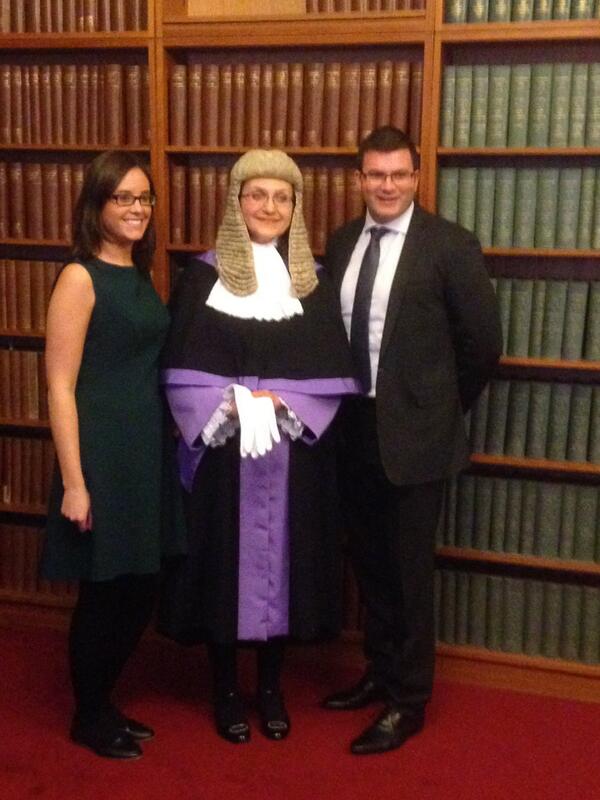
Christian NHS worker who gave a book to Muslim co-worker loses her appeal

Judge Jennifer Jane Eady, Queens Counsel

The UK Telegraph reports on the state of religious liberty in the United Kingdom.

Excerpt:

A Christian NHS worker suspended for giving a religious book to a Muslim colleague has lost her appeal against a ruling that the decision to discipline her was lawful.

Victoria Wasteney, 39, was found guilty by her NHS employer in 2014 of “harassing and bullying” a work friend for giving her a book about a Muslim woman’s encounter with Christianity, praying with her and asking her to church.

She was suspended for nine months and given a written warning, even though the woman had been happy to discuss faith with her and never gave evidence about her allegations to the NHS.

Ms Wasteney, a senior occupational therapist, challenged the decision by East London NHS Foundation Trust at an employment tribunal last year, but it ruled that her employer had not discriminated against her.

A judge gave her the chance to appeal against that decision, saying it should consider whether the original ruling had correctly applied the European Convention on Human Rights’ strong protection of freedom of religion and expression.

But at a hearing in central London on Thursday, Her Honour Judge Eady QC dismissed the appeal.

Following the decision, Miss Wasteney, from Epping, Essex, said: “What the court clearly failed to do was to say how, in today’s politically correct world, any Christian can even enter into a conversation with a fellow employee on the subject of religion and not, potentially, later end up in an employment tribunal.

“If someone sends you friendly text messages, how is one to know that they are offended? I had no idea that I was upsetting her.”

[…]The woman, who quit her job shortly after making the complaints, never gave any evidence about her allegations to the NHS or later to the employment tribunal.

It sounded to me like the Muslim woman encouraged the Christian woman and the Christian woman was later surprised by the complaints. I think most Christians can take no for an answer, but Christians are caring, and they see offering to pray and offering to bring someone to church as a caring thing to do. If they don’t hear a no, then they keep right on doing what comes naturally to Christians – talking about spiritual things and trying to lead others to the Lord.

It was much easier to do this in the past, before people got more concerned about not feeling offended than they were about discussing what is or is not true. So now, even in a country like England, you can be anything you want to be as long as you’re not behaving like a Christian in public. I think this is especially the case when the people who adjudicate these cases are more focused on feelings… the person who feels the most offended seems to win all the time.

Before I had an alias, I had experience dealing with co-workers who did not much like me talking about spiritual things at work. Some types of people are more risky than others, I’ve found. That’s when I started to make rules based on my experiences, about who was and who was not safe to talk to. And that’s when I decided that to really say what I wanted to say, I’d have to get an alias, and not tell too many co-workers about it.

So who is dangerous? Obviously, people who are committed to a sinful lifestyle already are dangerous to talk to. I don’t talk to people about anything interesting if they are committed to a sinful lifestyle, because they will feel obligated to discuss issues defensively, rather than in a truth-focused way. I also avoid people who are more focused on feelings, family and community above truth. They tend to be more focused on feeling good and getting along, and they are the worst people to disagree with. The safest people are people who like to argue about what is true, and who respond to evidence.

So how to detect who is safe? Well, If the person talks about themselves a lot, and about their feelings, and happy experiences, and their vacations, their families and popular culture fluff, then I would avoid them. Don’t say a word to them. The ones who are safer are the ones who accept disagreements and don’t just rush to agree with you while hiding their own opinions in order to be liked. You also want to avoid people who take everything personally, instead of debating the outside world with a focus on what is true.

I am terrified of people who try to agree with me on everything, or who cannot explain both sides of an issue respectfully. I watch what people watch on TV in the gym – if it’s sports, housewives of beverly hills, or other shallow life enhancement fluff, then I don’t talk to them. If it’s news or business, then it’s safer to talk to them – because then you can talk about facts. Beware of people who try to jump to agreement quickly, without showing any evidence or reasons for their view. It’s always better to talk about issues in the abstract, rather than offering to pray or asking someone to church. For example, you can discuss whether the universe had a beginning, or which books of the Bible were written early. Christians need to learn how to do that – how to talk about facts.

A good question to ask to test a person is to ask where they get their news. If there is no balance there, then it’s a good sign to avoid them. Two of my leftist co-workers this week asked me why I thought that the Washington Post and the New York Times were “radically leftist”. I asked them to name conservative columnists at either paper. They couldn’t name a single one. One tried to google it right in front of me! I named Arthur Brooks, Ross Douthat, Jennifer Rubin, etc. and explained why they weren’t conservative. Then I listed off a half-dozen liberal names at the Washington Post. If the person you are talking to is in a bubble, then they are too risky to talk to. Pretty much everyone on the secular left is that way, and you should check first by seeing what they read for news. If they’re not safe, then get yourself an alias and write something online, instead.

Will there be a contested convention in Cleveland? Will Ted Cruz win it?

Wisconsin Governor Scott Walker, Texas Senator Ted Cruz, and Heidi Cruz

A lot of people are asking me what Cruz chances are to defeat Trump and win the nomination. I’m going to look at three columns, one from radically leftist CNN, one from the radically leftist Washington Post, and one from National Review. I found both of these stories at the Conservatives 4 Ted Cruz news aggregator, by the way. I check that site at least twice a day, and so should you.

The first one is from David Gergen at CNN. David Gergen is a senior political analyst for CNN and has been a White House adviser to four presidents. A graduate of Harvard Law School, he is a professor of public service and co-director of the Center for Public Leadership at the Harvard Kennedy School.

His headline is “Ted Cruz: Now the odds-on favorite”:

With his decisive victory in Wisconsin, Sen. Ted Cruz has not only shaken up the Republican presidential race, but heading into the homestretch, he has suddenly become the odds-on favorite to win the nomination in Ohio.

With 16 primaries and caucuses remaining, Donald Trump has to win 70% of the delegates to secure the 1,237 needed to win a first ballot at the Republican convention. Several states are coming up that are more favorable territory for Trump than Cruz, especially New York and Pennsylvania where Trump still has significant leads.

Even so, winning more than two thirds of the remaining delegates is a daunting challenge for him. In the 36 primaries and caucuses leading up to Wisconsin, Trump won only 46% of the delegates. And now he heads down a tough homestretch with Cruz seizing the momentum.

In a year crammed with surprises, no one can say for sure what will unfold in Cleveland, Ohio. But there are two likely outcomes: First, Cruz and Trump have each vowed to vote against a change in the GOP’s Rule 40. That’s an obscure provision that requires any candidate to win at least eight primaries and caucuses before he or she can be nominated.

Trump and Cruz will be the only two people in Cleveland with that distinction. They should also have enough delegate strength between them to block a rewrite of Rule 40. In other words, potential candidates like John Kasich, Paul Ryan and Mitt Romney won’t be eligible even if many delegates think them likely to fare better against Hillary Clinton — the race could narrow to Trump vs. Cruz.

If Trump then falls short on the first ballot, there will be a donnybrook. But it is now becoming apparent that Cruz is much better prepared to win that fight. Trump has run a campaign long on the outside game of televised rallies but short on the inside game of quietly piling up delegates.

By contrast, Cruz has been superlative playing to the inside. Just look at how craftily he captured delegates away from Trump a few days ago in North Dakota. (The capacity of the Obama team to play the inside game so well helped to propel them past Hillary Clinton in 2008.)

In a first ballot, delegates must vote for the candidate to whom they are pledged but thereafter, of course, may vote for someone else. Signs increasingly point to the fact that Republican party regulars pledged to Trump are ready to bolt on a second or third ballot. With Cruz the only other man in the race, that almost certainly means they will drift — rush? –toward the Texan, and he will take the crown.

That’s an accurate analysis. The most likely scenario now is that Cruz capitalizes on his momentum to deny Trump the delegates he needs to get to 1,237 before the convention, then wins the nomination on round 2 or later, when the GOP delegates from each state become “unbound”. And Cruz is already reaching out to the delegates to make sure that they choose him in round 2 and later rounds, as they free up.

Can Cruz win a contested convention?


Now, I’m going to balance that with something hilarious from moderate conservative Pulitzer Prize–winning syndicated columnist George Will, writing in National Review.

Will’s column is entitled “Ted Cruz Is Surging by Design”:

People here at Ted Cruz’s campaign headquarters are meticulously preparing to win a contested convention, if there is one. Because Donald Trump is a low-energy fellow, Cruz will be positioned to trounce him in Cleveland, where Trump’s slide toward earned oblivion would accelerate during a second ballot.

[…]For months Cruz’s national operation has been courting all convention delegates, including Trump’s. Cruz aims to make a third ballot decisive, or unnecessary.

On the eve of Wisconsin’s primary, the analytics people here knew how many undecided voters were choosing between Cruz and Trump (32,000) and how many between Cruz and John Kasich (72,000), and where they lived. Walls here are covered with notes outlining every step of each state’s multistage delegate-selection process. (Cruz’s campaign was active in Michigan when the process of selecting persons eligible to be delegates began in August 2014.) Cruz’s campaign is nurturing relationships with delegates now committed to Trump and others. In Louisiana’s primary, 58.6 percent of voters favored someone other than Trump; Cruz’s campaign knows which issues are particularly important to which Trump delegates, and Cruz people with similar values are talking to them.

[…]Usually, more than 40 percent of delegates to Republican conventions are seasoned activists who have attended prior conventions. A large majority of all delegates are officeholders — county commissioners, city council members, sheriffs, etc. — and state party officials. They tend to favor presidential aspirants who have been Republicans for longer than since last Friday.

Trump is a world-class complainer (he is never being treated “fairly”) but a bush-league preparer. A nomination contest poses policy and process tests, and he is flunking both.

Regarding policy, he is flummoxed by predictable abortion questions because he has been pro-life for only 15 minutes, and because he has lived almost seven decades without giving a scintilla of thought to any serious policy question. Regarding process, Trump, who recently took a week-long vacation from campaigning, has surfed a wave of free media to the mistaken conclusion that winning a nomination involves no more forethought than he gives to policy. He thinks he can fly in, stroke a crowd’s ideological erogenous zones, then fly away. He knows nothing about the art of the political deal.

The nomination process, says Jeff Roe, Cruz’s campaign manager, “is a multilevel Rubik’s Cube. Trump thought it was a golf ball — you just had to whack it.” Roe says the Cruz campaign’s engagement with the granular details of delegate maintenance is producing a situation where “the guy who is trying to hijack the party runs into a guy with a machine gun.”

Cruz graduated at the top of his classes at Princeton and Harvard Law. He clerked for Court of Appeals Justice J. Michael Luttig and Supreme Court Chief Justice William Rehnquist. Insofar as this primary election is a contest based on hard work and preparation, Cruz will win it. And then he’s going to beat Hillary.