Category Archives: Mentoring

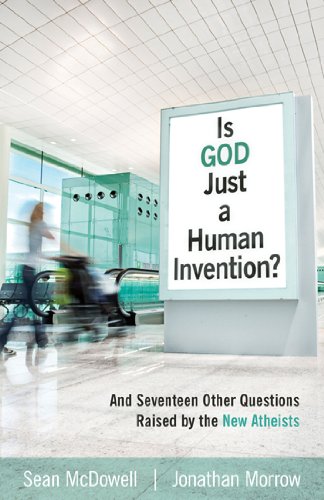
Review of the book “Is God Just a Human Invention?”

Is God Just A Human Invention?

The thorough, chapter-by-chapter review of the book is here at Apologetics 315.

Excerpt:

One of the brashest challenges that religious truth has experienced over the past several decades is the remarkable rise of the pugnacious New Atheists. Sean McDowell and Jonathan Marrow, new generation Christian apologists, have undertaken the task of contesting this anti-theistic upsurge. And in Is God Just a Human Invention? And Seventeen Other Questions Raised by the New Atheists the authors have pulled together a wide range of research that powerfully critiques the arguments from the combative non-theists.

[…]The authors deal with the scientific and philosophical challenges to Christian theism in a reasoned and respectful manner.

[…]Is God Just a Human Invention? is loaded with exceptional quotes from Christian and non-Christian thinkers. Additionally, the book furnishes very short essays at the back of each chapter from various erudite Christian scholars that augment the thesis of what was advanced by the authors.

This volume combines simplicity and applicability without forfeiting precision. The authors lead the reader into the full girth of the many contemporary discussions concerning the defense of Christianity. They offer several of the leading arguments for Christian theism while toppling some of the most belligerent of the objections promoted by the New Atheists. They have written, with abundant care, to attain a thoroughness that is not often established in popular books. The wisdom and excellence with which each chapter is written makes this a crucial volume for the budding apologist’s library.

Here are the 18 topics, and after each topic a Christian scholar discusses the relevance of each topic.

  1. Is Faith Irrational? (Commentary by: Gregory Koukl)
  2. Are Science and Christianity at Odds? (Commentary by: John Warwick Montgomery)
  3. Are Miracles Possible? (Commentary by: Gary R. Habermas)
  4. Is Darwinian Evolution the Only Game in Town? (Commentary by: William A. Dembski)
  5. How Did the Universe Begin? (Commentary by: R. Douglas Geivett)
  6. How Did Life Begin? (Commentary by: Fazale R. Rana)
  7. Why Is the Universe Just Right for Life? (Commentary by: Jay W. Richards)
  8. Has Science Shown There Is No Soul? (Commentary by: Dale Fincher and Jonalyn Fincher)
  9. Is God Just a Human Invention? (Commentary by: Garry DeWeese)
  10. Is Religion Dangerous? (Commentary by: Douglas Groothuis)
  11. Does God Intend for Us to Keep Slaves? (Commentary by: Paul Copan)
  12. Is Hell a Divine Torture Chamber? (Commentary by: Frank Turek)
  13. Is God a Genocidal Bully? (Commentary by: Clay Jones)
  14. Is Christianity the Cause of Dangerous Sexual Repression? (Commentary by: Kerby Anderson)
  15. Can People Be Good Without God? (Commentary by: Mark D. Linville)
  16. Is Evil Only a Problem for Christians? (Commentary by: Randy Alcorn)
  17. What Good Is Christianity? (Commentary by: Glenn S. Sunshine)
  18. Why Jesus Instead of the Flying Spaghetti Monster? (Commentary by: Darrell L. Bock)

If you’re looking for a good book on Christian apologetics for beginners, this is a great choice.

By the way, my Dad is currently reading my copy of this book! So it’s fine for normal people.

I have some book reviews that people have sent me in my inbox, so maybe I should be reading them and posting them too! I get a bit behind on e-mail, though.

Ten pitfalls of the foolish Christian apologist

From Apologetics 315, a list of ten common traps that Christian apologists fall into.

Here are my really bad ones: (links removed)

1. The foolish apologist speaks before listening. Proverbs 18:13 says, “He who answers before listening – that is his folly and his shame.” Not only does he communicate to others that he could care less about what they have to say, but he also becomes unable to give a well informed answer. The wise apologist is patient, seeks to understand, and avoids monologue.

7. The foolish apologist neglects spiritual disciplines. He finds reading philosophy more interesting than reading the Bible, so he neglects the Bible. Prayer is seldom and rushed. In fact, prayer, meditation, Bible study, worship and fellowship take the back seat to study. The foolish apologist deceives himself that he is being spiritual, all the while drifting away. The wise apologist sits at the feet of Jesus.

9. The foolish apologist isolates himself from others. He doesn’t need their input. He doesn’t appreciate correction. He has his own plans, his own agenda, and own personal ministry. He refuses to let iron sharpen iron. When he falls, he has no one to help him up. He’s accountable to himself only. The wise apologist surrounds himself with godly counsel and fellow laborers.

I know that some people will think that I am guilty of number 8, but sometimes you have to break the rules in order to get the conversation started, and then walk it back later.  That’s how you get the other person to engage.

Do any of these pitfalls that Christian apologists fall into sound familiar to you?

Michael Murray explains how to talk about religion in the public square

In this post, I want to discuss a research paper by evangelical Christian philosopher Michael J. Murray. The title of the paper is “Who’s Afraid of Religion?”

Murray begins with a distinction, as philosophers love to do:

…we would be perfectly happy to have a discussion of claims like…”Mahayana Buddhism emerged in the first century BCE with the appearance of the Mahayana sutras.” … It is OK to speak of religion… as a historical phenomenon or a socio-cultural influence. It is something altogether different to discuss religious commitments that one owns. That is the sort of religion that troubles us.

People who aren’t religious feel discomfort about hearing about the religious beliefs of others, because those beliefs influence public policy, but (they think) those beliefs are based non-rational factors, such as place of birth, parental beliefs, peer groups, emotions, prejudices, superstitions, etc. They are uncomfortable living in a government that was voted in by people whose views are based on irrational religious beliefs.

Murray has some illustrations of this “theo-phobia” here:

…think about the last time you heard a devoutly religious person argue, on explicitly religious grounds, that gay marriage should be banned, or that intelligent design should be taught in the public school biology curriculum, or that abortion is murder and thus should be outlawed.

He thinks that arguing for views on pureliy religious grounds makes people uncomfortable.

And I agree with that. I feel uncomfortable when people argue for positions from faith-based premises, especially if I don’t believe in their religion. But do discussions of religious beliefs necessarily have to be about faith-based personal preferences? Or is there another way to discuss religion that doesn’t make non-religious people squirm with discomfort?

In the remainder of the paper, Murray explores five reasons why theo-phobia exists in academic settings:

  1. Religion supports oppression, violence, and tyranny and is thus best ignored, excluded or perhaps even actively opposed.
  2. Religion is a personal or subjective matter and as a result can’t be subjected to canonical standards of rational scrutiny. It thus has no place in the academy.
  3. Religion can’t have a role in scholarly inquiry since it at best plays a balkanizing role in the scholarly world.
  4. If religion is allowed to have a role in the academy it will quickly intrude into domains where it does not belong.
  5. Reason #5 is kept secret until the end of the paper.

Regarding point 1, Murray argues that religious excesses can be controlled by falsifying the religion using reason and evidence, because religions make testable claims. So, if academics are afraid of the excesses of a dangerous religion, they should falsify it by arguing that its claims are false. There is no reason to be afraid of expressions of religious belief when you are free to argue against the testable truth claims of that religion.

I repeat: different religions make different claims about the external world. Either the universe had a beginning (Christianity) or it didn’t (Mormonism). Either Jesus died on the cross (Christianity) or he didn’t (Islam). If academics are worried about the effects of some religion, they can argue against it! If a religious person is not willing to defend the testable truth claims, then they are discredited anyway by refusing to engage.

For the remaining 4 points, especially the last one, I recommend you read the whole article. Give it to your friends, religious and non-religious, who believe that faith is fundamentally different from other academic disciplines. Some truth claims of different religions can be tested. And Christians especially should help others to feel comfortable talking to them by sticking to testable truth claims and publicly accessible evidence.

I’ll give you a hint about reason #5, from atheist philosopher Thomas Nagel of New York University. Nagel is quoted as follows:

“In speaking of the fear of religion, I don’t mean to refer to the entirely reasonable hostility toward certain established religions and religious institutions, in virtue of their objectionable moral doctrines, social policies, and political influence. Nor am I referring to the association of many religious beliefs with superstition and the acceptance of evident empirical falsehoods. I am talking about something much deeper–namely, the fear of religion itself. I speak from experience, being strongly subject to this fear myself: I want atheism to be true and am made uneasy by the fact that some of the most intelligent and well-informed people I know are religious believers.
(“The Last Word” by Thomas Nagel, Oxford University Press: 1997)

So we learn from Murray that religions stand or fall based on logical consistency and empirical validation against the external world, just like any other academic discipline. So long as you stick to discussing the public, testable claims of religions, there is no reason to be uncomfortable about discussing religions. Don’t discuss the parts of a religion that can’t be tested, only discuss the parts that can be tested.

(Note: Nagel isn’t all bad, he defends intelligent design as science in a research paper summarized here).

If you would like to see how you can discuss religion in a public forum, check out this debate between a Christian philosopher, William Lane Craig, and an atheist Christopher Hitchens:

It can be done. Theists just have to learn to stick to discussing things that can be tested and proved using public knowledge.

Positive arguments for Christian theism