
Category Archives: Commentary

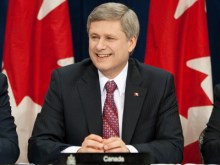
Canadian prime minister Stephen Harper interviewed by Larry Kudlow

Canadian Prime Minister Stephen Harper

Larry Kudlow sat down with Canadian prime minister Stephen Harper and had a conversation about Canada’s economic situation and policies. (Video here)

Kudlow first asks Harper about the banking situation in Canada. Harper says that the banks are run much more tightly in Canada. Harper explains that there are no bailouts planned for Canadian banks because Canadian banks are private institutions.

KUDLOW: Let me begin with an interesting subject here, banking. Everybody’s talking about banking. The Canadian banks appear to be in much better shape than the American banks. They have fewer toxic assets. Their losses aren’t nearly as bad. No one’s talking about bankruptcy up there. I want to learn from our northern cousins. What can you tell us? Why are Canadian banks looking better than our banks?

HARPER: Well first of all I can tell you, it is true. We have, I think, the only banks in the western world where we’re not looking at bailouts or anything like that.

KUDLOW: No TARP money sir, if I’m not mistaken? No TARP money?

HARPER: We haven’t got any TARP money. We’ve gone in and done some market transactions with our banks to improve liquidity. But I think the reasons are really complex, Larry. You know, first of all, our banks are private. We don’t have a Fannie Mae or Freddie Mac equivalent mucking around in the system.

KUDLOW: Is that a lesson right there Prime Minister?

HARPER: Well, I think my observation is those are institutions with a difficult private/public mix. And sometimes private/ public mixes have benefits and sometimes they have the worst of both worlds. We don’t have anything like that. We do have though, a strong system of regulation, and activist regulators, who go and meet with the sector. But they’re macro, prudential kind of regulations. They don’t try and micromanage banks’ decisions. We try and establish good oversight and transparency.

KUDLOW: Do you have leverage and borrowing ratios that might have been enforced? Because that’s clearly one of the breakdowns here in the states?

HARPER: Well, we do have leverage ratios. What’s ironic is that our own banks had not actually achieved those ratios. They were actually working under them. Part of what we…

KUDLOW: They were under leveraged?

HARPER: They were under leveraged.

KUDLOW: Wait, wait. Canadian banks were under leveraged?

HARPER: Under what they could have been.

KUDLOW: I didn’t know there was such a thing on this entire planet earth.

HARPER: Well I think part of what we have done is through the system of regulation we’ve had, we’ve encouraged a fairly cautious culture in the banks. For example, our banks, when they sign mortgages, largely hold those mortgages rather than trading them. So they have a lot more interest in the underlying quality of those mortgages. And we avoided the sub-prime kind of problem.

Kudlow goes on to quiz Harper on individual income tax rates, corporate income tax rates, tax cuts, Canadian energy production, carbon emissions, protectionism/free trade and auto-union bailouts. If you want to know what it is like to have an F.A. Hayek-admiring economist running your country, (BA and MA in Economics from the University of Calgary), read the whole thing!

UPDATE: More interviews with Stephen Harper with CNN, Wall Street Journal and Fox Business are here!

Vladimir Putin tells America that socialism doesn’t work

Found this transcript of Putin’s remarks in the Wall Street Journal. The story was linked over on John Lott’s blog.

Putin opposes protectionism:

We must not revert to isolationism and unrestrained economic egotism. The leaders of the world’s largest economies agreed during the November 2008 G20 summit not to create barriers hindering global trade and capital flows. Russia shares these principles.

Putin opposes state intervention in the economy:

Excessive intervention in economic activity and blind faith in the state’s omnipotence is another possible mistake.

True, the state’s increased role in times of crisis is a natural reaction to market setbacks. Instead of streamlining market mechanisms, some are tempted to expand state economic intervention to the greatest possible extent.

Putin opposes big government:

The concentration of surplus assets in the hands of the state is a negative aspect of anti-crisis measures in virtually every nation.

In the 20th century, the Soviet Union made the state’s role absolute. In the long run, this made the Soviet economy totally uncompetitive. This lesson cost us dearly.

Putin opposes wealth redistribution and welfare:

Nor should we turn a blind eye to the fact that the spirit of free enterprise, including the principle of personal responsibility of businesspeople, investors and shareholders for their decisions, is being eroded in the last few months. There is no reason to believe that we can achieve better results by shifting responsibility onto the state.

Putin opposes bailouts and deficit spending:

And one more point: anti-crisis measures should not escalate into financial populism and a refusal to implement responsible macroeconomic policies. The unjustified swelling of the budgetary deficit and the accumulation of public debts are just as destructive as adventurous stock-jobbing.

Putin goes on to give recommendations on how to solve the problem.

I can’t believe that America and the USSR have switched places. What is the world coming to? Obama has unilaterally plunged us into bankruptcy and angered the entire world with his naive protectionism. How could we have been so ignorant as to have elected someone with no knowledge of economics whatsoever? During an economic crisis!

First report from William Lane Craig’s Quebec speaking tour

William Lane Craig completed his tour in Quebec, Canada on 2/13/09. One of the Quebecois students named Martin wrote to Dr. Craig, challenging him on many aspects of his presentation. Quebec is widely regarded as the most secular and progressive of the Canadian provinces, so I was delighted to hear from this student, but I don’t think Dr. Craig spent enough time replying to him, so I will help.

First, if you need a refresher on Craig’s standard 20 minute opening speech, look here (opening speech from the Craig-Pigliucci debate, audio from the Craig-Stenger debate, video from the Craig-Dacey debate). Bill usually argues for God from the origin of the universe, the fine-tuning of the universe for permitting life of any kind, objective moral values, the resurrection of Jesus as a historically-testable miracle claim, and the immediate personal experience of God.

The student Martin starts off by complaining that atheism is an adequate foundation for rational moral behavior. He writes:

…you know as well as I do that any thinking person, atheist or no, understands why rape isn’t acceptable in modern society. Being an atheist isn’t being a hedonist, and I feel that it’s pathetic I need to remind you of this.

Notice that Martin links the moral rules to the time and place in which he lives. Rape isn’t really wrong for all times and places, it’s wrong for us in this society in this time.

First of all, on atheism morality is an illusion. In an accidental universe, the only morality that exists is when societies make them up. In that sense, morality is similar to the fashion of clothing – it is purely convention. It varies by time and place. It is completely arbitrary. Let me explain some of the problems with briefly here, but a longer treatment is here.

On atheism, there is no non-physical soul, and no free will. There are therefore no moral choices nor is there moral responsibility. On atheism moral behavior is ultimately futile, as humans are all going to die individually and collectively in the heat death of the universe: it does not matter if you are moral or not, on atheism. On atheism, there is no standard by which to judge individual moral progress, or the evil in other cultures, such as widow-burning or slavery.

When an atheist speaks about morality, is isn’t talking about the way humans everywhere ought to be, he is talking about social conventions. When an atheist acts morally, he is simply imitating the fashions of the people around him – either to please himself by feeling moral, or to please other people. If they can escape the social consequences, it would be irrational for them to do the right them if it gives them no pleasure.

By the way, it’s not just me who says this. Richard Taylor, an atheist who once debated against William Lane Craig, says this:

The idea of political or legal obligation is clear enough… Similarly, the idea of an obligation higher than this, referred to as moral obligation, is clear enough, provided reference to some lawgiver higher…than those of the state is understood. In other words, our moral obligations can…be understood as those that are imposed by God…. But what if this higher-than-human lawgiver is no longer taken into account? Does the concept of moral obligation…still make sense? …The concept of moral obligation [is] unintelligible apart from the idea of God. The words remain but their meaning is gone. (Richard Taylor, Ethics, Faith, and Reason (Englewood Cliffs, N. J.: Prentice-Hall, 1985), p. 83-84)

Next, Martin argues that the anthropic principle is an adequate refutation of the fine-tuning of the physical constants of the universe for life. The anthropic principle is the idea that the presence of intelligent life causes the constants to be fine-tuned 14 billion years ago. He writes:

Impressing a room full of vaguely interested people with figures about the extremely rare conditions that allow life to exist is all well and good – handwaving away the entire anthropic principle with a single bad analogy is not.

Regarding Martin’s claim about fine-tuning being explained by the anthropic principle, let me say this. First, the fine-tuning is real. If you change the constants of physics in the big bang, the universe will not support life of any kind. Consider another Martin, Martin Rees, an atheist and the British Astronomer Royal. In his book “Just Six Numbers: The Deep Forces That Shape The Universe”, he discusses 6 finely-tuned numbers.

Rees writes here:

These six numbers constitute a ‘recipe’ for a universe. Moreover, the outcome is sensitive to their values: if any one of them were to be ‘untuned’, there would be no stars and no life. Is this tuning just a brute fact, a coincidence? Or is it the providence of a benign Creator?

It is impossible for humans, who just appeared relatively recently, to have any causal impact on the selection of these physical constants 14 billion years ago. I discuss two known responses to the fine-tuning problem, (unobservable multiverse and non-existent observer), here.