Category Archives: Commentary

Harvard economist says stimulus was designed to reward Democrat constituencies

EVERYONE  PLEASE GO VOTE TODAY! (NOVEMBER 2nd, 2010)

Hans Bader at the Competitive Enterprise Institute comments on a new published paper by Harvard economist Jeffrey Miron, which explains why the stimulus failed to stimulate the economy and to create more jobs.

The paper is here. (PDF)

Excerpt:

Harvard economist Jeffrey Miron explains why the $800 billion stimulus package failed in a recent article.

What’s interesting about Dr. Miron’s critique is that he shows how the stimulus was a failure even if you take for granted liberal assumptions about economic policy (such as Keynesian economic theory), since it was so badly designed and executed that it failed to achieve its goals, spending wastefully while failing to revive the economy.  Indeed, the stimulus was so poorly tailored to the economy (and the goal of reducing unemployment) that Miron concludes that it was designed to reward politically connected “constituencies” and special-interest groups, like public-employee unions, rather than being focused on ”economic stimulus.”

Other Harvard economics professors like Robert Barro have also criticized the stimulus package. Barro called it “the worst bill that has been put forward since the 1930s.”  Former Obama economic advisor Martin Feldstein, a Harvard professor who is a big believer in stimulus packages in principle, said that the stimulus designed by Obama and congressional Democrats was “poorly done

Much stimulus money has been wasted.  It has gone to prisoners and dead people, wasteful welfare spending, abandoned bridges to nowhere, and unnecessary government buildings.  The stimulus subsidized foreign green jobs and wiped out jobs in America’s export sector.

The “’stimulus’ is not the road to economic recovery. It’s the problem, not the solution, writes Nobel Prize winning economist Vernon L. Smith.” Other Nobel Laureates like Gary Becker have also criticized the stimulus package.  200 economists signed a statement publicly opposing the stimulus package in an ad published in the Washington Post and New York Times.

So the stimulus bill was a failure because it was not designed to grow the economy or create jobs.

What was the real purpose of the stimulus bill?

George Mason University professor Veronique de Rugy looked at recovery.org and found that Democrat districts got more stimulus money than Republican districts.

Here’s the first chart:
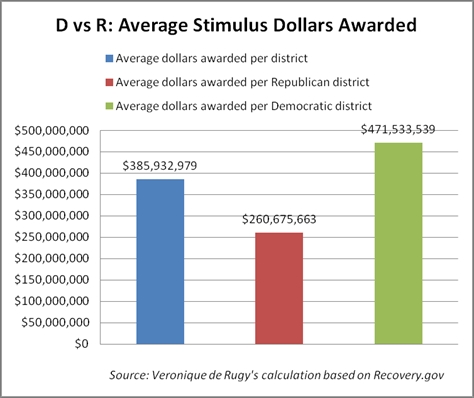
Stimulus spending by voting district affiliation

She writes:

…based on my new analysis of the Recovery.org data, Democratic districts are getting 1.8 times more money on average than Republican districts. Using Recovery.gov data, and cleaning it up seriously to be able to use it, we find that Republican districts are getting on average $260.6 million in stimulus awards while democratic districts are getting on average $471.5 million. The average is award per district is $385.9 million.

Interestingly, my data also confirms that the stimulus funds are not allocated based on unemployment rates or even variations in unemployment rates. So basically,  if the administration believes that government spending can create jobs, the allocation of the funds doesn’t show it.

And here’s the second chart showing which government departments got stimulus money.

Stimulus spending by government department
Stimulus spending by government agency

She writes:

Based on the Recovery.gov data, more than two third of the 594,754.3 jobs “created or saved” with the stimulus funds were “created or saved” in the Department of Education (see chart).  Basically, what the administration meant by shovel ready projects was funding for your next door teacher.

[…]A third of all union jobs are in Education

33 percent of the education industry is unionized

The union boss, Andy Stern, was appointed to be on the president’s debt commission.

The stimulus bill was never about stimulating the economy. It was about rewarding Democrat special interest groups. Remember, people who disagree with Obama are his “enemies”. And that means he isn’t there to govern for all the people equally. He’s there to reward his people. With Your Money.

Is Dennis Kucinich or Pete Corrigan a better candidate?

This Cleveland Plain Dealer article explains the differences between Ohio candidates Dennis Kucinich and Peter Corrigan.

Excerpt:

Could the voters produce a Republican sweep thorough enough to whisk away Dennis Kucinich?

It’s hard to imagine. It’s harder yet to get one’s hopes up. But a very credible Republican candidate is running against Cleveland’s unrepresentative representative this year, and residents of the 10th Congressional District should be falling all over themselves to elect him.

His name is Peter J. Corrigan. He’s a businessman with expertise in the financial side of companies and — of all things — physics. In other words, he’s not stupid.

[…]A mere 17 years after Clevelanders banished him from office for sinking their city into default, Kucinich headed off to Congress. And there he has lingered — at least when not running for president — ever since.

[…]When he was first elected, the not entirely tongue-in-cheek assessment was that with 434 adults to supervise him in the House of Representatives, how much damage could Dennis do?

[…]Since arriving at the House 13 years ago, Kucinich has sponsored 104 bills — some of them containing some pretty wacky stuff.

Fortunately, only four have become law. Their effects:

  • The Ukrainian Museum and Archives has a copy of “Window on America,” a TV program the U.S. Information Agency beamed at Ukraine in 1998.
  • Revolutionary War hero Casimir Pulaski is now an honorary citizen of the United States.
  • A Cleveland post office has a new name.
  • Another Cleveland post office has a new name.

His bills to yank U.S. troops out of active war zones right this very minute, and impeach this, that and the other member of the George W. Bush administration didn’t make the cut. Embarrassed fellow Democrats hunched their shoulders, averted their eyes and voted down those crazy ideas.

[…]When he popped in to shake a few hands at a suburban Catholic church’s clambake a couple of weeks ago, one wag in attendance said he was tempted to grab a microphone and introduce “Congressman Dennis Kucinich, who used to be pro-life.”

[…]And then there’s that lonely battle Kucinich fought for single-payer health care, right up until President Barack Obama gave him a ride on Air Force One.

People who didn’t want to see the nation’s health care system wrecked by the federal government were praying that Kucinich would stick to his guns — relax, Congressman, it’s just a metaphor — and provide a crucial “no” vote on Obamacare.

People who bought years and years of his rhetoric about profiteering insurance companies just knew he’d show Obama and Speaker Nancy Pelosi how a person of real integrity behaves.

Instead, he caved. He voted for a bill he had vilified as an eternal guarantor of insurance company profits.

Read the whole thing and if you are in Ohio, vote for Pete Corrigan. Kucinich is the least sane person in Washington.

Greg Koukl comments on the decline of shame and personal responsibility

Here is the commentary on the Stand to Reason web site.

Read the whole thing, and take note of this part:

But there’s one necessary requirement for someone ever to feel ashamed for his behavior, and the resistance to shame is really a resistance to this necessary requirement. This requirement is: he must feel responsible for the behavior. If you were forced to do something or it was an accident, there is no reason to feel ashamed. It is when you choose to do something that is patently immoral, and you reflect on it, there is a sense of shame associated with that because you chose to do it. But this is currently one of the deep, deep flaws in the American moral character–the loss of a sense of personal responsibility.

One of the reasons for the plethora of legal cases now is because everybody is saying it’s somebody else’s fault. I trimmed my hedges with a Sears lawnmower. I fell and it cut me. That’s not my fault for doing something stupid. It is Sears fault for not telling me that I shouldn’t have used their lawnmower to trim the hedges with. By the way, that’s a real story and the person collected for that. There are abundant examples of those kinds of crazy things because more and more people are saying that they are not the ones who are really responsible. Everybody is a victim, and if you are not responsible then there is no reason to feel shame about what you are not responsible for. Ergo, no shame and no guilt. The two go hand in hand.

I think it would be great if one phrase was restored to the language of our moral discourse. It would be great if we would have the moral fortitude to say with conviction, Shame on you. You ought to be ashamed of yourself. It feels kind of awkward even to say that. It sounds so rude. Of course, this cuts across the grain of the cult of self-love and self-esteem, which exists not only in our culture but even in the church.

[…]Nowadays we go way out of our way not to act as if there is anything even marginally questionable about any of those things. It’s as if we’re desperately trying to make people who do bad things feel good, or at least feel neutral when they should be feeling very bad about what they’ve done.

It’s as if people have the idea that if we can get rid of shame, we can get rid of the moral offense that is at its root. To say that you ought to be ashamed is like saying that you ought to feel something about your genuine guilt.

The idea seems to be that if we can change our feeling about guilt–I’m speaking here of true moral guilt, not the emotion of guilt, which I would consider much like shame itself–then the guilt itself will disappear. It’s like saying that if we can get rid of the symptoms that sickness causes, then we can get rid of sickness, too. If we can take away the pain that causes the sickness, the sickness is gone. It doesn’t work that way.

If a sinner harms another person, they need to not gloss over the sin and just try to be friends with the victim again, without any real effort to treat the sin as a serious failure. The sinner needs to claim responsibility, to understand how the victim felt, to make it up to them with some actions, and to take steps to change their character so that the mistake won’t happen again.

Without growth, the same selfish mistakes are made over and over again. And saying “I’m sorry – are we friends now? are we friends now?” doesn’t fix the problem with the victim of the sin, and it doesn’t prepare  sinner for real relationships with real self-sacrifice and real moral obligations. It’s OK to make a mistake, but you don’t learn from it unless you listen to the other person and then come up with things to do to change who you are and how you treat them. Creating sympathy through deliberately selected experiences can change how you feel. For example, I’m very selfish and arrogant, so I should probably do more volunteer work and spend more time helping other people with ordinary stuff. Reading about issues to create empathy and understanding is also good.