Category Archives: Commentary

Charles Krauthammer writes the column of the year on Obamacare

Note: I am on Christmas blogging hours now, so we are only going to have posts at 10 AM and 4 PM till January 6th! Sorry for the interruption in service.

This Washington Post editorial might be the editorial of the year, so please read the whole thing.

Excerpt:

Obamacare was sold as simply a refinement of the current system, retaining competition among independent insurers but making things more efficient, fair and generous. Free contraceptives for Sandra Fluke. Free mammograms and checkups for you and me. Free (or subsidized) insurance for some 30 million uninsured. And, mirabile dictu, not costing the government a dime.

In fact, Obamacare is a full-scale federal takeover. The keep-your-plan-if-you-like-your-plan ruse was a way of saying to the millions of Americans who had insurance and liked what they had: Don’t worry. You’ll be left unmolested. For you, everything goes on as before.

That was a fraud from the very beginning. The law was designed to throw people off their private plans and into government-run exchanges where they would be made to overpay — forced to purchase government-mandated services they don’t need — as a way to subsidize others. (That’s how you get to the ostensible free lunch.)

It wasn’t until the first cancellation notices went out in late 2013 that the deception began to be understood. And felt. Six million Americans with private insurance have just lost it. And that’s just the beginning. By the Department of Health and Human Services’ own estimates, about 75 million Americans would have plans that their employers would have the right to cancel. And millions of middle-class workers who will migrate to the exchanges and don’t qualify for government subsidies will see their premiums, deductibles and co-pays go up.

[…]Look what happened just last week. Health and Human Services unilaterally and without warning changed coverage deadlines and guidelines. It asked insurers to start covering people on Jan. 1 even if they signed up as late as the day before and even if they hadn’t paid their premiums. And is “strongly encouraging” them to pay during the transition for doctor visits and medicines not covered in their current plans (if covered in the patient’s previous — canceled — plan).

On what authority does a Cabinet secretary tell private companies to pay for services not in their plans and cover people not on their rolls? Where in Obamacare’s 2,500 pages are such high-handed dictates authorized? Does anyone even ask? The bill itself is simply taken as a kind of blanket warrant for HHS to run, regulate and control the whole insurance system.

Remember the uproar over forcing religious institutions to provide contraception coverage? The president’s “fix” was a new regulation ordering insurers to provide these services for free. Apart from the fact that this transparent ruse does nothing to resolve the underlying issue of conscience — God sees — by what right does the government order private companies to provide free services for anyone?

Previously, I blogged about a Duke University health care policy expert’s estimate that it was going to be 129 million. I blogged about these problems from 2010 to now, study after study, maybe one post a month. No one listened. But these things were known. We knew that government was going to destroy a private health care system that was number one in the world for patient outcomes. Now everyone knows what conservatives were warning about in 2010.

The last column by Charles Krauthammer was also really good. It’s about how Obama had never realized how bad government is at doing things when compared to the private sector.
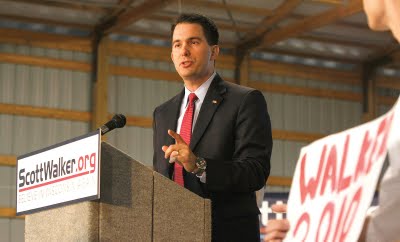
George Will: Governor Scott Walker is a good pick for Republicans in 2016

Wisconsin Governor Scott Walker

I like Scott Walker because he is a man who defeats Democrats and gets things done, and I like Senator Ted Cruz because he is a brilliant debater. Both are tough conservatives. But if I had to pick one of them right now for 2016, I’d pick Scott Walker. And I’m not alone.

Here’s an editorial from the St. Louis Dispatch that Dennis Prager discussed on Monday, authored by moderate conservative George Will.

Excerpt:

In 2011, tens of thousands of government employees and others, enraged by Gov. Scott Walker’s determination to break the ruinously expensive and paralyzing grip that government workers’ unions had on Wisconsin, took over the Capitol building in Madison. With chanting, screaming and singing supplemented by bullhorns, bagpipes and drum circles, their cacophony shook the building that the squalor of their occupation made malodorous. They spat on Republican legislators and urinated on Walker’s office door. They shouted, “This is what democracy looks like!”

When they and Democratic legislators failed to prevent passage of Act 10, they tried to defeat — with a scurrilous smear campaign that backfired — an elected state Supreme Court justice. They hoped that changing the court’s composition would get Walker’s reforms overturned. When this failed, they tried to capture the state Senate by recalling six Republican senators. When this failed, they tried to recall Walker. On the night that failed — he won with a larger margin than he had received when elected 19 months earlier — he resisted the temptation to proclaim, “This is what democracy looks like!”

[…]Walker has long experience in the furnace of resistance to the looting of public funds by the public’s employees. He was elected chief executive of heavily Democratic Milwaukee County after his predecessor collaborated with other officials in rewriting pension rules in a way that, if he had been re-elected instead of resigning, would have given him a lump-sum payment of $2.3 million and $136,000 a year for life.

To fight the recall — during which opponents disrupted Walker’s appearance at a Special Olympics event, and squeezed Super Glue into the locks of a school he was to visit — Walker raised more than $30 million, assembling a nationwide network of conservative donors that could come in handy if he is re-elected next year. Having become the first U.S. governor to survive a recall election, he is today serene as America’s first governor to be, in effect, elected twice to a first term.

The radically leftist New Republic has this to say about Governor Walker.

Excerpt:

Right now, the Republican Party is an increasingly factional place, divided between north and south, establishment and grassroots, Tea Party Conservatives and practical Conservatives, religious right and business, libertarians and populists.

[…]There’s another potentially unifying mainline conservative, though, and he lurks in Madison. Scott Walker, the battle-hardened governor of Wisconsin, is the candidate that the factional candidates should fear. Not only does he seem poised to run—he released a book last week—but he possesses the tools and positions necessary to unite the traditional Republican coalition and marginalize its discontents.

Walker has the irreproachable conservative credentials necessary to appease the Tea Party, and he speaks the language of the religious right. But he has the tone, temperament, and record of a capable and responsible establishment figure. That, combined with Walker’s record as a reformist union-buster, will appeal to the party’s donor base and appease the influential business wing. Walker’s experience as an effective but conservative blue state governor makes him a credible presidential candidate, not just a vessel for the conservative message. Equally important, his history of having faced down organized labor and beaten back a liberal recall effort is much more consistent with the sentiment of the modern Republican Party than Jeb Bush’s compassionate conservatism. Altogether, Walker has the assets to build the broad establishment support necessary for the fundraising, media attention, and organization to win the nomination. He could be a voter or a donor’s first choice, not just a compromise candidate.

The other mainline conservatives possess some of Walker’s characteristics, but not all. He’s more compelling and presidential, with more gravitas than Rubio or Jindal.

[…]But even though Walker’s political skills remain an open question, there are reasons why he might be a stronger candidate on paper. For one, he’s a more experienced politician—and the fact is that political skills and instincts are learned and honed under tough circumstances. By the time Walker’s wins reelection—which I expect—he will have won three competitive statewide contests in a tilt-blue state, under three different circumstances. He will have done so while campaigning and governing as a conservative. There are very few politicians who can claim as much.

We need to have someone who is a non-Romney – someone who likes to fight with the Democrats, and is able to beat them.

I found this article that lists six of his accomplishments.

Here’s are a couple:

#2 He passed a killer budget. Over the summer, he signed into law a state budget thatslashed taxes as well as unnecessary spending, including a $650 million income tax cut (part of nearly $1 billion in total tax cuts), Medicaid reform (see #4), the introduction of work requirements for people on food stamps, a freeze in university tuition and limits on residential property tax increases.

#3 He stands up to corruption. One of Walker’s first actions as governor was to create the Commission on Government Waste, Fraud, and Abuse, which was projected to save taxpayers $300 million. He also passed a law that prevents unions from using members’ dues to fund political campaigns.

I have placed his new book about his victories in Democrat-dominated Wisconsin on my wishlist. If you like politics, might be a good one for you as well.

Study finds that attitude of gratitude has many health benefits

From the Harvard Mental Health Newsletter.

Excerpt:

Two psychologists, Dr. Robert A. Emmons of the University of California, Davis, and Dr. Michael E. McCullough of the University of Miami, have done much of the research on gratitude. In one study, they asked all participants to write a few sentences each week, focusing on particular topics.

One group wrote about things they were grateful for that had occurred during the week. A second group wrote about daily irritations or things that had displeased them, and the third wrote about events that had affected them (with no emphasis on them being positive or negative). After 10 weeks, those who wrote about gratitude were more optimistic and felt better about their lives. Surprisingly, they also exercised more and had fewer visits to physicians than those who focused on sources of aggravation.

Another leading researcher in this field, Dr. Martin E. P. Seligman, a psychologist at the University of Pennsylvania, tested the impact of various positive psychology interventions on 411 people, each compared with a control assignment of writing about early memories. When their week’s assignment was to write and personally deliver a letter of gratitude to someone who had never been properly thanked for his or her kindness, participants immediately exhibited a huge increase in happiness scores. This impact was greater than that from any other intervention, with benefits lasting for a month.

Of course, studies such as this one cannot prove cause and effect. But most of the studies published on this topic support an association between gratitude and an individual’s well-being.

Other studies have looked at how gratitude can improve relationships. For example, a study of couples found that individuals who took time to express gratitude for their partner not only felt more positive toward the other person but also felt more comfortable expressing concerns about their relationship.

Managers who remember to say “thank you” to people who work for them may find that those employees feel motivated to work harder. Researchers at the Wharton School at the University of Pennsylvania randomly divided university fund-raisers into two groups. One group made phone calls to solicit alumni donations in the same way they always had. The second group — assigned to work on a different day — received a pep talk from the director of annual giving, who told the fund-raisers she was grateful for their efforts. During the following week, the university employees who heard her message of gratitude made 50% more fund-raising calls than those who did not.

My editor Mary writes: There is a health bonus to thankfulness but health isn’t why we should be thankful. We should be thankful because we are the recipients of many good things and it is appropriate under such circumstances to express gratitude. It is also the overflow of a heart made happy by the generosity of another.

To help us be thankful, here is a famous Thanksgiving day proclamation.

Here it is:

PRESIDENTIAL THANKSGIVING PROCLAMATIONS

1789-1815 : George Washington, John Adams, James Madison

THANKSGIVING DAY 1789

BY THE PRESIDENT OF THE UNITED STATES OF AMERICA – A PROCLAMATION

Whereas it is the duty of all Nations to acknowledge the providence of almighty God, to obey his will, to be grateful for his benefits, and humbly to implore his protection and favor – and Whereas both Houses of Congress have by their joint Committee requested me “to recommend to the People of the United States a day of public thanksgiving and prayer to be observed by acknowledging with grateful hearts the many signal favors of Almighty God, especially by affording them an opportunity peaceably to establish a form of government for their safety and happiness.”

Now therefore I do recommend and assign Thursday the 26th day of November next to be devoted by the People of these States to the service of that great and glorious Being, who is the beneficent Author of all the good that was, that is, or that will be – That we may then all unite in rendering unto him our sincere and humble thanks – for his kind care and protection of the People of this country previous to their becoming a Nation – for the signal and manifold mercies, and the favorable interpositions of his providence, which we experienced in the course and conclusion of the late war –for the great degree of tranquillity, union, and plenty, which we have since enjoyed – for the peaceable and rational manner in which we have been enabled to establish constitutions of government for our safety and happiness, and particularly the national One now lately instituted, for the civil and religious liberty with which we are blessed, and the means we have of acquiring and diffusing useful knowledge; and in general for all the great and various favors which he hath been pleased to confer upon us.

And also that we may then unite in most humbly offering our prayers and supplications to the great Lord and Ruler of Nations and beseech him to pardon our national and other transgressions – to enable us all, whether in public or private stations, to perform our several and relative duties properly and punctually – to render our national government a blessing to all the People, by constantly being a government of wise, just, and constitutional laws, discreetly and faithfully executed and obeyed – to protect and guide all Sovereigns and Nations (especially such as have shewn kindness unto us) and to bless them with good government, peace, and concord – To promote the knowledge and practice of true religion and virtue, and the increase of science among them and Us – and generally to grant unto all mankind such a degree of temporal prosperity as he alone knows to be best.

Given under my hand at the City of New York the third day of October in the year of our Lord 1789.

(signed) G. Washington

That’s from George Washington.

Happy Thanksgiving Day!