

Category Archives: Commentary

Bible study: responsibilities and obligations in Philippians 1-4

Bible study that hits the spot

Here are some parts of Philippians that speak to an issue that I think is a problem today for many Christians – self-centeredness.

Philippians 2 talks about the importance of not being self-centered, but instead being focused on the needs of others.

Phil 2:1-8:

2 Therefore if there is any encouragement in Christ, if there is any consolation of love, if there is any fellowship of the Spirit, if any affection and compassion,2 make my joy complete by being of the same mind, maintaining the same love, united in spirit, intent on one purpose. 3 Do nothing from selfishness or empty conceit, but with humility of mind regard one another as more important than yourselves; 4 do not merely look out for your own personal interests, but also for the interests of others. 5 Have this attitude in yourselves which was also in Christ Jesus, 6 who, although He existed in the form of God, did not regard equality with God a thing to be grasped, 7 but emptied Himself, taking the form of a bond-servant, and being made in the likeness of men. 8 Being found in appearance as a man, He humbled Himself by becoming obedient to the point of death, even death on a cross.

And Phil 2:19-23:

19 But I hope in the Lord Jesus to send Timothy to you shortly, so that I also may be encouraged when I learn of your condition. 20 For I have no one else of kindred spirit who will genuinely be concerned for your welfare. 21 For they all seek after their own interests, not those of Christ Jesus. 22 But you know of his proven worth, that he served with me in the furtherance of the gospel like a child serving his father.

Nothing very complicated here, it’s important to look out for the interests of others and to be concerned about their welfare.

I think it’s a good idea to be practical about partnering with people, and instead of just speaking words like “I care” or “I’ll pray for you”, try to find out what needs to be done and do it. Solve the problem with actions. Prayer is important, of course, because so much of what happens to that other person is in God’s hands. You aren’t going to be around all the time, but God is, so talk to him about the other person and what you’re planning to do. But you must also do your part, and do it intelligently and effectively. (The New Testament book of James talks about the need to accompany good wishes with actions that solve the problem)

Also don’t just stand back and give orders while feeling righteous. Many people want to influence others by just quoting the Bible, putting on pious airs, or using mere words. This doesn’t work in any area of the real world. Instead, take a more active approach. Think about the problem that is preventing someone from serving Christ well, and then act to make it easier for the person to do the right thing.

I’ve been able to achieve good success by praying AND performing supportive actions, rather than by issuing commands or prayer alone. For example, I’ve gotten people to transition for useless careers into IT careers, got them to pay off their high-interest debts, got them to switch their majors from something useless to something useful, got them to move on from an abortion or a divorce, got them to not commit suicide, listened to their health problems, helped them pass the GRE or the GMAT or something, got them to take a better job, got them to do a public speaking engagement, taught them how to debate their atheist brother, sponsored a Christian speaker at their university, helped them recover from bad parents, etc. It’s pretty fun to partner with people to further the Kingdom, but if you just leave it at prayer and giving orders, you won’t get the same good results.

All it takes to move from prayer alone to prayer and solutions is to think about other people like a puzzle, and then sacrifice some of your time or your money to build them up. I have a lot of experience doing this, but it’s not something that I learned to do in church. Church doesn’t teach you to be practical about following the Bible intelligently and with your own initiative. It’s set up to favor emotions (singing) and passive listening. To be active, you have to think about the Bible from a higher strategic level. Think about who Jesus is, and then follow his example. Don’t read the Bible in order to just feel happy or sound pious, instead try to make a plan to really DO good. Your goal should be to achieve a result in line with Jesus’ character and goals.

By the way, part of being able to partner with other people to solve problems with actions is being capable yourself. Don’t study stupid things in college. Don’t get into debt. Don’t try to fill your days with fun and thrills. Instead, study hard things, get hard jobs in the private sector, save your money, and learn useful skills. That way, you’ll be able to do more when something more than passive words or feelings is needed. One time, a woman I knew severely hurt her hand at work. She has OCD, and liked to clean the stairs in her house every day. She has a furry cat who drops fur everywhere. So she was lugging this heavy vacuum up and down the stairs every day. And spending a lot of time ironing with an old-fashioned heavy iron, too. So I bought her a hand vacuum and a fancy new iron. With the extra time she saved, she was able to do more reading, public speaking and helping others. Doing Christianity well means making yourself strong, so you can look after others with more than just feelings, piety and prayers.

Philippians is my favorite book of the Bible. And the most important thing about Philippians is that it’s good to be focused on other people, and not on ourselves, and to think of the interests of others, not our own interests. It’s good to get down into the weeds of other people’s problems, and act to self-sacrificially to solve them. Read the book (it’s short) and see if there are not people who you could partner with by helping them solve problems so they can be more effective.

How to test a white conservative to see if they are racist

Let's take a look at the left's accusations of racism
Let’s take a look at the left’s accusations of racism

I’ve noticed that a lot of people on the left like to cry “racism” whenever anyone disagrees with them about any of their policies. If a conservative opposes Medicare for All, the Green New Deal, banning all guns, infanticide or gay marriage, the response from the left is always to cry “racism”. As if there is no content at all to the conservative worldview. Let’s take a look at this.

Here is a Daily Signal column by famous Jewish conservative Dennis Prager:

So here is a way to show it is a lie.

Ask any white conservative, including one who supports Trump, the following three questions:

1). Do you have more in common with, and are you personally more comfortable in the company of, a white leftist or a black conservative?

2). Would you rather have nine white leftists or nine black conservatives on the U.S. Supreme Court?

3). Would you rather your child marry a black Christian conservative or a white non-Christian liberal?

A white racist would prefer the whites in each case.

I have asked these questions of thousands of Trump supporters at lectures and on my radio show.

Not once has a white Trump-supporting conservative said he or she would be more comfortable in the presence of a white leftist than a black conservative, or would prefer an all-white liberal Supreme Court to an all-black conservative Supreme Court.

Not once has a white Christian conservative said he or she would prefer his or her child marry a white non-Christian liberal rather than a black Christian conservative.

If you’re an honest leftist, this should present a powerful challenge to your belief that all white conservatives are racist.

Now, I’m not white (and one day in the future I’ll be revealing more about me and my story), and I talk to white conservatives all the time. They are tired of being called “racist” when trying to make the case for conservative views, e.g. – school vouchers, legal gun ownership, protection of the unborn, etc. Since I agree with them, they want to grab me and bring me to their debates and have me explain all the reasons why I hold the conservative beliefs that I do – just to take skin color out of the equation. Because their reasons are my reasons. We read the same people: Thomas Sowell, John Lott, Mark Levin, Victor Davis Hanson, Francis J. Beckwith, Ryan T. Anderson, etc. My arguments and evidence are the same as theirs.

The non-racism of white conservatives should be no surprise to anyone. Who is the favorite economist of white conservatives? Thomas Sowell, a black economist. And who is the favorite Senator of white conservatives? Ted Cruz, a Cuban lawyer. And who is the favorite radio show host of white conservatives? Ben Shapiro, an orthodox Jew. And who is their favorite Supreme Court Justice? The most conservative one, Clarence Thomas – who is black. And who leads the favorite think tank of white conservatives? Kay Cole James, a black woman, who is president of the Heritage Foundation. And white conservatives love legal immigrants, and love to hear their stories of becoming citizens by following the rules. They love to hear anyone express love for America.

White conservatives couldn’t care less about another conservative’s skin color. Or sex, for that matter. They only care about one thing: that the person loves the Constitution, the Declaration, the Bill of Rights, and the founding ideals of the country as a whole.

It’s actually the secular left that is obsessed with dividing people into groups and making them feel like victims. They want to push these groups into supporting a bigger secular government, higher taxes and less liberty. A successful black conservative and a legal immigrant would be their worst nightmare.

Update: just this morning, one of the white conservatives in my office, who was really upset that Trump is getting blamed for gun violence, invited me and a white progressive co-worker for lunch next Monday. He was trying to make me talk to the progressive in the office, and I was. But we were going long, so now we’re going to lunch!

Meet four heroes of the D-Day invasion of Normandy on June 6th, 1944

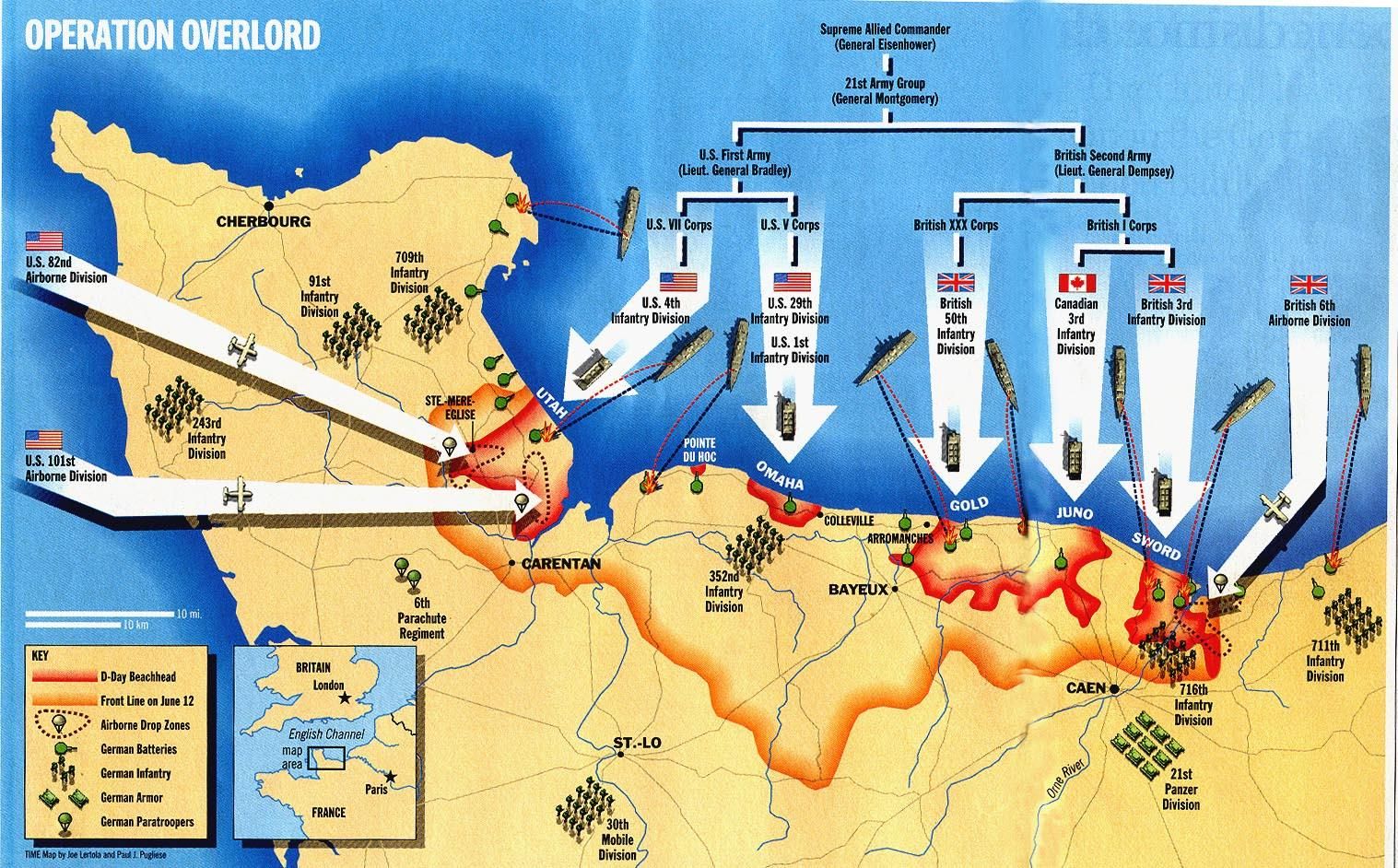
Map of D-Day landings (click for larger image)
Map of D-Day landings (click for larger image) (courtesy of Time magazine)

I thought it might be a good idea to write up something about D-Day in order to help people understand some of our military history, and to put the spotlight on some real heroes. I don’t regard artists, athletes, dancers, singers, actors, or other celebrities as heroes. It really alarms me that so many people know more about these fake heroes than they do about real ones.

Weakness emboldens aggressors

For one thing, many people don’t understand how British and American libertarian isolationism made World War 2 into a much bigger mess than it needed to be. As historian Victor Davis Hanson explains in the lecture I linked below, the Allied nations were much stronger and better equipped than the Axis nations before the war started. But Germany and Japan didn’t think that the Allied nations would do anything if they were aggressive. We know this from their writings and correspondence. They thought that British and Americans were just too scared of blood and death to ever go to war to stop them.

Germany and Japan tested their hypothesis out by re-arming and annexing territory from their neighbors. Britain and America were led by libertarian isolationists, so they didn’t fight back. The aggressors correctly understood that libertarian isolationists didn’t have the will to oppose them, even if they were weaker than the Allies. But the more they re-armed and annexed territory, the stronger they became. The Allied nations waited too long to confront them. And that’s why World War 2 was much harder to win than it needed to be.

Libertarian isolationism actually causes wars, because weakness emboldens aggressors. This is the lesson of history. But since libertarian isolationists don’t study history, (too busy with legalizing drugs, legalizing prostitution, promoting abortion, and redefining marriage), they haven’t learned the lessons of history.

Here’s a very good lecture about the causes of World War 2 by an actual military historian, Victor Davis Hanson:

So, that’s the first point I wanted to make: libertarian isolationism causes wars. Although libertarians claim to oppose war, they actually cause war, due to their weakness in the face of evil. So who stops wars? People who favor a strong defense, and show a willingness to fight back against aggression are the ones who REALLY oppose wars. This is called “peace through strength”, and you can see it in action in the Cold War, where Ronald Reagan defeated the Soviet Union by making their aggression costly.

Heroes of D-Day

My second concern was to promote the real heroes of D-Day, over the fictional heroes of movies, fiction, music, dancing, sports, and other entertainment nonsense.

Here are the four heroes I chose:

  • Major John Howard
  • Lieutenant Colonel Benjamin Vandervoort
  • Brigadier General Norman Cota
  • Major Richard Winters

Let’s take a look at each of them.

John Howard

So let’s take the heroes in order. Major John Howard led elements of the British 6th Airborne Division to take two vital bridges southeast of Sword beach. He did this in order to prevent German socialist counterattacks coming from the east. After they took the bridges, they had to repulse German tanks with nothing more than their useless PIAT (Projector Infantry Anti-Tank) grenade launchers. The PIAT was nothing more than a grenade launcher powered by a coiled spring. It was very inaccurate, and only effective to 50 yards. But that’s all the British paratroops had to stop tanks, and they made it work. You can read about him in this book by Stephen E. Ambrose, entitled: “Pegasus Bridge: June 6, 1944“. This New York Times article tells the story in brief. He also is played by Richard Todd in the famous movie “The Longest Day“.

Benjamin Vandervoort

Lt. Col. Ben Vandervoort served with the 82nd Airborne Division. I read about how he lead an infantry attack against German Tiger tanks (!) and infantry in Stephen E. Ambrose’s book “Citizen Soldiers: The U.S. Army from the Normandy Beaches to the Bulge to the Surrender of Germany“.  Ben Vandervoort broke his ankle during the D-Day landing, but he insisted that the medic just “lace it up tight” so that he could supervise the attacking and holding of Ste. Mere Eglise, southwest of Utah beach, against a vastly superior enemy force.  This article tells about how he defended against elite German SS infantry and heavy Tiger tanks at Trois-Ponts, during the Battle of the Bulge. He was outgunned and outnumbered 20 to 1, and had just a few lightly-armed soldiers, two low-power 57mm anti-tank guns and some bazookas. He is portrayed by John Wayne in the famous movie “The Longest Day“.

Norman Cota

Brig. General Norman Cota is my favorite person in World War 2. At 51 years old, he nevertheless landed at  D-Day, and rallied terrified Army Rangers to follow him up the bluff, by telling them that Rangers ought to lead the way. “Rangers Lead The Way” later became the motto of the Army Rangers. He always led from the front, demonstrating how to attack a German machine gun position in a farmhouse to a group of American soldiers who were pinned down. He actually grabbed a bunch of grenades and led the assault team against a heavy machine gun! You can read about him in this short article. You can read about him in Stephen E. Ambrose’s “D-Day: June 6, 1944: The Climactic Battle of World War II“. He is portrayed by Robert Mitchum in the famous movie “The Longest Day“.

Richard Winters

Major Richard Winters served in the 101st Airborne Division. Winters led an assault against a superior force of heavy machine guns and 105mm field guns. His tactics were so brilliant that they are still studied at West Point today. You can see Richard Winters and Carwood Lipton in the HBO “Band of Brothers” series, or read this book by Stephen E. Ambrose entitled “Band of Brothers: E Company, 506th Regiment, 101st Airborne, from Normandy to Hitler’s Eagle’s Nest“, which is the basis for that series.

OK, we’re done. But I’ll post some video clips from Band of Brothers:

Carentan:

Foy:

Bloody Gulch:

Night Patrol:

I hope this convinces you that military heroes are far more important than the “heroes” of fiction and entertainment. It’s alarming to me that people invest more and have more respect for characters in Hollywood science fiction movies, and other such make-believe nonsense. We need to be rooted in reality. In reality, men who fight and die fighting evil to protect your freedoms are the real heroes. People who take military history seriously are able to give respect and gratitude where it is due – a very important part of being a mature, moral human being.