Category Archives: Commentary

Does the New Testament book of James undermine salvation by faith alone?

Theology that hits the spot

Are people brought in a right relationship with God because God provides for their salvation, or must we do works in order to earn our place with God in the afterlife?

The Bible is pretty clear that God provides our salvation from our rebellion by himself, all we have to do is accept it.

Look at Romans 3:21-30:

21 But now apart from the Law the righteousness of God has been manifested, being witnessed by the Law and the Prophets,

22 even the righteousness of God through faith in Jesus Christ for all those who believe; for there is no distinction;

23 for all have sinned and fall short of the glory of God,

24 being justified as a gift by His grace through the redemption which is in Christ Jesus;

25 whom God displayed publicly as a propitiation in His blood through faith. This was to demonstrate His righteousness, because in the forbearance of God He passed over the sins previously committed;

26 for the demonstration, I say, of His righteousness at the present time, so that He would be just and the justifier of the one who has faith in Jesus.

27 Where then is boasting? It is excluded. By what kind of law? Of works? No, but by a law of faith.

28 For we maintain that a man is justified by faith apart from works of the Law.

29 Or is God the God of Jews only? Is He not the Godof Gentiles also? Yes, of Gentiles also,

30 since indeed God who will justify the circumcised by faith and the uncircumcised through faith is one.

Here’s theologian R.C. Sproul, to explain a passage from the Bible that seems to contradict the passages that teach that faith alone is sufficient for salvation.

Here’s James 2:18-24:

18 But someone may well say, “You have faith and I have works; show me your faith without the works, and I will show you my faith by my works.”

19 You believe that God is one. You do well; the demons also believe, and shudder.

20 But are you willing to recognize, you foolish fellow, that faith without works is useless?

21 Was not Abraham our father justified by works when he offered up Isaac his son on the altar?

22 You see that faith was working with his works, and as a result of the works, faith was perfected;

23 and the Scripture was fulfilled which says, “And Abraham believed God, and it was reckoned to him as righteousness,” and he was called the friend of God.

24 You see that a man is justified by works and not by faith alone.

Sproul explains the apparent conflict:

What James is saying is this: If a person says he has faith, but he gives no outward evidence of that faith through righteous works, his faith will not justify him. Martin Luther, John Calvin, or John Knox would absolutely agree with James. We are not saved by a profession of faith or by a claim to faith. That faith has to be genuine before the merit of Christ will be imputed to anybody. You can’t just say you have faith. True faith will absolutely and necessarily yield the fruits of obedience and the works of righteousness. Luther was saying that those works don’t add to that person’s justification at the judgment seat of God. But they do justify his claim to faith before the eyes of man. James is saying, not that a man is justified before God by his works, but that his claim to faith is shown to be genuine as he demonstrates the evidence of that claim of faith through his works.

So yes, works are important as a sign to others that you believe what you say you believe, but not important for balancing your sins. Your sins are already paid for by Jesus, what you do in your life doesn’t add or take away anything from that. But I will say that if you can see that a person is spending a great deal of their time performing actions that are consistent with a concern for God’s purposes and reputation, then that’s a good sign that his faith is in good shape. Yes, even if he doesn’t do as much Bible study, devotions, singing and praying as he should. The important thing about actions (works) is that you can look at a person’s life and see evidence that he is taking God seriously – that Jesus is his leader, and that Jesus’ character is informing their decision-making and prioritizing.

Slowly but surely, I am becoming less upset when bad things happen

Étienne Prosper Berne-Bellecour - The wounded soldier
“The wounded soldier” – Étienne Prosper Berne-Bellecour

I had some drama at the end of last week. My plan to share my thoughts online using an alias ran into a snag, and I’ve had to make adjustments.

Anyway, things are fixed now as well as they can be, so we continue. But what was interesting to me was that all my closest friends thought that I must be ready to jump off a cliff because of the setback. Well, no. I just took a couple of days to think about it and then did the best I could to fix it, and that’s it.

So I thought about why they might be so concerned and I came up with three ideas. First, they thought that because I always talk about plans, responsibilities, expectations and obligations so much that I would flip out if anything went wrong. Second, they thought that because I have anxiety left over from being stuck in daycare so much that I would be shattered by the setback. Third, some of my male friends thought that I should be really angry and fight against the injustice.

Well, here’s why I didn’t get depressed or angry.

1. First, and most importantly, it’s important to understand that in Christianity, salvation is a free gift of God. God’s love for me is not conditional on me achieving specific results, even though I am very serious about achieving specific results. Although I’m not a guy who has a past full of wild sins, I have something else – I have a lot of missed opportunities. I could have succeeded better and been more effective and influential. In my first job, I got a ton of stock options, but we were acquired 1 month before they vested. The gain in our stock price would have been worth $100,000 to me. I also missed a chance to intern with a small company that was later acquired by Oracle. I chose instead to intern with a much larger company that eventually went bankrupt. I failed an on-site interview with a great small company because I mentioned my conservative politics (my manager-to-be had run at the state level as a Democrat). They also got acquired by Oracle.

And there have been many more near misses. And even now, some of the plans I made (marriage, PhD) are 12 years and 8 years behind schedule, respectively. I’ve been forced to scramble to find other options in order to make a difference. But that’s OK, because I’m not under pressure to earn my way to Heaven here. God is in control. Being faithful doesn’t mean you get everything you plan to achieve, it just means being serious and self-sacrificial when you make decisions, and then leave the rest to God. It means reacting to targets of opportunity when your primary and secondary targets are not available.

2. Second, God has done an excellent job of strengthening me to recover from the daycare anxiety. He’s done it in three ways.

First, my education and career went well enough that I have kept up with my financial goals. Having enough money to survive all the terrible things I can imagine happening to me is a big calming influence on me. And this was a gift from God. I believe that my finances and my career are not things that I achieved, but things that God gave me in order for me to be able to mentor and assist others with the experience gained from being given these gifts. God gave these things to me so that I could fill a role with others – advising them on their decisions about education and career.

God also gave me a string of unexpected disasters to experience to build up my toughness, e.g. – running over a large possum at night while on the way back from a J. Warner Wallace event, or being rear-ended by a college student driving her Dad’s SUV. When these things happened to me early in my life, I would cry like Niagara Falls. I was raised to think that everything had to be “perfect” growing up – my working mom was always stressed out and aggressive. But now, when bad things happen, I’m much less phased. Sometimes, people run away from challenges if they don’t learn that it’s OK to fail, but thanks to God leading me, I didn’t end up like that. I kept trying.

Finally, the influence of supportive Christian women in my life has helped me a lot. It’s amazing how one action – the first time a Christian woman put her hand on my face – has stayed with me, and it makes everything terrible seem so easy to bear with. Whenever things go wrong, I just think of that day. It was a big deal. When you wait a long time for it, and when the woman understands you and approves of you, it makes a difference – for the rest of your life.

3. Third, I believe that God is sovereign so that I don’t have to defend myself all the time when things go wrong. Sometimes, when things go wrong, the most important thing to do is to not fix it, and just concentrate on being calm and polite to everyone around you.  Sometimes, God has reasons for allowing me to fail or get hurt. And since I can’t see everything he can see, what’s the point in thinking that I have to get upset every time someone disrespects me or sets me back? I don’t. If God wanted me to make a huge difference right away, he could make me do that. But he’s not going to do anything that will threaten his most important goal for me, and that’s making sure I get where I need to be after my life is finished. With all the focus on plans and goals, it can be easy to forget that this is what really matters.

So all of that is just to say that I am not earning my way to Heaven here – the most important thing to know about me is that God the Father has saved me through his Son, Jesus. The rest of my life is just me reacting to that as respectfully and effectively as I can, and not really caring much what people think of me. That doesn’t mean I’m going to do whatever I want, but it does mean that if things don’t go perfectly, then the most important thing about me isn’t going to be affected. At all. There is a great contentment in understanding these things when you are trying to interpret unexpected setbacks.

By the way, please like the new Facebook page for the blog if you haven’t already. It has fewer likes than the old page did right now, but we’ll get back up there.

Why is it so hard for young people to find a job?

Young people have a sense of entitlement

Bloomberg News discusses the “Professionalism in the Workplace” survey of human resources specialists from York College of Pennsylvania.

Forty-nine percent of [those surveyed] stated that less than half of new employees “exhibit professionalism in their first year.” More than half (53 percent) have noticed “a sense of entitlement” rising among younger workers; almost 45 percent have seen a “worsening of the work ethic,” including “too casual of an attitude toward work” and “not understanding what hard work is.”

Younger workers believe they can multitask and remain productive, the human-resources people told the York researchers. Thirty-eight percent of respondents blamed multitasking for the lack of “focus” among younger workers. The authors of the study explained that the younger generation “believes that it is possible to multi-task effectively” and that using social media, for example, is an efficient way to communicate. In interviews, the applicants check their phones for texts and calls, dress inappropriately and overrate their talents.

“The sad fact is some of these persons probably do not understand what is wrong with this,” the authors note.

Older workers have always complained about younger workers, of course, but there’s a difference: This time they attribute the youthful flaws not to ignorance or waywardness, but to a “sense of entitlement.”

We might forgive 18-year-olds fresh out of high school for lacking employability skills (the manufacturing sector hires many workers lacking undergraduate degrees). But when he or she reaches 23 and has four years of college, employers expect a white-collar worker to recognize basic norms of dress and deportment.

What happened in college, then? The survey by York College’s Center for Professional Excellence assigns colleges part of the blame, observing that letting students miss deadlines without penalty and assigning good grades for middling work only make them form the wrong expectations.

Meanwhile, the UK Daily Mail had the results from a 2013 survey:

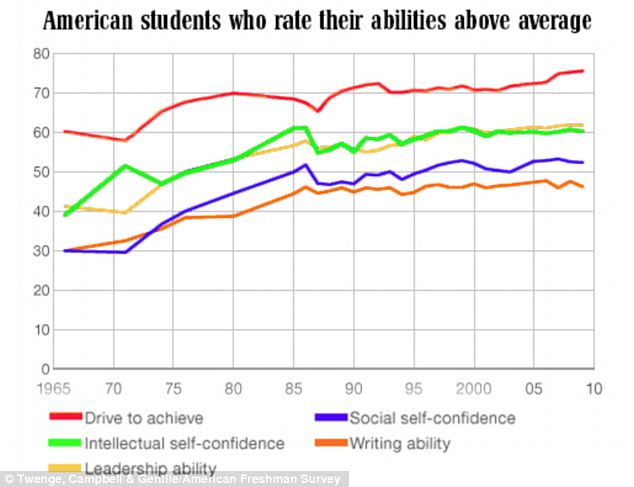
Young people’s unprecedented level of self-infatuation was revealed in a new analysis of the American Freshman Survey, which has been asking students to rate themselves compared to their peers since 1966.

Roughly 9 million young people have taken the survey over the last 47 years.

Psychologist Jean Twenge and her colleagues compiled the data and found that over the last four decades there’s been a dramatic rise in the number of students who describe themselves as being ‘above average’ in the areas of academic ability, drive to achieve, mathematical ability, and self-confidence.

But in appraising the traits that are considered less invidualistic – co-operativeness, understanding others, and spirituality – the numbers either stayed at slightly decreased over the same period.

Researchers also found a disconnect between the student’s opinions of themselves and actual ability.

While students are much more likely to call themselves gifted in writing abilities, objective test scores actually show that their writing abilities are far less than those of their 1960s counterparts.

Also on the decline is the amount of time spent studying, with little more than a third of students saying they study for six or more hours a week compared to almost half of all students claiming the same in the late 1980s.

Though they may work less, the number that said they had a drive to succeed rose sharply.

[…]Twenge is the author of a separate study showing a 30 per cent increase towards narcissism in students since 1979.

‘Our culture used to encourage modesty and humility and not bragging about yourself,’ Twenge told BBC News. ‘It was considered a bad thing to be seen as conceited or full of yourself.’

Just because someone has high self-esteem doesn’t mean they’re a narcissist. Positive self-assessments can not only be harmless but completely true.

However, one in four recent students responded to a questionnaire called the Narcissistic Personality Inventory with results pointing towards narcissistic self-assessments.

Narcissism is defined as excessive self-love or vanity; self-admiration, or being self-centered.

Twenge said that’s a trait that is often negative and destructive, and blames its boom on several trends – including parenting styles, celebrity culture, social media, and easy credit – for allowing people to seem more successful than they really are.

I think what I am seeing is that not only do they work less, but they work at things they “like”, rather than at things that will allow them to provide value to others. So, you’re not going to find a lot of computer programmers or petroleum engineers among young Americans, but you will find a lot of people gravitating to jobs that are easy that make them feel good about themselves, and look good to other people, too.

Obviously, there are policy reasons for youth unemployment being so high, but I think this attitude that young people have is definitely part of it.