
All posts by Wintery Knight

https://winteryknight.com/

Divorce is horribly painful for boys

About a month ago, one of my friends ECM committed suicide. He used to send me a lot of stories for this blog. Whenever we talked about his background, he would always point to his parents’ divorce as something that really hurt him badly, and caused him to abandon the faith of his childhood for drinking and promiscuity in college. I found an editorial on Fox News that talks about some of the things that he told me he had experienced.

Suzanne Venker writes:

Broken homes, or homes without a physically and emotionally present mother and father, are the cause of most of society’s ills. “Unstable homes produce unstable children,” writes Peter Hasson at The Federalist.

He adds, “On CNN’s list of the “27 Deadliest Mass Shootings In U.S. History,” seven of those shootings were committed by young males since 2005. Of the seven, only one—Virginia Tech shooter Seung-Hui Cho—was raised by his biological father throughout childhood.”

Life for Nikolas Cruz was no different. His adoptive father died when Cruz was very young, and his adoptive mother had a difficult time raising him.

America’s boys are in serious trouble. As Warren Farrell’s new book, The Boy Crisis, explains, boys are experiencing a crisis of education, a crisis of mental health (as in the case of Nikolas Cruz), a crisis of purpose. And at the root of it all is fatherlessness.

Indeed, there is a direct correlation between boys who grow up with absent fathers and boys who drop out of school, who drink, who do drugs, who become delinquent and who wind up in prison.

And who kill their classmates.

The reason why so many people on the left want to ban guns as the solution to violent crime they don’t like is because they don’t want to address the root cause of the problem: fatherlessness. And why don’t they want to address it? In a second editorial, Suzanne Venker explains why not.

Excerpt:

To point out that boys need their fathers is to shine a spotlight on divorce and single mothers; and that is, admittedly, uncomfortable. But there’s no way to address fatherlessness comfortably.

The fact is, divorce and family breakdown—which, to answer my emailer’s question, is the root of fatherlessness—is catastrophic for children. There’s more than one reason why, but an obvious one is that in the majority of cases, divorce separates children from their fathers.

This is destructive to both boys and girls, but each sex suffers differently. Girls who grow up deprived of their father are more likely to become depressed, more likely to self-harm, and more likely to be promiscuous. But they still have their mothers, with whom they clearly identify. Boys do not have a comparable identification and thus suffer more from father absence. They also tend to act out in a manner that’s harmful to others, which girls typically do not.

[…]More often than not, children lose contact with their fathers—for two reasons. One, mothers remain the default custodial parent in the average American divorce and thus retain most of the control. Second, it is usually women who consider themselves the aggrieved party, as evidenced by the fact that wives initiate 70 percent of divorces.

The unfortunate result is that some divorced mothers use any opportunity to undermine their children’s relationship with their father or, if not that, dismiss the significance of a father’s role.

[…]And the saddest part is most absent fathers aren’t absent by choice. The “deadbeat dad” exists, but not in spades. In many instances, women are divorcing perfectly good husbands in their search for what they believe will be a better match—which is a natural outgrowth of no-fault divorce. Certainly, women who are married to abusive or dangerous men must file for divorce. But such husbands and fathers cannot account for the 70 percent female-led divorce rate.

Seventy percent of divorces are initiated by women, and most of those are for flimsy reasons like unhappiness. As if marriage is about feeling good, and it’s the other person’s job to make you feel good. And if they don’t make you feel good, then you can nuke the relationship. It can be very difficult for men to make women feel anything. Most men do the normal male roles in marriage: protect, provide, lead on moral and spiritual issues. But it’s becoming very common for women today to not be “happy” with the normal male roles.
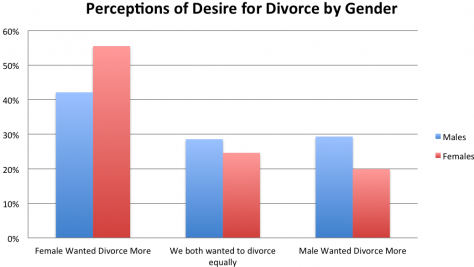
Differing attitudes on divorce

Personally, I think it’s because of the pattern of hedonism that they build up with alcohol and promiscuity in college. The more men that women have sex with before marrying, the higher their likelihood of dissolving their marriage.
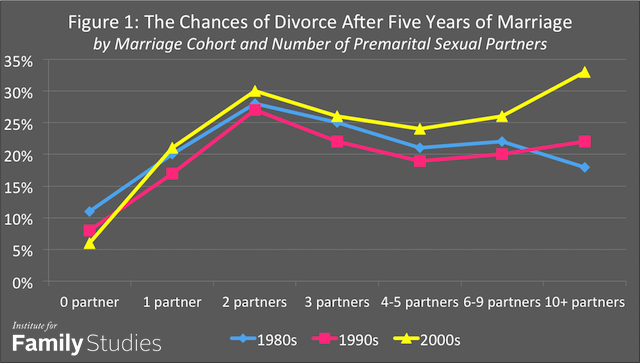
Even one non-husband premarital sex partner raises risk of divorce

Previously, I blogged about a Swiss study that showed that children tend to rebel against the religion of their parents if the father is not actively promoting it to them. Studies of prominent atheists find that their fathers are defective in some way – absent, immoral, unfaithful, weak, etc. It’s not use crying about crime later if we as a society have decided to stay silent when women choose men poorly, and choose the timing of sex in relationships poorly. If women chase bad boys and make babies with bad boys, then we should be asking them why. This is a community, and poor decisions about who to make babies with costs us all in the long run.

Is Sam Harris successful at rationally grounding objective moral values and duties?

I have a key that will unlock a puzzling mystery

I just wanted to put out a few snips from this layperson-level article on the Reasonable Faith web site. The article is about atheist scholar Sam Harris, and his attempt to provide a basis for morality on atheism.

Here’s the Harris project:

The question then is, what is the best foundation for the existence of objective moral values and duties? What grounds them? What makes certain actions good or evil, right or wrong? Traditionally, God has been the highest Good (summum bonum) and His commandments constitutive of our moral duties. But if God does not exist, what foundation remains for objective moral values and duties?

Dr. Craig is able to show why Harris’ attempt to ground the objective moral value of humans in “human flourishing” fails, by using the law of identity to show that Harris’ rule doesn’t account for the possibility that those who do evil could possibly flourish and be happy. If Harris is right that objective morality is identical to human flourishing, then it cannot even be possible that this be the case. This can be a bit confusing to non-philosophers, though, so I’ll focus on Dr. Craig’s argument against Harris’ attempt to ground objective moral duties.

Dr. Craig writes:

That takes us to a second question: Does atheism provide a sound foundation for objective moral duties? Duty has to do with moral obligation and prohibition, what I ought or ought not to do. Here reviewers of The Moral Landscape have been merciless in pounding Harris’ attempt to provide a naturalistic account of moral obligation. Two problems stand out.

First: Natural science tells us only what is, not what ought to be, the case. As philosopher Jerry Fodor has written, “Science is about facts, not norms; it might tell us how we are, but it wouldn’t tell us what is wrong with how we are.” In particular it cannot tell us that we have a moral obligation to take actions that are conducive to human flourishing.

So if there is no God, what foundation remains for objective moral duties? On the naturalistic view, human beings are just animals, and animals have no moral obligations to one another. When a lion kills a zebra, it kills the zebra, but it does not murder the zebra. When a great white shark forcibly copulates with a female, it forcibly copulates with her but it does not rape her — for there is no moral dimension to these actions. They are neither prohibited nor obligatory.

So if God does not exist, why think we have any moral obligations to do anything? Who or what imposes these moral duties on us? Where do they come from? It is hard to see why they would be anything more than a subjective impression ingrained into us by societal and parental conditioning.

So we might feel morally obligated to do something, maybe what our herd expects of us in this time and place we live in. But on atheism those feelings are arbitrary. After all, societies have evolved where feelings of obligation are felt by people to perform suicide bombings against civilians. On atheism, those feelings are as valid and grounded as any other “duties” because they emerge from the same process in other times and places. Obligations change between time and place – they are not objectively real. But that means that our moral duties are not objective, they are arbitrary – if atheism is true. The same “socio-biological evolution” is generating opposite moral duties in different times and places. This is not “objective”.

And the second objection is even more lethal:

Second: “ought” implies “can.” A person is not morally responsible for an action he is unable to avoid. For example, if somebody shoves you into another person, you are not to blame for bumping into this person. You had no choice. But Harris believes that all of our actions are causally determined and that there is no free will. Harris rejects not only libertarian accounts of freedom but also compatibilistic accounts of freedom. But if there is no free will, no one is morally responsible for anything. In the end, Harris admits this, though it’s tucked away in his endnotes. Moral responsibility, he says, “is a social construct,” not an objective reality: “in neuroscientific terms no person is more or less responsible than any other” for the actions they perform. His thoroughgoing determinism spells the end of any hope or possibility of objective moral duties on his worldview because we have no control over what we do.

Harris recognizes that “determinism really does threaten free will and responsibility as we intuitively understand them.” But not to worry! “The illusion of free will is itself an illusion.” The point, I take it, is that we do not really have the illusion of free will. Not only is such a claim patently false phenomenologically, as any of us can attest, but it is also irrelevant. The fact remains that whether we experience the illusion of free will or not, on Harris’ view we are thoroughly determined in all that we think and do and can therefore have no moral responsibilities.

On Harris’ view, human beings are computers made out of meat. But if you cannot freely make moral choices, then you cannot choose to perform moral duties or not. What is amazing to me is why he wants to deny free will in the first place. He is surely very well aware of his own experience of free will, and his own consciousness, for that matter. Before we even start to look at scientific evidences against atheism like the origin of the universe, the cosmic fine-tuning, the origin of life, the Cambrian explosion, etc. we already have evidence within ourselves that naturalism is false.

Just in passing, my friend Micah sent me this article about Sam Harris’ academic credentials. Although Harris has a PhD in neuroscience, the underlying reality is a bit more complicated. When I watched him debate William Lane Craig, he seemed to be ignorant of simple problems with his utilitarian moral views, and his inability to ground libertarian free will. The problems with utilitarianism have been known for hundreds of years. You can watch the debate yourself and see if you think he was prepared or not.

Making sense of evil and suffering within a Christian worldview

One thing I’ve noticed in talking to atheists who grew up in Christian homes is that they often leave their Christian worldview behind because of a disappointment with God. For some reason, they get this idea that God is our cosmic butler. We can do whatever we want in order to be happy, and if we want any help in this, then we just ring for him. When we encounter disappointment, our tendency is to just leave God behind.

Paul Copan explains the high points of the problems of evil and suffering in 17 minutes. (H/T Apologetics 315)

The MP3 file is here.

The video is here:

Topics:

  • the question itself reveals that we are moral beings
  • the problem of evil is the great interrupter of human well-being
  • every philosophy of life has to address this question
  • is God required to give us a life that is easy and comfortable?
  • evil is a departure from good, i.e. – the way things ought to be
  • a way things ought to be implies a plan for what ought to be
  • human evil implies a plan for the way we ought to be
  • free creatures have the ability to deviate from the plan
  • where does this plan for the universe and us come from?
  • how can there be a way we ought to be come from?
  • evil is the flip side of good so where does good come from?
  • God’s own moral nature is the standard of good and evil
  • where does evil from natural disasters come from?
  • how dangerous natural phenomena preserve Earth’s habitability
  • there is a benefit from tectonic activity
  • similarly, God lets humans freely choose knowing harm may result
  • people are free to try to find meaning in something other than God
  • God is able to use negative things to bring about positive results
  • e.g. – when good people suffer, they can comfort and care for others
  • can people be good enough on their own without God?

I do think it’s worth thinking about whether the New Testament portrays God as our cosmic butler, just waiting on us hand and foot so that we can be happy. Personally, I think you’d have to be crazy to get that impression of God from the Bible. Especially from the life of Jesus, who suffers in order to do the will of his Father. Wouldn’t it be funny if atheists were disbelieving in a God of their own making? Suffering in the pursuit of goodness has always been the center of the Christian life. I’m not sure where people get this idea that God’s job is to make us happy, according to our own desires. Seems kind of shallow. Certainly not Biblical. Do people even read the Bible any more to find out what God is really like? Maybe that’s the problem.

If you want to read two good books for beginners on Christian Apologetics that cover a range of intermediate issues, then pick up “Passion Conviction” and the companion “Contending With Christianity’s Critics”. Awesome, awesome resources. The Kindle editions can often be had for $3 each on Amazon.