Prior to certain scientific discoveries, most people thought that the universe had always been here, and no need to ask who or what may have caused it. But today, that’s all changed. Today, the standard model of the origin of the universe is that all the matter and energy in the universe came into being in an event scientists call “The Big Bang”. At the creation event, space and time themselves began to exist, and there is no material reality that preceded them.
So a couple of quotes to show that.
An initial cosmological singularity… forms a past temporal extremity to the universe. We cannot continue physical reasoning, or even the concept of spacetime, through such an extremity… On this view the big bang represents the creation event; the creation not only of all the matter and energy in the universe, but also of spacetime itself.
Source: P. C. W. Davies, “Spacetime Singularities in Cosmology,” in The Study of Time III, ed. J. T. Fraser (Berlin: Springer Verlag ).
And another quote:
[A]lmost everyone now believes that the universe, and time itself, had a beginning at the big bang.
Source: Stephen Hawking and Roger Penrose, The Nature of Space and Time, The Isaac Newton Institute Series of Lectures (Princeton, N. J.: Princeton University Press, 1996), p. 20.
So, there are several scientific discoveries that led scientists to accept the creation event, and one of the most interesting and famous is the discovery of how elements heavier than hydrogen were formed.
Nucleosynthesis: forming heavier elements by fusion
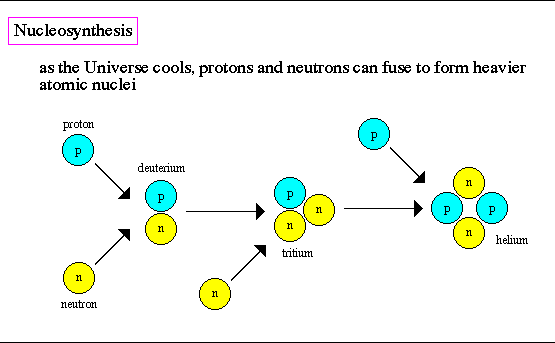
The term nucleosynthesis refers to the formation of heavier elements, atomic nuclei with many protons and neutrons, from the fusion of lighter elements. The Big Bang theory predicts that the early universe was a very hot place. One second after the Big Bang, the temperature of the universe was roughly 10 billion degrees and was filled with a sea of neutrons, protons, electrons, anti-electrons (positrons), photons and neutrinos. As the universe cooled, the neutrons either decayed into protons and electrons or combined with protons to make deuterium (an isotope of hydrogen). During the first three minutes of the universe, most of the deuterium combined to make helium. Trace amounts of lithium were also produced at this time. This process of light element formation in the early universe is called “Big Bang nucleosynthesis” (BBN).
The creation hypothesis predicts that there will be specific amounts of these light elements formed as the universe cools down. Do the predictions match with observations?
Yes they do:
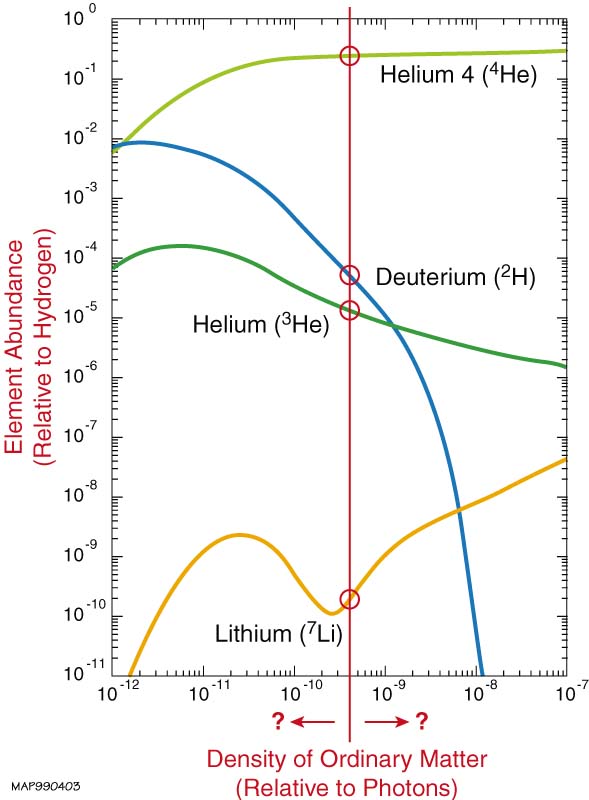
The predicted abundance of deuterium, helium and lithium depends on the density of ordinary matter in the early universe, as shown in the figure at left. These results indicate that the yield of helium is relatively insensitive to the abundance of ordinary matter, above a certain threshold. We generically expect about 24% of the ordinary matter in the universe to be helium produced in the Big Bang. This is in very good agreement with observations and is another major triumph for the Big Bang theory.
Moreover, WMAP satellite measurements of mass density agree with our observations of these light element abundances.
Here are the observations from the WMAP satellite:
Scientific observations match predictions
And here is how those WMAP measurements confirm the Big Bang creation event:
However, the Big Bang model can be tested further. Given a precise measurement of the abundance of ordinary matter, the predicted abundances of the other light elements becomes highly constrained. The WMAP satellite is able to directly measure the ordinary matter density and finds a value of 4.6% (±0.2%), indicated by the vertical red line in the graph. This leads to predicted abundances shown by the circles in the graph, which are in good agreement with observed abundances. This is an important and detailed test of nucleosynthesis and is further evidence in support of the Big Bang theory.
“An important and detailed test”.
For completeness, we should learn how elements heavier than these light elements are formed:
Elements heavier than lithium are all synthesized in stars. During the late stages of stellar evolution, massive stars burn helium to carbon, oxygen, silicon, sulfur, and iron. Elements heavier than iron are produced in two ways: in the outer envelopes of super-giant stars and in the explosion of a supernovae. All carbon-based life on Earth is literally composed of stardust.
That’s a wonderful thing to tell a young lady when you are on a date: “your body is made of stardust”. In fact, as I have argued before, this star formation, which creates the elements necessary for intelligent life, can only be built if the fundamental constants and quantities in the universe are finely-tuned.
Now, you would think that atheists would be happy to find observations that confirm the origin of the universe out of nothing, but they are not. Actually, they are in denial.
Here’s a statement from the Secular Humanist Manifesto, which explains what atheists believe about the universe:
Religious humanists regard the universe as self-existing and not created.
For a couple of examples of how atheistic scientists respond to the evidence for a cosmic beginning, you can check out this post, where we get responses from cosmologist Lawrence Krauss, and physical chemist Peter Atkins.
You cannot have the creation of the universe be true AND a self-existing, eternal universe ALSO be true. Someone has to be wrong. Either the science is wrong, or the atheist manifesto is wrong. I know where I stand.
Prior to certain scientific discoveries, most people thought that the universe had always been here, and no need to ask who or what may have caused it. But today, that’s all changed. Today, the standard model of the origin of the universe is that all the matter and energy in the universe came into being in an event scientists call “The Big Bang”. At the creation event, space and time themselves began to exist, and there is no material reality that preceded them.
So a couple of quotes to show that.
An initial cosmological singularity… forms a past temporal extremity to the universe. We cannot continue physical reasoning, or even the concept of spacetime, through such an extremity… On this view the big bang represents the creation event; the creation not only of all the matter and energy in the universe, but also of spacetime itself.
Source: P. C. W. Davies, “Spacetime Singularities in Cosmology,” in The Study of Time III, ed. J. T. Fraser (Berlin: Springer Verlag ).
And another quote:
[A]lmost everyone now believes that the universe, and time itself, had a beginning at the big bang.
Source: Stephen Hawking and Roger Penrose, The Nature of Space and Time, The Isaac Newton Institute Series of Lectures (Princeton, N. J.: Princeton University Press, 1996), p. 20.
So, there are several scientific discoveries that led scientists to accept the creation event, and one of the most interesting and famous is the discovery of the cosmic microwave background radiation.
Bell Labs radio astronomers Arno Penzias and Robert Wilson were using a large horn antenna in 1964 and 1965 to map signals from the Milky Way, when they serendipitously discovered the CMB. As written in the citation, “This unexpected discovery, offering strong evidence that the universe began with the Big Bang, ushered in experimental cosmology.” Penzias and Wilson shared the Nobel Prize in Physics in 1978 in honor of their findings.
The CMB is “noise” leftover from the creation of the Universe. The microwave radiation is only 3 degrees above Absolute Zero or -270 degrees C,1 and is uniformly perceptible from all directions. Its presence demonstrates that that our universe began in an extremely hot and violent explosion, called the Big Bang, 13.7 billion years ago.
In 1960, Bell Labs built a 20-foot horn-shaped antenna in Holmdel, NJ to be used with an early satellite system called Echo. The intention was to collect and amplify radio signals to send them across long distances, but within a few years, another satellite was launched and Echo became obsolete.2
With the antenna no longer tied to commercial applications, it was now free for research. Penzias and Wilson jumped at the chance to use it to analyze radio signals from the spaces between galaxies.3 But when they began to employ it, they encountered a persistent “noise” of microwaves that came from every direction. If they were to conduct experiments with the antenna, they would have to find a way to remove the static.
Penzias and Wilson tested everything they could think of to rule out the source of the radiation racket. They knew it wasn’t radiation from the Milky Way or extraterrestrial radio sources. They pointed the antenna towards New York City to rule out “urban interference”, and did analysis to dismiss possible military testing from their list.4
Then they found droppings of pigeons nesting in the antenna. They cleaned out the mess and tried removing the birds and discouraging them from roosting, but they kept flying back. “To get rid of them, we finally found the most humane thing was to get a shot gun…and at very close range [we] just killed them instantly. It’s not something I’m happy about, but that seemed like the only way out of our dilemma,” said Penzias.5 “And so the pigeons left with a smaller bang, but the noise remained, coming from every direction.”6
At the same time, the two astronomers learned that Princeton University physicist Robert Dicke had predicted that if the Big Bang had occurred, there would be low level radiation found throughout the universe. Dicke was about to design an experiment to test this hypothesis when he was contacted by Penzias. Upon hearing of Penzias’ and Wilson’s discovery, Dicke turned to his laboratory colleagues and said “well boys, we’ve been scooped.”7
Although both groups published their results in Astrophysical Journal Letters, only Penzias and Wilson received the Nobel Prize for the discovery of the CMB.
The horn antenna was designated a National Historic Landmark in 1990. Its significance in fostering a new appreciation for the field of cosmology and a better understanding of our origins can be summed up by the following: “Scientists have labeled the discovery [of the CMB] the greatest scientific discovery of the 20th century.”8
It’s the greatest scientific discovery of the 20th century.
In the New York Times, Arno Penzias commented on his discovery – the greatest discovery of the 20th century – so:
The best data we have [concerning the Big Bang] are exactly what I would have predicted, had I nothing to go on but the five books of Moses, the Psalms, the bible as a whole.
Just one problem with the greatest scientific discovery of the 20th century: atheists don’t accept it. Why not?
Here’s a statement from the Secular Humanist Manifesto, which explains what atheists believe about the universe:
Religious humanists regard the universe as self-existing and not created.
For a couple of examples of how atheistic scientists respond to the evidence for a cosmic beginning, you can check out this post, where we get responses from cosmologist Lawrence Krauss, and physical chemist Peter Atkins.
You cannot have the creation of the universe be true AND a self-existing, eternal universe ALSO be true. Someone has to be wrong. Either the science is wrong, or the atheist manifesto is wrong. I know where I stand.
In the summer, a couple of Jehovah’s Witness ladies were going door-to-door and they stopped by my house while I was out mowing. I decided to talk to them. They asked me why I was an evangelical Protestant rather than a JW. Rather than go into a lot of theology about the Trinity and the Watchtower translation, I decided to to just tell them about the false predictions their group has made.
So, let’s just quickly review that using this article from Watchman fellowship, which quotes JW publications:
Initially the organization taught the “battle of the Great Day of God Almighty” (Armageddon) would end in 1914. Every kingdom of the world would be overthrown in 1914 which was “God’s date” not for the beginning but “for the end” of the time of trouble.
“…we consider it an established truth that the final end of the kingdoms of this world, and the full establishment of the Kingdom of God, will be accomplished by the end of A.D. 1914” (Watchtower founder, Charles Taze Russell, The Time is at Hand, p. 99).
“…the ‘battle of the great day of God Almighty’ (Rev. 16:14), which will end in A.D. 1914 with the complete overthrow of earth’s present rulership, is already commenced” (Ibid., p. 101).
“CAN IT BE DELAYED UNTIL 1914?…our readers are writing to know if there may not be a mistake in the 1914 date. They say that they do not see how present conditions can last so long under the strain. We see no reason for changing the figures – nor could we change them if we would. They are, we believe, God’s dates not ours. But bear in mind that the end of 1914 is not the date for the beginning, but for the end of the time of trouble” (Watch Tower, 15 July 1894, p. 226).
Clearly, the world did not end in 1914, and it did not end at subsequent JW predictions, either, e.g. 1925, 1975.
So, as the title of the post says that I can’t be a global warming alarmist for the same reason I can’t be a Jehovah’s Witness: failed predictions.
Here’s an excellent article from Daily Signal by famous black economist Walter Williams, who explains the connection:
As reported in The New York Times (Aug. 1969) Stanford University biologist Paul Ehrlich warned: “The trouble with almost all environmental problems is that by the time we have enough evidence to convince people, you’re dead. We must realize that unless we’re extremely lucky, everybody will disappear in a cloud of blue steam in 20 years.”
In 2000, David Viner, a senior research scientist at University of East Anglia’s climate research unit, predicted that in a few years winter snowfall would become “a very rare and exciting event. Children just aren’t going to know what snow is.”
In 2004, the U.S. Pentagon warned President George W. Bush that major European cities would be beneath rising seas. Britain will be plunged into a Siberian climate by 2020. In 2008, Al Gore predicted that the polar ice cap would be gone in a mere 10 years. A U.S. Department of Energy study led by the U.S. Navy predicted the Arctic Ocean would experience an ice-free summer by 2016.
In May 2014, French Foreign Minister Laurent Fabius declared during a joint appearance with Secretary of State John Kerry that “we have 500 days to avoid climate chaos.”
Peter Gunter, professor at North Texas State University, predicted in the spring 1970 issue of The Living Wilderness:
Demographers agree almost unanimously on the following grim timetable: by 1975 widespread famines will begin in India; these will spread by 1990 to include all of India, Pakistan, China and the Near East, Africa. By the year 2000, or conceivably sooner, South and Central America will exist under famine conditions. … By the year 2000, thirty years from now, the entire world, with the exception of Western Europe, North America, and Australia, will be in famine.
Ecologist Kenneth Watt’s 1970 prediction was, “If present trends continue, the world will be about four degrees colder for the global mean temperature in 1990, but eleven degrees colder in the year 2000.” He added, “This is about twice what it would take to put us into an ice age.”
Williams concludes:
Today’s wild predictions about climate doom are likely to be just as true as yesteryear’s. The major difference is today’s Americans are far more gullible and more likely to spend trillions fighting global warming. And the only result is that we’ll be much poorer and less free.
We have known for decades that the Earth’s temperatures were much warmer during the “Medieval Warming Period”, hundreds of years ago. But some people are just having irrational fears about overpopulation, resource shortages, etc. and so they will promote nonsense to try to scare people into doing what they want. World history is full of pious-sounding attention-seeking hoaxsters who try to scare the gullible masses into giving them money and/or power. It’s not new.