A practical lecture on money – spending, saving, charitable giving – from famous pastor Wayne Grudem.
I like the way that Wayne Grudem navigates the Bible finding the passages that tell you who God is, so that you can make better decisions by analyzing alternatives and choosing the one that gives your Boss a maximum return on investment. He’s very practical.
Christianity does not teach asceticism (= don’t enjoy anything in this world), Paul condemns it in 1 Timothy 4:1-5
When you buy nice things, even if it is a little more expensive, it’s an opportunity to be thankful for nice things that God has provided
Even being rich is OK, but don’t let it make you haughty and arrogant, and don’t set your hopes on your money (see 1 Tim 6:17)
It is important for you to earn money, and you are supposed to use it to support yourself and be independent
It is possible to overspend and live recklessly (Luke 15:13) and it’s also possible to overspend and live too luxuriously
Increasing your income through career progression is wise, because it allows you to give away more and save more
God gives us freedom to decide how much we spend, how much we give away, and how much we save
every choice a Christian makes with money will give him or her more or less reward in his or her afterlife
Do not spend more than you have – you should make every effort to get out of debt as quickly as possible
Saving:
Saving money is wise so you can help yourself and others, and have money in your old age when you will not be working
If you do not save your own money, you end up being dependent on others (e.g. – family or taxpayers)
Not saving money for the future is a way of “putting God to the test” (Matt 4:7)
You are to “be dependent on no one”, to the extent that you can (1 Thes 4:12)
We don’t know the future, that’s why we should prepare for an emergency, and buy insurance to guard (James 4:13-17)
It’s right for us to learn how to save to be able to buy bigger assets, like a car or a college education
Saving and investing in stocks and bonds lets people in business start and grow companies, creating jobs and new products
Don’t over-save, trusting too much in money more than you trust in God (Ps 62.10; Matt 6:19,24; Luke 12:15-21)
Giving:
it is required for the people of God to give something out of what they earn, but no percentage is specified (Deut 26:12-13)
you do not give money to become right with God, you can’t earn your salvation
a Christian gives to show God that you trust him to take care of you, and to experience trusting him through your giving
the quality of your resurrection life with God is affected by giving you do for the Kingdom (Phil 4, Matt 6:19-21; 1 Tim 6:18-19)
when you get involved in the lives of others and give to them, you have the joy of experiencing caring for others (Acts 20:35)
it’s possible to give too little, but it’s also possible to give too much – be careful about pride creeping in as well
The first part of this lecture made me think of my treat for the week, which is to get a double chicken burrito bowl after my weight lifting. It is very easy to say grace when you are hovering over a double chicken burrito bowl. It is good to have nice things especially when it makes you thankful for what you have.
I was so happy listening to this talk because he was condemning bad stewardship, which I see in a lot of young people these days. I was happy until he got to the part about trusting in your savings for your security, and then I thought – that’s what I do wrong! I save a lot but it’s not just for emergencies and to share with others, like he was saying – I want a sense of security. This was more of a temptation in my 20s than it is now in my 30s, though.
Charity should hurt
I can remember being in my first full-time job as a newly hired junior programmer when the 2001 recession struck. I would cry while signing checks to support William Lane Craig’s Reasonable Faith ministry, because I was so scared. I had no family or friends where I lived to help me if anything went wrong, and that’s been the story of my working life. If anything goes wrong, there is no backup. But it’s that experience of crying when I gave that allows me to say today “that’s when I became the man I am, that’s what a man does when he is a follower of Jesus”. If you are not doing the actions of charity, then you will not having the experience of trusting God and letting him lead you. There is more to the Christian life than just saying the right things – you have to do the right things.
Don’t follow your heart
If you’re scared about giving when you are young, then do what I did in my 20s: work 70-hour weeks, get promoted often, and save everything you earn. I volunteered every Saturday for 9 months in order to get my first white-collar part-time job when I was still in high-school. The faster you increase your savings, the easier it’s going to be to take a genuine interest in caring for the people around you. Read Phil 1 (fellowship), Phil 2 (concern for others), and Phil 4 (charity). Turn off your emotions and desires when it comes to choosing what to study and what work to do, and put Philippians into practice. Your freedom to give is very much tied to the quality of your decisions of what to study, where to work, how much you spend on entertainment, and so on. That’s why you need to turn off your feelings and desires and do what works, even it it’s not fun, and even if it involves responsibilities, expectations and obligations.
British Spitfire and German Messerschmitt Me 109 locked in a dogfight
Here’s a debate with a well-qualified atheist and Dr. Craig.
Video:
Audio:
Description from the Youtube upload:
This debate on “Does God Exist?” took place in front of a capacity audience at the Great Hall, University of Birmingham. It was recorded on Friday 21st October 2011 as part of the UK Reasonable Faith Tour with William Lane Craig.
William Lane Craig is Research Professor of Philosophy at Talbot School of Theology, La Mirada, California and a leading philosopher of religion. Peter Millican is Gilbert Ryle Professor of Philosophy at Hertford College, University of Oxford and a noted scholar in studies of Hume.
The debate was hosted by the University of Birmingham Student Philosophy Society, and the debate was moderated by Professor Carl Chinn.
Dr. Millican proved to be an amazing debater, and that allowed Dr. Craig to show the full range of his talents in a way that he has never done before. This was a great debate – right up there with Craig’s two debates against Austin Dacey and Paul Draper. Dr. Millican is excellent at analytical philosophy, had studied cosmology and physics, and he came prepared to answer Craig’s arguments. There is NO SNARK in my debate summary below, out of respect for Dr. Millican. However, I haven’t proof-read it, so please do point out any errors. There is about 30 minutes of Q&A time at the end.
Dr. Craig’s opening speech:
There are good reasons to believe that God exists.
There are no good reasons to believe that God does not exist.
A1) The origin of the universe
The universe began to exist
If the universe began to exist, then the universe has a transcendent cause.
The universe has a transcendent cause.
The origin of the universe is confirmed by philosophical arguments and scientific evidence.
There cannot be an actual infinite number of past events, because mathematical operations like subtraction and division cannot be applied to actual infinities.
The Borde-Guth-Vilenkin (BGV) proof shows that every universe that expands must have a space-time boundary in the past. That means that no expanding universe, no matter what the model, cannot be eternal into the past.
Even speculative alternative cosmologies do not escape the need for a beginning.
The cause of the universe must be transcendent and supernatural. It must be uncaused, because there cannot be an infinite regress of causes. It must be eternal, because it created time. It must be non-physical, because it created space. There are only two possibilities for such a cause. It could be an abstract object or an agent. Abstract objects cannot cause effects. Therefore, the cause is an agent.
A2) The fine-tuning of the universe
The fine-tuning of the universe is either due to law, chance or design.
It is not due to law or chance.
Therefore, it is due to design.
The progress of science has revealed that the Big Bang was fine-tuned to allow for the existence of intelligent life.
Type 1: Constants like the gravitational constant are finely-tuned, and are not dependent on the laws of physics.
Type 2: Quantities like the amount of entropy in the universe, are not dependent on the laws of physics.
The range of life-permitting values is incredibly small compared to the possible values of the constants and quantities. (Like having a lottery with a million black balls and one white ball, and you pick the white ball. Even though each individual ball has the same tiny chance of being picked, but the odds are overwhelming that the whichever ball you pick will be black, and not white).
Not only are the numbers not due to laws, but they are not due to chance either. It’s not just that the settings are unlikely, it’s that they are unlikely and they conform to an independent pattern – namely, the ability to support complex life.
A3) The moral argument
If God does not exist, then objective moral values do not exist.
Objective morality does exist.
Therefore, God exists.
Objective moral values are values that exist independently of whether any humans believe them or not.
Michael Ruse, an atheist philosopher agrees that if God does not exist, then there is only a “herd morality” that is determined by biological evolution and social evolution. There no objective moral standard, just different customs and conventions that vary by time and place. Anyone who acts against the herd morality is merely being unfashionable and unconventional. On the atheistic view, there is nothing objective and binding about this evolved “herd morality”. However, people do experience objective moral values, and these cannot be grounded on atheism.
Furthermore, God must exist in order to argue that there is evil in the world. In order to be able to make a distinction between good and evil that is objective, there has to be a God to determine a standard of good and evil that is binding regardless of the varying customs and conventions of different people groups. Even when a person argues against God’s existence by pointing to the “evil” in the world, they must assume objective moral values, and a God who grounds those objective moral values.
A4) The resurrection of Jesus.
There are certain minimal facts that are admitted by the majority of historians, across the ideological spectrum: the empty tomb, the appearances and the early belief in the resurrection.
Naturalistic attempts to explain these minimal facts fail.
The best explanation of these facts is that Jesus rose from the dead.
A5) Religious experience
People can know that God exists through experience. In the absence of defeaters for these experiences, these experiences constitute evidence for God’s existence.
Dr. Millican’s opening speech:
Dr. Craig has the burden of proof because he claims that God exists.
The Christian God hypothesis:
An omnipotent, omniscient, omnibenevolent God created the universe.
This God cares about humans.
This God has acted in history though the life of Jesus of Nazareth.
This is a factual claim, and we are discussing the evidence for whether these claims are true or false. We are not interested in religious practice, or the consolation of religious belief, nor any other religions.
A1) Religious pluralism and epistemology
Human beings are purpose-finding creatures – we are prone to prefer explanations that involve purpose.
Human beings are pattern-finding animals – we tend to find designs in states of affairs.
Human beings have an interest in maintaining religious hierarchies because of the power it gives them.
Religious beliefs are not determined by rational considerations, but are determined by geographic location.
The same non-scientific method of generating religious beliefs (purpose-finding, pattern-finding, geographic location, parental teaching, charismatic speakers, praise songs and worship, religious education, ancient holy books) is being used in several religions, and it leads to different, contradictory truth claims. So at least some of those conflicting claims are false. And if the method is generating some false claims, then it’s not a good method, and it undermines all the religions that use those methods.
A2) Absence of evidence is evidence of absence
There is no scientific evidence for God.
A3) Mental processes depend on physical systems
There is no scientific evidence for a disembodied intelligence.
Our universal human experience is that intelligence and mental operations require a physical brain.
The quality of our thinking depends on physical conditions, like being tired or on drugs.
But Christian theists believe that mental processes can exist independently of an underlying physical reality, unimpaired by the death of the physical body and the brain.
R.A1) The origin of the universe
1. There is no evidence that whatever begins to exist requires a cause. All the evidence we have of things beginning to exist are when something is created from rearrangements of other things that already existed.
The closest analog we have to something coming into being from nothing is quantum particles coming into being from nothing, and that causation is random.
There is no evidence that thoughts can bring about physical effects, and Bill is arguing for a mental cause to the origin of the universe.
Even if things that begin to exist IN the universe have causes, it doesn’t hold for the universe as a whole. Bill is committing the fallacy of composition.
Time begins with the universe, but our experience of causation is that it is a temporal process. So if there is no time “prior to” the universe’s beginning, then how can there be a cause to the universe?
It’s possible that there could be something outside our universe that is eternal.
It’s also possible that the Big Bang could be wrong, and this universe could oscillate eternally and not require a beginning.
2. There are cosmological theories that avoid the beginning of the universe by positing a prior period of contraction prior to the Big Bang.
The beginning of this universe depends on general relativity, and that theory breaks down at the level of quantum mechanics.
3. There is no evidence that minds can exist without an underlying physical system. So even if there is a cause of the universe, then it is neither an abstract object nor a mind. It would have to be something else, and not something we are familiar with – we are just not in a position to speculate of what it could be.
R.A3) The moral argument
Atheists do believe in a standard of morality that is not based on what groups of humans believe.
Utilitarians think there is a standard of moral values that is objective, because the measure of human happiness (for the greatest number) is objective, even if people are mistaken about what promotes that happiness.
Kantians have a rational process for determining which moral imperatives should be universalized.
Humeans have a system that is rooted in natural human sentiment.
Dr. Craig’s first rebuttal:
I do not have the only burden of proof. The topic is “Does God Exist?”. If Dr. Millican answers “no” then he has a burden of proof, otherwise we are left with agnosticism.
R.A1) Religious pluralism and epistemology
First, there is no single common method of adopting a religion.
Second, MY method this evening is logic and evidence and personal experience – which is the same as his method. So his comments about how people in different religions adopt their religion through parents, church, singing, etc. have no bearing on the arguments I will be making.
R.A2) Absence of evidence is evidence of absence
Absence of evidence is only evidence of absence if we can reasonably expect that there should be some evidence that is not present. He would have to show that there should be more evidence for God’s existence that the 5 arguments that I already presented – something that we should expect to see that we don’t see.
R.A3) Mental processes depend on physical systems
No response by Dr. Craig. (but see below)
A1) The origin of the universe
1. He says that there are speculative cosmologies like the multiverse that escape the need for a beginning, but that’s false, the BGV proof applies to them, and they do need a beginning.
He says that you can escape BGV by positing a contraction prior to the expansion. However Vilenkin says that any contraction phase is unstable and would introduce additional singularities that would hamper any later expansion phase.
He says that we need a theory of quantum gravity in order to describe the early universe. But Vilenkin says that the BGV proof is independent of gravity as defined by general relativity.
He did not respond to the philosophical arguments for a beginning of the universe.
2. He says that we don’t have experience of things coming into being except from material causes. However, it would be even more difficult to explain the universe coming into being on atheism since you can’t appeal to a material cause nor to an efficient cause. Even Hume recognizes that things can’t pop into being without causes.
He talks about how in quantum physics virtual particles appear out of nothing. But that’s false, because the quantum vacuum in which virtual particles appear is not nothing, it is a sea of subatomic particles and energy. Quantum physics is not an exception to the idea that things that come into being require a cause.
He mentions the fallacy of composition. But I am not saying that everything in the universe has a cause, therefore the universe as a whole has a cause. I am saying that non-being has no capacity to bring something into being. Non-Being doesn’t even have the potential to bring something into being.
3. He says that there are no unembodied minds, so the cause of the universe can’t be an unembodied mind. But the argument concludes that there is a non-material cause, and it can’t be an abstract object, so it would have to be a mind.
In addition, we ourselves are unembodied minds. This is because physical objects cannot have the properties that minds have, like the property of having feelings.
Material conceptions of mind don’t explain identity over time.
Material conceptions of mind don’t explain free will.
Material conceptions of mind don’t explain intentional states (thinking about something).
Material conceptions of mind don’t explain mental causation.
The best explanation for our own first person experience of the mental realm is a substance dualism. We are non-material minds, and we can cause effects in the physical world. And God does the same thing. He is a mind, and he causes physical effects.
A2) He gave no response.
A3) He says that there are atheistic theories of morality that don’t depend on the opinions of groups. But these theories all depend on the idea that human beings have instrinsic value – that they are the sorts of things to which moral considerations apply. Naturalism cannot ground this moral value – human beings are no more valuable any other animal.
Also, there are no objective moral obligations in naturalist systems of morality, because there is no one in authority to command them. Moral prescriptions require moral prescribers.
A4) He gave no response.
A5) He gave no response.
Dr. Millican’s first rebuttal:
R.A2) The fine-tuning argument
We have to be careful not to judge what counts as finely-tuned through our intuitions.
We have to be careful about reasoning for a sample size of this one observable universe.
We don’t really know about the full range of possibilities for these constants and quantities.
There might be other universes that we can’t observe that aren’t fine-tuned, and we just happen to be in the one that is fine-tuned.
The fine-tuning might be solved by future discoveries, like the inflationary cosmology removed some of the fine-tuning.
There might be a multiverse that we don’t have evidence for right now.
We need to be careful about using science to prove God because science might change in the future.
The universe is very big and mysterious.
This argument doesn’t prove that God is good. He could be evil = anti-God.
God created the universe inefficiently if his goal was to produce life.
God created the universe too big.
God created the universe too old.
God created too many galaxies and stars that are not hospitable to life.
If the universe were fine-tuned for life, then there should be more aliens.
If the universe were fine-tuned for life, then there are probably lots of alien civilizations. But then Jesus would have to appear to all of the aliens too.
R.A1) The origin of the universe
2. It’s not a big deal that you can get multiple solutions to equations involving subtraction of actual infinities. For example, the equation 0 x y = 0 has many solutions for y, but that doesn’t mean that multiplication doesn’t work in the real world.
A2) Absence of evidence is evidence of absence
I would expect that there would be more evidence than there is.
R.A1) The origin of the universe
2. The BVG proof might be overturned by future scientific discoveries. We have no reason to be confident in current physics.
I agree that the quantum vacuum is something and not nothing, but it’s similar to nothing.
We don’t have any reason to believe that things that come into being require causes – except for our universal experience that this is always the case.
3. As to the cause of the universe coming into being, you said that it could only be an abstract object or a mind, and it can’t be an abstract object because they don’t cause effects, so it must be a mind. But there are all sorts of things we’ve never thought of that it could be other than a mind.
I agree that mental properties are not physical properties and that epiphenomenalism is incorrect. Physical objects can have “algorithmic properties” as well as physical properties, it doesn’t mean that computers have minds.
Dr. Craig’s second rebuttal:
R.A2) Absence of evidence is evidence of absence
He expressed his personal opinion that there should be more evidence, but that’s not an argument.
God knows how people will respond to getting more evidence or less evidence and he has to be careful not to take away their free will to disbelieve by piling them up with coercive evidence. God’s goal is not just to convince people that he exists. God’s goal is to have people respond to him and pursue him.
A1) The origin of the universe
2. He said that multiple answers to equations are no problem. But the problem is that you can’t translate multiple answers into a real world context.
The problem is that you are subtracting an identical number from an identical number and getting contradictory results, and that cannot be translated into the real world, where subtraction always gives a definite single result.
He talks about how you can get multiple answers with multiplication by 0. But 0 is not a real quantity, it is just the absence of something, and that cannot translate into the real world, because it has no being.
He says that I am only using evidence from current physics. But that is the point – the evidence of current physics and cosmology supports the beginning of the universe.
3. He said that an umembodied mind can’t be the cause, but we are minds and we cause effects on our physical bodies.
In addition, the design argument supports the idea that the cause of the universe is intelligent.
A2) The fine-tuning of the universe
He says we should be cautious. Of course.
He says the probabilities can’t be assessed. But you can just take the current value and perturb it and see that the resulting universe loses its ability to support life, and you can test an entire range around the current value to see that that vast majority of values in the range don’t permit life.
He says that the current physics is not well-established, but there are so many examples of fine-tuning across so many different areas of science that it is not likely that all of them will be overturned, and the number of finely-tuned constants and quantities has been growing, not shrinking.
He says it doesn’t prove that God is good, and he’s right – that’s what the moral argument is for.
He says that God isn’t efficient enough, but efficiency is only important for those who have limited time and/or limited resources. But God has unlimited time and resources.
He says that the universe is too old, but the large age of the universe is a requirement to support intelligent life – (i.e. – you need third generation stars to provide a stable source of energy to planets, and those stars require that two generations of stars are born and die).
He said what about aliens, and theists are open to that, and God can certainly provide for the salvation of those beings, if they have fallen into sin.
Dr. Millican’s second rebuttal:
R.A1) The origin of the universe
3. Just because epiphenominalism is false, it doesn’t mean that substance dualism is true.
The majority of philosophers of mind do not accept substance dualism.
R.A3) The moral argument
The majority of philosophers are moral realists, but a minority of philosophers are theists. So that means that there must be some way of justifying morality on atheism, which I will not describe right now.
Atheists can express their opinion that humans have intrinsic moral value.
He grants that atheists can perceive moral values. But if atheists can perceive moral values, then why is God needed to enable that?
Atheists can express their opinion that humans are special. We can be rational, and that makes us special.
Atheists can express their opinion that it is good to care about other humans because they are of the same species.
R.A4) The resurrection of Jesus
We don’t have any reasons to believe i the supernatural.
The gospels are written late for the purposes of evangelism.
The gospels are not independent, e.g. Matthew and Luke depend on Q.
John is the latest gospel, and the Christology of John is the highest of all.
The four gospels agree because the early church rejected other (unnamed) gospels that didn’t agree.
Matthew 27 – the earthquake and the raised saints – is not recorded in any other contemporary non-Christian source.
Dr. Craig’s final rebuttal:
A3) The moral argument
He says that human beings are rational, and that gives them value. But atheists like Sam Harris prefer the flourishing of sentient life. He includes non-rational animals as having moral value. So without God, we see that the choice of who or what has moral value is arbitrary. And where would objective moral duties come from if there is no moral lawgiver?
The fact that most atheists accept objective moral values doesn’t mean that they can rationally ground those values on their atheistic worldview. You can’t provide a basis for moral values on atheism by counting the number of atheists who accept objective morality. It’s not surprising that atheists can perceive objective moral values IF they are living in auniverse created by God who grounds these objective moral values and duties that atheists perceive.
A4) The resurrection of Jesus
He cites Geza Vermes and Bart Ehrman as authorities on the historical Jesus, but both of them accept all three of the facts that I presented as minimal facts. Ehrman doesn’t accept the resurrection of Jesus because he presupposes naturalism. He rejects the resurrection on philosophical grounds, not historical grounds.
Dr. Millican’s final rebuttal:
R.A5) Religious experience
Religious experience is an unreliable way to test the claims of a religion, because lots of religions have them and they make contradictory truth claims. In the future, we may discover naturalistic ways of explaining religious experience.
R.A4) The resurrection of Jesus
Even if you can make a case for the resurrection based on these3 minimal facts, there are other stories in the New Testament like Matthew 27 that are quite weird and they undermine the 3 minimal facts that even Geza Vermes and Bart Ehrman accept.
R.A1) The origin of the universe
Bill hasn’t shown that there is any reason for thinking that things don’t come into being, uncaused, out of nothing.
A4) The problem of evil
Theists can’t explain what God’s specific morally sufficient reasons are for permitting the apparently gratuitous evil that we see.
Politifact is a web site run by some left-wing journalists at the Tampa Bay Times. As you might expect from academic studies of media bias, their content might as well be written by the Democrat Party. But it’s not enough to just declare Politifact a Democrat propaganda operation – I need to actually give you details and examples. And so I will, in the rest of this post.
Let’s start with two recent examples, then I’ll show you the worst example of media bias I have ever seen from Politifact.
On Tuesday, Politifact, which purports to be a neutral fact-checking website but in fact leans heavily to the left, got caught protecting a member of the Democratic Party: Democratic Missouri Sen. Claire McCaskill.
Politifact took issue with the ad from The Senate Leadership Fund, a pro-Republican super PAC, that claimed that McCaskill said “normal people” could afford private planes.
[…]After they were corrected, Politifact acknowledged the mistake, writing,
Initially, we published this fact-check with a rating of False, because based on the video available, it did not appear that McCaskill was talking about private planes. After publication, we received more complete video of the question-and-answer session between McCaskill and a constituent that showed she was in fact responding to a question about private planes, as well as a report describing the meeting. We re-assessed the evidence, archived the original version here, and published the version you see here with a new rating of Half True. We apologize for the error.
Daily wire also linked to some more failed Politifact “fact checks”: here, here, and here.
Arizona Senate Race
Politifact also screwed up their fact-check for the Arizona Senate race.
PolitiFact incorrectly labeled it “mostly false” that Democratic Senate candidate Kyrsten Sinema “protested troops in a pink tutu” during its live fact-check of the Arizona Senate debate Monday night.
It’s an established fact that Sinema, a former Green Party activist who co-founded an anti-war group, wore a pink tutu at one of the multiple anti-war protests she attended in 2003.
“While we were in harm’s way, she was protesting our troops in a pink tutu,” Republican candidate Martha McSally, a former Air Force fighter pilot, said during Monday night’s debate.
Here’s their Politifact’s evaluation of McSally’s claim:
Who are you going to believe? Politifact, or your own eyes?
And here’s the photo of Kyrsten Sinema, protesting the troops, in a pink tutu:
Anti-war Democrat Senate candidate Kyrsten Sinema in a pink tutu
The Daily Caller notes:
A 2003 Arizona State University news article at the time described Sinema wearing “something resembling a pink tutu” at one of the protests.
[…]Sinema openly associated with fringe elements of the far-left during her anti-war activism.
She promoted an appearance by Lynne Stewart, a lawyer who was convicted of aiding an Islamic terrorist organization, in 2003.
Sinema also reportedly partnered with anarchists and witches in her anti-war activism and said she did “not care” if Americans wanted to join the Taliban.
Colonel Martha McSally, as I’ve blogged about before, is a former U.S. Air Force A-10 fighter pilot, and squadron commander. She logged a lot of hours leading actual combat missions against America’s enemies – the sorts of people who sell and rape Yazidi girls. She fought them.
And now for the big one: Politifact’s fact-checking of Obamacare.
Obama’s claims about Obamacare
Avik Roy, health care policy expert at Forbes magazine, wrote about Politifact’s assessment of Obama’s promise to Americans about keeping their health plans after Obamacare.
In 2008, before the presidential election, PolitiFact rated Obama’s claims about Obamacare “True”:
Roy writes: (links removed)
On October 9, 2008, Angie Drobnic Holan of PolitiFact published an article using the site’s “Truth-O-Meter” to evaluate this claim: “Under Barack Obama’s health care proposal, ‘if you’ve got a health care plan that you like, you can keep it.’”
And she concluded:
[…]…people who want to keep their current insurance should be able to do that under Obama’s plan. His description of his plan is accurate, and we rate his statement True.”
Roy notes:
PolitiFact’s pronouncements about Obamacare were widely repeated by pro-Obama reporters and pundits, and had a meaningful impact on the outcome of the election. Indeed, in 2009, PolitiFact won the Pulitzer Prize for its coverage of the 2008 campaign.
Here’s the screen capture from 2008:
Politifact says that everyone who likes their health care plan can keep it
Before the election, it’s true! And Obama got re-elected, because people believed that. But what happened after the election?
In 2013, after the 2012 election, PolitiFact rated Obama’s claims about Obamacare “Pants On Fire”:
Roy writes: (links removed)
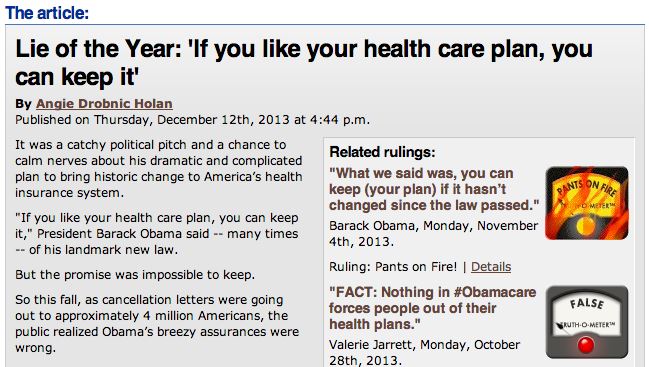
On December 12, [2013] the self-appointed guardians of truth and justice at PolitiFact named President Obama’s infamous promise—that “if you like your health care plan, you can keep it”—its 2013 “Lie of the Year.”
[…][N]one of the key facts that made that promise “impossible” in 2008 had changed by 2013. The President’s plan had always required major disruption of the health insurance market; the Obamacare bill contained the key elements of that plan; the Obamacare law did as well. The only thing that had changed was the actual first-hand accounts of millions of Americans who were losing their plans now that Obamacare was live.
And the screen capture from 2013:
Politifact said one thing before the election, and the opposite afterwards
So when Politifact rates a statement by a Democrat as true, what they really mean is that it’s pants-on-fire-false, but it’s election time so they don’t say that. It’s not like the critical assessments of Obamacare from health policy experts were not out there between 2007-2012. I know, because I blogged on every study and report on the predicted effects of the law that I could find. But the intellectually lazy journalism-major clowns at Politifact couldn’t be bothered to read those studies and reports.