All posts by Wintery Knight

https://winteryknight.com/

Five states passing legislation to allow abortion up to 40 weeks, and after birth

CNN: Unborn baby born at 21 weeks is "thriving"
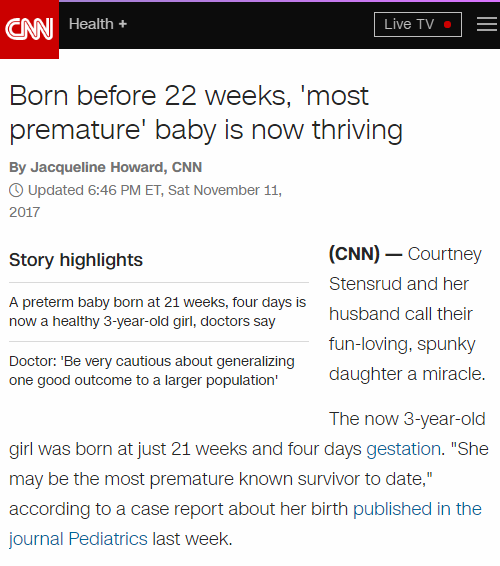
CNN: Unborn baby born at 21 weeks is now “thriving” at 3 years old

Last week the Governor of New York signed a law that makes abortion legal right up to birth. But other Democrat governors are willing to do the same thing in their states. We’re really seeing Democrats reveal their real priorities now. It’s not job creation, it’s infanticide.

So Virginia is going infanticide, next. Here is video of a Democrat legislator being questioned about her infanticide bill:

So will the bill get signed into law? Here’s the latest report about the Democrat Governor of Virginia from The Federalist:

When asked about the controversial late term abortion bill presented in Virginia’s House of Delegates this week, Governor Ralph Northam said a fully developed child born in the third trimester would be kept alive, but the physician and mother would get to discuss and decide whether to take its life or not.

“If a mother is in labor…the infant would be delivered. The infant would be kept comfortable. The infant would be resuscitated if that’s what the mother and the family desired, and then a discussion would ensue between the physicians and mother,” Northam said on WTOP’s “Ask The Governor” segment this morning.

Here’s the Governor in his own words:

Just to be clear, if people are deciding whether the baby should live or die after it’s been born, that’s infanticide. Babies are viable at 22 weeks, so there will be abortions being performed on viable babies, from 22-36 weeks, and even after birth.

Next, there’s Rhode Island.

The author of the Rhode Island bill, Edith Ajello, says:

[…]The Rhode Island Reproductive Health Care Act, co-sponsored by state Sen. Gayle L. Goldin and Rep. Edith H. Ajello, would strip away even minor, common-sense abortion regulations – ones that a strong majority of Americans support. It would eliminate all protections for unborn babies and codify Roe v. Wade into state law in case the U.S. Supreme Court overturns the ruling.

Ajello described protections for unborn babies as “insidiously restrictive, harmful and patriarchal reproductive laws.” Her bill would even repeal the state partial-birth abortion ban and fetal homicide law, which provides justice to pregnant mothers whose unborn babies are killed by abusive partners, drunken drivers or others whose illegal actions cause the death of the unborn baby.

The ACLU, which supports Ajello’s bill, has claimed fetal homicide laws are problematic because they treat “a fetus as a person.”

[…]Earlier this month, [Rhode Island Gov. Gina] Raimondo promised to support the pro-abortion bill in her State of the State address, NBC 10 reports.

Life News reports that more states are introducing legislation to remove all restrictions on abortion:

New York, Vermont, New Mexico and now Rhode Island politicians are pushing radical pro-abortion legislation that could legalize the killing of unborn babies for basically any reason up to birth in their states.

Earlier this week, Rhode Island lawmakers introduced legislation to keep abortion legal and unrestricted if the U.S. Supreme Court overturns Roe v. Wade, the AP reports.

So it’s New York, Virginia, Rhode Island, New Mexico and Vermont.

The only silver lining to this cloud that I can think of is that Democrat voters who don’t pay attention to the news will hear about this and reconsider whether they want to be on the side of people who don’t think that a baby is a baby, even when it’s just about to be born, or has just been born.

(Image source: CNN)

Are the Galapagos finch beaks evidence of Darwinian evolution?

I have a key that will unlock a puzzling mystery

Jonathan Wells has an article about it at Evolution News.

It says:

When Charles Darwin visited the Galápagos Islands in 1835, he collected specimens of the local wildlife. These included some finches that he threw into bags, many of them mislabeled. Although the Galápagos finches had little impact on Darwin’s thinking (he doesn’t even mention them in The Origin of Species), biologists who studied them a century later called them “Darwin’s finches” and invented the myth that Darwin had correlated differences in the finches’ beaks with different food sources (he hadn’t). According to the myth, Darwin was inspired by the finches to formulate his theory of evolution, thoughaccording to historian of science Frank Sulloway “nothing could be further from the truth.”

In the 1970s, biologists studied a population of medium ground finches on one of the islands in great detail. When a severe drought left only large, hard-to-crack seeds, 85 percent of the birds perished. The survivors had beaks that were about 5 percent larger than the average beak size in the original population. The biologists estimated that if similar droughts occurred once every ten years, the population could become a new species in only 200 years. In a 1999 booklet defending evolution, the U.S. National Academy of Sciences called the finches “a particularly compelling example” of the origin of species.

But after the drought, birds with smaller beaks flourished again, and the average beak size of the population returned to normal. No net evolution had occurred. No matter; Darwin’s finches became an icon of evolution that is still featured in most biology textbooks.

In the 1980s, a population of large ground finches, with larger beaks than the medium ground finches, migrated to the island. When a drought in 2004-2005 again reduced the food supply, the medium and large ground finch populations both declined. But since even the largest beaks among the medium ground finches were no match for the beaks of the large ground finches, the latter pretty much monopolized the larger seeds and the former had to make do with smaller seeds. This time, the medium ground finches that survived the drought had beaks that were smaller than the average size in the original population. Biologists studying the finches argued that birds with smaller beaks were better able to eat the tiny seeds that were left after the large ground finches ate the big ones, and they concluded that this was again an example of “evolutionary change.”

[…]Wait a minute. Average beak size increased slightly during one drought, only to return to normal after the rains return. Then average beak size decreased slightly during another drought. A region of DNA is correlated with beak size. And somehow that tells us how finches evolved in the first place?

There is an important distinction to make between micro-evolution and macro-evolution. Changes within a type is micro-evolution. Evolving a new organ type or body plan is macro-evolution. There is plenty of evidence for micro-evolution, but no evidence for macro-evolution.

What needs to be proven by the Darwinists is that the same process that results in different average beak size in a population of finches after a drought can create the finches in the first place. I think that Darwinists are credulous – they believe what they want to believe because they want to believe it, even if the evidence is incredibly weak. Darwinists must demonstrate that heritable variations can result in the generation of new organ types and body plans. Changes in average beak size is not interesting. What is needed is to show how the beaks, much less the wings, evolved in the first place.

Icons of Evolution

Jonathan has actually written about a number of  misleading things that you may mind in Biology textbooks.

Here are the sections in his book “Icons of Evolution“:

  • The Miller-Urey Experiment
  • Darwin’s Tree of Life
  • Homology in Vertebrate Limbs
  • Haeckel’s Embroys
  • Archaeopteryx–The Missing Link
  • Peppered Moths
  • Darwin’s Finches
  • Four-Winged Fruit Flies
  • Fossil Horses and Directed Evolution
  • From Ape to Human: The Ultimate Icon

Dr. Wells holds a Ph.D in Molecular and Cell Biology from the University of California at Berkeley.

New study: prenatal exposure to smoked or ingested marijuana harms children

Number of drivers involved in fatal crashes who used marijuana
CO drivers involved in fatal crashes who used marijuana (Source: Denver Post)

Whenever debating moral issues, I find that the most useful approach is to is to appeal to scientific studies. Although people today tend to be skeptical of philosophical or religious arguments, they can’t deny the success of science in solving problems in the real world. With that said, here is a recent study showing some previously unknown effects of marijuana use.

The Scientist reports:

When marijuana is ingested or smoked during pregnancy, exogenous cannabinoids enter the blood and cross easily through the placental barrier due to their highly lipophilic nature. Pairing this ready availability with slow pharmacokinetics—active metabolites continue circulating for up to five days depending on dosage and frequency of use—fetal exposure to the active compounds in cannabis is both efficient and prolonged.

[…]To date, the three largest longitudinal studies of the children of women who smoked marijuana once a week or more during their pregnancies have identified remarkably consistent outcomes during early development and through young adulthood. In infants, these include increased impulsivity, hyperactivity, and delinquent behaviors, as well as memory dysfunction and decreased IQ scores. During adolescence and early adulthood, fetal cannabis exposure has been linked to persistent reduction in memory and concentration, higher rates of drug use, and an increased incidence of hyperactivity, signs of depression, and psychotic and schizophrenic-like symptoms. These mental health issues are further evidenced by increased reports from both parents and schoolteachers of problematic behavior and delinquency in cannabis-exposed kids.

What I thought was most interesting was how the intuitions of pregnant women in America conflict with what the science showed:

[…]70 percent of women in the United States believe that there is “slight or no risk of harm” in using cannabis during pregnancy. And about 4 percent of pregnant women in the US report using the drug during gestation, just like Carol. Of expectant moms between the ages of 18 and 25, this number is nearly 7.5 percent.

It’s a scary thing when a person generates their views by how they make them feel, or whether other people like them for their views. But that seems to be so popular these days, especially with the young people. Right and wrong is decided by how consenting adults feel about things, in the moment. It seems to me that the only way to break through the feelings is with science that shows the real consequences of the immoral behavior.

(Image source: Denver Post)

Related posts