Prior to certain scientific discoveries, most people thought that the universe had always been here, and no need to ask who or what may have caused it. But today, that’s all changed. Today, the standard model of the origin of the universe is that all the matter and energy in the universe came into being in an event scientists call “The Big Bang”. At the creation event, space and time themselves began to exist, and there is no material reality that preceded them.
So a couple of quotes to show that.
An initial cosmological singularity… forms a past temporal extremity to the universe. We cannot continue physical reasoning, or even the concept of spacetime, through such an extremity… On this view the big bang represents the creation event; the creation not only of all the matter and energy in the universe, but also of spacetime itself.
Source: P. C. W. Davies, “Spacetime Singularities in Cosmology,” in The Study of Time III, ed. J. T. Fraser (Berlin: Springer Verlag ).
And another quote:
[A]lmost everyone now believes that the universe, and time itself, had a beginning at the big bang.
Source: Stephen Hawking and Roger Penrose, The Nature of Space and Time, The Isaac Newton Institute Series of Lectures (Princeton, N. J.: Princeton University Press, 1996), p. 20.
So, there are several scientific discoveries that led scientists to accept the creation event, and one of the most interesting and famous is the discovery of how elements heavier than hydrogen were formed.
Nucleosynthesis: forming heavier elements by fusion
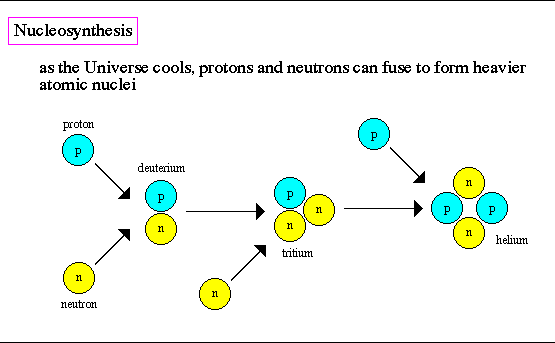
The term nucleosynthesis refers to the formation of heavier elements, atomic nuclei with many protons and neutrons, from the fusion of lighter elements. The Big Bang theory predicts that the early universe was a very hot place. One second after the Big Bang, the temperature of the universe was roughly 10 billion degrees and was filled with a sea of neutrons, protons, electrons, anti-electrons (positrons), photons and neutrinos. As the universe cooled, the neutrons either decayed into protons and electrons or combined with protons to make deuterium (an isotope of hydrogen). During the first three minutes of the universe, most of the deuterium combined to make helium. Trace amounts of lithium were also produced at this time. This process of light element formation in the early universe is called “Big Bang nucleosynthesis” (BBN).
The creation hypothesis predicts that there will be specific amounts of these light elements formed as the universe cools down. Do the predictions match with observations?
Yes they do:
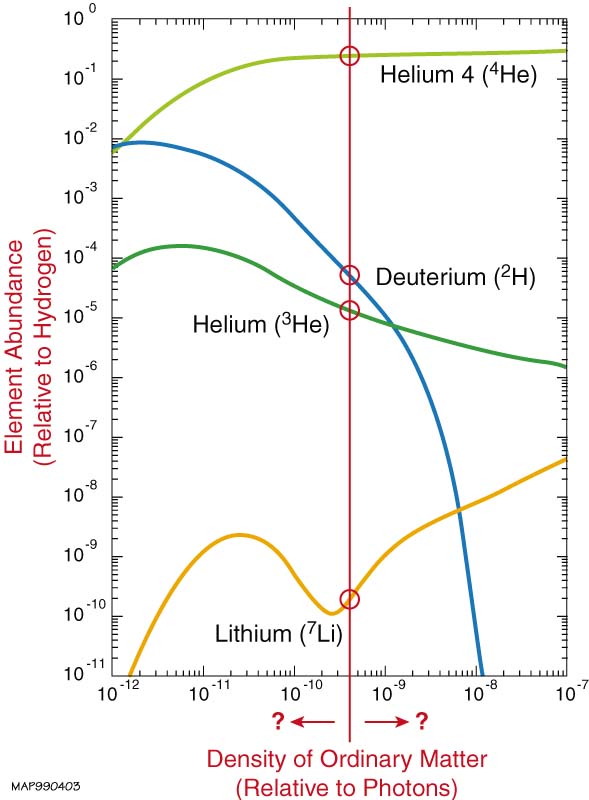
The predicted abundance of deuterium, helium and lithium depends on the density of ordinary matter in the early universe, as shown in the figure at left. These results indicate that the yield of helium is relatively insensitive to the abundance of ordinary matter, above a certain threshold. We generically expect about 24% of the ordinary matter in the universe to be helium produced in the Big Bang. This is in very good agreement with observations and is another major triumph for the Big Bang theory.
Moreover, WMAP satellite measurements of mass density agree with our observations of these light element abundances.
Here are the observations from the WMAP satellite:
Scientific observations match predictions
And here is how those WMAP measurements confirm the Big Bang creation event:
However, the Big Bang model can be tested further. Given a precise measurement of the abundance of ordinary matter, the predicted abundances of the other light elements becomes highly constrained. The WMAP satellite is able to directly measure the ordinary matter density and finds a value of 4.6% (±0.2%), indicated by the vertical red line in the graph. This leads to predicted abundances shown by the circles in the graph, which are in good agreement with observed abundances. This is an important and detailed test of nucleosynthesis and is further evidence in support of the Big Bang theory.
“An important and detailed test”.
For completeness, we should learn how elements heavier than these light elements are formed:
Elements heavier than lithium are all synthesized in stars. During the late stages of stellar evolution, massive stars burn helium to carbon, oxygen, silicon, sulfur, and iron. Elements heavier than iron are produced in two ways: in the outer envelopes of super-giant stars and in the explosion of a supernovae. All carbon-based life on Earth is literally composed of stardust.
That’s a wonderful thing to tell a young lady when you are on a date: “your body is made of stardust”. In fact, as I have argued before, this star formation, which creates the elements necessary for intelligent life, can only be built if the fundamental constants and quantities in the universe are finely-tuned.
Now, you would think that atheists would be happy to find observations that confirm the origin of the universe out of nothing, but they are not. Actually, they are in denial.
Here’s a statement from the Secular Humanist Manifesto, which explains what atheists believe about the universe:
Religious humanists regard the universe as self-existing and not created.
For a couple of examples of how atheistic scientists respond to the evidence for a cosmic beginning, you can check out this post, where we get responses from cosmologist Lawrence Krauss, and physical chemist Peter Atkins.
You cannot have the creation of the universe be true AND a self-existing, eternal universe ALSO be true. Someone has to be wrong. Either the science is wrong, or the atheist manifesto is wrong. I know where I stand.
Prior to certain scientific discoveries, most people thought that the universe had always been here, and no need to ask who or what may have caused it. But today, that’s all changed. Today, the standard model of the origin of the universe is that all the matter and energy in the universe came into being in an event scientists call “The Big Bang”. At the creation event, space and time themselves began to exist, and there is no material reality that preceded them.
So a couple of quotes to show that.
An initial cosmological singularity… forms a past temporal extremity to the universe. We cannot continue physical reasoning, or even the concept of spacetime, through such an extremity… On this view the big bang represents the creation event; the creation not only of all the matter and energy in the universe, but also of spacetime itself.
Source: P. C. W. Davies, “Spacetime Singularities in Cosmology,” in The Study of Time III, ed. J. T. Fraser (Berlin: Springer Verlag ).
And another quote:
[A]lmost everyone now believes that the universe, and time itself, had a beginning at the big bang.
Source: Stephen Hawking and Roger Penrose, The Nature of Space and Time, The Isaac Newton Institute Series of Lectures (Princeton, N. J.: Princeton University Press, 1996), p. 20.
So, there are several scientific discoveries that led scientists to accept the creation event, and one of the most interesting and famous is the discovery of the cosmic microwave background radiation.
Bell Labs radio astronomers Arno Penzias and Robert Wilson were using a large horn antenna in 1964 and 1965 to map signals from the Milky Way, when they serendipitously discovered the CMB. As written in the citation, “This unexpected discovery, offering strong evidence that the universe began with the Big Bang, ushered in experimental cosmology.” Penzias and Wilson shared the Nobel Prize in Physics in 1978 in honor of their findings.
The CMB is “noise” leftover from the creation of the Universe. The microwave radiation is only 3 degrees above Absolute Zero or -270 degrees C,1 and is uniformly perceptible from all directions. Its presence demonstrates that that our universe began in an extremely hot and violent explosion, called the Big Bang, 13.7 billion years ago.
In 1960, Bell Labs built a 20-foot horn-shaped antenna in Holmdel, NJ to be used with an early satellite system called Echo. The intention was to collect and amplify radio signals to send them across long distances, but within a few years, another satellite was launched and Echo became obsolete.2
With the antenna no longer tied to commercial applications, it was now free for research. Penzias and Wilson jumped at the chance to use it to analyze radio signals from the spaces between galaxies.3 But when they began to employ it, they encountered a persistent “noise” of microwaves that came from every direction. If they were to conduct experiments with the antenna, they would have to find a way to remove the static.
Penzias and Wilson tested everything they could think of to rule out the source of the radiation racket. They knew it wasn’t radiation from the Milky Way or extraterrestrial radio sources. They pointed the antenna towards New York City to rule out “urban interference”, and did analysis to dismiss possible military testing from their list.4
Then they found droppings of pigeons nesting in the antenna. They cleaned out the mess and tried removing the birds and discouraging them from roosting, but they kept flying back. “To get rid of them, we finally found the most humane thing was to get a shot gun…and at very close range [we] just killed them instantly. It’s not something I’m happy about, but that seemed like the only way out of our dilemma,” said Penzias.5 “And so the pigeons left with a smaller bang, but the noise remained, coming from every direction.”6
At the same time, the two astronomers learned that Princeton University physicist Robert Dicke had predicted that if the Big Bang had occurred, there would be low level radiation found throughout the universe. Dicke was about to design an experiment to test this hypothesis when he was contacted by Penzias. Upon hearing of Penzias’ and Wilson’s discovery, Dicke turned to his laboratory colleagues and said “well boys, we’ve been scooped.”7
Although both groups published their results in Astrophysical Journal Letters, only Penzias and Wilson received the Nobel Prize for the discovery of the CMB.
The horn antenna was designated a National Historic Landmark in 1990. Its significance in fostering a new appreciation for the field of cosmology and a better understanding of our origins can be summed up by the following: “Scientists have labeled the discovery [of the CMB] the greatest scientific discovery of the 20th century.”8
It’s the greatest scientific discovery of the 20th century.
In the New York Times, Arno Penzias commented on his discovery – the greatest discovery of the 20th century – so:
The best data we have [concerning the Big Bang] are exactly what I would have predicted, had I nothing to go on but the five books of Moses, the Psalms, the bible as a whole.
Just one problem with the greatest scientific discovery of the 20th century: atheists don’t accept it. Why not?
Here’s a statement from the Secular Humanist Manifesto, which explains what atheists believe about the universe:
Religious humanists regard the universe as self-existing and not created.
For a couple of examples of how atheistic scientists respond to the evidence for a cosmic beginning, you can check out this post, where we get responses from cosmologist Lawrence Krauss, and physical chemist Peter Atkins.
You cannot have the creation of the universe be true AND a self-existing, eternal universe ALSO be true. Someone has to be wrong. Either the science is wrong, or the atheist manifesto is wrong. I know where I stand.
The 9/11 terrorist attacks resulted from weak Democrat foreign policy
One of my libertarian friends was objecting to the 9/11 memorial being conducted today. So I decided to re-post a VERY old post I wrote in February 2009 when I was just starting out blogging. In it, I explain why I became so conservative on foreign policy after 9/11. Watching the response of the secular left and libertarians to the attack (blame America and praise terrorists) turned me into a hawk.
—-
The Wall
Democrats have a reputation for not taking defense and counter-terrorism seriously. According to this post over at the American Thinker, the 9/11 tragedy was mostly due to a failure in intelligence caused by a “wall” between different intelligence-gathering organizations.
Gorelick, an appointee of Bill Clinton, is the one who constructed the wall of separation that kept the CIA and the FBI from comparing notes and therefore invading the privacy of nice young men like, say, Muhammed Atta and Zacarius Moussaoui. While countless problems were uncovered in our intelligence operations in the wake of 9-11, no single factor comes close to in importance to Jamie Gorelick’s wall.
In fact, it was Gorelick’s wall, perhaps more than any other single factor, that induces some people to blame Clinton himself for 9-11 since he appointed her and she acted consistent with his philosophy of “crime fighting.” She put the wall into place as Deputy Attorney General in 1995.
Now let’s see how a Republican president responded to a terrorist attack.
George W. Bush
George W. Bush’s bold action abroad gave us 7 years free from terrorist attacks on American assets. If there is one thing that deters future attacks, it is military invasions of countries that support and/or harbor terrorists. They understand military force. For Bush, one terrorist attack was enough to get us to respond with force.
As a result of the Bush doctrine of invading states suspected of developing and/or proliferating WMDs, Libya discontinued its weapons program and invited inspectors to come in and cart away all of its research equipment. That was the Bush doctrine – which Libya believed only because they saw that we were willing to back up our demands with force. We can have peace if our enemies believe that we have the will to go to war, and that our enemies fear that they will lose that contest.
Bill Clinton
Contrast George W. Bush’s immediate response to terrorism with Democrat Bill Clinton. According to Byron York, we had four terrorist attacks during Clinton’s presidency.
So Clinton talked tough. But he did not act tough. Indeed, a review of his years in office shows that each time the president was confronted with a major terrorist attack — the February 26, 1993, bombing of the World Trade Center, the Khobar Towers attack, the August 7, 1998, bombing of U.S. embassies in Kenya and Tanzania, and the October 12, 2000, attack on the USS Cole — Clinton was preoccupied with his own political fortunes to an extent that precluded his giving serious and sustained attention to fighting terrorism.
How did Clinton respond to these four attacks? According to this interview with Richard Miniter, President Clinton was much less aggressive than Bush was, during his two terms. Bush’s administration did not fear public opinion, but Clinton’s administration did. Miniter lists sixteen of the Clinton administration’s failures to treat terrorism as a serious threat. Below, I cite my favorites. Read the whole list!
Lopez: In sum, how many times did Bill Clinton lose bin Laden?
Miniter: Here’s a rundown. The Clinton administration:
[…]4. Did not militarily react to the al Qaeda bombing in Riyadh, Saudi Arabia.
[…]7. Objected to Northern Alliance efforts to assassinate bin Laden in Afghanistan.
8. Decided against using special forces to take down bin Laden in Afghanistan.
[…]11. Clumsily tipped off Pakistani officials sympathetic to bin Laden before a planned missile strike against bin Laden on August 20, 1998. Bin Laden left the camp with only minutes to spare.
12-14. Three times, Clinton hesitated or deferred in ordering missile strikes against bin Laden in 1999 and 2000.
15. When they finally launched and armed the Predator spy drone plane, which captured amazing live video images of bin Laden, the Clinton administration no longer had military assets in place to strike the archterrorist.
16. Did not order a retaliatory strike on bin Laden for the murderous attack on the USS Cole.
When you look at the facts, we begin to understand why Democrats perform so poorly on national security issues.
In foreign policy, Reagan sought to achieve “peace through strength.” During his two terms he increased defense spending 35 percent, but sought to improve relations with the Soviet Union. In dramatic meetings with Soviet leader Mikhail Gorbachev, he negotiated a treaty that would eliminate intermediate-range nuclear missiles. Reagan declared war against international terrorism, sending American bombers against Libya after evidence came out that Libya was involved in an attack on American soldiers in a West Berlin nightclub.
I’ve been reading a lot about the run up to World War 2 lately. And what I discovered was that leading figures in the governments of both the Germany and Japan (in their correspondence) believed that no one in the West would stop them for being aggressive. So, in the 1930s, both Germany and Japan took aggressive actions against their neighbors. For example, Germany and Japan both seized territory from their peaceful neighbors. We got into a world war because we didn’t deter these early aggressive actions. That’s why we had to fight against a much stronger enemy in a world war – we gave them time to build up while we did nothing to prepare.
The differences between the two political parties could not be more clear. Weakness provokes war. Wars start when our enemies believe that they can strike us with impunity. Military strength, and the will to use it, deter aggression.