

All posts by Wintery Knight

https://winteryknight.com/

Left-wing abortion activist arrested with a weapon outside SCOTUS Justice’s home

If you pay attention to the news media, they like to make a big deal out of bad behaviors that serve their anti-conservative, anti-Christian, anti-American narrative. But bad behaviors that are committed by their political allies don’t get covered at all. In order to counter that bias, I wanted to show you a story about a radicalized Democrat from The Federalist.

Excerpt:

The shady left-wing organization Ruth Sent Us, which published the addresses of Republican-nominated Supreme Court justices’ homes following a leak of the SCOTUS Dobbs v. Jackson draft opinion, is downplaying a threat against Justice Brett Kavanaugh and his family.

The Washington Post reported on Wednesday morning that a California man “carrying at least one weapon” and “burglary tools” was arrested close to Kavanaugh’s residence in Maryland around 1:50 a.m. The man was allegedly angry about the court’s aim to get rid of Roe v. Wade and reportedly confessed to officers that “he wanted to kill the Supreme Court justice.”

[…]Ruth Sent Us was one of the many groups that encouraged protesting and other tactics to bully conservative justices into abandoning their position on Dobbs. They even organized “Walk-by Wednesday” where they led crowds into the justices’ neighborhoods and by their homes in two states.

And that sort of violence is acceptable to the secular left. When you remove God from your worldview, anything is possible. Morality is only rationally grounded in a theistic worldview, where there is an objective moral lawgiver. Secular leftists are always using threats, vandalism, and violence to coerce compliance from people who don’t agree with them enough.

The Federalist noted:

“I want to tell you, Gorsuch, I want to tell you, Kavanaugh, you have released the whirlwind, and you will pay the price. You won’t know what hit you if you go forward with these awful decisions.”

Those were the words of the Senate Majority Leader Chuck Schumer, one of the most powerful elected officials in the nation, in March of 2020. After spending years cynically delegitimizing the high court, Schumer had moved to openly threatening life-time appointed judges, by name, because he feared they would knock down the concocted constitutional right to an abortion.

Previously, a far-left hate group called the Southern Poverty Law Center posted the location of the Family Research Council (a conservative Washington D.C. think tank) on their web site. A secular left gay activist used their web site to plan and attempt a mass shooting at their building. He was later convicted of domestic terrorism.

Fox News explains:

Nine years after a terrorist attempted mass murderer using the Southern Poverty Law Center’s “hate map” to target the Christian non-profit Family Research Council (FRC) in Washington, D.C., the SPLC continues to list FRC on its “hate map.”

“Nothing speaks to the SPLC’s inhumanity as much as its behavior after the shooting at FRC. Rather than remove the map used by a terrorist to attempt to kill dozens of people, the SPLC doubled down and even expanded its list to include other non-violent conservative, Christian and parent organizations who opposed the SPLC’s political agenda,” Lt. Gen. (Ret.) Jerry Boykin, executive vice president at FRC, told Fox News.

Sunday, Aug. 15, 2021 marks the ninth anniversary of the attempted shooting, and FRC remains on the “hate map”.

[…]A former SPLC spokesman even said, “Our aim in life is to destroy these groups, completely destroy them.”

[…]On Aug. 15, 2012, a man named Floyd Lee Corkins came into FRC armed with a 9 mm pistol, two ammunition clips of 15 rounds, the rounds in his gun and a box of 50 additional rounds. He also carried 15 individually-wrapped Chick-fil-A chicken sandwiches.

“He was not puffing things up when he told the investigators that he intended ‘to kill as many people as [he] could,’” Boykin, a former member of the Delta Force who was involved in the “Black Hawk Down” incident, told Fox News.

You won’t hear about secular left domestic terrorism in the mainstream media. And don’t expect federal law enforcement in the Biden administration to do anything about it. They reserve their law enforcing for concerned parents, who they think are the real threats.
How a small, poor country became the top economy in Latin America

One way to learn about whether specific economic policies work or not is to look at different countries that have tried them. Believe it or not, patterns do emerge about what works and what doesn’t work, as you look across different times and places. I’ve been reading a book called “Money, Greed and God” with my friend Carla, which talks about what has worked to reduce poverty.

The author basically outlined two approaches. In the first approach, the government 1) confiscates the wealth of the most productive workers, 2) nationalizes (takes control of) the businesses of the most successful entrepreneurs, 3) restricts trading between citizens and with other countries, with minimum wage, price controls and tariffs. In the second approach, the government does the opposite: 1) lowers taxes on the most productive workers, and 2) lets entrepreneurs compete to provide goods and services to consumers, and 3) lowers restrictions on internal trading and trading with other countries, e.g. – eliminating minimum wage, tariffs and price controls.

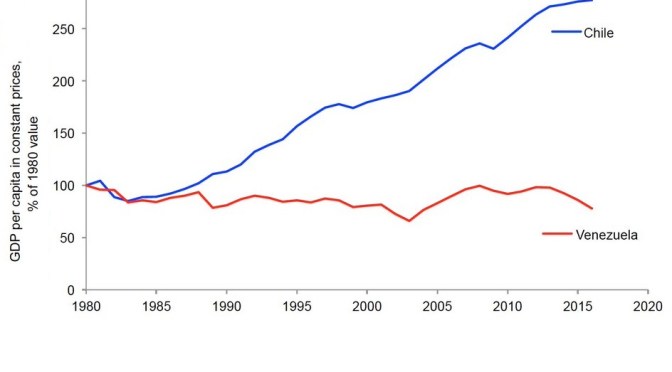
Let’s take a look at two Latin American countries that went in opposite directions. Venezuela and Chile. Then we can finally find out which policies actually achieve results for the people.

Here is how Chile started out in 1973.

PROBLEM: Price controls and tariffs:

Prices for the majority of basic goods were fixed by the government in 1973. Even though Chile was and still is a small economy, the level of protection­ism was high. By the end of 1973, the nominal average tariff for imports was 105 percent, with a maximum of 750 percent. Non-tariff barriers also impeded the import of more than 3,000 out of 5,125 registered goods. Just as economic theory predicts, large queues in front of stores were usual in Santiago and other cities in Chile as a result of the scarcity caused by price controls.

PROBLEM: Government taking over private businesses:

The decline in GDP during 1973 reflected a shrinking productive sector in which the main assets were gradually falling under government control or ownership through expropriations and other government interventions in the economy.

PROBLEM: Deficit spending and government printing money:

The fiscal situation was chaotic. The deficit reached 55 percent of expenditures and 20 percent of GDP and was the main cause of inflation because the Central Bank was issuing money to finance the government deficit.

SOLUTION: lower or eliminate restrictions on trade:

The most important economic reform in Chile was to open trade, primarily through a flat, low tar­iff on imports. Much of the credit for Chilean eco­nomic reforms in the following 30 years should be given to the decision to open our economy to the rest of the world. The strength of Chilean firms, productive sectors, and institutions grew up thanks to that fundamental change.

SOLUTION: let competing entrepreneurs in the private sector provide goods and services to consumers:

A second fundamental reform was to allow the private sector to recover, adding dynamism to the economy. In fact, important sectors such as elec­tricity generation and distribution and telecommu­nications were still managed by state companies. After we implemented a massive privatization plan that included more than 50,000 new direct share­holders and several million indirect (through pen­sion funds) shareholders, these companies were managed by private entrepreneurs that carried out important expansion plans.

SOLUTION: let people take responsibility for their own lives instead of depending on government:

The 1981 reform of the Chilean pension fund system deserves special mention. Under the leader­ship of Minister José Piñera, an individual capitali­zation account program was designed with specific contributions, administered by private institutions selected by the workers. The Chilean Administra­doras de Fondos de Pension (Pension Fund Administrators or AFP) has been replicated in more than 20 countries, and more than 100 million workers in different parts of the world use these accounts to save for retirement.

SOLUTION: allow parents to choose the school that fits their needs from competing education providers, and push school administration down from the federal government to the municipal level, where it would be more responsive to voter’s needs:

In 1981, Chile introduced a universal educational voucher system for students in both its elementary and secondary schools. At the same time, the central government transferred the administration of public schools to municipal governments…  The financial value of the voucher did not depend on family income.

RESULTS: And I was able to find a nice short, description of how all that worked out for them on the far-left Wikipedia, of all places:

The economy of Chile is a high-income economy as ranked by the World Bank, and is considered one of South America’s most stable and prosperous nations, leading Latin American nations in competitiveness, income per capita, globalization, economic freedom, and low perception of corruption.

In 2006, Chile became the country with the highest nominal GDP per capita in Latin America. In May 2010 Chile became the first South American country to join the OECD. Tax revenues, all together 20.2% of GDP in 2013, were the second lowest among the 34 OECD countries, and the lowest in 2010. In 2017, only 0.7% of the population lived on less than US$1.90 a day.

According to the Heritage Foundation, Chile is ranked as the 18th freest economy in the world. The World Bank ranked Chile as the 50th highest GDP per capita for 2018, just below Hungary and above Poland.

Now, you can contrast those results with Venezuela. I have been blogging about Venezuela for years on this blog, and documenting how they raised taxes, banned guns, nationalized private sector companies, raised tariffs, and increased regulations. They are now ranked JUST ABOVE NORTH KOREA for economic freedom – #179 out of 180 countries measured. Basically, they did the opposite of everything that Chile did – transferring power away from parents, workers, business owners, churches and municipal governments to the powerful centralized federal government.

Wikipedia explains how Hugo Chavez took over in 1999 and enacted a communist revolution.

More:

Since the Bolivarian Revolution half-dismantled its PDVSA oil giant corporation in 2002 by firing most of its 20,000-strong dissident professional human capital and imposed stringent currency controls in 2003 in an attempt to prevent capital flight, there has been a steady decline in oil production and exports. Further yet, price controls, expropriation of numerous farmlands and various industries, among other government authoritarian policies… have resulted in severe shortages in Venezuela and steep price rises of all common goods, including food, water, household products, spare parts, tools and medical supplies; forcing many manufacturers to either cut production or close down, with many ultimately abandoning the country as has been the case with several technological firms and most automobile makers.

They confiscated private property, took over private sector businesses, implemented tariffs and price controls, redistributed wealth via massive welfare programs, and pushed all decision-making out of families and municipal governments up to the federal government. By depriving the producers of their earnings, the country caused massive shortages of goods and services, to the point where people are fleeing the country, consuming zoo animals, and selling their bodies as prostitutes in order to get food and water.

Application

In the next election, we are not picking a tribe because of how they make us feel about ourselves. We are not choosing in order to see ourselves as “nice” and “not nice”. We need to look at specific policies being proposed, and see what works and what doesn’t work. The examples of Chile (rags-to-riches) and Venezuela (riches-to-rags) are helpful for voters who want to get RESULTS instead of FEELINGS.

I’ll leave you with a list of links from previous posts so you can see how communism worked out for Venezuela.

Related posts

Older career woman calls Dennis Prager show to warn young women about marriage

I used to listen to the Dennis Prager show all the time, and my favorite hour was the male-female hour, which is the second hour every Wednesday. In that hour, you will hear some of the most frank discussion of male and female issues. I was surprised to see Better Bachelor, a men’s rights activist, talk about an article about the male-female hour in his show. I’ll link to the article below.

Prager explains in The Stream:

Every Wednesday, the second hour of my national radio show is the “Male/Female Hour.” A few weeks ago, a woman named Jennifer called in. For reasons of space, I have somewhat shortened her comments. Every young woman should read them. This is precisely what she said:

Dennis, I want to get right to it. I’m 50 years old with four college degrees. I was raised by a feminist mother with no father in the home. My mother told me get an education to the maximum level so that you can get out in the world, make a lot of money. And that’s the path I followed. I make adequate money. I don’t make a ton of money. But I do make enough to support my own household.

I want to tell women in their 20s: Do not follow the path that I followed. You are leading yourself to a life of loneliness. All of your friends will be getting married and having children, and you’re working to compete in the world, and what you’re doing is competing with men. Men don’t like competitors. Men want a partner. It took me until my late 40s to realize this.

And by the time you have your own household with all your own bills, you can’t get off that track, because now you’ve got to make the money to pay your bills. It’s hard to find a partner in your late 40s to date because you also start losing self-confidence about your looks, your body. It’s not the same as it was in your 20s. You try to do what you can to make your life fulfilling. I have cats and dogs. But it’s lonely when you see your friends having children, going on vacations, planning the lives of their children, and you don’t do anything at night but come home to your cats and dogs. I don’t want other women to do what I have done.

How did this happen to her?

Somebody asked me the other day, “Why did you stay single and never have kids?” There’s answers: Because I was brainwashed by my mother into this. But it’s hard and it’s shameful to tell people, “I don’t know. I ran out of time.”

There’s not a good answer for it except “I was programmed to get into the workforce, compete with men and make money.” Supposedly, that would be a fulfilling life. But I was told that by a feminist mother who was divorced, who hated her husband — my father.

She tried to steer me on what she thought was the right path, but feminism is a lie. That’s what I want women to know.

I didn’t realize this until late in life. I want to tell women: Find someone in your 20s. That’s when you’re still very cute. That’s when you’re still amiable to working out problems with someone. It’s harder in your 50s, when you’ve lived alone, to compromise with someone, to have someone in your home and every little thing about them annoys you because you’re so used to being alone. It’s hard to undo that, so don’t do what I did. Find someone in your 20s.

I don’t want young women to be wasting their teens and 20s like this woman is, choosing men for relationships using criteria that have nothing at all to do with marriage, or what a man does in a marriage.

Look at this weird list of criteria from a dating ad – is any of this related to the actual work that a man does as a husband and father?

This person is looking for domestic violence, not a husband
She’s looking for drama, domestic violence and instability – not for a husband

I see young women going for “bad boy” qualities a lot, but for some reason, they think that the bad boy will turn into a good man. What could cause this? Is it that easy to change a man? I don’t think that men change that easily, which is why you should pick the man you marry based on his ability to do the work.

I think young women should focus their energy on relationships with men who are sober and chaste, and looking to commit and start a family. These men are easy for women to find when the women are in their teens and early 20s, but much harder for women to find if they delay marriage into their 30s and 40s. Although these marriage-minded men may not be “attractive” according to “bad boy” criteria, they should be selected because they are good at marriage, and want to marry sooner, rather than later. Feelings are not the best way to judge a man. Sometimes, you have to look at his academic transcripts, his resume, his bank account, his library.

On the other hand, I would advise successful man to choose a woman who is attracted to his abilities as a husband and father. Choose a woman who respects your ability to be serious, to be self-controlled, to be focused on serving others, and to achieve what you set out to achieve. Men need respect more than they need oxygen. In order to get that respect, a man has to choose a woman who has, from earliest times, preferred men who have good moral character, demonstrated leadership ability, and a proven record of achieving what he set out to achieve by wise decision-making.