All posts by Wintery Knight

https://winteryknight.com/

48-year-old divorced single mother seeks bailout for $430,000 of student loan debt

If there’s one area where I feel comfortable leading a woman, it’s education, career and finances. I wasn’t born in the USA, so it was quite a struggle to know how to navigate education, career and finances. But I did it, and I learned how to do it. And I like to share what I learned with Christian women, so that they don’t end up with a useless degree and a bunch of student loan debt.

Here’s a story about a woman I didn’t advise, reported by the far-left Business Insider:

Maria had a goal to teach at a university full-time. Today, she “absolutely” regrets pursuing that goal.

While Maria’s undergraduate education, which she completed in 2001, was funded through scholarships and Pell grants, she knew more advanced degrees would give her a leg up in university teaching — especially as a woman in the industry. So she pursued a master’s degree and a PhD, the latter of which took seven years to complete.

[…]Now, at 48 years old, Maria’s student-loan balance is $430,000…

[…]As a full-time human resources representative and part-time adjunct professor in Michigan, Maria now makes a five-figure salary while supporting her 15-year-old daughter on her own, with very minimal child support from the father.

[…]Of her total student-debt load, more than $70,000 is interest that accumulated while her student-loan payments were on hold, during which she cashed out her 401k and lived on unemployment benefits.

[…]Maria even filed for bankruptcy in 2018

I don’t recommend doing a degree in non-STEM fields, they don’t pay. I don’t recommend spending 7 years with no income for a PhD. But notice how society gives her free money to subsdize these poor decisions. She got free scholarships, Pell grants, child support, unemployment benefits. The article doesn’t mention if she got alimony, too. And she filed for bankruptcy… screwing her creditors out of what she owed them. Who knows what other social programs and tax benefits she got? While other women do STEM degrees, work in the private sector, marry and stay married, she’s been doing life on easy mode, passing off the costs of her poor decisions to the people around her. I don’t want women to make decisions that impose costs on their neighbors.

And now, she wants to get a bailout from taxpayers:

The Education Department recently announced reforms to PSLF, which included going back over denied applications and payments to the program. So there’s a chance that Maria may earn a quicker route to loan forgiveness. But with her current financial outlook, she’s not confident she can complete the program and wants President Joe Biden to do more to help millions of borrowers with debt burdens.

The article notes that teachers and other public sector “workers” can default on their loans and pass the costs along to taxpayers:

Maria does not work enough hours to qualify for the Public Service Loan Forgiveness (PSLF) program, which forgives student debt for public servants, like teachers, after ten years of qualifying payments.

Just understand that if society pays women to make poor decisions with their education, careers and finances, then more women will do it. That raises the costs on the men that pay taxes for this, reducing their ability to get married and conceive children. If men are paying for this woman’s mistakes, they can’t pay for their own marriage and parenting plans.

Consider this other article from the far-left Business Insider:

There are over 4 times as many scholarships restricted to females as there are restricted to males.

This is despite the fact that about 60% of college students are women. Why are we focusing on subsidizing the group that’s already doing well?

By the way, the author of the first Business Insider article, is a recent journalism graduate (expensive university) living in expensive Washington, D.C.. She advocates for bailouts through her journalism. She probably has massive student loan debt, too. It seems like choosing easy non-STEM majors, going into debt, then hoping for a bailout from socialism is quite common.

According to far-left Yahoo News, women hold two thirds of the $1.4 trillion outstanding student loan debt:

Women hold nearly two-thirds of the outstanding student debt in the U.S., according to the American Association of University Women. And, they have a harder time paying off their debt compared to men. Prior to the student loan forbearance period, 70% of men made at least their required minimum monthly loan payments, while only half (54%) of women said the same, a recent survey by D.A. Davidson found.

Young women today don’t like to have to “settle” for a lower cost college in a city with a lower cost of living. Like the Business Insider reporter, they want the Sex in the City lifestyle. So they go live in an expensive city, and run up debt doing useless degrees at an expensive university. And sometimes overseas! As you can see from the chart below, women avoid hard STEM degrees. But those programs are hard for a reason – they pay more money.
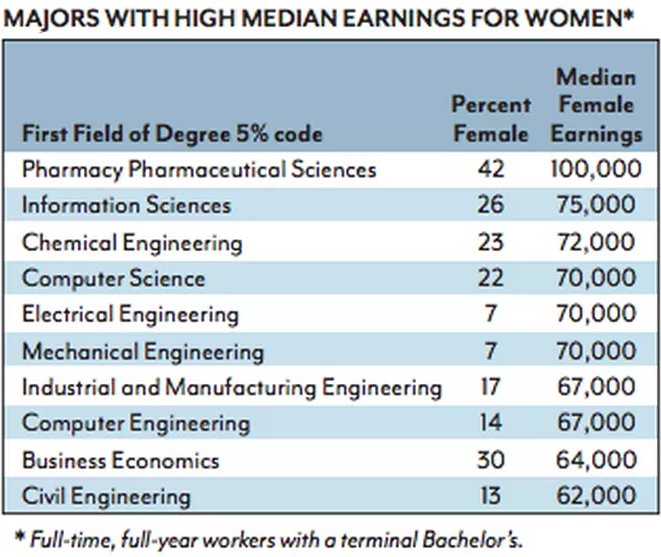
The best majors for women to avoid student loan debt

My thoughts

What I wanted to do here is report to you what happens when I try to coach young women about their decisions in education, career and finances. And keep in mind, I’m doing this from a position of starting out in a foreign country, earning a BS and MS in computer science, graduating debt-free and working 22 years full-time. I had a $1.3 million net worth by age 45 (including the new construction home I bought for cash). So I have achievements here.

I run into the student loan debt problem while dating Christian women for marriage. Christian women seem to be even less likely to do hard degrees than women on average. You see a lot of art, music, English, journalism, etc. degrees there. I show them that student loans are a risk factor for divorce, and they also set back the plan to stop paying rent and start having children. I also show them which majors pay the most.

Here’s what I usually get in response:

  • Women think that they will be an exception to all studies and reports showing that the likely consequences of their actions.
  • One woman dismissed the need to clean up her finances  because God decided what degrees I would have, and how much I would earn, so I had no authority to advise her from my experience.
  • Other women say that I am only doing what makes me happy, and they must do that too. (Note: I cried in second year calculus after failing the first test).
  • I advised a 29-year-old woman with $25K of student loan debt and was working as a waitress to take a job I found her as an IT project manager. She said “No! Being a waitress is the easiest job I’ve ever had!”
  • A 30-year-old woman with $23K in student loan debt wanted to do a Masters degree in Europe. I told her to pay off her loans first. She got two useless Masters degrees in Europe, and never worked again.
  • I’m told that there is no rush to get out of debt to afford children, because women can have children in their 40s.
  • I’m told that it will be fine for the children if she has to work to pay off her debts, because daycare and public schools work better for children than stay-at-home moms and homeschooling.
  • I’m told that the $30 trillion national debt and bailouts for student loans, etc. are no big deal because the government can just print more money.
  • I’m told that I can fix her financial problems by working harder and longer. One of my friends actually married a woman with $200K in student loan debt in order to get his green card, so some men take this deal.
  • I’m told that too much planning feels bad, and I need to be more spontaneous and adventurous. One woman literally said “I don’t want to make decisions based on fear”.
  • A famous Christian apologist woman (not WIA) told me that I can’t judge a woman who has student loans because if God forgives a woman, then a man can’t exclude her from marriage.

I’m not going to run a marriage that way. I have goals.
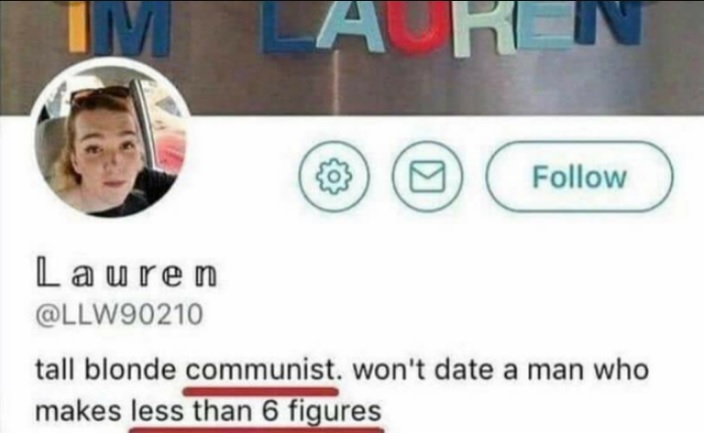
Men can’t afford BOTH bailouts AND marriage

So, my point is that we have a real problem with figuring out how to get women to make better decisions about education, career and finance. I want to help them. I really do. Because we are $30 trillion in debt now, and we simply don’t have enough money to keep bailing out people for student loans. And the problem will only get worse, as the younger generation of losers keeps making poor decisions and demanding that someone else pay for their mistakes.

Men don’t marry women who are bad with money. Money is one of the biggest causes of divorce, and divorce is a financial disaster for men because of anti-male divorce courts.

The number of men who can afford marriage and children is declining because they have to bail out all these reckless, irresponsible young women through their taxes. We need to fix this problem.

What is it really like for a young woman to regret her gender transition?

A few months ago, I blogged about this British woman who sued the NHS  after they transitioned her when she was still very young. At 16, the NHS gave her puberty blockers and testosterone injections. At age 20, they gave her a double masectomy. She regretted what they did to her, and won a case against them in court. She’s posted an article at Persuasion telling her side of the story.

Excerpt:

From the earliest days, my home life was unhappy. My parents—a white Englishwoman and a black American who got together while he was in Britain with the U.S. Air Force—divorced when I was about 5. My mother, who was on welfare, descended into alcoholism and mental illness. Although my father remained in England, he was emotionally distant to me and my younger sister.

I was a classic tomboy, which was one of the healthier parts of my early life in Letchworth, a town of about 30,000 people, an hour outside London. Early in childhood, I was accepted by the boys—I dressed in typically boy clothing and was athletic. I never had an issue with my gender; it wasn’t on my mind.

Then puberty hit, and everything changed for the worse. A lot of teenagers, especially girls, have a hard time with puberty, but I didn’t know this. I thought I was the only one who hated how my hips and breasts were growing. Then my periods started, and they were disabling. I was often in pain and drained of energy.

Also, I could no longer pass as “one of the boys,” so lost my community of male friends. But I didn’t feel I really belonged with the girls either. My mother’s alcoholism had gotten so bad that I didn’t want to bring friends home. Eventually, I had no friends to invite. I became more alienated and solitary. I had been moving a lot too, and I had to start over at different schools, which compounded my problems.

By the time I was 14, I was severely depressed and had given up: I stopped going to school; I stopped going outside. I just stayed in my room, avoiding my mother, playing video games, getting lost in my favorite music, and surfing the internet.

You know, the first thing I would do with a girl like this is get her to talk to a doctor about what she should expect. Maybe get her some medication to ease some of the puberty troubles. But mainly, just spend some time with her, talking to her, playing with her, and so on. But really the most important thing would be to tell her the truth about where she stood in terms of value, meaning and purpose. After all – how sad can you really be if Jesus gave his life for you, and has very important work for you to do? Young people seem to put so much emphasis on what their peers think of them, but on a Christian worldview, that doesn’t matter at all. What matters is what God thinks of you, and what he thinks is based on your character inside, not on how you look. He’s not selfish.

More:

Around the end of that first year post-surgery, something started happening: My brain was maturing. I thought about how I’d gotten where I was, and gave myself questions to contemplate. A big one was: “What makes me a man?”

I started realizing how many flaws there had been in my thought process, and how they had interacted with claims about gender that are increasingly found in the larger culture and that have been adopted at the Tavistock.

[…]I was also concerned about the effect my transition would have on my ability to find a sexual partner.

Then there was the fact that no one really knew the long-term effects of the treatment. For instance, the puberty blockers and testosterone caused me to have to deal with vaginal atrophy, a thinning and fragility of the vaginal walls that normally occurs after menopause. I started feeling really bad about myself again.

[…]Five years after beginning my medical transition to becoming male, I began the process of detransitioning. A lot of trans men talk about how you can’t cry with a high dose of testosterone in your body, and this affected me too: I couldn’t release my emotions. One of the first signs that I was becoming Keira again was that—thankfully, at last—I was able to cry. And I had a lot to cry about.

The consequences of what happened to me have been profound: possible infertility, loss of my breasts and inability to breastfeed, atrophied genitals, a permanently changed voice, facial hair. When I was seen at the Tavistock clinic, I had so many issues that it was comforting to think I really had only one that needed solving: I was a male in a female body. But it was the job of the professionals to consider all my co-morbidities, not just to affirm my naïve hope that everything could be solved with hormones and surgery.

Her article has a lot more information about her experiences with the NHS, and her court case. But what I wanted you guys to see was how important it is to not let children just say “I want this”, which is something they saw on TV, or heard from their peers, or read online. Instead, you need to find out what problem they are really trying to solve. Once upon a time, Christians thought that the Christian worldview and a relationship with God in Christ was the most important thing you had to offer people who were in distress. What happened to that? When did we stop offering truth, and start offering disinterested agreement and shallow affirmation? Did we just want to feel good and have people think we were “nice”?

Which population group is most likely to reject heterosexual relationships?

The Federalist reports:

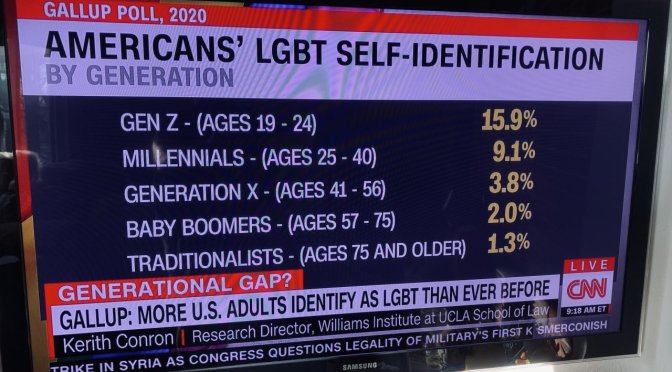
A new Gallup poll published on Feb. 24 shows 1 in 6 Gen Z adults identify as LGBT. These results represent a remarkable jump from 2017, when 4.5 percent of Americans identified as LGBT, a number that has now risen to 5.6 percent just three years later.

The increase is indeed dramatic, yet it doesn’t fully tell the whole story. Why? While the population of Americans identifying as LGBT has risen steadily since 2012, last year the question was expanded from a simple “yes” or “no” to LGBT identity to include specific categories to choose from. Only one identity group showed a dramatic increase: bisexual women.

[…]One in ten high school students identify as LGBT. Of these, 75 percent are female, and 77 percent identify as bisexual. As detailed by the Washington Post, the Williams Institute at the University of California at Los Angeles has found that 35 percent of LGBT adults are bisexual women.

Further, Hammack argues that his research shows young women are more likely to identify as “non-binary” or “gender-fluid.”

I’m going to have something to say about this in a minute, but for now just note that it’s young women who are the ones who are most likely to abandon natural marriage, traditional families and complementary sex roles.

More:

As Abigail Shrier discussed in great detail with in-depth research in her book, “Irreversible Damage: The Transgender Craze Seducing Our Daughters,” the power of social contagion and peer group identity is important to consider:

Between 2016 and 2017, the number of gender surgeries for natal females in the US quadrupled; in the UK, the rates of gender dysphoria for teenage girls are up 4,400 percent over the previous decade.

Indeed, as 16-year-old Jasper Swartz — who identifies as non-binary — expressed to the Washington Post, all of her friends are “queer in some way.”

Rather than reflecting the natural progression of openness to human variation in sexuality and gender identity, it seems to better reflect a pop culture fad to be included in the LGBT spectrum in any way possible. This seems especially true for younger people, who are inundated with LGBT education, culture, and positivity and, as Abigail discusses in her book, find meaning in being different, unique, and rebellious, along with their friends. As indicated by the Gallup survey, as people age, their identities become more stable and bisexuality drops significantly.

[…]For young women seeking identity and being part of a special or important group, all they have to do is cut their hair short, dress like a boy, and declare themselves non-binary or bisexual to gain instant victimhood status and self-validation. If it becomes too much and they still get the exciting thrill of being LGBT, they can always slip back into safer roles.

So, my suspicion is that young women are more vulnerable to this for two reasons. One, young women are more likely to determine their beliefs by deciding what makes them feel good. And two, young women are more likely to determine their beliefs by what makes them look good to their peer group. They’re not reading non-fiction, and forming a worldview that’s bound by logic and evidence. They like fiction. They like entertainment. They’re not even embracing their values based on their future goals. Their long-term goals might be to marry and have security and family. But they’re not taking steps towards that right now. Right now, they’re just doing what feels good in the moment. They’re adapting to their peers, and the culture at large, rather than thinking for themselves.

Young people seem to like gay marriage more than they like individual liberties
Young women like LGBT lifestyles more than they like natural marriage and family

In fact, there have been studies on how these ideas spread, and that’s exactly what they found – young women are the ones who swallow this, and for reasons of feelings and peer approval. It’s a social benefit to claim to be a minority sexual identity. Our culture has set it up so that you get prestige and sympathy for this. You get to play the victim, and everyone has to be nice to you. And you’re so interesting! So sophisticated. To young women, it’s an offer they can’t refuse – so they don’t.