All posts by Wintery Knight

https://winteryknight.com/

Richard Epstein explains why economic inequality is required in order to promote innovation

My friend Matt, who blogs at The Conscience of  a Young Conservative, posted this on Facebook.

Epstein explains how the profit motive creates economic value that raises the standard of living of all people, who are able to exchange their money for valuable products and services that they did not create. He explains how wealth redistribution is wasteful and harmful to economic growth.

(Found here)

Now let’s look at some myths that Christians believe about economics.

We need to understand basic economics

Christian philosopher Jay Richards explains basic economics.

Excerpt:

THE ZERO-SUM GAME MYTH.

There are three kinds of games: win-lose, lose-lose, and win-win. Win-lose games, like basketball, are sometimes called “zero-sum games.” When the Celtics and the Bulls compete, if the Celtics are up, then the Bulls are down, and vice versa. The scales balance. It’s a zero-sum.

Besides lose-lose games, which most of us avoid, there are positive-sum, or win-win, games. In these games, some players may end up better off than others, but everyone ends up at least the same if not better off than they were at the beginning.

Millions of people think that the free trade in capitalism is a dog-eat-dog competition, where winners always create losers. This is the zero-sum game myth, which leads many to think that the government should somehow redistribute wealth. While some competition is a part of any economy, of course, an exchange that is free on both sides, in which no one is forced or tricked into participating, is a win-win game. When I pay my barber $18 for a haircut, I value the haircut more than the $18. My barber values the $18 more than the time and effort it took her to cut my hair. We’re both better off. Win-win.

THE MATERIALIST MYTH.

A similar myth leads people to think of the economy as some fixed amount of material stuff—money in safes or gold bars in a vault. Since two firms competing for one customer can’t both get the customer’s money, we might think the whole economy looks that way: wealth itself isn’t created, it’s merely transferred from one party to another.

A common image of this “Materialist Myth” is a pie. If one person gets too big a slice, someone else will get just a sliver. To serve it fairly, you have to slice equal pieces.

This isn’t how a free economy works, however. Over the long run, the total amount of wealth in free economies grows. We can create wealth that wasn’t there before. The “pie” doesn’t stay the same size. Under capitalism, someone can get wealthy not merely by having someone else’s wealth transferred to his account, but by creating new wealth, not only for himself, but for others as well.

THE GREED MYTH.

Friends and foes of capitalism often claim that it is based on greed. Writer Ayn Rand even claimed that selfishness is a virtue (see the accompanying feature article). But greed is one of the seven deadly sins. If capitalism is based on it, then Christians can’t be capitalists.

In truth, Adam Smith and other capitalist thinkers did not believe this “Greed Myth.” Rather, Smith argued that capitalism, unlike static economies, channels even greedy motives into socially beneficial outcomes. “In spite of their natural selfishness and rapacity,” Smith wrote, business people “are led by an invisible hand…and thus without intending it, without knowing it, advance the interest of the society.”3

Rather than inspire miserliness, capitalism encourages enterprise. Entrepreneurs, including greedy ones, succeed by delaying their own gratification, by investing their wealth in creative but risky ventures that may or may not pan out. Before they ever profit, they must first create.

In a fallen world, we should want an economic system that not only channels greed into productive purposes, but unleashes human ingenuity, creativity, and willingness to risk as well.

I think Christians who don’t understand economics really need to make the effort to understand the basics. I recommend Robert Murphy’s “The Politically Incorrect Guide to Capitalism” and Thomas Sowell’s “Basic Economics“. If you want to see how economics works together with Christianity, then you also want Jay Richards “Money, Greed and God” and Wayne Grudem’s “Politics According to the Bible“.
Is Luke 10:13 more of problem for Calvinists or Molinists?

Calvinism is the view that God decides whether you go to Heaven or Hell and nothing that you do affects where you end up. If God wants to save you, then he will, and you can’t resist it. If God wants to damn you, then he will, and you can’t resist that. God saves some people and not others, but not based on anything that the people themselves do. God does not want everyone to be saved.

Molinism is the view that God draws people to him, and they can resist his drawing, just like in any ordinary love relationship where the beloved is not drawn against his or her will. On Molinism, God also places people in the best time and place for them to respond to him, depending on what evidence they need. He can do this because he knows how people respond in any set of circumstances. If people go to Hell, then the people are responsible, on Molinism. But God wants everyone to be saved, but not against their will. God actualizes a world in which he is sovereign over everything that happens, and gets the outcome that he wants, but without violating free will.

So here’s a verse that I think is troubling to both sides, Luke 10:13:

13 “Woe to you, Chorazin! Woe to you, Bethsaida! For if the miracles that were performed in you had been performed in Tyre and Sidon, they would have repented long ago, sitting in sackcloth and ashes.

This verse is a problem for Molinists, because if the people in these cities would have repented if they got better miracles, then why didn’t they get the better miracles they needed? If God loves them, then why didn’t he give them better miracles?

And this verse is a problem for Calvinists, because it shows that people do have free will to respond to evidence that God allows them to see. Why would evidence matter on Calvinism, since God can just flip the person’s switch (or not). If God wanted those people to repent, he could just do it without having to care about evidence, since he is the one who decides whether they believe in him or not, totally apart from their free will.

A closer look at Obama’s three-point plan to create American jobs

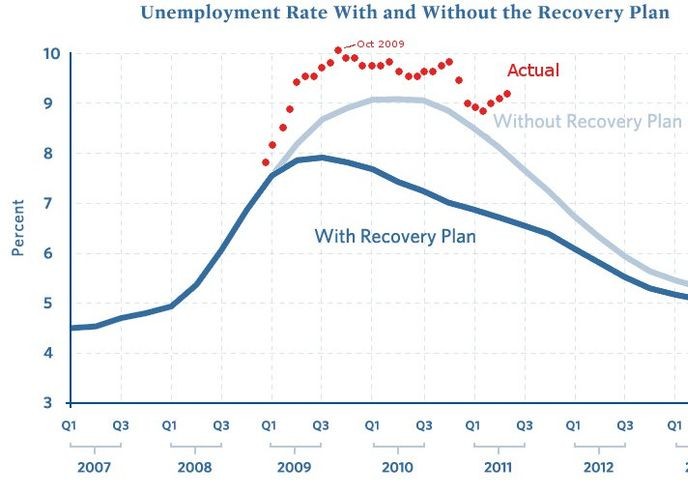
Unemployment rate chart 2011
Democrats take over the House and Senate in January 2007

The Heritage Foundation outlines three of Obama’s job creation plans.

Excerpt:

This week, President Obama is again set to make a pitch for his latest plan to stimulate the economy, but meanwhile he is turning his back on projects that would put tens or even hundreds of thousands of Americans to work. And he’s doing it all to appease his left-wing, environmentalist base at the expense of domestic energy production.

Heritage’s Rob Bluey reported last week on a new finding by a New Orleans-based group that the Obama administration is approving just 35 percent of the oil drilling plans for the Gulf of Mexico so far this year. It is also taking an average of 115 days — nearly four months — to secure approval from the Bureau of Ocean Energy Management, Regulation and Enforcement. Those numbers are a sharp drop from previous years, well below the historical average 73.4 percent approval rate and 61 days it takes to approve plans. And for plans that require drilling activity, the numbers are even worse with an average approval time of 222 days.

That’s bad news for job creation. One deepwater rig alone can create 700 jobs locally. But slowing down oil drilling in the Gulf isn’t the only way the President is blocking jobs. Earlier this month, the Obama Administration announced it would delay the construction of the $7 billion Keystone XL pipeline that would bring in more than 700,000 barrels of oil per day from Alberta, Canada, to the Texas Gulf coast–and could have produced upwards of 20,000 jobs. Heritage’s Nicolas Loris explains the impact:

What this delay really means is that President Obama is putting off an important election year decision in which two of his largest supporters–labor unions and environmentalists–are split on the issue. This tactic allows the decision to be delayed until after the 2012 elections.

More importantly, this means a delay in access to easy imports from our northern neighbor, the creation of thousands of jobs, and the generation of revenue for the states where the pipeline passes. Montana, South Dakota, Kansas, Oklahoma, Nebraska, and Texas are collectively projected to collect $5.2 billion in property tax revenue as a result of building the pipeline.

As if that weren’t enough, the White House made another decision blocking energy-related jobs in the United States. In mid-November, the Obama Administration delayed a mineral lease sale in Ohio’s Wayne National Forest for oil and gas drilling. Apart for providing Americans access to affordable energy, the project could have had a tremendous impact in the state, including the creation of an estimated 200,000 jobs, an overall wage and personal-income boost of $12 billion by 2015, and a billion-dollar boon to Ohio landowners, schools, businesses, and communities.

So Obama has three plans to create more American jobs:

  1. Block drilling in the Gulf of Mexico
  2. Block the construction of the Keystone XL pipeline
  3. Block drilling for oil and gas in Ohio

I don’t think Obama’s three job creation plans are working.

Maybe he just just do the opposite: 1) more drilling in the Gulf, 2) build the Keystone XL pipeline, and 3) allow development of the Ohio oil shale. And while he’s at it, 4) drill for oil in Alaska. That would create real jobs.