
Are Christians responsible for making plans and making good decisions?

Here’s a wonderful post on decision making and the will of God posted on Neil’s blog. In his post, Neil explains the Biblical model for making good decisions.

Excerpt:

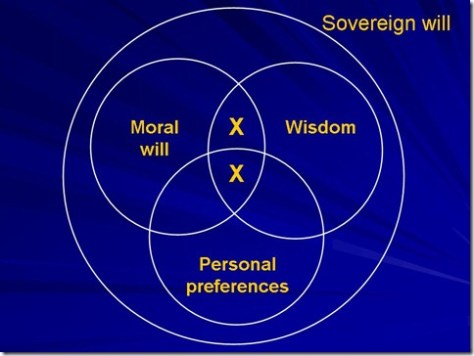
Really short version: Aside from direct and clear personal revelation from God, you don’t have access to his sovereign will when making decisions.  Therefore you must look at other factors.  If it isn’t moral, don’t do it.  If it is moral but not wise, don’t do it.  If it is moral and wise, then use your personal preferences.

Using this model you can end up with a wise and biblical decision, but you have avoided the traps of the “God told me to ____” routine.  People who run around saying that God told them this and that convey a super-spirituality that can leave less mature believers wondering if they really have a relationship with God (i.e., “God doesn’t tell me every little thing to do, so maybe I don’t really know him.”).

He has a helpful picture posted as well:
This is actually a very important topic for me, because I like making plans and making good decisions. I like being the quarterback or squad leader of my own life. I like to pick objectives and then make plans to achieve them. (Nothing too exotic, just simple stuff like saving money or reading more books)

Actually, I really oppose the idea that God has a magical fairy tale will for each person that will make them happy and fulfilled. For me, life isn’t like that. I don’t expect God to lead me along like a child at a scavenger hunt. I expect to survey the battlefield where I am and then do something to make a difference. There are lots of things you can do that will please God. Should you focus on your career and sponsor apologetics conferences? Or should you use your spare time preparing Sunday school lessons? There are lots of good things you could do to please God. Your job is to pick the one that will be the most effective. It doesn’t matter if it makes you happy, it only matters if it’s effective and if you are good at it.

Who is Rifleman Dodd?

A while back, I was busily working my way through the U.S. Marine Corps Official Reading List, and I came across a book by C.S. Forester called Rifleman Dodd, or alternatively titled Death to the French. It’s a work of historical fiction that takes place during the Napoleonic wars. The story is about a British marksman named Dodd, who is cut off from his own lines during a withdrawal maneuver. He is subsequently left to fend for himself behind enemy lines. An ordinary man might be full of despair and forget about his mission entirely. But Dodd is no ordinary man. Not only does he find a way to survive by finding food to eat, water to drink and places to sleep, but he also tries to remember his orders and to think about what he can do to advance the cause of his General, the Duke of Wellington.

Here’s an excerpt from a gritty book review:

It’s about a green-coated British infantry rifleman in the Napoleonic Wars, an age when rifles were a novelty and most of the army was red-coated and carried muskets. Private Matthew Dodd gets separated from his regiment during a retreat and finds himself stranded behind enemy (French) lines in Portugal. With the occasional aid of some natives, but mostly on his own, he harasses the French with his rifle and tries to prevent them from building a bridge across the Tagus River. It’s a remarkable tale of survival and solitary achievement, of a rank-and-file soldier who lives by his wits and slowly learns to make plans without orders, and shows leadership qualities and a knowledge of warfare.

I think we’re in the same situation as Dodd.

There is no point in us looking for breadcrumb trails to happiness at this point. That’s not the point of Christianity. The point of Christianity is friendship with God, imitation of Christ, honoring moral obligations, self-sacrificial love for your neighbor (and even your enemies!), and dedication to the truth – whether anyone else likes you or not. It’s not supposed to make you happy, and it’s not necessarily going to be a normal life like everyone else has. Things may not work out the way you’d like them to.

We seem to be making such a big deal about compassion and forgiveness in the Christian life these days – such a big emphasis on our feelings. Almost like we have forgotten that we have obligations to our friend. A relationship doesn’t mean that one person does whatever they feel like, completely disregarding the character and goals of the other person and then is automatically granted forgiveness whenever they want it. That’s not a friendship – that’s using someone else for your own ends.

For a lot of people today, Christianity only comes into play after you’ve made a mistake and you’re feeling guilty. For example, suppose you decide to go to a party with your secular friends, then you drink too much, and you do something sexual that you shouldn’t have done. Or maybe you watched some prosperity gospel preacher on TV, then made irresponsible business decisions thinking that God would bail you out and make you rich, and you went bankrupt. Most people think Christianity is for this situation: you’re a Christian so that you don’t have to feel guilty about sin. And so that you can tell people that God forgives you, so that they can’t think anything bad about you, either. You sort of get your idea about what you should be doing in order to feel good from the culture, and God is just there to forgive it all when it blows up in your face.

But in my case, putting myself in a situation like that is not even possible. I’m more likely to try to plan to do something for God. Like, I might try to mentor a young Christian by sending them books. Or, I might try to teach a class in apologetics at my church. These are things that are for God, not for me. I’m not just being dragged along by the culture, and trying to find happiness by feeling good (e.g. – with alcohol) or being liked by non-Christians. And if my plans fail because the mentoree doesn’t grow up into anything, or nobody comes to my apologetics class, that’s when I go to God and say “I screwed up. but can I still be in your army?” And God always says yes to that. You don’t have to be the best player on the team for the Coach to like you. He already likes you.

One of the great things about being a Christian is that you can never lose your identity as a Christian by failing to do something for him that you planned to do. That’s what forgiveness is for. If you set out to do something for God’s glory, and you mess it all up, that’s OK. But I do think that, like Dodd, our ambition should not be about just making ourselves happy, or making non-Christians like us. We should be trying to make plans and carry them out for God.

That’s how I understand forgiveness. It’s not just something that’s there for you to use to fix your feelings when you’ve been irresponsible while seeking your own happiness in secular ways. It’s also there when you’re trying to do something good for God, and you fail. A lot of times in life you try your best, but you fail, and then you lose something that you really wanted. With God, when you try your best for his glory, and fail, you don’t lose your identity as a member of his team. I think that not losing your identity in Christ is even more important than not feeling guilty about selfish decision making.

So, have you got a plan to serve your General? Let’s focus more on what operations we’re planning for God than on being happy and being popular with non-Christians. Your life should not be all about you, with God just there to make your bad feelings go away. Your life should be about God’s goals and God’s interests.

Are men allowed to have preferences about which women are best for marriage?

Telling a woman how to make wise decisions protects her

So, in my last post, I explained why men have to be careful about choosing a wife. Men have plans and they need a woman with the right skills to achieve it. Even if a woman genuinely repents her past, she may not have developed the skills for a godly man’s marriage plan. For example, her 50K of student loans makes it harder to afford a stay-at-home homeschooling mother.

But many Christian women feel that there is no such thing as a Christian woman who is a bad candidate for marriage. It doesn’t matter what a Christian woman did in the past, a man should not be allowed to evaluate her skills for the roles of wife and mother. After all, if God forgives a Christian woman for running up student loan debt for a useless women’s studies degree, or for getting drunk and sleeping around with hawt bad boys in college, then no Christian man should hold it against her. Men are obligated to disregard the past anti-marriage decisions made by women. To do anything else is to deny the Gospel of Jesus Christ. So many Christian women say.

What would happen if the shoe were on the other foot? What if it were the MAN who had been selfish, lazy and irresponsible? What if the MAN had made choices that seriously harmed his ability to perform male marriage roles like protecting and providing for his wife and children? Would marriage-ready women be obligated to marry this man as much as a man who had remained chaste, got a good education, built up a gapless resume, saved enough for a downpayment on a house, and taught apologetics in his home church? Is she allowed to prefer a man who has made good decisions to prepare for his marriage roles over a man who has made horrible decisions, but just hollers “grace” when anyone questions his ability to be a husband and father?

This MUST-READ article from The Federalist asks and answers that question. (H/T Lindsay)

Do you agree with the author?

I think it’s time for a conversation about another elephant in the room: this idea that women prefer physically fit men with good jobs and no criminal record. It’s incredibly sexist and matriarchal to insist that women have a natural preference for men who have invested time and energy into stewarding their bodies, have shown the capability of earning a living and supporting a family, and have not gone to jail for attempting to grow 452 marijuana plants in their mother’s basement.

I know more than a few men who spent their twenties languishing in their parents’ homes, subsisting on Cheetos and Mountain Dew, playing Xbox, watching pornography, and smoking controlled substances. If one of these men turns his life around, accepts Jesus, and starts fresh, young women have no right to overlook him as a potential mate just because he is 280 pounds, has almost no marketable skills at 30 years old, and cannot vote, serve on a jury, or own a firearm. He is created in the image of God, and accepted by Jesus! Any women who would overlook every other noble quality he possesses for basic financial security and a clean background check (not to mention browsing history) isn’t a woman he should want.

Men like this have often long since repented of their listless and slothful ways. If the lingering consequences of their pasts didn’t stop Christ from living and dying for them, then it shouldn’t stop a Christian woman from loving them, either. Period.

The Federalist article makes it clear that a man’s poor choices about his education, job, obedience to the law, and physical fitness CLEARLY compromise his ability to perform his male duties to protect and provide. What about moral and spiritual leading? Well if he didn’t spent his teens and 20s studying  apologetics, moral issues, etc. then he isn’t going to compare favorably to a man who teaches apologetics in his church, debates atheists, and writes blog posts for the Life Training Institute.

My friend Lee is a superb stay-at-home wife and mother. She says that we shouldn’t accept “Jesus forgives me” as an immediate reversal of past harmful choices:

I would note that there is a difference between just being forgiven of sin and actually repenting of it. Repenting is a turning away from and will manifest in changes; paying down debts, becoming chaste, becoming otherwise responsible and wise. Someone’s past doesn’t have to define their future. But that will manifest in observable and measurable changes.

She’s right.

I knew a Christian woman who had 25,000 worth of student loan debt when she was 29. She wasn’t using her degree, she was just working as a waitress. I found her a job as an IT project manager in an FT100 company, so she could pay off her loans. She declined, because “being a waitress is the easiest job I’ve ever had”. She hasn’t worked full-time as a professional since January 2013. She’ll say “Jesus forgives me!” and “I hate my student loans!”, but the loans are even larger now, and the wasteful spending on fun and thrills hasn’t stopped. Hollering “grace” and saying you hate debt doesn’t make you a good steward. She’s not ready to manage the finances of a household. If she had taken the job, and paid off the loans, then she would have overcome the mistake, and become marriage-ready.

So what’s really behind the hysteria against men evaluating women for marriage?

Deti nails the real root problem:

Not one person – NOT ONE PERSON – said that nonvirgins with tattoos and debt are bad people; that they are irredeemable, that they’re bad Christians; that they cannot be Christians; that they’re unsalvageable; that they’re ugly; or that they couldn’t and shouldn’t marry. That is NOT what was said.

All that was said was that men prefer tattooless, debtfree virgins for marriage. That’s all.

[…]The bible… teaches repentance is the way to salvation. But repentance does not mean you no longer bear the scars of your past sins in body and mind. You do. Oh yes you do. The effects can be minimized, even overcome. But they’re still there.

And more to the point, what’s really being complained about here is a Christian woman acknowledging that men have preferences and that men are entitled to have preferences. If women want men, then they have to satisfy those preferences or lower their standards until they find men whose preferences they can satisfy.

This can’t be overemphasized – it’s the idea that men have preferences. Its’ the idea that there’s a man that’s one-half of that relationship, and there are things HE wants, and HE needs, and HE desires. Why does it matter what HE wants? Why do we care about him?

Men don’t want to marry high N women. Men don’t want to take on debt and they don’t prefer markedup tatted up women who look and act like men.

What this gets down to is women objecting to men having standards. Because that leads to men judging women. And that leads to men evaluating women. And that leads to men rejecting some women and accepting others. And women hate judgment and rejection, especially when it’s “less than” men who are doing the judging and rejecting.

One of my editors (Mary) didn’t think that some readers would know what N means. N refers to the number of sexual partners a person has had.

The reason we discuss best practices for marriage-minded women is so that young women, especially young women who lack a father in the home because of the irresponsible and selfish choices of their mothers, can get some kind of guidance about how to resist the culture’s lies about men, sex and marriage. Such a woman has NOWHERE TO GO in this culture in order to learn how to relate to men, and how to marry to a man who will love her faithfully and forever. That’s not fair! We have to help her!

What Christian men are doing by promoting chastity, sobriety, good stewardship and self-control to these young women is protecting them from a culture that lies to them. The well-meaning Christian women who think that talking about moral boundaries and wisdom will hurt the feelings of women who have made mistakes are actually making it harder for young women who have no guidance at all. The most vulnerable ones are the ones who need to hear that chastity is wise. Doing a STEM degree is wise. Getting out of debt by spending less is wise. Not seeking attention with graffiti on your body is wise. That’s what unmarried women need to hear.

It’s amazing to me that so many Christians do not understand the protective value of recommending Biblical morality and Biblical wisdom to young women. They would rather sacrifice these young women to the secular culture than allow older women to feel bad about their past decisions. So many Christians seem to be more concerned about their own feelings than about promoting and defending what the Bible teaches to young people who really need help.

How the discovery of the cosmic microwave background radiation falsified atheism

Christianity and the progress of science

Prior to certain scientific discoveries, most people thought that the universe had always been here, and no need to ask who or what may have caused it. But today, that’s all changed. Today, the standard model of the origin of the universe is that all the matter and energy in the universe came into being in an event scientists call “The Big Bang”. At the creation event, space and time themselves began to exist, and there is no material reality that preceded them.

So a couple of quotes to show that.

An initial cosmological singularity… forms a past temporal extremity to the universe. We cannot continue physical reasoning, or even the concept of spacetime, through such an extremity… On this view the big bang represents the creation event; the creation not only of all the matter and energy in the universe, but also of spacetime itself.

Source: P. C. W. Davies, “Spacetime Singularities in Cosmology,” in The Study of Time III, ed. J. T. Fraser (Berlin: Springer Verlag ).

And another quote:

[A]lmost everyone now believes that the universe, and time itself, had a beginning at the big bang.

Source: Stephen Hawking and Roger Penrose, The Nature of Space and Time, The Isaac Newton Institute Series of Lectures (Princeton, N. J.: Princeton University Press, 1996), p. 20.

So, there are several scientific discoveries that led scientists to accept the creation event, and one of the most interesting and famous is the discovery of the cosmic microwave background radiation.

Here’s the history of how that discovery happened, from the American Physical Society web site:

Bell Labs radio astronomers Arno Penzias and Robert Wilson were using a large horn antenna in 1964 and 1965 to map signals from the Milky Way, when they serendipitously discovered the CMB. As written in the citation, “This unexpected discovery, offering strong evidence that the universe began with the Big Bang, ushered in experimental cosmology.” Penzias and Wilson shared the Nobel Prize in Physics in 1978 in honor of their findings.

The CMB is “noise” leftover from the creation of the Universe. The microwave radiation is only 3 degrees above Absolute Zero or -270 degrees C,1 and is uniformly perceptible from all directions. Its presence demonstrates that that our universe began in an extremely hot and violent explosion, called the Big Bang, 13.7 billion years ago.

In 1960, Bell Labs built a 20-foot horn-shaped antenna in Holmdel, NJ to be used with an early satellite system called Echo. The intention was to collect and amplify radio signals to send them across long distances, but within a few years, another satellite was launched and Echo became obsolete.2

With the antenna no longer tied to commercial applications, it was now free for research. Penzias and Wilson jumped at the chance to use it to analyze radio signals from the spaces between galaxies.3 But when they began to employ it, they encountered a persistent “noise” of microwaves that came from every direction. If they were to conduct experiments with the antenna, they would have to find a way to remove the static.

Penzias and Wilson tested everything they could think of to rule out the source of the radiation racket. They knew it wasn’t radiation from the Milky Way or extraterrestrial radio sources. They pointed the antenna towards New York City to rule out “urban interference”, and did analysis to dismiss possible military testing from their list.4

Then they found droppings of pigeons nesting in the antenna. They cleaned out the mess and tried removing the birds and discouraging them from roosting, but they kept flying back. “To get rid of them, we finally found the most humane thing was to get a shot gun…and at very close range [we] just killed them instantly. It’s not something I’m happy about, but that seemed like the only way out of our dilemma,” said Penzias.5 “And so the pigeons left with a smaller bang, but the noise remained, coming from every direction.”6

At the same time, the two astronomers learned that Princeton University physicist Robert Dicke had predicted that if the Big Bang had occurred, there would be low level radiation found throughout the universe. Dicke was about to design an experiment to test this hypothesis when he was contacted by Penzias. Upon hearing of Penzias’ and Wilson’s discovery, Dicke turned to his laboratory colleagues and said “well boys, we’ve been scooped.”7

Although both groups published their results in Astrophysical Journal Letters, only Penzias and Wilson received the Nobel Prize for the discovery of the CMB.

The horn antenna was designated a National Historic Landmark in 1990. Its significance in fostering a new appreciation for the field of cosmology and a better understanding of our origins can be summed up by the following: “Scientists have labeled the discovery [of the CMB] the greatest scientific discovery of the 20th century.”8

It’s the greatest scientific discovery of the 20th century.

In the New York Times, Arno Penzias commented on his discovery – the greatest discovery of the 20th century – so:

The best data we have [concerning the Big Bang] are exactly what I would have predicted, had I nothing to go on but the five books of Moses, the Psalms, the bible as a whole.

Just one problem with the greatest scientific discovery of the 20th century: atheists don’t accept it. Why not?

Here’s a statement from the Secular Humanist Manifesto, which explains what atheists believe about the universe:

Religious humanists regard the universe as self-existing and not created.

For a couple of examples of how atheistic scientists respond to the evidence for a cosmic beginning, you can check out this post, where we get responses from cosmologist Lawrence Krauss, and physical chemist Peter Atkins.

You cannot have the creation of the universe be true AND a self-existing, eternal universe ALSO be true. Someone has to be wrong. Either the science is wrong, or the atheist manifesto is wrong. I know where I stand.

Positive arguments for Christian theism