How long do people wait to be treated in a single-payer health care system?

Instead of talking about single payer health care in the abstract (“wouldn’t it be nice if health care were free?”), let’s discuss a concrete case of a single payer health care system. Canada’s health care system is a pure government-funded system.  Canadian residents pay money into the system via taxation. And when they get sick, they go into a government-run hospital and ask for government-run health care. The idea of single payer health care makes a lot of politicians feel good, and it draws applause when they talk about it in the abstract. But forget the abstract. How well does it work in reality?

Here’s an article from a Canadian health care policy expert, Sally C. Pipes.

She writes:

The Canadian single-payer regime subjects thousands of patients to life-threatening delays for treatment.

Our northern neighbors’ wait times grow longer with each passing year. According to the Fraser Institute, a Canadian think tank, the typical patient in need of specialist treatment last year waited 21.2 weeks after referral from a general practitioner — a record high. In 1993, the median wait time was less than half that figure — 9.3 weeks.

In British Columbia, the median wait is even longer — a grand total of 26.5 weeks from referral from a general practitioner to receipt of treatment from a specialist.  That’s more than half a year.

Lengthy delays are a hallmark of single-payer. Demand for care is essentially limitless when someone else is paying the bill.

But the provincial and federal governments in Canada don’t have limitless resources. So they typically set a global budget for care.  Doctors and hospitals can only provide so much care before their costs exceed their revenue from the government. And they can only afford to keep a limited amount of equipment operational, such as MRI machines or CT scanners.

Demand for care inevitably outstrips supply. So the government has to establish wait lists.

Long waits aren’t merely inconvenient; they’re dangerous. Consider the case of Walid Khalfallah, a British Columbian boy with severe scoliosis profiled by the Vancouver Sun in 2012. The Sun reported that he faced a three-year wait for spinal surgery, even though medical guidelines recommended a maximum wait of three months.

Delays can even prove fatal. Long waits have contributed to the deaths of more than 44,000 Canadian women in the past two decades, according to a Fraser Institute study.

Many patients would gladly pay extra to receive care more quickly. But British Columbian law makes it effectively impossible to do so.

The hardest thing to explain to Americans who are only familiar with private insurance is that if the government tells you no in a single-payer system, your only option is to take whatever money you have left (after being taxed for the single-payer system) and go outside the country. A lot of Canadian socialist politicians do exactly that, when they need reliable health care. Like Bernie Sanders, they say one thing to their naive followers, and do something else in their private lives.

So how good is American health care? Maybe Canadians are waiting in line because their health care is so much better than ours.

American health care

One of the best health care policy experts writing today is Avik Roy, who writes for Forbes magazine.

Here is a recent column, which I think is useful for helping us all get better at debating health care policy.

Excerpt:

It’s one of the most oft-repeated justifications for socialized medicine: Americans spend more money than other developed countries on health care, but don’t live as long. If we would just hop on the European health-care bandwagon, we’d live longer and healthier lives. The only problem is it’s not true.

[…]If you really want to measure health outcomes, the best way to do it is at the point of medical intervention. If you have a heart attack, how long do you live in the U.S. vs. another country? If you’re diagnosed with breast cancer? In 2008, a group of investigators conducted a worldwide study of cancer survival rates, called CONCORD. They looked at 5-year survival rates for breast cancer, colon and rectal cancer, and prostate cancer. I compiled their data for the U.S., Canada, Australia, Japan, and western Europe. Guess who came out number one?

Here is the raw data:
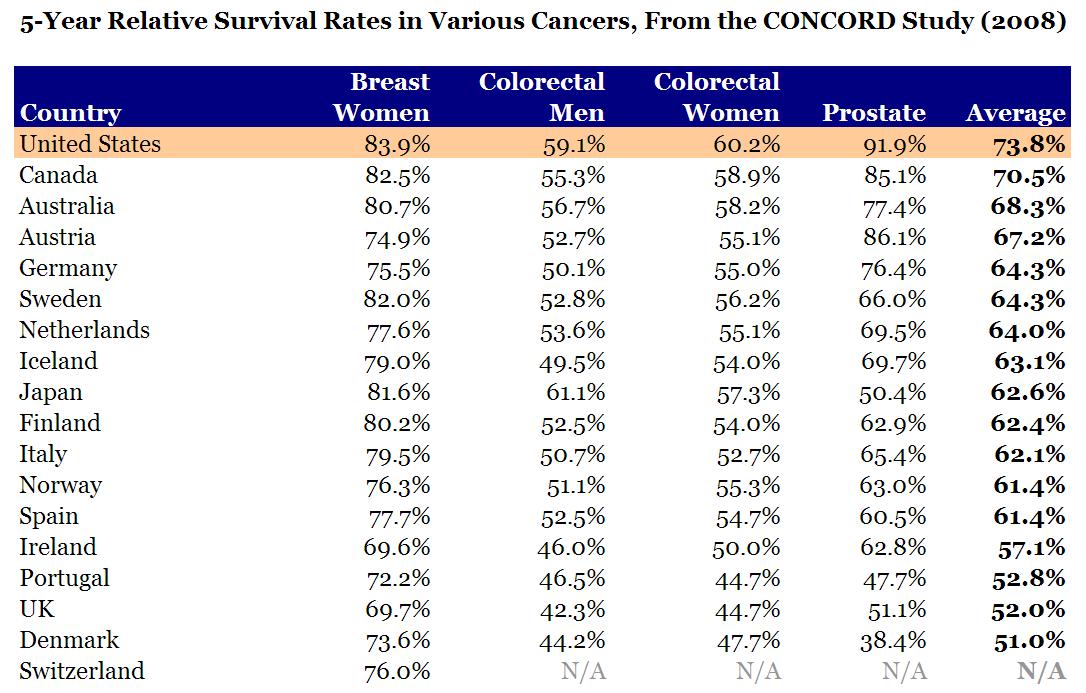
Health care outcomes
Health care outcomes by country and type of treatment

Click here to see the larger graph.

So, what explains this?

The article continues:

Another point worth making is that people die for other reasons than health. For example, people die because of car accidents and violent crime. A few years back, Robert Ohsfeldt of Texas A&M and John Schneider of the University of Iowa asked the obvious question: what happens if you remove deaths from fatal injuries from the life expectancy tables? Among the 29 members of the OECD, the U.S. vaults from 19th place to…you guessed it…first. Japan, on the same adjustment, drops from first to ninth.

It’s great that the Japanese eat more sushi than we do, and that they settle their arguments more peaceably. But these things don’t have anything to do with socialized medicine.

Finally, U.S. life-expectancy statistics are skewed by the fact that the U.S. doesn’t have one health-care system, but three: Medicaid, Medicare, and private insurance. (A fourth, the Obamacare exchanges, is supposed to go into effect in 2014.) As I have noted in the past, health outcomes for those on government-sponsored insurance are worse than for those on private insurance.

To my knowledge, no one has attempted to segregate U.S. life-expectancy figures by insurance status. But based on the data we have, it’s highly likely that those on private insurance have the best life expectancy, with Medicare patients in the middle, and the uninsured and Medicaid at the bottom.

Certainly, the life expectancy in our 100% government-run health care system, the Veteran’s Affairs health care system, is really, really low. They just kill the patients, give themselves bonuses, and then cover-up their failures when the investigators come.

I know that my readers who like to dig deep into economics and policy will love the links at the bottom of the article:

For further reading on the topic of life expectancy, here are some recommendations. Harvard economist Greg Mankiw discusses some of the confounding factors with life expectancy statistics, citing this NBER study by June and Dave O’Neill comparing the U.S. and Canada. (Mankiw calls the misuse of U.S. life expectancy stats “schlocky.”) Chicago economist Gary Becker makes note of the CONCORD study in this blog post. In 2009, Sam Preston and Jessica Ho of the University of Pennsylvania published a lengthy analysis of life expectancy statistics, concluding that “the low longevity ranking of the United States is not likely to be a result of a poorly functioning health care system.”

If we’re going to discuss health care, then let’s discuss facts. We shouldn’t be picking a health care system from the campaign speeches of politicians who tell us that we can keep our doctor, and keep our health plan, and our premiums will go down. We tried electing a charismatic deceiver in 2008, and it didn’t work out. We lost our doctors, lost our health plans, and our premiums went up enormously. We can do better than single-payer health care. We can do better than socialism.

Should we expect to know what God’s reason is for allowing evil and suffering?

Lets take a closer look at a puzzle

Here is an article by Steven Cowan about the problems of evil and suffering.

Intro:

The problem of evil is no doubt the most serious challenge to belief in God. Even religious believers find it troubling that evil exists in the world—and so much evil! It is puzzling, to say the least, that an all-powerful, absolutely good being would allow evil to exist in his creation. And yet it does. Evil and suffering exist and they are often overwhelming in their magnitude.

Now let’s find out what a noseeum is, and how it relates to the existence of evil and suffering:

However, perhaps God’s existence is incompatible with a certain kind of evil that exists. For example, the atheist William Rowe has argued that God’s existence is inconsistent with pointless or gratuitous evil. By “pointless evil,” Rowe means evil that does not and cannot serve a greater good. And Rowe believes that there is such pointless evil in the world. He thus concludes that God does not exist. Rowe’s argument may be simply stated as follows:

  1. If God exists, there would be no pointless evil.
  2. There is pointless evil.
  3. Therefore, God does not exist.

[…]But, is there pointless evil in the world? Rowe thinks there is. To show that there is pointless evil, Rowe introduces what he calls the “noseeum inference.” Like the pesty little bugs that some readers may be familiar with, a “noseeum” is something that you cannot see—it is a “no-see-um.” And a noseeum inference is a conclusion drawn on the basis of what one does not see. The basic structure of all noseeum inferences looks like this:

  1. I cannot see an x.
  2. Therefore, there probably is no x.

We all make noseeum inferences everyday of our lives. Every time I go to cross a street, I look both ways and I step out into the street only after I “no-see-um” a car coming.

[…]Rowe applies this kind of noseeum reasoning to God and evil. Rowe suggests that if we cannot see a reason for a particular instance of evil, then there is probably not a reason. Suppose we hear about a very young child who is tortured to death to amuse some psychotic person. We think about this event and we examine all the circumstances surrounding it. No matter how hard we try, we cannot see any good reason why this child had to suffer the way she did. Since we cannot see a reason why God would allow this child to suffer, there probably is not a good reason—the child’s suffering was pointless. Of course, Rowe would be quick to point out that he is not speaking merely hypothetically. There are cases like this in the news every day—real-life cases in which we shake our heads in frustration, wondering why God would allow such a thing.

Is Rowe correct in his conclusion? Do such examples prove that there is pointless evil in the world? I don’t think so. To see why, we must recognize that noseeum inferences are not all created equal. Some noseeum inferences, as we have seen, are reasonable and appropriate. But, many are not. Suppose I look up at the night sky at the star Deneb and I do not see a planet orbiting that star. Would it be reasonable for me to conclude that there is no planet orbiting Deneb? Of course not. Suppose that using the best telescopes and other imaging equipment presently available, I still cannot see a planet around Deneb. I would still be unjustified in concluding that there was no such planet.

In that example, the planet is the noseeum. Just because you look really hard, you can’t be confident that the planet is not there. And similarly with the problem of evil and suffering, looking really hard and finding no reason does not mean that there is no reason. It just means that you are not in a good position to see the reason. You don’t know enough to to be sure that there is no reason, because of your limitations as a human being.

To know that any given instance of evil or suffering is gratuitous/pointless requires a high level of knowledge. How much knowledge? Well, consider this paper by the late William Alston of Syracuse University, who lists six problems with the idea that humans can know that any particular instance of evil and suffering is gratuitous. (You can get the PDF here)

According to the paper, human beings just do not have the capability to know for certain that God has NO morally sufficient reason for allowing any particular instance of evil and/or suffering. God’s morally sufficient reason is a noseeum. To know for sure that there is no reason, we would need to have more knowledge than we do.

Also, remember that on the Christian view, the good aim that God has is NOT to make humans have happy feelings in this life, regardless of their knowledge, wisdom and character. That’s what atheists think, though. They think that God, if he exists, is obligated to make them feel happy all the time. They don’t think that God’s goal is being actively involved in forming their knowledge, wisdom and character. God has a purpose – to work in the world so that everyone who can freely respond to him will respond to him. The Bible says that allowing pain and suffering is one of the ways that he gets that group of people who are willing to respond to respond to him – FREELY. To be able to claim that evil is gratuitous, the atheist has to show that God can achieve his goal of saving all the people he wants to save while permitting less suffering in the world. And that is a very difficult thing for an atheist to show, given our human cognitive limitations.

The best place to learn more about no-see-ums is in this excellent lecture by Biola University professor Doug Geivett.

Even alpha male bad boys are disappointed by the Sexual Revolution

Marriage stability vs sexual partners,(Teachman et al. JAMF, August 2010)

Thanks to radical feminism’s dominance in the culture, young unmarried women are very disinterested in marriage. Many of them see marriage as boring, and children as restrictive of their freedom. Instead, young women want to make sure to use their young and fertile years to pack in as much fun and thrills as they can. So what sort of men do they choose to pursue?

This article from the UK Daily Mail illustrates the problem:

Women are often said to be the less shallow sex when it comes to what they find attractive.

But a study of an online gallery of ‘hot male commuters’ has found that the fairer sex are just as superficial as men – as they find muscles and money the sexiest male attributes.

The study based its findings on a website called Tube Crush, where women and gay men secretly take pictures of the capital’s attractive men on the London Underground.

[…]While the authors acknowledge that gay men also use the site, they say that female responses to the ‘hot commuters’ suggest females have not moved on in what they find attractive beyond ‘money and strength’ – despite their advancement in society.

Signs that the man is wealthy – such as a flashy watch or an expensive suit – were considered highly attractive by site users, as were powerful arm and chest muscles.

But the classic image of the ‘new man’ – a man holding a baby – or skinnier or nerdier types of man were far less represented.

Now, in my experience, men who are getting a lot of attention because of their looks are probably the least likely to be faithful, much less commit. If the man is putting in a lot of effort into his appearance (as opposed to his education, his career, his spiritual life, etc.), he’s probably doing it in order to get sexual access to a lot of women. He’s not looking to commit, in short. He’s looking to play the field. But it turns out that even the men who are successful at this are not happy with their success.

Consider this article from the UK Sun: (H/T Sarah)

It sounds like every young man’s idea of heaven: endless sex with a constant stream of gorgeous, up-for-it women who don’t even expect a pizza date before, or a conversation afterwards – and all via a tap on your smartphone.

Yet incredibly, a new generation of handsome, successful – and sexually prolific – Tinder-weary lads are claiming sex with hundreds of one-night stands is leaving them burned out, bored – and lonely.

Despite bedding a bevvie of beauties, they claim they’re desperate for lasting romance – and broody for children with a new wave of sexually-liberated young women who just don’t want to commit.

I got to know a group of these seemingly lucky men after I co-wrote the UK’s biggest ever academic study into more than 2,000 British men, released this week.

Called the Harry’s Masculinity Report, the survey was conducted by University College London and Harry’s, a new men’s grooming company that’s just launched in the UK.

Harry’s wanted to shatter the myths around masculinity, and discover what truly made modern men tick in 2017.

Here are some details:

One of these was Simone Ippolito, 25, from Bournemouth, a self-confessed Tinder “player” for two years.

The salesman and part-time model claimed: “When I first got Tinder two years ago, it was heaven. In three months I got 300 matches. They were coming so fast I couldn’t keep up.

“People on Tinder are only there for sex. I’ve been on 200 dates, and I get a result 99 per cent of the time.

“Getting sex is too easy. You get bored of it. Tinder takes all the pleasure out of flirting. It’s not fun anymore. Tinder is literally two glasses of wine then back home for sex. There is no emotion.

“It is boring, empty and lonely. You can’t have a nice conversation after mechanical sex. It’s just sex and go. Now I just want to stop it and settle down”.

Talking to other single men, it rapidly became clear that while dating apps like Tinder means it’s never been easier to get sex, it’s never been harder to fall in love.

This sentiment was echoed by Gary Barnett, 34, social media manager from Brighton, who’s been single for three months.

“For the first time ever in human history, sex is on tap,” he says.

“Nine times out of ten you don’t even have to go out on a date. If a girl likes your photos, they just come round.

“If you’re half attractive you’re bombarded with offers. You can go on Tinder dates every single night of the week.

“The social interaction is totally lacking. You can have sex and never talk again.

“They always ask the same three questions. ‘Hi how are you?’ ‘how’s your week been?’ or ‘I love your beard/tattoos’. That’s literally code for ‘do you want to f***?’

“That was really good for the first year. I filled my boots. After 50 Tinder dates, including 20 in the last two months with no sign of any ‘keepers,’ I’m over it. You get to the point where you can’t be bothered to do it anymore”.

Ah yes, the beard and tattoos. These are apparently very important for attracting women today. But it doesn’t work to attract a serious marriage-minded women to settle down with. Men are designed to want relationships with women. But not every woman is capable of having a relationship with a man. Especially after so many women have been taught by feminism not to prefer commitment-minded men who can perform the traditional male roles: protecting, providing and leading on moral and spiritual issues. Beards, muscles, shiny watches and tattoos might attract women, but it doesn’t make those women marriage-ready. In fact, the sort of women who are impressed with appearances are probably looking for fun. They are definitely NOT going to be comfortable with relationship obligations to a husband or children. To build a capacity for self-sacrificial commitment, you don’t practice having fun and thrills. You practice self-sacrificial commitment. You work on developing a worldview that makes self-sacrificial commitment rational, even when it goes against your self-interest. A worldview like Christianity, for example.

We already knew that women are unhappy with the dating scene today. And now we know that even the men who are “succeeding” are unhappy with it too, in the long term. The Sexual Revolution has messed up love and commitment for everyone.