Trying to make Christianity entertaining makes people think that it’s fake

Church sucks, that's why men are bored there
Church sucks, that’s why men are bored there

My friend Bruce shared this article from the leftist The Atlantic on Facebook. It’s written by Larry Taunton of Fixed Point Foundation.  Larry surveyed some people who had left the church, and I thought it was worth it to look at this case of Phil.

Larry writes:

“Church became all about ceremony, handholding, and kumbaya,” Phil said with a look of disgust. “I missed my old youth pastor. He actually knew the Bible.”

[…]Phil was in my office as part of a project that began last year. Over the course of my career, I have met many students like Phil. It has been my privilege to address college students all over the world, usually as one defending the Christian worldview. These events typically attract large numbers of atheists. I like that. I find talking to people who disagree with me much more stimulating than those gatherings that feel a bit too much like a political party convention, and the exchanges with these students are mostly thoughtful and respectful.

[…]A smart, likable young man, he sat down nervously as my staff put a plate of food before him. Like others after him, he suspected a trap. Was he being punk’d? Talking to us required courage of all of these students, Phil most of all since he was the first to do so. Once he realized, however, that we truly meant him no harm, he started talking — and for three hours we listened.

Now the president of his campus’s SSA [Secular Student Alliance], Phil was once the president of his Methodist church’s youth group. He loved his church (“they weren’t just going through the motions”), his pastor (“a rock star trapped in a pastor’s body”), and, most of all, his youth leader, Jim (“a passionate man”). Jim’s Bible studies were particularly meaningful to him. He admired the fact that Jim didn’t dodge the tough chapters or the tough questions: “He didn’t always have satisfying answers or answers at all, but he didn’t run away from the questions either. The way he taught the Bible made me feel smart.”

Listening to his story I had to remind myself that Phil was an atheist, not a seminary student recalling those who had inspired him to enter the pastorate. As the narrative developed, however, it became clear where things came apart for Phil. During his junior year of high school, the church, in an effort to attract more young people, wanted Jim to teach less and play more. Difference of opinion over this new strategy led to Jim’s dismissal. He was replaced by Savannah, an attractive twenty-something who, according to Phil, “didn’t know a thing about the Bible.” The church got what it wanted: the youth group grew. But it lost Phil.

An hour deeper into our conversation I asked, “When did you begin to think of yourself as an atheist?”He thought for a moment. “I would say by the end of my junior year.”

I checked my notes. “Wasn’t that about the time that your church fired Jim?”

He seemed surprised by the connection. “Yeah, I guess it was.”

A couple of years ago, I was talking to a woman who grew up in a Christian home that was very focused on externals. There was a lot of bullying to get her to comply with expected Christian behavior, although the expected Christian behavior was often arbitrary, and had nothing to do with Christianity and more with just appearing “nice”. There was no discussion of the evidence, no talking through objections. No focus on truth at all. She was always very curious about me, and how come I didn’t drink, and how come I was able to stay a virgin through college, grad school, to the present day when many people who were raised in the church fell away from it in college. My answer was simple. I never grew up in a Christian home so I was never bullied into acting like a Christian beyond what I was convinced of myself. There was no rebellion, I just took my time and proved everything out before I had to act any particular way.

I didn’t ever have to go to church. I didn’t go to church until  was comfortable going, and I would say that I still am not comfortable in church – ever. If I felt bored in church, I read an apologetics book, and I did this openly. If I didn’t like the words of a song, then I didn’t sing. I liked to read apologetics books from the beginning, and when I talked to church Christians, I just classified the ones who didn’t read apologetics as non-Christians – as fakes. So I never felt like there was anything wrong with me because I didn’t sing, pray, read the Bible or do more church stuff. To me, if you didn’t like apologetics, you were a fake and you were faking behaviors that you had no way of verifying. Apologetics is the baseline activity of church, and only fakers try to skip over it. Knowing the truth about God comes before acting as if God is real and God has a specific character and will for us. From the existence of God, we move on to the accuracy of the Bible, and on to theology, and then and only then do we start the outward behaviors of a Christian. If you skip to the behaviors, that is unnatural – like acting a part of a doctor when you have never been to medical school. It’s morally wrong to try to pretend to be something you are not.

Bruce commented this above the post:

When authentic conviction is lacking in your words and actions–or your “zeal” lacks the requisite knowledge to back it up–your teenager knows it.

Right. Young people in the church can tell when old people are more interested in feelings and posing. All they have to do is ask you how much you have done to study whether the things you believe are true. If you have read more devotional literature than you have read apologetics, then you’re a fraud. And that, more than anything, is what causes young people to step away from a two-way relationship with God.

My friend Stephen Bedard tweeted this, recently:

“Frankly, I find it hard to understand how people today can risk parenthood without having studied apologetics.” – William Lane Craig

I think you have to blame parents and the pastors when young people reject Christianity.  They are the ones who focus on outward behaviors, feelings and rituals instead of frank discussions about truth where reason and evidence are center stage.

If I had to rely on deciding what Christianity was from looking at people in the church, or from looking to my parents or peers, I would never be where I am today. I can barely tolerate church, especially the singing. I generally don’t like pastors. Pastors who think that simply speaking the words of the Bible out loud will magically cause a person listening to become a Christian. Pastors who assume the Bible is true without ever arguing for the truth of it. Pastors who never connect their preaching to historical context, historical evidence, philosophical arguments or scientific evidence. Pastors who try to make me feel things. Pastors who never mention current events or public policy. Christianity ought to be more like engineering or lab work if you want to appeal to young people – testable, repeatable, practical. Think back to math class, and how teachers would insist that students show their work, instead of just writing the answer down. Instead of just saying “the Bible says”, pastors and parents really need to show young people their work – how did they arrive at their worldview? It’s not respectable to be ignorant about these things – there should be no respect in the church for people who put piety above truth.
Thinking practically about the gospel with an illustration from a war movie

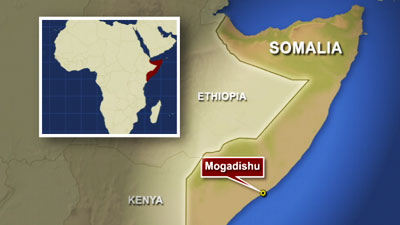
The city of Mogadishu, in Somalia, Africa

I decided to re-post one of my favorite posts for Veteran’s Day / Remembrance Day.

First, let’s get an overview that helps us understand the context and goals of the mission we are going to discuss.

The scene is set in Somalia, Africa, in 1992. There a civil war between two warlords: Ali Mahdi and Mohammed Farah Aidid. The war has destroyed agricultural operations, and the people are starving. The United Nations are trying to help, but Aidid hijacks the food from UN aircraft so that he can use the food to gain control of the people. Hundreds of thousands of Somalis are dying of starvation. The UN requests American military forces to secure the air-dropped supplies so they can be distributed to the starving people.

In December 1992, President George H.W. Bush answers the call, sending 25,000 troops to Somalia to protect the food from the Somali warlords. However, in 1993, Bill Clinton is elected. He orders that the number of U.S. troops be reduced to 12,000. Following an attack by Aidid on Pakistani peace-keepers, the U.N. issues a resolution to capture those responsible. The U.S. armed forces have the arms and training to battle evil, so they get the call to capture Aidid and his lieutenants.

In late August 1993, Task Force Ranger is deployed to Mogadishu to capture Aidid and his lieutenants at the Olympic Hotel. The U.S. force consists of 440 troops from the Army Rangers and Army Delta Force special forces, commanded by General William Garrison. Garrison requested light armored units (Bradley Infantry Fighting vehicles) that would offer more protection than the unarmored HMMWV Humvees. Garrison was denied the light armor by the Clinton administration. Garrison requested heavier air support (AC-130 Spectre gunships) that would offer better fire support than the UH-60 Blackhawk miniguns. Garrison was denied the air support by the Clinton administration. The Clinton administration did not want the American forces to appear too heavily armed for the peace-keeping role.

The actual mission turned out to be much harder than it needed to be, because of the resources denied by the Clinton administration. Although the Aidid lieutenants were captured, Aidid himself escaped. Eighty-four American soldiers were wounded. Eighteen American soldiers were killed, and their bodies were dragged through the streets of Mogadishu. This was shown over and over by the media, and it undermined American resolve to help the Somali people. As a result, Clinton had the excuse he needed to retreat the American military.

(Source: Nova Online)

Two heroes lost their lives

Today, I want to talk about two of the men who lost their lives in Operation Gothic Serpent. They are Master Sergeant Gary I. Gordon and Sergeant First Class Randall D. Shughart – a Delta Force sniper team.

Here is a clip from the movie Blackhawk Down, which shows what happened to them:

The pilot of the downed Blackhawk was protected by the two men who volunteered to go in after him. They requested that they be inserted at the crash site, even though they knew that reinforcements were likely not going to be there in time to save them. They made the request to go and help the pilot three times before being allowed to go in. Their first two requests were denied by their commanding officer, because the odds against their survival were so overwhelming. The rescued pilot was later released by his captors, and the two heroes were awarded the Medal of Honor for their brave actions.

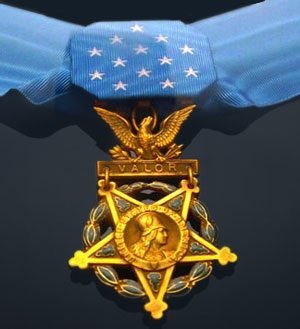
A Congressional Medal of Honor

Here is a description of the requirements to be awarded a Medal of Honor:

The Medal of Honor is the highest military decoration that may be awarded by the United States government. It is presented by the President of the United States, in the name of Congress, and is conferred only upon members of the United States Armed Forces who distinguish themselves through conspicuous gallantry and intrepidity at the risk of life above and beyond the call of duty:

  • While engaged in action against an enemy of the United States;
  • While engaged in military operations involving conflict with an opposing foreign force; or
  • While serving with friendly foreign forces engaged in an armed conflict against an opposing armed force in which the United States is not a belligerent party.

You can read the official details of their actions.

The point of this post

It is important for Christians to be familiar with real-world examples of people giving their lives in order to save the lives of others. When we see real-world examples of self-sacrifice, it helps us to understand what Jesus really achieved for us, and what he must have felt making that hard choice to volunteer to go in and rescue us. In general, my philosophy when it comes to the Bible is to make every effort to connect what the Bible says to the real world. We must not push Christianity into some far-off world of piety and feelings. We must make connections to real evidence and real life, so that what the Bible says becomes practical, and so that we have a deep friendship with and sympathy for God revealed in Jesus Christ. In real life, being willing to give your life to save someone else is hard. Understanding how that really happens will help us to value what Jesus has done for us.

Bible verses

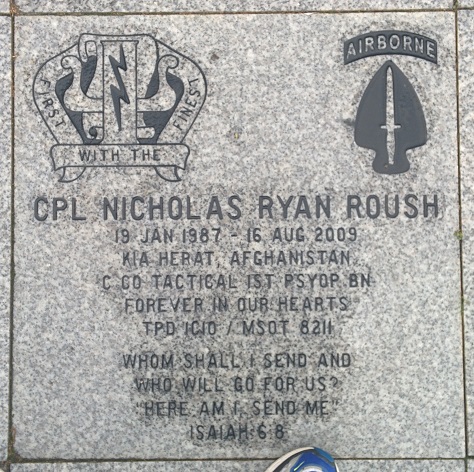
I saw this verse on the ground outside the Airborne & Special Operations Museum in Fayetteville, NC, where I went for my summer vacation in 2015. (Thanks to my friend Curby who hosted me)

Isaiah 6:8:

Then I heard the voice of the Lord saying, “Whom shall I send? And who will go for us?”

And I said, “Here am I. Send me!”

Here is the picture I took (yes, that is my running shoe):

“Here am I, send me” Isaiah 6:8

When confronted with an opportunity to imitate Christ in his self-sacrifice, we should think less about ourselves and our own desires, and take the opportunity to serve others effectively. We do not do what makes us happy, and we do not pursue fun and thrills. We do what heals, we do what helps others. We do not push away our responsibility to imitate Christ by caring for those in danger. Christianity is not just about “not doing bad things”. It’s the good things you do because of your relationship with Jesus that show your real allegiance, and give you the experience of being a Christian in deed.

And here is another good verse:

John 15:13:

13 Greater love has no one than this: to lay down one’s life for one’s friends.

If you get a chance to watch the movie Blackhawk Down, then do so. I highly recommend it. You can also read the book that the movie is based on.

I love the Medal of Honor books by Edward F. Murphy. He writes about all the people who have been awarded the Medal of honor in different wars: World War II, the Korean War, and the Vietnam War.

If you check my reading list, you’ll find that I usually read two military books for every one book on another subject.

Marine Captain earned Medal of Honor fighting communists in North Korea

First, let’s go from the top down to set the context for the profile of William E. Barber.

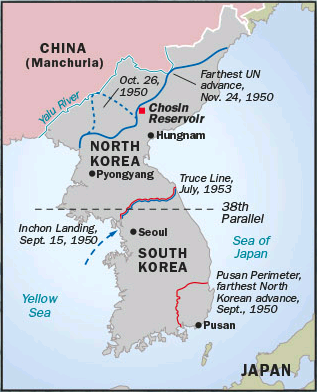
Map of the Korean War

In the summer of 1950, North Korean communists launch a completely unprovoked attack across the 38th parallel against their peaceful, democratic neighbors, the South Koreans. The Americans immediately sent an invasion force by sea to drive them out. The North Koreans easily manage to take over the capital Seoul, and the allies are left with only one port in the southeast – Pusan. In September of 1950, American forces land an invasion force at Inchon, cutting off the North Korean invasion force surrounding Pusan. The North Koreans retreat, and there is hope that American forces will be home by Christmas. But then, unbeknownst to the Americans, the Chines communists  invade North Korea from the north and surround the American forces near the Chosin reservoir, threatening to annihilate an entire Marine division.

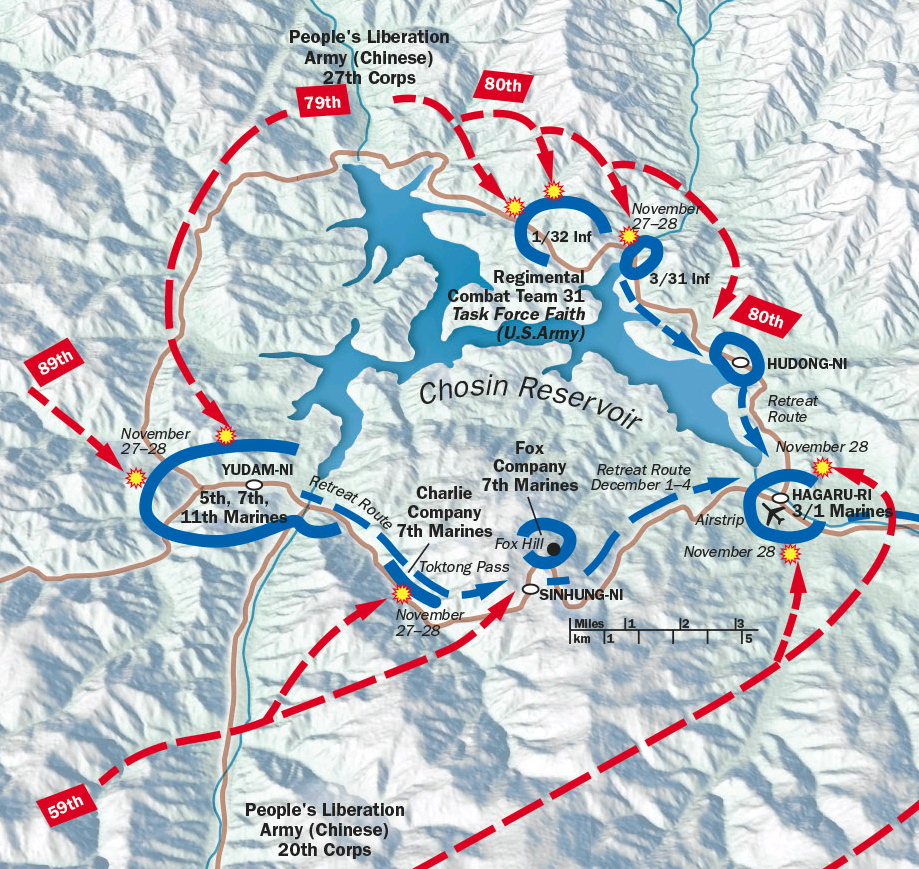
The Marines at Yudam-Ni are surrounded and must retreat to Hagaru-Ri

As you can see from the map, there are a whole bunch of American troops fighting to the north/east and south/west of the Chosin Reservoir. The marines near Yudam-Ni need to retreat along a road called the MSR (main supply road) back to Hagaru-Ri. But in order to conduct that retreat, they have to hold onto the vital Toktong pass, which is overwatched by Fox company from their position on Fox Hill. Can Charlie company and Fox company hold off the entire Chinese 59th division (10,000 men) with only two companies (about 250 men each)?

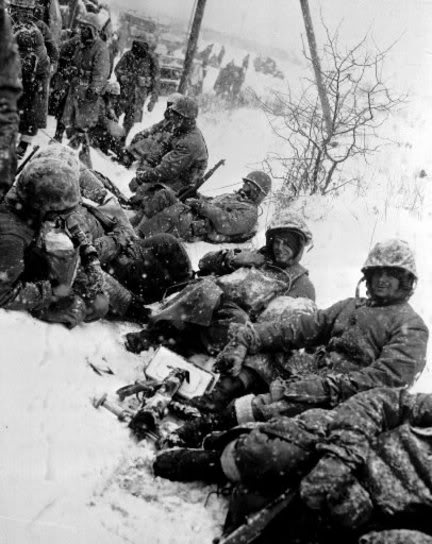
U.S. Marines "The Chosin Few", December 1950
U.S. Marines “The Chosin Few”, December 1950

Well, the book I read (which Dina gave me for Christmas), was about Fox company and their defense of the Toktong pass. This is what the leftist New York Times had to say about the man in charge of Fox company (“F company”) in a 2002 article:

Col. William E. Barber, who won the Medal of Honor for his leadership of a vastly outnumbered company under siege on a snowy hilltop in one of the worst defeats in Marine history, the Battle of the Chosin Reservoir in 1950, died on April 19 at his home in Irvine, Calif. He was 82.

The cause was bone-marrow cancer, said Jerry Courtier, a friend who hopes to write Colonel Barber’s biography.

The reservoir is south of the Yalu River, which separates North Korea from China. After the Americans had pushed the North Koreans almost to the Yalu, 150,000 Chinese troops unexpectedly crossed the river into North Korea. Colonel Barber’s unit, Company F of the Second Battalion of the Seventh Marines, First Marine Division, was on a hill that commanded the Toktong Pass, a vital gap between Yudam Ni and Hagaru Ri, two towns separated by 78 miles.

The stakes were huge. If F Company yielded its position, 8,000 marines at Yudam Ni would be cut off from the 3,000 at Haguru Ri by tens of thousands of Chinese troops.

Through five days and six nights in subzero weather and often swirling snow, Colonel Barber, then a captain, inspired his men, outnumbered more than five to one, to cling to their tenuous positions. He was shot in a bone near his groin on the second day but continued to make the rounds of the hill. He likened the wound to a bee sting.

When the unit was ordered to withdraw and fight its way to safety, Captain Barber refused. Three times, the enemy broke through the line, only to be repulsed.

”I knew that we could probably hold, and I knew that if we didn’t hold we could exact a very heavy toll,” he said in an interview in 1976 with The Los Angeles Times.

His citation for the nation’s top medal said that he commanded his men from a stretcher. But Hector A. Cafferata Jr., who as a rifleman won the Medal of Honor in the same battle, insisted that Captain Barber refused the stretcher.

”He walked the line, he kept us together,” said Mr. Cafferata, who was beside Captain Barber when he was shot.

In the mayhem, the Chinese blew whistles, beat cymbals and tooted bugles as they repeatedly attacked. Coffee froze before men could drink it, and some of the wounded died because plasma froze with no way to thaw it.

When the battle was over, more than 1,000 enemy soldiers were dead. Of Captain Barber’s original 240 men, 82 were able to walk away.

Gen. Raymond G. Davis, who was a lieutenant colonel in the Marines, received a Medal of Honor for leading the unit that rescued F Company.

William Earl Barber was born on Nov. 30, 1919, in Dehart, Ky. He attended what is now Morehead State University in Morehead, Ky., for two years and enlisted in the Marines, at the age of 21, in 1940.

He was so good at shooting a rifle that he was made a weapons instructor. After volunteering for parachute training, he demonstrated such proficiency that he became a parachute instructor.

In World War II, he was promoted to sergeant in 1942 and commissioned a second lieutenant in 1943. He was a rifle platoon commander at Camp Pendleton, Calif., when his unit was shipped to the Pacific.

Colonel Barber was in the first wave to hit Iwo Jima, where he was wounded twice. He received the Silver Star for bravery in addition to two Purple Hearts. At a ceremony on the 50th anniversary of the battle in 1995, he said:

”I am older now, as you are, but I can still see the colors of that February morning. The sky. The island. And sometimes I think I can hear the noise of battle.”

He was treated in Japan for his wounds and returned to the United States, where he worked as a recruiter, among other positions. He was promoted to captain in 1949 and was in the force that occupied Japan.

When he joined F Company in Korea, he saw a raggedy unshaven bunch and immediately ordered the the troops to shave, shine their shoes and look like marines. He suggested that his new charges resembled Pancho Villa’s bandits.

”He was one tough guy,” Mr. Cafferata said. ”He was by the book.”

He was by the book. He enlisted in the Marines because he was grateful to his country for allowing him to escape poverty and go into college, and he wanted to give something back.

You can read a review of the book I read about Fox company, and read about some of the details of what it was like for those men. You’ll never look at your own troubles the same way again. You can also read about Barber’s Medal of Honor citation here.

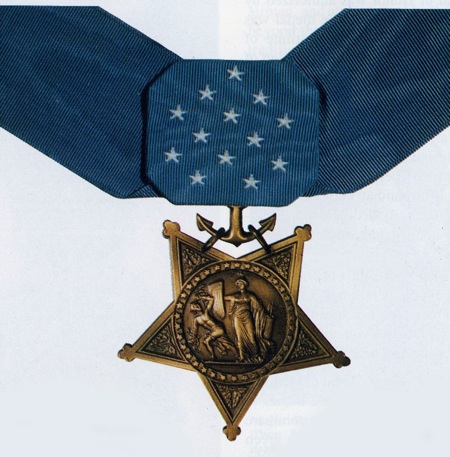
The Medal of Honor, Navy and Marines variant

So, now that I am done with that book, I have moved on to another Korean War book that Dina gave me, this one about George company. The Korean War might have been our most just war – defending a peaceful democratic ally from a totalitarian communist regime. You just have to compare North Korea and South Korea today to understand the stakes. North Korea is basically a godless concentration camp that tortures and murders its people if they so much as think the wrong thoughts about the atheist state. South Korea is free and prosperous, where the people have human rights, like the right to free speech and freedom of religion.

It’s important for me to read about the hardships that real heroes face, so that I don’t complain too much about my own tiny struggles. When you read about the struggles of great American soldiers, so many good things happen to you. Your own problems get smaller, your humility and gratitude get bigger. And you are reminded about why America is a great country, and what American character is really like. These things are not taught by leftists in the public schools. They are not talked about by leftists in the mainstream media. They are not presented by leftists in the Hollywood film industry. If you want to know the real America, you have to find it yourself.