

Christians have always believed in a romantic, committed, exclusive view of sex

Does government provide incentives for people to get married?
The natural family is the only place where sexual activity makes sense

Consider this post from Michael Krueger about the history of Christianity with respect to sex, love and marriage.

Excerpt:

[I]n the second century, as Christianity emerged with a distinctive religious identity, the surrounding pagan culture began to take notice.  And it didn’t like what it saw.  Christians were seen as strange and superstitious–a peculiar religious movement that undermined the norms of a decent society.  Christians were, well, different.

So, what was so different about Christians compared to the surrounding Greco-Roman culture?

[…]While it was not unusual for Roman citizens to have multiple sexual partners, homosexual encounters, and engagement with temple prostitutes, Christians stood out precisely because of their refusal to engage in these practices.

For instance, Tertullian goes to great lengths to defend the legitimacy of Christianity by pointing out how Christians are generous and share their resources with all those in need.  But, then he says, “One in mind and soul, we do not hesitate to share our earthly goods with one another. All things are common among us but our wives” (Apol. 39). Why does he say this?  Because, in the Greco-Roman world, it was not unusual for people to share their spouses with each other.

In the second-century Epistle to Diognetus, the author goes out of his way to declare how normal Christians are in regard to what they wear, what they eat, and how they participate in society.  However, he then says, “[Christians] share their meals, but not their sexual partners” (Diogn. 5.7).  Again, this is the trait that makes Christians different.

We see this play out again in the second-century Apology of Aristides.  Aristides defends the legitimacy of the Christian faith to the emperor Hadrian by pointing out how Christians “do not commit adultery nor fornication” and “their men keep themselves from every unlawful union” (15).

A final example comes from the second-century apology of Minucius Felix.  In his defense to Octavius, he contrasts the sexual ethic of the pagan world with that of Christians:

Among the Persians, a promiscuous association between sons and mothers is allowed. Marriages with sisters are legitimate among the Egyptians and in Athens. Your records and your tragedies, which you both read and hear with pleasure, glory in incests: thus also you worship incestuous gods, who have intercourse with mothers, with daughters, with sisters. With reason, therefore, is incest frequently detected among you, and is continually permitted. Miserable men, you may even, without knowing it, rush into what is unlawful: since you scatter your lusts promiscuously, since you everywhere beget children, since you frequently expose even those who are born at home to the mercy of others, it is inevitable that you must come back to your own children, and stray to your own offspring. Thus you continue the story of incest, even although you have no consciousness of your crime. But we maintain our modesty not in appearance, but in our heart we gladly abide by the bond of a single marriage; in the desire of procreating, we know either one wife, or none at all (31).

The genius of Christ-centered relationships is that both parties have to prove that they can be faithful and committed during the courtship. Both people have to work before the marriage to demonstrate their ability at marital roles (husband or wife, father or mother). It’s not just that this is the way that we have always done it, it’s that there are real reasons why chastity and fidelity are important for marriage success. You can’t just have fun, pick anyone you like, and have marriage “work out”. You have to be comfortable with chastity and fidelity, and the person you choose has to be comfortable with chastity and fidelity. Each person has to demonstrate that they are capable of self-sacrificial love for others, since that’s the main thing that marriage is about – at least the ones that last. Virtue is at the center of the Christian concept of marriage.
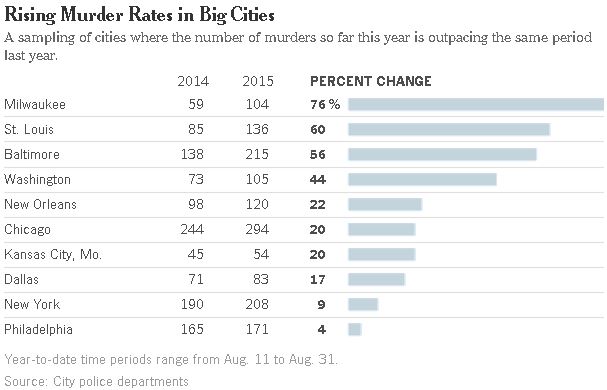
Violent crime soars as Democrat politicians cater to Black Lives Matter agenda

Crime rates in major cities, all Democrat-run

Quick: which city has the strongest anti-gun laws and regulations? Washington, D.C.? Baltimore, MD? Milwaukee, WI? Or maybe it’s Chicago, IL, which is run by Barack Obama’s good friend Rahm Emanuel.

National Review reports on what’s going on in Chicago:

Thirteen people were shot to death in Chicago over Labor Day weekend, bringing the city’s gun-homicide total to 512 since the beginning of the year. Already, the city has exceeded last year’s gun-homicide total (491), and it is on pace to see its deadliest year since 1998 (704 dead). Meanwhile, August was the city’s deadliest month since June 1996; 90 people were gunned down — and another 382 shot non-fatally, a rate of one shooting every 95 minutes. With the violence that generally has been confined to the gang-ridden South and West Sides of the city reaching the central business district, it is not an exaggeration to say that Chicago is experiencing a crisis of law and order. And it is a crisis that is almost entirely self-inflicted.

Chicago is perhaps the most obvious example to date of the “Ferguson Effect,” the previously mocked hypothesis that, in the wake of the hostility toward law enforcement that sprang up following events in Ferguson, Mo., in 2014, police in minority neighborhoods have backed off interacting with residents when not absolutely necessary. Last year saw homicide rates spike in cities with aggressive anti-police movements — St. Louis, Baltimore, Milwaukee, Chicago, etc. — and even Ferguson Effect–skeptics such as Richard Rosenfeld of the University of Missouri–St. Louis were forced to change their minds. Rosenfeld has declared that the Ferguson Effect is “the only explanation that gets the timing right.” In October 2015, even Chicago mayor Rahm Emanuel said that police in his city were going “fetal.”

[…]In March 2015, the American Civil Liberties Union charged that the Chicago Police Department’s investigatory-stop policy was racist, since the percentage of blacks being stopped was significantly higher than the percentage of Chicagoans who are black (never mind that the relevant standard is the rate at which blacks commit crime). By autumn, the city had struck an agreement to allow the ACLU to review all investigatory stops beginning January 1. In the first quarter of 2016, stops decreased by almost 90 percent. The result is not just a markedly diminished police presence, but a loss of much of the intelligence-gathering that is regularly used to solve crimes.

The consequence of these “reforms” has been to make life more dangerous for exactly the people the ACLU, Black Lives Matter, and similar groups want to protect. It’s not police targeting young black men; it’s other young black men, generally killing on behalf of gangs, who become more aggressive when law enforcement retreats. 

[…]Chicago’s notoriously high crime rates are the result of decades of municipal mismanagement and social breakdown, which will likely take decades to turn around. But there is no excuse for Rahm Emanuel & Co.’s exacerbating these problems by basing policy on knee-jerk outrage and unsubstantiated accusations of systematic racism. Chicago’s leaders seem to be more interested in accommodating left-wing interest groups than in saving lives.

Now, the major cause of crime is welfare, which is paid to single mothers of every race to encourage them to raise fatherless children.  Fatherless boys are more likely to commit criminal acts. Almost every boy you meet in prison comes from a background where the father was absent, but the welfare checks were present. It’s the welfare that causes young women to think that getting pregnant before marriage is a viable life plan. After all, if the government is paying you to have fatherless children, it’s almost like having a job – it’s legitimate.

This is not a race issue, it’s a morality issue. If we were serious about stopping crime, we should take all the money that is being wasted on welfare, and spend it on promoting marriage to young women. We need to teach them to not have sex before they are married. But of course, this is against the radical feminist agenda of the Democrat Party, which despises chastity and the “unequal gender roles” in marriage. We can’t trust the Democrats to stop crime, they are the ones who are causing it by destroying marriage in the communities where marriage is most needed.

What happened to the Christian baker who declined to celebrate redefining marriage?

Gay activist vandalizes pro-marriage sign

I thought that this recent article from The Federalist was worth reading so that everyone can understand how the tolerance crowd really deals with respectful disagreement.

Excerpt:

The employees tasked with handling the front of the shop are busy tending to consumers, so owner Jack Phillips, the kind of guy who’s more comfortable dealing with sugar paste than strangers, jumps in to help out.

We’d like you to design a cake for our wedding, the man explains, motioning to his partner at the other side of the shop.

Sorry, Phillips responds, I can’t create specialty cakes for gay weddings. If you’d like, I can sell you anything else you want — cupcakes, pastries, whatever.

Anger flushes over the would-be customer, who stands up, curses, and flips off Phillips while he heads for the door — a reaction that is well within the normal bounds of serious disagreements in American life.

Oh, but the two men could not handle disagreement like you or I could:

A half hour after Mullins and Craig storm out of Masterpiece Cakeshop, the store’s phone rings. An irate caller asked Jack if he’s the jerk who turned away the gay couple. Well, no, I just don’t design cakes for same-sex weddings; I didn’t turn away anyone, he explains.

This distinction fails to pacify the agitated man, and after offering an array of colorful suggestions, he hangs up. In the hour between the incident and closing time that Thursday night, Phillips estimates he received another six comparably incensed calls berating him for cake-denying bigotry. When he finally got home, his inbox is fuller than it’s ever been. And it’s not because locals have a sudden hankering for Funshine Cookie Pops.

[…]Jack begins his demanding work at 6 a.m. the next morning, so he can prepare for a Bible study class he hosts on Fridays. The phone is already ringing. It rings all day. All day Saturday (probably all day Sunday) and all day Monday, as well. Angry voices, swearing at him; demanding cakes; threatening him. Jack stops answering.

Then the protestors show up.

One of the disadvantages of showing off your righteous passion in a suburban parking lot in Lakewood, Colorado is that very few people can see or hear you. So the activists picketing Masterpiece that weekend were forced to pick up their rainbow flags and move to a busy intersection on nearby Wadsworth Ave — right across the street from another bakery. Actually, within the five square miles radius of Masterpiece there are a dozen places that could have accommodated the jilted couple.

Then again, this has nothing to do with a cake.

No, they didn’t want a cake, they wanted to stamp out anyone who disagreed with their lifestyle – stop them from earning a living so that they would starve. Or maybe put them in prison. And to the people on the secular left, this rage made sense. It was normal. It was justified. They didn’t protest the murder of gay people in Muslim countries, they protested being told no by a Christian man whose first priority was to keep his conscience clean according to his moral convictions.

More:

On Monday, the TV stations showed up. By Tuesday, Jack was on local news.

[…]The first letter from the Colorado Civil Rights Commission arrived soon enough. Americans, evidently, no longer share a “common” sense about societal norms. So Mullins and Craig had lawyered up immediately — contacting the ACLU, once champions of free expression and now champions of hurt feelings.

[…]The commission was not above retroactive punishment, however. At the time, being found guilty of violating civil rights laws didn’t only mean the end of Phillips’ life’s work. The punishment for refusing to make a special cake for a gay wedding was $500 and one year in prison per charge (jail time was only later amended out of the law when general public learned about the statue).

The shop was not only ordered to alter its policy and start participating in gay weddings or else face debilitating fines, it was told to provide comprehensive staff training, ensure compliance, then file quarterly obedience reports with the government for two full years. In these reports, Phillips was to describe exactly which remedial measures the shop had taken to conform, and document the reasons any other patrons were denied service.

Colorado’s Thought Police would teach Phillips how to stop himself acting on any ideas that were heretical.

The commission could only pass quasi-criminal judgments. In the end, these charges had to be authorized by the attorney general, who was charged with executing complaints and filing formal proceedings. In this case, that person was John Suthers, a Republican. He did.

The case is now headed to the Supreme Court. The article notes that complaints filed with the Colorado Civil Rights Commission by Christians who were denied cakes by non-Christian bakers were dismissed – because the laws are only enforced against Christians. It’s very much like 1930s Nazi Germany, in that regard, with the secular leftists in place of the Nazis, of course.

Well, I would never respond like that to people who disagreed with my sexual orientation. My sexual orientation is chastity – no sex before marriage for any reason. I would not even kiss a girl on the lips before marriage. How would I handle someone who refused to sell me a cake? I would thank them, and find another cake. That’s what grown-ups who have self-control do when confronted with people who disagree with them. It’s called “celebrating diversity”. It’s called “tolerance”.

I don’t need pride parades or government coercing those who disagree with me. Chastity is self-evidently virtuous, because it puts self-sacrificial commitment above recreational sex. But some people are not so sure that what they are doing is morally right, and that’s why they want to involve the government to force people to celebrate them. They think that maybe if everyone agrees with them, then the majority of sinful humans can somehow overturn the moral law. Or at least make rebellion more comfortable for now. In my case, the honor of what I am doing with my sexuality is internal and self-attesting, even if the culture is against it.