After a Houston-based Planned Parenthood abortion clinic was caught selling aborted baby body parts, state investigators conducted a raid today on multiple Planned Parenthood abortion clinics across the state.
Texas officials raided several Planned Parenthood facilities today in an unprecedented move that follows on the heels of pro-life Governor Greg Abbott announcing earlier in the week that the state would further de-fund the abortion business. Abbott said this week “the gruesome harvesting of baby body parts by Planned Parenthood will not be allowed,” but so far the state has released no evidence of illegal activity by the group.
The raids were carried out at Planned Parenthood abortion centers in Houston, Dallas and San Antonio by representatives from the Texas Office of the Inspector General and the state served subpoenas on five total Planned Parenthood centers. The Houston Chronicle has more:
Officials with the inspector general’s office at the Texas Health and Human Services Commission went to two facilities in Houston as well as clinics in Dallas, San Antonio and Brownsville. The Brownsville center does not perform abortions.
Planned Parenthood was given 30 days to respond to the move; a legal challenge is likely.
On Thursday, Planned Parenthood officials decried the subpoenas as politically-motivated, saying officials were “looking for an excuse to take health care away from thousands of women and men who rely on Planned Parenthood for preventive care.”
“The investigators were seeking hundreds of pages of information, from patient records to employee home addresses, involving 10 Planned Parenthood facilities across the state” the Austin newspaper reported. “Officials would not confirm details of the investigation, but the sources said it’s related to suspicions of misspent Medicaid money.”
ECM was quite delighted with this story, and it does show why the United States of America is still a great country. My Canadian friends have been filling up my ears with laments. “Angry”, was how one Calgary man described his feelings to me. “I’m hiding under blankets” one Calgary woman told me. Well, yes. When the Liberal Party gets a majority in a country where federalism is severely crippled, then no matter where you live, you’re pretty much done for.
But that’s not the case in the USA, where a man can dream of living under Mary Fallin in Oklahoma, or Bobby Jindal in Louisiana, or under Sam Brownback in Kansas. Or even in Tennessee or Texas under other Republican governors. You have your pick. And when you open up the local newspaper, you are going to see things happening that don’t make you angry, or make you hide under blankets. What a country! We should be thankful for the boundary between federal and state governments, and seek to strengthen the jurisdiction of states.
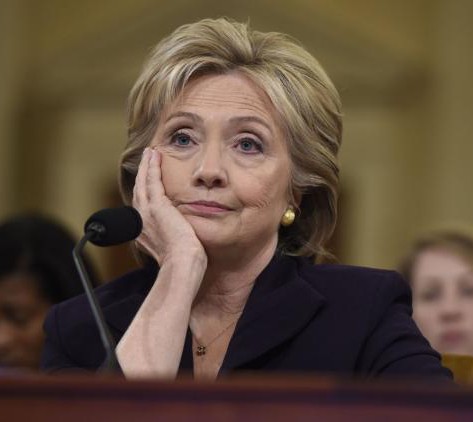
Hillary Clinton bored by the deaths of 4 Americans who repeatedly asked for help
Moderate Republican Hugh Hewitt played the “smoking gun” clips on his radio show on Thursday night. The best questions came from Congressman Mike Pompeo and Congressman Jim Jordan.
CNS News has the full transcript of the Pompeo questions.
Mike Pompeo transcript:
POMPEO: “Do you know how many security requests there were in the 1st quarter of 2012?”
CLINTON: “For everyone or for Benghazi?”
POMPEO: “I’m sorry, yes ma’am. Related to Benghazi and Libya. Do you know how many there were?”
CLINTON: “No.”
POMPEO: “Ma’am, there were just over 100 plus. In the 2nd quarter, do you know how many there were?”
CLINTON: “No, I do not.”
POMPEO: “Ma’am there were 172ish – might have been 171 or 173. … How many were there in July and August and then in that week and few days before the attacks? Do you know?”
CLINTON: “There were a number of them. I know that.”
POMPEO: “Yes, ma’am – 83 by our count. That’s over 600 requests. You’ve testified this morning that you’ve had none of those reach your desk. Is that correct also?”
CLINTON: “That’s correct.”
POMPEO: “Madam Secretary, Mr. Blumenthal wrote you 150 emails. It appears from the materials that we’ve read that all of those reached your desk.
“Can you tell us why security requests from your professionals, the men that you just testified … are incredibly professional, incredibly capable people, trained in the art of keeping us all safe, none of those made it to you, but a man who was a friend of yours, who’d never been to Libya, didn’t know much about it – at least that’s his testimony – didn’t know much about it, every one of those reports that he sent on to you that had to do with situations on the ground in Libya, those made it to your desk?
“You asked for more of them. You read them. You corresponded with him, and yet the folks that worked for you didn’t have the same courtesy.”
On the night of the attack, Jordan said, Clinton had a phone call with the president of Libya where she told him Ansar al-Sharia was claiming responsibility.
The next day, Jordan said, Clinton told the Egyptian prime minister something “significant,” where she acknowledged they knew the attack in Libya had nothing to do with any video.
“We know the attack in Libya had nothing to do with the film,” Jordan read out from Clinton’s email. “It was a planned attack. Not a protest. Let me read that one more time. We know, not we think, not it might be, we know the attack in Libya had nothing to do with a film. It was a planned attack. Not a protest. State Department experts knew the truth. You knew the truth, but that’s not what the American people got. Again, the American people want to know why. Why didn’t you tell the American people exactly what you told the Egyptian prime minister?”
[…]Jordan showed with other emails that her top staffers were already discussing the political ramifications of the attack and how to respond. He said Clinton picked the option of a “video narrative” “with no evidence” because she wanted the Libya situation to be a key success story for the Obama administration.
“You did it because Libya was supposed to be this great success story for the Obama White House and the Clinton State Department, and a key campaign theme that year was GM’s alive, bin Laden’s dead, al-Qaeda’s on the run,” Jordan said. “Now you have a terrorist attack, and it’s a terrorist attack in Libya and it’s just 56 days before an election. You can live with the protest about a video. That won’t hurt you, but a terrorist attack will. So you can’t be square with the American people.”
Full recording (10 minutes):
Now, you will hear a lot in the mainstream media that Hillary Clinton took no damage and did a great job in the hearings. But that is a lie. And I’m going to cite Chuck Todd to explain what really happened in the hearings:
NBC’s Chuck Todd said former secretary of state Hillary Clinton “has no good answers” to offer Thursday on the Libya policy she was part of in the Obama administration when she testifies before the Benghazi Select Committee.
[…]“There’s two tough things that she has to deal with,” Todd said. “One is for 15 years, the State Department was told it had to improve embassy security. 15 years. This is four secretaries of state, and she along with three other secretaries of state didn’t do that. And second, it’s about Libya and the decision to go into Libya. That’s where she has no good answers.”
So two points. First, the State Department refused to respond to 600+ requests for additional security leading up to the attack. And even more important, Hillary Clinton told multiple people that the attack was a terrorist attack, days before she came out and said that the attack was a spontaneous demonstration caused by “an Internet video”. She told this to the family of the victims, when she knew that the truth was different. Why is this woman leading the Democrat primary? Do Democrat voters not pay attention to national security and foreign policy?
UPDATE: Stephen Hayes has a Weekly Standard podcast episode to comment on the hearings.
Sherlock Holmes and John Watson: let’s take a look at the facts
Have you ever heard Gary Habermas, Michael Licona or William Lane Craig defend the resurrection of Jesus in a debate by saying that the resurrection is the best explanation for the “minimal facts” about Jesus? The lists of minimal facts that they use are typically agreed to by their opponents during the debates. Minimal facts are the parts of the New Testament that meet a set of strict historical criteria. These are the facts that skeptical historians agree with, totally apart from any religious beliefs.
So what are the criteria that skeptical historians use to derive a list of minimal facts about Jesus?
The other way, more influential in contemporary New Testament scholarship, is to establish specific facts about Jesus without assuming the general reliability of the Gospels. The key here are the so-called “Criteria of Authenticity” which enable us to establish specific sayings or events in Jesus’ life as historical. Scholars involved in the quest of the historical Jesus have enunciated a number of these critieria for detecting historically authentic features of Jesus, such as dissimilarity to Christian teaching, multiple attestation, linguistic semitisms, traces of Palestinian milieu, retention of embarrassing material, coherence with other authentic material, and so forth.
It is somewhat misleading to call these “criteria,” for they aim at stating sufficient, not necessary, conditions of historicity. This is easy to see: suppose a saying is multiply attested and dissimilar but not embarrassing. If embarrassment were a necessary condition of authenticity, then the saying would have to be deemed inauthentic, which is wrong-headed, since its multiple attestation and dissimilarity are sufficient for authenticity. Of course, the criteria are defeasible, meaning that they are not infallible guides to authenticity. They might be better called “Indications of Authenticity” or “Signs of Credibility.”
In point of fact, what the criteria really amount to are statements about the effect of certain types of evidence upon the probability of various sayings or events in Jesus’ life. For some saying or event S and evidence of a certain type E, the criteria would state that, all things being equal, the probability of S given E is greater than the probability of S on our background knowledge alone. So, for example, all else being equal, the probability of some event or saying is greater given its multiple attestation than it would have been without it.
What are some of the factors that might serve the role of E in increasing the probability of some saying or event S? The following are some of the most important:
(1) Historical congruence: S fits in with known historical facts concerning the context in which S is said to have occurred.
(2) Independent, early attestation: S appears in multiple sources which are near to the time at which S is alleged to have occurred and which depend neither upon each other nor a common source.
(3) Embarrassment: S is awkward or counter-productive for the persons who serve as the source of information for S.
(4) Dissimilarity: S is unlike antecedent Jewish thought-forms and/or unlike subsequent Christian thought-forms.
(5) Semitisms: traces in the narrative of Aramaic or Hebrew linguistic forms.
(6) Coherence: S is consistent with already established facts about Jesus.
For a good discussion of these factors see Robert Stein, “The ‘Criteria’ for Authenticity,” in Gospel PerspectivesI, ed. R. T. France and David Wenham (Sheffield, England: JSOT Press, 1980), pp. 225-63.
Notice that these “criteria” do not presuppose the general reliability of the Gospels. Rather they focus on a particular saying or event and give evidence for thinking that specific element of Jesus’ life to be historical, regardless of the general reliability of the document in which the particular saying or event is reported. These same “criteria” are thus applicable to reports of Jesus found in the apocryphal Gospels, or rabbinical writings, or even the Qur’an. Of course, if the Gospels can be shown to be generally reliable documents, so much the better! But the “criteria” do not depend on any such presupposition. They serve to help spot historical kernels even in the midst of historical chaff. Thus we need not concern ourselves with defending the Gospels’ every claim attributed to Jesus in the gospels; the question will be whether we can establish enough about Jesus to make faith in him reasonable.
And you can see Dr. Craig using these criteria to defend minimal facts in his debates. For example, in his debate with Ehrman, he alludes to the criteria when making his case for the empty tomb.
Here, he uses multiple attestation and the criteria of embarrassment:
Among the reasons which have led most scholars to this conclusion are the following:
1. The empty tomb is also multiply attested by independent, early sources.
Mark’s source didn’t end with the burial, but with the story of the empty tomb, which is tied to the burial story verbally and grammatically. Moreover, Matthew and John have independent sources about the empty tomb; it’s also mentioned in the sermons in the Acts of the Apostles (2.29; 13.36); and it’s implied by Paul in his first letter to the Corinthian church (I Cor. 15.4). Thus, we have again multiple, early, independent attestation of the fact of the empty tomb.
2. The tomb was discovered empty by women.
In patriarchal Jewish society the testimony of women was not highly regarded. In fact, the Jewish historian Josephus says that women weren’t even permitted to serve as witnesses in a Jewish court of law. Now in light of this fact, how remarkable it is that it is women who are the discoverers of Jesus’ empty tomb. Any later legendary account would certainly have made male disciples like Peter and John discover the empty tomb. The fact that it is women, rather than men, who are the discoverers of the empty tomb is best explained by the fact that they were the chief witnesses to the fact of the empty tomb, and the Gospel writers faithfully record what, for them, was an awkward and embarrassing fact.
There are actually a few more reasons for believing in the empty tomb that he doesn’t go into in the debate, but you can find them in his written work. For example, in his essay on Gerd Ludemann’s “vision” hypothesis. That essay covers the reasons for all four of his minimal facts.
So, if you are going to talk about the resurrection with a skeptic, you don’t want to invoke the Bible as some sort of inerrant/inspired Holy Book.
Try this approach instead:
Explain the criteria that historians use to get their lists of minimal facts
Explain your list of minimal facts
Defend your list of minimal facts using the criteria
Cite skeptics who admit to each of your minimal facts, to show that they are widely accepted
List some parts of the Bible that don’t pass the criteria (e.g. – guard at the tomb, Matthew earthquake)
Explain why those parts don’t pass the criteria, and explain that they are not part of your case
Challenge your opponent to either deny some or all the facts, or propose a naturalistic alternative that explains the facts better than the resurrection
Don’t let your opponent attack any of your minimal facts by attacking other parts of the Bible (e.g. – the number of angels being one or two, etc.)
And remember that there is no good case for the resurrection that does not make heavy use of the early creed in 1 Corinthians 15:3-8. You have to use that – it’s the law.
Back to the minimal facts criteria. The best essay on the minimal facts criteria that I’ve read is the one by Robert H. Stein in “Contending with Christianity’s Critics“. It’s a good short essay that goes over all the historical criteria that are used to derive the short list of facts from which we infer the conclusion “God raised Jesus from the dead”. That whole book is really very, very good.



 WINTERY KNIGHT