
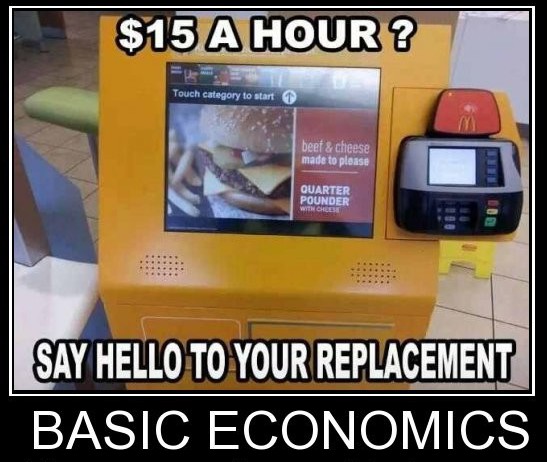
This is from the leftist Washington Post, of all places. Not the place you would normally look for knowledge of basic economics.
Excerpt:
The [restaurant / fast food] industry could be ready for another jolt as a ballot initiative to raise the minimum wage to $15 an hour nears in the District and as other campaigns to boost wages gain traction around the country. About 30 percent of the restaurant industry’s costs come from salaries, so burger-flipping robots — or at least super-fast ovens that expedite the process — become that much more cost-competitive if the current federal minimum wage of $7.25 an hour is doubled.
[…]Many chains are already at work looking for ingenious ways to take humans out of the picture, threatening workers in an industry that employs 2.4 million wait staffers, nearly 3 million cooks and food preparers and many of the nation’s 3.3 million cashiers.
[…]Labor isn’t the only ingredient that factors into the price of a Big Mac: There’s also real estate, which has been getting more expensive, especially in the hot urban markets where restaurants are seeking to locate. Wholesale food costs, meanwhile, have escalated 25 percent over the past five years.
The avalanche of rising costs is why franchisers are aggressively looking for technology that can allow them to produce more food faster with higher quality and lower waste. Dave Brewer is chief operating officer with Middleby Corp., which owns dozens of kitchen equipment brands, and is constantly developing new ways to optimize performance and minimize cost.
“The miracle is, the wage increase is driving the interest,” Brewer said. “But the innovation and the automation, they’re going after it even before the wages go up. Why wait?”
All that innovation helps restaurants streamline other parts of their operations — and draw more customers. Electronic menus can be constantly updated so that items that are out of stock can be removed. Connecting the point of the sale to the oven’s operating system allows precise amounts of food to be cooked, which helps cut down on costs. Other inventions save energy, reduce maintenance and better dispose of grease. On the digital side, restaurants are working on apps that include reward systems and location tracking that prompt customers to eat with them more frequently.
[…]The labor-saving technology that has so far been rolled out most extensively — kiosk and tablet-based ordering — could be used to replace cashiers and the part of the wait staff’s job that involves taking orders and bringing checks. Olive Garden said earlier this year that it would roll out the Ziosk system at all its restaurants, which means that all a server has to do is bring out the food.
Robots can even help cut down on the need for high-skilled workers such as sushi chefs. A number of high-end restaurants use machines for rolling rice out on sheets of nori, a relatively menial task that takes lots of time. Even though sushi chefs tend to make more than $15 an hour, they could be on the chopping block if servers need to make $15 an hour, too.
“For our operation, we’re not buying entry-level labor, but if entry-level labor goes up a huge amount, everything goes up,” said Robert Bleu, the president of True World Group, a seafood distributor and consultant that also owns a sushi restaurant in Chicago. “I don’t consider rice-forming a high art. You can escape some of the drudgery.”
Let’s review the facts on minimum wage.
Abstract from new National Bureau of Economic Research study:
We estimate the minimum wage’s effects on low-skilled workers’ employment and income trajectories. Our approach exploits two dimensions of the data we analyze. First, we compare workers in states that were bound by recent increases in the federal minimum wage to workers in states that were not. Second, we use 12 months of baseline data to divide low-skilled workers into a “target” group, whose baseline wage rates were directly affected, and a “within-state control” group with slightly higher baseline wage rates. Over three subsequent years, we find that binding minimum wage increases had significant, negative effects on the employment and income growth of targeted workers.
[…]Over the late 2000s, the average effective minimum wage rose by 30 percent across the United States. We estimate that these minimum wage increases reduced the national employment-to-population ratio by 0.7 percentage point.
That comes out to 1.4 million workers who lost their jobs, thanks to minimum wage mandates. And those are primarily young, unskilled workers who are affected – people trying to get a start in the workplace and build their resumes, so they can move up.
Harvard economist Greg Mankiw explains the top 14 views that a majority professional economists agree on, and here’s #12:
12. A minimum wage increases unemployment among young and unskilled workers. (79%)
And these facts affect more than the restaurant / fast food business. Here’s an example from ABC News of another business that is having to shut its doors: independent bookstores. It always seems that the people on the lowest “start” rungs of the economic-independence ladder are most affected by bad liberal economic policies.
 WINTERY KNIGHT
They will then respond to increased unemployment with increased government benefits. Because the jobs just aren’t out there these days.
LikeLike
And more people grow dependent on the government because the marxists promise more “free” stuff.
LikeLike
Until the money runs out. Then suddenly common sense returns.
LikeLike
How many lives will it cost in this century?
LikeLike
It will just be like what you see in France or Germany. People will just have to live with less.
LikeLike
“The miracle is, the wage increase is driving the interest,” Brewer said. “But the innovation and the automation, they’re going after it even before the wages go up. Why wait?”
*Slow Clap*
I’m going to hang on to this article. I know too many Sanders flock who are very, very happy about a wage increase.
LikeLike
Business people aren’t stupid – they are risking their own money.
LikeLike
*Like*
LikeLike