A friend of mine sent me a link to this lecture, and he says the Q&A is dynamite.
Here’s the description:
What is the meaning of my life? What is my purpose? What happens after I die? How do I know what is true? How should I live? Why? What does Jesus have to do with my everyday life? Does he answer life’s biggest questions? If he does is there evidence for this?
On Feb 12, 2015 at the University of Toronto, Dr. Paul Gould gave a compelling case for why Jesus answers life’s biggest questions and he also answered a number of tough and interesting questions in the Question and Answer Period.
In this series professors, thinkers, academics, or graduate students give reasons why they trust in God and address objections to trusting in God.
SPEAKER’S BIO:
Dr. Paul Gould is a philosopher, a scholar, a teacher, a husband, a father, and a follower of Jesus Christ. He believes that Jesus is humanity’s greatest need and our highest good. As C.S. Lewis, puts it:
“God wills our good, and our good is to love Him (with that responsive love proper to creatures) and to love Him we must know Him: and if we know Him, we shall in fact fall on our faces.”
So, God wills our good–and our good is to love Him–and to love Him is to know Him. His passion in life is to present to the world Jesus–in all his brilliance and beauty.
He received his MA in Philosophy of Religion and Ethics from Biola University and a PhD in Philosophy from Purdue University.
Dr. Paul Gould is an Assistant Professor of Philosophy and Christian Apologetics at Southwestern Theological Seminary.
He is married to Ethel and has four wonderful children.
EMCEE’S BIO:
Mark Sutherland received his BEng in Engineering Science from the University of Toronto and is currently a masters student in Applied Science (Computer Engineering) at the University of Toronto.
My friend also noted that Dr. Gould has an article up on his web site on the same topic as the lecture that lays out all the questions he covered in the lecture.
It says:
Is there a God? Yes, and he loves and pursues you.
What is the nature of Reality? It is enchanted, a world of rich physical, aesthetic and moral beauty.
What is the purpose of the universe? For God to spread his joy and delight and love and you to find happiness in creaturely response.
What is the meaning of life? Ditto.
Why am I here? Because God created me.
Does prayer work? Yes, God is ever present and involved in your life, even when you don’t know it.
Is there a soul? Is it immortal? Yes, you are essentially a soul that has a body, you will live forever.
Is there free will? Yes, we are self-determiners of our action and our character.
What happens when we die? We enter into eternal life, either with God in heaven or without God in hell.
What is the difference between right and wrong, good and bad? There is objective morality, the right is what God commands and the wrong is what God prohibits; the good is that which God has created, the bad that which sin has corrupted.
Why should I be moral? Because it is good in itself and for what it brings (as Plato puts it in the Republic).
Is abortion, euthanasia, suicide, paying taxes, foreign aid, or anything else you don’t like forbidden, permissible, or sometimes obligatory? There is a moral law, not everything is permissible, nor is everything forbidden.
What is love, and how can I find it? Love is the one thing that can never hurt anyone, although it may cost dearly.
Does history have any meaning or purpose? Yes, there is meaning and purpose to everything.
Does the human past have any lessons for our future? Yes, and we’d be wise to listen to them.
Paul Gould is one of my favorite Christian scholars – he comes from a business background and has a real heart for evangelism. We also agree that the “top-down” approach to having an influence is the correct approach, and therefore we both see impacting young people when they are at the university as absolutely vital. There are a lot of things that are worthwhile for Christians to do, but the university is the place that creates the next generation of influential people. We have to make our stand there, whether we like it or not. Whether it feels good or not.
This story, which was written up in National Review by religious liberty defender David French, has two parts.
The first part talks about the police raids. I can only snip a little to capture the horror of the raid.
It says:
‘THEY CAME WITH A BATTERING RAM.”
Cindy Archer, one of the lead architects of Wisconsin’s Act 10 — also called the “Wisconsin Budget Repair Bill,” it limited public-employee benefits and altered collective-bargaining rules for public-employee unions — was jolted awake by yelling, loud pounding at the door, and her dogs’ frantic barking. The entire house — the windows and walls — was shaking.
She looked outside to see up to a dozen police officers, yelling to open the door. They were carrying a battering ram.
She wasn’t dressed, but she started to run toward the door, her body in full view of the police. Some yelled at her to grab some clothes, others yelled for her to open the door.
“I was so afraid,” she says. “I did not know what to do.” She grabbed some clothes, opened the door, and dressed right in front of the police. The dogs were still frantic.
“I begged and begged, ‘Please don’t shoot my dogs, please don’t shoot my dogs, just don’t shoot my dogs.’ I couldn’t get them to stop barking, and I couldn’t get them outside quick enough. I saw a gun and barking dogs. I was scared and knew this was a bad mix.”
She got the dogs safely out of the house, just as multiple armed agents rushed inside. Some even barged into the bathroom, where her partner was in the shower. The officer or agent in charge demanded that Cindy sit on the couch, but she wanted to get up and get a cup of coffee.
“I told him this was my house and I could do what I wanted.” Wrong thing to say. “This made the agent in charge furious. He towered over me with his finger in my face and yelled like a drill sergeant that I either do it his way or he would handcuff me.”
They wouldn’t let her speak to a lawyer.
The article talks about a few more of the home invasions, and the warnings not to tell anyone were the same.
Here’s another:
Don’t call your lawyer. Don’t talk to anyone about this. Don’t tell your friends. The kids watched — alarmed — as the school bus drove by, with the students inside watching the spectacle of uniformed police surrounding the house, carrying out the family’s belongings. Yet they were told they couldn’t tell anyone at school.
They, too, had to remain silent.
The mom watched as her entire life was laid open before the police. Her professional files, her personal files, everything.
Now the second part. Who was ordering these pre-dawn police raids on law-abiding families, and why?
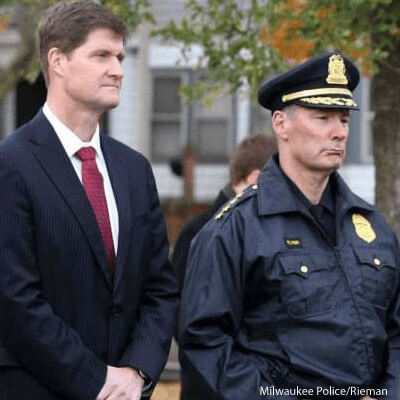
District attorney John Chisolm (left)
Here’s who and why:
District Attorney Chisholm was a Democrat, a very partisan Democrat.
Almost immediately after opening the John Doe investigation, Chisholm used his expansive powers to embarrass Walker, raiding his county-executive offices within a week. As Mr. O’Keefe and the Wisconsin Club for Growth explained in court filings, the investigation then dramatically expanded:
Over the next few months, [Chisholm’s] investigation of all-things-Walker expanded to include everything from alleged campaign-finance violations to sexual misconduct to alleged public contracting bid-rigging to alleged misuse of county time and property. Between May 5, 2010, and May 3, 2012, the Milwaukee Defendants filed at least eighteen petitions to formally “[e]nlarge” the scope of the John Doe investigation, and each was granted. . . . That amounts to a new formal inquiry every five and a half weeks, on average, for two years.
This expansion coincided with one of the more remarkable state-level political controversies in modern American history – the protest (and passage) of Act 10, followed by the attempted recall of a number of Wisconsin legislators and, ultimately, Governor Walker.
Political observers will no doubt remember the events in Madison — the state capitol overrun by chanting protesters, Democratic lawmakers fleeing the state to prevent votes on the legislation, and tens of millions of dollars of outside money flowing into the state as Wisconsin became, fundamentally, a proxy fight pitting the union-led Left against the Tea Party–led economic Right.
At the same time that the public protests were raging, so were private — but important — protests in the Chisholm home and workplace. As a former prosecutor told journalist Stuart Taylor, Chisholm’s wife was a teachers’-union shop steward who was distraught over Act 10’s union reforms. He said Chisholm “felt it was his personal duty” to stop them.
Meanwhile, according to this whistleblower, the district attorney’s offices were festooned with the “blue fist” poster of the labor-union movement, indicating that Chisholm’s employees were very much invested in the political fight.
[Chisholm] launched yet another John Doe investigation, “supervised” by Judge Barbara Kluka. Kluka proved to be capable of superhuman efficiency — approving “every petition, subpoena, and search warrant in the case” in a total of one day’s work.
If the first series of John Doe investigations was “everything Walker,” the second series was “everything conservative,” as Chisholm had launched an investigation of not only Walker (again) but the Wisconsin Club for Growth and dozens of other conservative organizations, this time fishing for evidence of allegedly illegal “coordination” between conservative groups and the Walker campaign.
In the second John Doe, Chisholm had no real evidence of wrongdoing. Yes, conservative groups were active in issue advocacy, but issue advocacy was protected by the First Amendment and did not violate relevant campaign laws. Nonetheless, Chisholm persuaded prosecutors in four other counties to launch their own John Does, with Judge Kluka overseeing all of them.
Empowered by a rubber-stamp judge, partisan investigators ran amok. They subpoenaed and obtained (without the conservative targets’ knowledge) massive amounts of electronic data, including virtually all the targets’ personal e-mails and other electronic messages from outside e-mail vendors and communications companies.
The investigations exploded into the open with a coordinated series of raids on October 3, 2013. These were home invasions, including those described above. Chisholm’s office refused to comment on the raid tactics (or any other aspect of the John Doe investigations), but witness accounts regarding the two John Doe investigations are remarkably similar: early-morning intrusions, police rushing through the house, and stern commands to remain silent and tell no one about what had occurred.
This is how Democrats operate… and it shows what we can expect from them the more they gain political power.
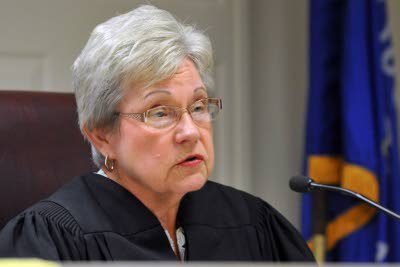
Judge Barbara Kluka
Here’s how the families were affected:
O’Keefe, who has been in contact with multiple targeted families, says, “Every family I know of that endured a home raid has been shaken to its core, and the fate of marriages and families still hangs in the balance in some cases.”
Anne also describes a new fear of the police: “I used to support the police, to believe they were here to protect us. Now, when I see an officer, I’ll cross the street. I’m afraid of them. I know what they’re capable of.”
Cindy says, “I lock my doors and I close my shades. I don’t answer the door unless I am expecting someone. My heart races when I see a police car sitting in front of my house or following me in the car. The raid was so public. I’ve been harassed. My house has been vandalized. [She did not identify suspects.] I no longer feel safe, and I don’t think I ever will.”
Rachel talks about the effect on her children. “I tried to create a home where the kids always feel safe. Now they know they’re not. They know men with guns can come in their house, and there’s nothing we can do.” Every knock on the door brings anxiety. Every call to the house is screened. In the back of her mind is a single, unsettling thought: These people will never stop.
Victims of trauma — and every person I spoke with described the armed raids as traumatic — often need to talk, to share their experiences and seek solace in the company of a loving family and supportive friends. The investigators denied them that privilege, and it compounded their pain and fear.
The investigation not only damaged families, it also shut down their free speech. In many cases, the investigations halted conservative groups in their tracks. O’Keefe and the Wisconsin Club for Growth described the effect in court filings:
O’Keefe’s associates began cancelling meetings with him and declining to take his calls, reasonably fearful that merely associating with him could make them targets of the investigation. O’Keefe was forced to abandon fundraising for the Club because he could no longer guarantee to donors that their identities would remain confidential, could not (due to the Secrecy Order) explain to potential donors the nature of the investigation, could not assuage donors’ fears that they might become targets themselves, and could not assure donors that their money would go to fund advocacy rather than legal expenses. The Club was also paralyzed. Its officials could not associate with its key supporters, and its funds were depleted. It could not engage in issue advocacy for fear of criminal sanction.
These raids and subpoenas were often based not on traditional notions of probable cause but on mere suspicion, untethered to the law or evidence, and potentially violating the Fourth Amendment’s prohibition against “unreasonable searches and seizures.” The very existence of First Amendment–protected expression was deemed to be evidence of illegality. The prosecution simply assumed that the conservatives were incapable of operating within the bounds of the law.
Even worse, many of the investigators’ legal theories, even if proven by the evidence, would not have supported criminal prosecutions. In other words, they were investigating “crimes” that weren’t crimes at all.
I really recommend that you read this entire article to get the details of the raids, and the trauma that was inflicted on families who thought that the police were their friends. It is literally the most astonishing and fearful thing that I have read all year, and I have read a lot of scary things. This is like my worst nightmare. It reminds me of one of my favorite movies “The Lives of Others”, which is a foreign film about the East German “Stasi” secret police. I didn’t think it could happen here. But I guess leftists are leftists.
Hillary Clinton’s official presidential announcement was a golden opportunity for networks to demand the former Secretary of State respond to unanswered questions about her e-mail scandal. Yet in the flurry of coverage since her official rollout (April 12 – April 20) the e-mail scandal garnered a total of just 7 minutes, 12 seconds on the Big Three (ABC, CBS, NBC) evening and morning shows.
Even a new angle on the e-mail scandal – the New York Times reported April 14 that Clinton never responded to a congressional inquiry [in December of 2012] that “directly asked” if she had used a private e-mail account – failed to re-ignite the interest networks initially showed when the scandal first broke in March.
Over the past five weeks, all three broadcast networks have essentially walked away from covering the ex-Secretary of State’s secret extra-governmental e-mail server and the possible loss of crucial documents needed by the House Select Committee investigating the 2012 Benghazi attacks, with coverage on ABC, CBS and NBC’s morning and evening news shows falling by more than 93 percent from the levels seen in early March.
When news first broke that Clinton improperly used her own private e-mail account, the Big Three networks actually jumped to cover the story, filling their evening and morning shows with a total of 124 minutes and 55 seconds of airtime (NBC: 53 minutes, 51 seconds; CBS: 36 minutes, 39 seconds; ABC: 34 minutes, 25 seconds) within the first two weeks (March 3-16) of coverage that encompassed Hillary Clinton’s March 10 press conference.
But despite pundits and journalists like NBC’s Chuck Todd insisting that Clinton’s press conference “didn’t satisfy her media critics” a look at the coverage in the ensuing weeks shows they lost a lot of their interest in the story.
In the third week, (March 17-23), the networks reduced their coverage of the latest Clinton controversy to just 1 minute and 59 seconds (NBC: 23 seconds; CBS 29 secondsl; ABC: 1 minute, 7 seconds).
In the fourth week (March 24-30), the stunning news that Clinton’s own attorney admitted her server had been wiped clean caused a brief spike in coverage — but even that development generated just 11 minutes and 14 seconds of airtime (ABC: 1 minute, 32 seconds; CBS: 4 minutes, 48 seconds; NBC: 4 minutes, 54 seconds).
By week 5 (March 31-April 6) the story was virtually non-existent drawing just 1 minute and 16 seconds total coverage. (ABC: 0; CBS: 29 seconds; NBC: 47 seconds).
[…]Even though unanswered questions still persist (Why was her private server wiped clean? Was there incriminating evidence in those e-mails regarding the Benghazi investigation or Clinton Foundation donations? Could a foreign nation, like Russia, have hacked her server?) the networks have essentially discarded the story, reducing their coverage to just a total of 2 minutes and 11 seconds (CBS: 14 seconds, ABC: 42 seconds, NBC: 1 minute, 15 seconds) by the seventh week.
Compare a few minutes here and there with the coverage of the VA scandal:
In nearly four and a half weeks, the ABC, CBS and NBC morning and evening news shows have offered 110 minutes to an evolving Obama administration scandal involving secret lists designed to keep veterans from receiving proper medical treatment. Back in January, it took those same network shows just four and a half days to churn that much coverage for Chris Christie’s Bridgegate.
Since the VA story broke on April 23 with the news that as many as 40 veterans seeking treatment at one Phoenix facility died while on secret waiting lists, CBS has provided the most coverage, 48 minutes and 46 seconds. NBC allowed 44 minutes and 53 seconds and ABC came in last with a scant 16 minutes and 44 seconds. None of the networks bothered covering the story until May 6, almost two weeks after it broke. (This is despite heavy investigative reporting by Fox News and CNN.)
An analysis last week by the Media Research Center found that through the morning of May 16, a mere five seconds of the coverage included criticism of Barack Obama’s handling of the VA hospital scandal. Only this week, as the pressure mounted and new details emerged, the storyline finally shifted to including criticisms of the President.
A 2014 Media Research Center study found that the broadcast networks of ABC, CBS, and NBC devoted a stunning 88 minutes of air time to the Bridgegate story in less that 48 hours after it broke on January 8 of that year.
In stark contrast, when a scandal involving the administration of New Jersey Governor Chris Christie (R) erupted in January, CNN provided wall-to-wall coverage. In the first full day of coverage on January 9, CNN spent a whopping eight hours and 35 minutes covering the Christie story.
I’m really not sure why so many Americans willingly indoctrinate themselves by watching the mainstream media and pretending that it’s unbiased news. If you’re looking for balance, then you’re better off reading something from a quality left-leaning source like National Journal or the Atlantic.

 WINTERY KNIGHT