
Ryan T. Anderson: background on the same-sex marriage case before the Supreme Court

This Daily Signal article is a great summary of everything that a lay-person like me or you ought to know about the case that is going to be decided by the Supreme Court.

Here are a few of the points I thought were most interesting:

2. The overarching question before the Supreme Court is not whether a male–female marriage policy is the best, but only whether it is allowed by the Constitution. The question is not whether government-recognized same-sex marriage is good or bad policy, but only whether it is required by the Constitution.

Those suing to overturn male-female marriage laws thus have to prove that the man–woman marriage policy that has existed in the United States throughout our entire history is prohibited by the Constitution. They cannot successfully so argue.

3. As Supreme Court Justice Samuel Alito pointed out two years ago, there are two different visions of what marriage is on offer. One view of marriage sees it as primarily about consenting adult romance and care-giving. Another view of marriage sees it as a union of man and woman—husband and wife—so that children would have moms and dads.

Our Constitution is silent on which of these visions is correct, so We the People have constitutional authority to make marriage policy.

The debate over whether to redefine marriage to include same-sex relationships is unlike the debate over interracial marriage. Race has absolutely nothing to do with marriage, and there were no reasonable arguments ever suggesting it did.

Laws that banned interracial marriage were unconstitutional and the Court was right to strike them down. But laws that define marriage as the union of a man and woman are constitutional, and the Court shouldn’t strike them down.

4. The only way the Court could strike down state laws that define marriage as the union of husband and wife is to adopt a view of marriage that sees it as an essentially genderless institution based primarily on the emotional needs of adults and then declare that the Constitution requires that the states (re)define marriage in such a way.

Equal protection alone is not enough. To strike down marriage laws, the Court would need to say that the vision of marriage that our law has long applied equally is just wrong: that the Constitution requires a different vision entirely.

But the Constitution does not require a new vision of marriage.

Advocates for the judicial redefinition of marriage cannot reasonably appeal to the authority of Windsor, to the text or original meaning of the Fourteenth Amendment, to the fundamental rights protected by the Due Process Clause, or to Loving v. Virginia. So, too, one cannot properly appeal to the Equal Protection Clause or to animus or Lawrence v. Texas.

Nor can one say that gays and lesbians are politically powerless, so one cannot claim they are a suspect class. Nor can one say that male–female marriage laws lack a rational basis or that they do not serve a compelling state interest in a narrowly tailored way, as explained in Heritage Foundation legal memorandum “Memo to Supreme Court: State Marriage Laws Are Constitutional.”

7. Redefining marriage to make it a genderless institution fundamentally changes marriage: It makes the relationship more about the desires of adults than the needs—or rights—of children. It teaches that mothers and fathers are interchangeable.

I think that’s the fundamental question in the marriage debate. The question is, is marriage a relationship that is geared towards producing children, and locking in husbands and wives together in an exclusive, permanent relationship so that those children have two people who are biologically-related to them who are nearby to watch over them and care for them. When I think about what it is like to be a little child, or even a little animal, it is obvious to me that we should be aggressive about encouraging and celebrating couples who have children and then stick together to raise them. It’s a hard, self-sacrificial job. It’s not about self-centered hedonism. It’s about doing the right thing to provide for the needs of children as they grow up. Marriage isn’t about grown-ups being happy, it’s about regulating sex for the benefit of children, and society as a whole. We do better together as a society with natural marriage.

A third of Americans who have a savings plan have less than $1000 in it

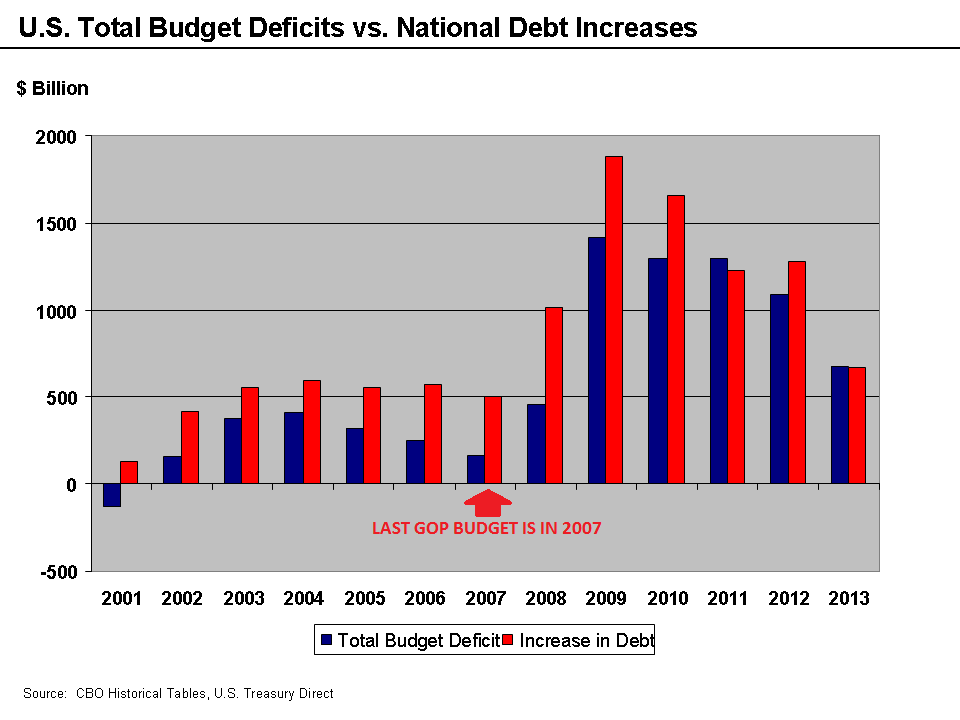
National Debt and Deficit 2007-2013

Let me start with the facts from Breitbart News, and then I’ll comment on the part in bold.

Excerpt:

Study after study shows that Americans are not saving for retirement like they should, and a new survey finds that nearly one third of people who have some sort of savings plan have amassed less than $1,000 for retirement.

The survey titled “Preparing for Retirement in America,” by Employee Benefit Research Institute (EBRI) and Greenwald and Associates, finds that only 65 percent of workers have any savings for retirement, a number that fell below the 75 percent figure from 2009.

But 28 percent of workers report that they have saved less than $1,000 for retirement, and almost 6 in 10 Americans say that their financial planning needs improvement.

Additionally, 34 percent say they have made no effort at all to saving anything or make a retirement plan. Still, most say that they intend to start saving at some point.

But intentions may not be enough. “Intending one thing and doing another is human, but it’s an impulse we should all fight hard to resist,” Rebekah Barsch, vice president of planning and sales at Northwestern Mutual, said in a press statement. “Intentions only get us so far. And when the stakes are high, it’s taking action that’s critical.”

Many say that the average person needs to save one million dollars for retirement, but a recent piece by David Marotta, president of Marotta Wealth Management in Charlottesville, VA, noted that a 20-year-old in 2015 may have to amass up to $7 million to retire comfortably.

“Someone retiring now in 2014 with $1 million at age 65 can safely withdraw $43,600 a year,” Marotta wrote last May. “However, [because of inflation], today’s 20-year-olds will need over $7 million to have that same lifestyle when they retire. In 1970, they would only have needed $166,000 in retirement to have a similar purchasing power for the rest of their life.”

Many Americans save for retirement using the 401K plans provided through their employer, but according to the federal government, around 50 million Americans don’t have the ability to enroll in such a savings plan.

Here’s a helpful article from CNBC that answers the question “how much do I need to retire?”.

It says:

You can’t feel secure in retirement if you don’t have a good idea of how much money you’ll need.

But if you believe a new Legg Mason survey, you may have to save far more than you think. Investors surveyed by the global investment management firm said they will require an average of $2.5 million in retirement to enjoy the quality of life they have today.

That’s about $2.2 million more than the average balance of $385,000 those investors actually had in 401(k)s and similar retirement plans, which might help explain why only 40 percent of the 458 investors surveyed said they are “very confident” in their ability to “retire at the age I want to.” (And the investors surveyed have set more aside than the average retirement saver. At Fidelity, the nation’s largest retirement plan provider, the average 401(k) balance was $91,300 at the end of 2014.)

[…]Fidelity estimates most investors require about eight times their ending salary to increase the chances that their savings will last during a 25-year retirement. But every retirement is different. People also tend to spend lavishly in their first years of retirement before their spending declines in later years.

Health care is the wild card in retirement planning, especially as Americans live longer. Fidelity projects a 65-year-old couple retiring will need an average of $220,000 to cover medical expenses in retirement.

So, according to Fidelity’s rule, if you are single and making $50K after taxes, then you need $400,000 to retire at age 65. You’ll need more the earlier you retire. That seems about right to me. The important thing to do when planning for the future is not to imagine a higher income than you have right now, though. Imagining that things will be better than they are right now is a terrible mistake. You can’t make the world change just by imagining things that make you feel good, or by looking at cherry-picked examples from people you know who got lucky.

The trouble with young people today is that they think that things tomorrow will be the same as they were yesterday. They don’t see the future implications of running our national debt up to $18.5 trillion dollars. They think entitlement programs will be solvent when they are ready to retire. They aren’t aware of what’s going on in the economies of other countries that we trade with. They aren’t aware of what’s going on in Greece, and how that will affect the European Union. They aren’t aware of the demographic crisis in Europe, and especially in Japan. They aren’t thinking about the implications for future wars as America withdraws from the world stage. And so on. And since they are not aware, they are delaying making a plan to save, so they can have more fun now. Their retirement plan is all future sunshine and rainbows, but no actions are being taken right now.

If I could give young people one piece of advice, it’s this. It’s much easier to shift your life out of a position of financial security to something lighter but more meaningful in the second half of your life. It’s harder to work back to earning and saving if you have squandered your early life on fun, thrills, travel, non-STEM degrees, etc. If you’re 30 years old and don’t have any savings, you are in serious, serious trouble. You need to get focused on a regular career as soon as possible, and start saving. Get those debts paid off now. Still think that your rosy picture of the future will obtain? Usually, you can tell how good you are at strategic forecasting by looking at your past decisions. Have you been wise before, or have you chosen poorly? If you’ve chosen poorly, then it’s a good idea to defer to people who haven’t made the same mistakes. If you’re an optimistic person who is always being surprised and disappointed, that’s a good sign you need to start saving now.

Mitt Romney: Hillary’s Clinton Foundation Uranium One scandal “looks like bribery”

What looks like bribery? Well, read this story from the radically leftist New York Times, of all places. It should be the end of Hillary’s campaign.

Excerpt:

The headline in the website Pravda trumpeted President Vladimir V. Putin’s latest coup, its nationalistic fervor recalling an era when its precursor served as the official mouthpiece of the Kremlin: “Russian Nuclear Energy Conquers the World.”

The article, in January 2013, detailed how the Russian atomic energy agency, Rosatom, had taken over a Canadian company with uranium-mining stakes stretching from Central Asia to the American West. The deal made Rosatom one of the world’s largest uranium producers and brought Mr. Putin closer to his goal of controlling much of the global uranium supply chain.

But the untold story behind that story is one that involves not just the Russian president, but also a former American president and a woman who would like to be the next one.

At the heart of the tale are several men, leaders of the Canadian mining industry, who have been major donors to the charitable endeavors of former President Bill Clinton and his family. Members of that group built, financed and eventually sold off to the Russians a company that would become known as Uranium One.

Beyond mines in Kazakhstan that are among the most lucrative in the world, the sale gave the Russians control of one-fifth of all uranium production capacity in the United States. Since uranium is considered a strategic asset, with implications for national security, the deal had to be approved by a committee composed of representatives from a number of United States government agencies. Among the agencies that eventually signed off was the State Department, then headed by Mr. Clinton’s wife, Hillary Rodham Clinton.

As the Russians gradually assumed control of Uranium One in three separate transactions from 2009 to 2013, Canadian records show, a flow of cash made its way to the Clinton Foundation. Uranium One’s chairman used his family foundation to make four donations totaling $2.35 million. Those contributions were not publicly disclosed by the Clintons, despite an agreement Mrs. Clinton had struck with the Obama White House to publicly identify all donors. Other people with ties to the company made donations as well.

And shortly after the Russians announced their intention to acquire a majority stake in Uranium One, Mr. Clinton received $500,000 for a Moscow speech from a Russian investment bank with links to the Kremlin that was promoting Uranium One stock.

At the time, both Rosatom and the United States government made promises intended to ease concerns about ceding control of the company’s assets to the Russians. Those promises have been repeatedly broken, records show.

[…]The path to a Russian acquisition of American uranium deposits began in 2005 in Kazakhstan, where the Canadian mining financier Frank Giustra orchestrated his first big uranium deal, with Mr. Clinton at his side.

The two men had flown aboard Mr. Giustra’s private jet to Almaty, Kazakhstan, where they dined with the authoritarian president, Nursultan A. Nazarbayev. Mr. Clinton handed the Kazakh president a propaganda coup when he expressed support for Mr. Nazarbayev’s bid to head an international elections monitoring group, undercutting American foreign policy and criticism of Kazakhstan’s poor human rights record by, among others, his wife, then a senator.

Within days of the visit, Mr. Giustra’s fledgling company, UrAsia Energy Ltd., signed a preliminary deal giving it stakes in three uranium mines controlled by the state-run uranium agency Kazatomprom.

[…][T]he company’s story was hardly front-page news in the United States — until early 2008, in the midst of Mrs. Clinton’s failed presidential campaign, when The Times published an article revealing the 2005 trip’s link to Mr. Giustra’s Kazakhstan mining deal. It also reported that several months later, Mr. Giustra had donated $31.3 million to Mr. Clinton’s foundation.

[…][T]he ultimate authority to approve or reject the Russian acquisition rested with the cabinet officials on the foreign investment committee, including Mrs. Clinton — whose husband was collecting millions of dollars in donations from people associated with Uranium One.

Romney, in his interview with Hugh Hewitt, explained that because Bill and Hillary are married, their assets are co-mingled.

So what’s the problem with this deal?

The national security issue at stake in the Uranium One deal was not primarily about nuclear weapons proliferation; the United States and Russia had for years cooperated on that front, with Russia sending enriched fuel from decommissioned warheads to be used in American nuclear power plants in return for raw uranium. Instead, it concerned American dependence on foreign uranium sources. While the United States gets one-fifth of its electrical power from nuclear plants, it produces only around 20 percent of the uranium it needs, and most plants have only 18 to 36 months of reserves, according to Marin Katusa, author of “The Colder War: How the Global Energy Trade Slipped From America’s Grasp.”

“The Russians are easily winning the uranium war, and nobody’s talking about it,” said Mr. Katusa, who explores the implications of the Uranium One deal in his book. “It’s not just a domestic issue but a foreign policy issue, too.”

It’s a national security issue. We shouldn’t be selling uranium companies to countries like Russia who not only invade their neighbors, but also sell long-range missiles to Iran – and a host of other nasty things, too. This country is not friendly to us.

Hillary Clinton: secretive, entitled, hypoctritical

What was Hillary’s response? It’s a distraction invented by the vast right-wing conspiracy:

That’s some vast right-wing conspiracy that makes its way onto the nation’s most respected leftist national newspaper.

So, does this explain why Hillary Clinton deleted tens of thousands of e-mails and then wiped her private e-mail server clean? We’ll never know, because she destroyed all the evidence. But one thing is for sure – there is no reason to vote for this candidate for President, although some people will:

That’s the only “reason” that people will vote for her, because on the merits, she’s a stinker.

Related posts