Robert Gagnon debates gay activist Jayne Ozanne on Bible vs homosexuality

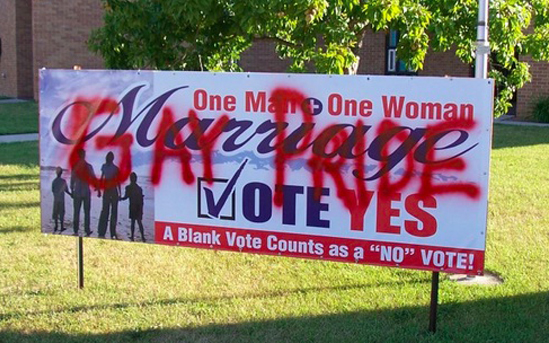
Gay activist vandalizes pro-marriage sign

I am tempted to say that this is the best podcast I have ever heard on the Unbelievable show. Do anything you have to do in order to listen to this podcast.

Details:

Prof Robert Gagnon has become a well-known voice advocating the traditional biblical view on sexuality. In a highly charged show he debates the scriptural issues on sexuality with Jayne Ozanne, the director of Accepting Evangelicals who came out as gay earlier this year.

The MP3 file is here.

If you can only listen for 15 minutes, then start at 49 minutes in and listen from there.

The following summary is rated MUP for made-up paraphrase. Reader discretion is advised.

Summary:
Intro:

  • Speaker introductions
  • Gagnon: scholars who support gay marriage agree that the Bible doesn’t support it
  • Gagnon: scholars who support gay marriage agree Jesus taught male-female marriage
  • Ozanne: I went to the hospital because I was sick from trying to suppress my gay desires
  • Ozanne: Doctors told me that I would die if I didn’t act on my gay desires
  • Ozanne: I decided to reinterpret the Bible to fit with my gay desires
  • Ozanne: According to my new interpretation, Jesus actually supports my gay desires

Segment 1: Genesis

  • Ozanne: In Genesis the Bible says that Adam needs a woman to complete him
  • Ozanne: I reinterpret this to mean that Adam needed a “complementarian human being”
  • Ozanne: Genesis doesn’t say whether Eve was complemented by Adam in that chapter
  • Ozanne: It’s not critical that men are complemented by women, a man could complement a man
  • Ozanne: Genesis 2 doesn’t talk about children, it’s all about adult needs from a relationship
  • Gagnon: Genesis 2 has never been interpreted that way in all of history
  • Gagnon: Genesis 2 language specifically implies a human being who is opposite/different
  • Gagnon: Genesis 2 language translates to complement or counterpart
  • Gagnon: Genesis as a whole teaches that the sexuality is for male and female natures
  • Gagnon: The extraction of something from the man that is given to the woman is complementarian
  • Ozanne: I think that people can be complementary outside of male-female Genesis language
  • Ozanne: I don’t want to discuss specific words and texts and Greek meanings
  • Gagnon: the text has always been read and interpreted to support male/female complementarity
  • Gagnon: the male-female nature argument is made because the two natures are complementary
  • Ozanne: the text was interpreted by patriarchal males who treated women like property, it’s biased
  • Ozanne: what is important to me is how Christ interprets Genesis (?? how does she know that?)
  • Ozanne: I am passionate about my interpretation of Scripture which supports my gay desires
  • Gagnon: just because a person is passionate about their interpretation it doesn’t make it right
  • Gagnon: I am not arguing for the male-female view based on passion, but on scholarship, evidence and history
  • Ozanne: both sides are equally passionate about their interpretations (?? so both are equally warranted?)
  • Ozanne: the real question is why God “allowed” two different interpretations of Scripture

Segment 2: Is homosexuality a sin?

  • Gagnon: Jesus affirmed traditional sexual morality, which forbids homosexuality
  • Gagnon: Jesus teaches that marriage is male-female, and limited to two people
  • Gagnon: No one in history has interpreted the Bible to say that homosexuality was not immoral
  • Ozanne: Jesus came to bring life, and that means he supports homosexuality
  • Ozanne: I was dying, and embracing my gay desires allowed me to live, so Jesus approves of me
  • Ozanne: God says “I am who I am” and that means he approves of me doing whatever I want
  • Ozanne: There is an imperative to be who I am, and that means embracing my gay desires
  • Gagnon: Jesus argued that the twoness of the sexual bond is based on the twoness of the sexes
  • Gagnon: Jesus did not come to gratify people’s innate desires, he called people to repent of sin
  • Gagnon: Jesus did reach out to sinners but he never condoned the sins they committed
  • Gagnon: Jesus’ outreach to tax collectors collecting too much and sexual sinners is the same: STOP SINNING
  • Ozanne: I don’t think that Romans 1 is talking about homosexuality
  • Ozanne: I think it’s talking about sexual addiction, not loving, committed gay relationships
  • Ozanne: Paul was condemning pederasty in Romans 1, not loving, long-term, consensual sexual relationships between gay adults
  • Gagnon: nothing in the passage limits the condemnation to pederasty
  • Gagnon: the passage was never interpreted to be limited to pederasty in history
  • Gagnon: rabbis and church fathers knew about committed two-adult same-sex relationships, and said they were wrong
  • Gagnon: the argument for marriage is based on the broad two-nature argument, with no exceptions
  • Gagnon: the condemnation is not limited to exploitative / coercive / lustful / uncommitted relationships
  • Gagnon: even pro-gay scholars agree the passage cannot be interpreted Ozanne’s way (he names two)

Segment 3: The showdown (49:00)

  • Ozanne: I don’t care how many pages people have written on this
  • Ozanne: God says that “the wisdom of the wise I will frustrate” so you can’t use scholars, even pro-gay scholars, to argue against my passionate interpretation
  • Ozanne: I am not interested in the text or history or scholarship or even pro-gay scholars who agree with you
  • Ozanne: what decides the issue for me is my mystical feelings about God’s love which makes my sexual desires moral
  • Ozanne: you are certain that this is wrong, but your view does not “give life” to people
  • Ozanne: your scholarship and historical analysis is “a message of death” that causes teenagers to commit suicide (= you are evil and a meany, Robert)
  • Ozanne: “I pray for you and your soul” (= opposing me will land you in Hell) and “I hope that listeners will listen with their hearts” (?? instead of their minds?)
  • Ozanne: you can prove anything you want with research, even two mutually exclusive conclusions, so you shouldn’t rely on scholarship and research since it could be used to prove my view as well
  • Ozanne: instead of relying on research, you should rely on your heart and your feelings about God’s love to decide what the Bible teaches about sexual morality
  • Gagnon: you are distorting the gospel in order to make your case
  • Gagnon: attacking my “certainty” is an ad hominem attack to cover your dismissmal of the scholarship and history
  • Gagnon: you distort the gospel to make it seem like Christ just wants us to get what we want, when we want it, with who we want it with
  • Gagnon: Christ calls us to take up our cross, to lose our lives and to deny ourselves
  • Gagnon: you have a notion of what “fullness of life” is, but it’s not reflective of the gospel
  • Gagnon: Paul’s life was much more troubling than yours, mine or anyone else around here
  • Gagnon: Paul was beaten, whipped, stoned, poorly sheltered, poorly clothed, poorly fed, shipwrecked, and anxious for his churches
  • Gagnon: on your view, he should have been miserable and angry with God all the time
  • Gagnon: but instead Paul was constantly thankful and rejoicing to be able to suffer with Jesus and look forward to the resurrection
  • Gagnon: I have suffered too, but the suffering we go through never provides us with a license to violate the commandments of God
  • Ozanne: “the ultimate thing is what people feel God has called them to”
  • Ozanne: My goal right now is to tell young people that homosexuality is fine so they don’t commit suicide
  • Ozanne: the view that homosexuality is wrong is “evil and misguided”
  • Gagnon: the greater rates of harm in the gay community are intrinsic to homosexual unions, not caused by external disapproval of homosexuality

Segment 4: Concluding statements

  • Gagnon: gay male relationships on average have more sex partners and more STDs
  • Gagnon: female relationships on average have shorter-length relationships and more mental issues
  • Gagnon: the greater rates of harm are because there is no complementarity / balance in the relationships
  • Gagnon: everyone has some disappointment or suffering in their lives that hurts them, and that they are tempted to break the rules to fix, but we should not break the rules in order to be happy
  • Ozanne: both sides are passionate, so no one can be right, and evidence proves nothing
  • Ozanne: only feelings about “what God is doing” can allow us to decide what counts as sin or not
  • Ozanne: the main thing that is at stake here is to make people like us, not to decide what the Bible says about sin
  • Ozanne: my message to people is to do whatever you want, and ignore mean people who don’t affirm you
  • Ozanne: we should be more opposed to mean people who make non-Christians feel unloved than about doing what the Bible says

What happened in other countries, e.g. Canada, after gay marriage was legalized?

If you want real confidence, try studying instead of yelling

This article from CNS News is a must-read for sleepy American Christians.

It says:

Rather than settle animosity and ease cultural tensions, the advent of same-sex “marriage” will lead to the repression of religious freedom and determination to root out dissent to the gay rights doctrine. At LifeSiteNews, we have watched this play out for nearly two decades in 17 countries around the world – and America is next.

A prime example is Canada. Same-sex “marriage” passed in 2005. Similar to European countries which have done so, there has been a relentless pursuit of the minds of children against the wishes of their parents. Schools, both public and private, were first mandated by law to have gay-straight alliance clubs under the auspices of anti-bullying. Then, sex-education, teaching the normalcy of homosexual sex, was given to children without parents being permitted to opt their children out of the classes.

We have arrived at this state of affairs because of the silence of Christian pulpits on sexual matters, and the concomitant shouting from every secular pulpit, screen and book. Even the current discussion around same-sex “marriage” in the United States reveals a grave reluctance to speak about the heart of the issue – homosexual sex. Rather, arguments are made about the goodness of natural marriage, about its benefit to children, and its unchangeable character.

From reporting on the subject every day for so many years, we knew that the struggle for same-sex “marriage” has very little to do with marriage. In fact, until just recently, gay activists didn’t even want to be “married” to each other. Most had no interest in the constraints that such a formalized union would entail in terms of exclusive partnership.

However, the leaders among the activists convinced the movement that they must attain marriage as a societal stamp of approval to homosexual behavior. And, frankly, they have largely succeeded.

Today, in many of the nations where same-sex “marriage” is law, opposition to it is seen as akin to racism. It is seen falsely as an animosity against someone for who they are—an unwillingness to recognize the human dignity of a class of persons due to an immutable characteristic.

However, that false perception is due to a purposeful agenda to conflate animosity against homosexual sex acts with animosity against persons who experience same-sex attraction.  The ancient Christian teaching to “love the sinner and hate the sin” is an impermissible distinction in the minds of some. It is, however, the key to understanding the majority of the opposition to same-sex “marriage.”

The plain truth of the matter is that opposition to same-sex “marriage” is rooted not in hatred and bigotry, but just the opposite – in love. Like parents who do not allow children to behave dangerously without lovingly correcting them, opponents of same-sex relationships are hoping to save people with same-sex attractions from severe physical, psychological, and spiritual harm.

Just as, out of love and concern for their children’s welfare, parents must correct and discipline, despite the protests they may get in return, any true believer in marriage, natural law and science must lovingly correct their fellow man.

In other nations, the perception that opposition to same-sex “marriage” is based upon bigotry has led to laws that violate religious liberty, parental rights and freedom of speech. This is why those who oppose same-sex “marriage” must present their reasoning as based on love and concern for the welfare of those in homosexual relationships, in addition to concerns for children and society itself.  And there is ample evidence on which to base that concern in the numerous studies showing the grave harm of homosexual sex to both body and psyche.

The danger is something that some gay activists (who are honest) speak about:

When I’ve spoken of these findings at conferences around the world, some have questioned if the researchers who showed these harms weren’t themselves biased by anti-gay sentiment.  And so I’ve taken to carrying with me on my phone the quotes of the late Canadian gay activist Gens Hellquist, whose testimony proves the harms of gay sex better than any study ever could.

Speaking a year after the passage of same-sex “marriage” into law, Hellquist was seeking more healthcare dollars for the LGBT community. “We have one of the poorest health statuses in this country,” he said. “Health issues affecting queer Canadians include lower life expectancy than the average Canadian, suicide, higher rates of substance abuse, depression, inadequate access to care and HIV/AIDS.”

“There are all kinds of health issues that are endemic to our community,” he added. “We have higher rates of anal cancer in the gay male community, lesbians have higher rates of breast cancer.”

He concluded: “Now that we can get married everyone assumes that we don’t have any issues any more. A lot of the deaths that occur in our community are hidden, we don’t see them. Those of us who are working on the front lines see them and I’m tired of watching my community die.”

Here is a good summary of what happened in Canada in the years after they legalized same-sex

Why is this happening? The answer is that American Christians have become more concerned about soft-aspects of Christianity than about truth. The church is more concerned about feeling good and being liked by non-Christians. Cultivating intellectual ability to defend marriage through a study of the relevant literature is definitely out. The very pious Bible-focused fundamentalists are confident that the best way to argue with non-Christians is to quote Bible verses to them.

I have a different idea of what we should be doing. I think we should be reading books on the philosophical arguments for marraige, (e.g. – “What Is Marriage?“) ,and reading books on what happens to children who are raised by same-sex adults instead of by their own mom and dad, (e.g. – “Gender and Parenthood“). It’s this study of philosophical arguments and social science evidence which allows us to be bold in defending marriage. Studying the issues instead of trying to do pious, subjective devotional activities will also help our children to be able to reach positions of influence in the culture, from which they can push the pro-marriage view.

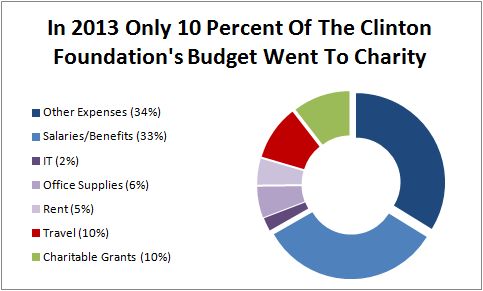
Only 10% of money given to Clinton Foundation goes to charity

Astonishing article from The Federalist.

It says:

After a week of being attacked for shady bookkeeping and questionable expenditures, the Clinton Foundation is fighting back. In a tweet posted last week, the Clinton Foundation claimed that 88 percent of its expenditures went “directly to [the foundation’s] life-changing work.”

There’s only one problem: that claim is demonstrably false. And it is false not according to some partisan spin on the numbers, but because the organization’s own tax filings contradict the claim.

Look:

Only 10% of their income goes to charity

And:

In order for the 88 percent claim to be even remotely close to the truth, the words “directly” and “life-changing” have to mean something other than “directly” and “life-changing.” For example, the Clinton Foundation spent nearly $8.5 million–10 percent of all 2013 expenditures–on travel. Do plane tickets and hotel accommodations directly change lives? Nearly $4.8 million–5.6 percent of all expenditures–was spent on office supplies. Are ink cartridges and staplers “life-changing” commodities?

Those two categories alone comprise over 15 percent of all Clinton Foundation expenses in 2013, and we haven’t even examined other spending categories like employee fringe benefits ($3.7 million), IT costs ($2.1 million), rent ($4 million) or conferences and conventions ($9.2 million). Yet, the tax-exempt organization claimed in its tweet that no more than 12 percent of its expenditures went to these overhead expenses.

How can both claims be true? Easy: they’re not. The claim from the Clinton Foundation that 88 percent of all expenditures go directly to life-changing work is demonstrably false. Office chairs do not directly save lives. The internet connection for the group’s headquarters does not directly change lives.

[…][T]he IRS 990 forms submitted by the Clinton Foundation include a specific and detailed accounting of these programmatic expenses. And even using extremely broad definitions–definitions that allow office supply, rent, travel, and IT costs to be counted as programmatic costs–the Clinton Foundation fails its own test.

According to 2013 tax forms filed by the Clinton Foundation, a mere 80 percent of the organization’s expenditures were characterized as functional programmatic expenses. That’s a far cry from the 88 percent claimed by the organization just last week.

[…]In 2013, for example, only 10 percent of the Clinton Foundation’s expenditures were for direct charitable grants. The amount it spent on charitable grants–$8.8 million–was dwarfed by the $17.2 million it cumulatively spent on travel, rent, and office supplies. Between 2011 and 2013, the organization spent only 9.9 percent of the $252 million it collected on direct charitable grants.

While some may claim that the Clinton Foundation does its charity by itself, rather than outsourcing to other organizations in the form of grants, there appears to be little evidence of that activity in 2013. In 2008, for example, the Clinton Foundation spent nearly $100 million purchasing and distributing medicine and working with its care partners. In 2009, the organization spent $126 million on pharmaceutical and care partner expenses. By 2011, those activities were virtually non-existent. The group spent nothing on pharmaceutical expenses and only $1.2 million on care partner expenses. In 2012 and 2013, the Clinton Foundation spent $0. In just a few short years, the Clinton’s primary philanthropic project transitioned from a massive player in global pharmaceutical distribution to a bloated travel agency and conference organizing business that just happened to be tax-exempt.

As if that were not bad enough, now Bloomberg News is reporting that there were 1100 UNREPORTED DONORS to the Clinton Foundation, most of them non-US residents.

Look:

There are in fact 1,100 undisclosed donors to the Clinton Foundation, Giustra says, most of them non-U.S. residents who donated to CGEP.

[…]The reason this is a politically explosive revelation is because the Clinton Foundation promised to disclose its donors as a condition of Hillary Clinton becoming secretary of state. Shortly after Barack Obama was elected president in 2008, the Clinton Foundation signed a “memorandum of understanding” with the Obama White House agreeing to reveal its contributors every year. The agreement stipulates that the “Clinton Giustra Sustainable Growth Initiative” (as the charity was then known) is part of the Clinton Foundation and must follow “the same protocols.”

It hasn’t.

So, if none of the money from all these foreign donors was being used for charitable activities, then what was it being used for? Hmmmn, what could a Secretary of State who wants to run for President do with all that money?