
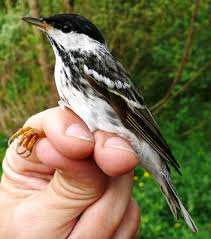
I love birds! I really, really do! A lot!
So here is the latest study, reported in Science Daily about our amazing feathered friends.
They write:
For more than 50 years, scientists had tantalizing clues suggesting that a tiny, boreal forest songbird known as the blackpoll warbler departs each fall from New England and eastern Canada to migrate nonstop in a direct line over the Atlantic Ocean toward South America, but proof was hard to come by.
Now, for the first time an international team of biologists report “irrefutable evidence” that the birds complete a nonstop flight ranging from about 1,410 to 1,721 miles (2,270 to 2,770 km) in just two to three days, making landfall somewhere in Puerto Rico, Cuba and the islands known as the Greater Antilles, from there going on to northern Venezuela and Columbia. Details of their study, which used light-level, or solar, geolocators, appear in the current issue of Biology Letters.
First author Bill DeLuca, an environmental conservation research fellow at the University of Massachusetts Amherst, with colleagues at the University of Guelph, Ontario, the Vermont Center for Ecostudies and other institutions, says, “For small songbirds, we are only just now beginning to understand the migratory routes that connect temperate breeding grounds to tropical wintering areas. We’re really excited to report that this is one of the longest nonstop overwater flights ever recorded for a songbird, and finally confirms what has long been believed to be one of the most extraordinary migratory feats on the planet.”
While other birds, such as albatrosses, sandpipers and gulls are known for trans-oceanic flights, the blackpoll warbler is a forest dweller that migrates boldly where few of its relatives dare to travel. Most migratory songbirds that winter in South America take a less risky, continental route south through Mexico and Central America, the authors note. A water landing would be fatal to a warbler.
[…]For this work the scientists fitted geolocator packs on 20 birds in Vermont and 20 more in Nova Scotia. They were able to recapture three birds from the Vermont group and two from the Nova Scotia group for analyses.
So-called light-level geolocators use solar geolocation, a method used for centuries by mariners and explorers. It is based on the fact that day length varies with latitude while time of solar noon varies with longitude. So all the instrument needs to do is record the date and length of daylight, from which daily locations can then be inferred once the geolocator is recaptured. “When we accessed the locators, we saw the blackpolls’ journey was indeed directly over the Atlantic. The distances travelled ranged from 2,270 to 2,770 kilometers,” DeLuca says.
Evolution News has more on the discovery.
They write:
More record-breaking discoveries may be in store. Oskin says that some of the blackpoll warblers spend their summers in Alaska and Canada instead of New England. If they fly east before joining the southern route to Colombia and Venezuela, it would add three thousand more miles to their annual migration.
[…]But that’s not all. Lest we forget, there are the Monarch butterflies, much smaller and lighter than birds, that travel three thousand miles from Canada to Mexico each year, as detailed in Illustra’s film Metamorphosis. Even though butterflies don’t fly non-stop, that’s — well, we need an adjective beyond “extraordinary.” And more recently, British scientists found that another butterfly, the painted lady, flies triple that distance — nine thousand miles — in its annual migration from the UK to Africa.
Think of all the integrated systems that have to be in place to make these migrations possible. The birds or butterflies need elegant flight systems, with all the attendant muscles, nerves, and structural supports required. They require digestive systems to sustain them, circulatory systems, thermal systems, sensory systems, and protection from the elements. Most astonishing are the navigational systems, including sensing the stars or the earth’s magnetic field, to take them unerringly to their destination and back over routes of thousands of miles. To pack all that in a tiny animal is a masterpiece of miniaturization. Oh — and then there’s a reproductive system, and a battery of instincts to operate all the systems.
It seems fair to say these engineering marvels are beyond the reach of unguided Darwinian evolution. The birds don’t have to fly that far. Warblers could stay inland along the coast, and feed on the way, or learn to get by through the winter like other birds do. Butterflies, too, could stay with other species that don’t migrate. Natural selection would take the easy road, get rid of the wings, and let them grovel in the dirt to eke out a living. These migratory abilities are gratuitous and superfluous to the requirements of mere survival. Such over-design, right on the “brink of impossibility,” speaks of design so beyond our comprehension, we can only stand in awe.
Butterflies are OK, but birds are much better – you can actually make friends with birds. Anyway, if you like birds as much as I do… well, no one likes them as much as I do… but if you like birds a lot, then you should get Illustra’s documentary Flight: The Genius of Birds and watch it. And share it with your friends.
 WINTERY KNIGHT
One of the reasons I enjoy your blog so much. I originally named mine “Birds of the Air” for my love for birds. I still sprinkle it from time to time with cool bird stuff. And I explained “Why birds?” here. I’m with you on the bird thing.
LikeLike