
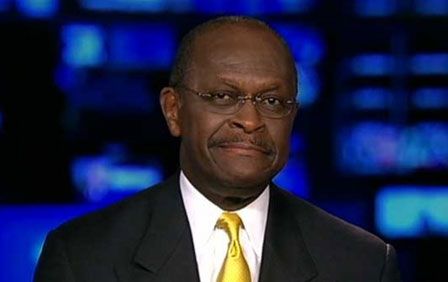
Consider this article by rock-star economist Arthur Laffer.
Excerpt:
In the recent past, federal tax revenues from the personal and business income taxes, all payroll taxes, and the capital gains, gift and estate taxes have averaged $2.3 trillion, while gross domestic product has averaged about $14.5 trillion. The total revenue from these taxes as a share of gross domestic product averages around 16%. Sometimes it’s a good deal higher, as in the boom of the late 1990s, and sometimes its lower, as in today’s “Great Recession.” But a number in the 16%-19% range is as good as you’ll get under our current tax code.
By contrast, the three tax bases for Mr. Cain’s 9-9-9 plan add up to about $33 trillion. But the plan exempts from any tax people below the poverty line. Using poverty tables, this exemption reduces each tax base by roughly $2.5 trillion. Thus, Mr. Cain’s 9-9-9 tax base for his business tax is $9.5 trillion, for his income tax $7.7 trillion, and for his sales tax $8.3 trillion. And there you have it! Three federal taxes at 9% that would raise roughly $2.3 trillion and replace the current income tax, corporate tax, payroll tax (employer and employee), capital gains tax and estate tax.
The whole purpose of a flat tax, à la 9-9-9, is to lower marginal tax rates and simplify the tax code. With lower marginal tax rates (and boy will marginal tax rates be lower with the 9-9-9 plan), both the demand for and the supply of labor and capital will increase. Output will soar, as will jobs. Tax revenues will also increase enormously—not because tax rates have increased, but because marginal tax rates have decreased.
By making the tax codes a lot simpler, we’d allow individuals and businesses to spend a lot less on maintaining tax records; filing taxes; hiring lawyers, accountants and tax-deferral experts; and lobbying Congress. As I wrote on this page earlier this year (“The 30-Cent Tax Premium,” April 18), for every dollar of business and personal income taxes paid, some 30 cents in out-of-pocket expenses also were paid to comply with the tax code. Under 9-9-9, these expenses would plummet without a penny being lost to the U.S. Treasury. It’s a win-win.
I have heard precious few conservative commentators reporting the facts on Herman Cain’s plan, so it’s nice to see Art Laffer looking at the details.
Here are three facts about Cain’s plan:
- Fact #1: People below the poverty line are exempt from ALL the taxes.
- Fact #2: It is a stupid objection to say that the tax rate can be raised. ALL taxes can be raised, and Cain has already said that his plan would require a 2/3rds majority to raise the tax rates.
- Fact #3: This plan has nothing to do with state income taxes or state sales taxes or state corporate taxes – his plan only reforms federal taxes. State tax laws are outside of the jurisdiction of the President.
I was really disappointed to hear some of the people in Tuesday night’s debate disparaging Herman Cain’s plan, especially Michele Bachmann, who ought to know better because this is her strength. When people say that a tax is regressive, that means that it is not progressive. And a progressive tax is communist. It punishes success. What we want to have is a flat tax rate that doesn’t punish success and broadens the tax base so that everyone pays something. What Cain’s plan does is lower the punishment on job creators and workers, and raises the tax on consumers who spend money. And isn’t that a good thing? Aren’t we in this whole mess because we spend too much money? Maybe we should incentivize job creation and work instead of spending. Cain’s plan would be the greatest boon to job creation that this company has ever seen – it’s brilliant precisely because it eliminates the cost of having to comply with an onerous, complicated tax code. We are getting this wealth for free, and the only losers will be the IRS and the Washington lobbyists.
 WINTERY KNIGHT
What drove me nuts in the debate is when Romney and Perry tried to say that states already subject to a sales tax would suffer. These guys are either disingenuous or they just can’t do math. The fact of the matter is, states like FL, TX, and TN would be BETTER OFF under 9-9-9 than under their current tax code.
For example, take a 6% tax in Florida. So today, you would be paying 6% more for an item than you would in another state that has a state income tax. But if all of a sudden Florida AND the “other state” have a 9% national sales tax added to that item, and all of a sudden you will no longer be paying 6% more for that item in FL, but more like 5.5% more (even though the dollar amount would be the same).
Mitt Romney’s argument in the debate last night was, “So what you’re saying Herman is that people in those states will be paying both apples and oranges!” When he said that, he came across as though he thought he was saying something of substance! Does Mitt Romney say that states that have income taxes are pears, so you would then have pears and oranges? Does Mitt Romney think that states without an income tax today are worse off than states with an income tax? That is the argument he and Perry were making, and people who live in those states should be offended by it (funny that Perry is the governor of such a state).
LikeLike
I agree with you Robb, that was really desperate stupidity. As if he has control of what individual states do. The mere fact that Perry, Romney and Bachmann attacked him for his tax plan makes me angry with them. Making people pay sales taxes rather than income taxes is capitalist. We need to do it, it’s the right thing to do.
LikeLike
Since a national sales tax would not replace the local, county, and state sales taxes, it would add to what we pay out as we go. Since so many people do not pay taxes now, it will definitely affect those who pay little/no taxes (middle and lower income with children). It will also affect those who live paycheck to paycheck. While more income would come in for the government, I’m not sure it is as good for married couples with children as our current system.
LikeLike
Perhaps you know, but I haven’t seen any sort of mechanism, either in the US constitution, rules of Congress, or from the Cain camp as to how he could implement a “2/3 vote to raise taxes”.
LikeLike
Mr. Cain said as President he would never sign a bill that raised these tax rates over 9%. So what could happen when he is out of office and once again a liberal is in office with a liberal Congress. This is what Michele is concerned about.
In addition, what about repealing the 16th amendment? Shouldn’t that take place first?
LikeLike
There is always a chance that taxes will increase. There is not a plan in the world that can guarantee taxes will never go up. What I like about Cain’s plan is that it is simple and I only pay taxes once rather than multiple times.
LikeLike
Why do you think only Cain’s plan is subject to this logic? How is it possible to guarantee that no president will ever try to raise taxes under any system?
Rick…is your last name Perry? :)
LikeLike
I have two concerns about the proposal, and neither is a problem with the 9-9-9 proposal itself.
The first is the use of the term “poverty line.” There is no such thing. There is the LICO – Low Income Cut Off – and it is surprisingly arbitrary. There are many times our household income was well below the LICO, but I would never had considered ourselves in poverty.
The other is that part of the plan’s success relies on prices going down after the hidden taxes are eliminated. This was an arguement made for the GST, as it replaced a hidden federal tax that retail prices reflected. The idea was that, as goods made their way to the consumer, and this tax was no longer levied, it would the markups wouldn’t have to be as high and retail prices would drop. Unfortunately, that didn’t happen. Virtually no one changed their mark ups. What used to be collected as a federal tax instead became profit. The consumers saw no savings, but instead saw a loss, since they were effectively paying the equivalent of both taxes, even though only one was being levied.
Now, I’ve got no problem with manufacturers, distributors, etc. making a profit, but it defeated the intent of removing one tax at one end and replacing it with another tax at the other end. I strongly suspect this will happen with 9-9-9.
LikeLike
Exactly.
LikeLike
Kunoichi, that is another way of looking at it. I don’t know all the nitty gritty details of the elimination of the GST and what industries did or did not lower their prices to be more competitive, but let’s assume as you say that ALL industries kept prices exactly the same (with inflation taken into account, they possible may have been lowered, but let’s not even consider that possibility as I am not sure exactly what happened):
But let me ask you this:
When the GST was eliminated and companies all collectively decided to profit from it as opposed to give it to the government (more money in the private sector), what do you suppose those corporations did with that extra profit? Do you think they stuffed it under their mattresses? Couldn’t they reinvest the extra money in their companies, hire more people, cause the stock to go up (boosting peoples’ 401k’s for example)?
You have to look at these things from an overall economic standpoint. Economically, it seems to me that more money in the private sector is always better than money going to the government.
As for me, if I owned a company and was able to reap more cash on each sale, I personally would leverage it to be more competitive. If I lower the price by some and others don’t, don’t you think that supply and demand would kick in and more sales would be made? I guess I could just decide not to lower prices too, and use the extra money to hire more people and reinvest in the company.
Now this all said, you still have to remember that under 9-9-9 there will presumably be something like the prebate, and you also have to take into account the reduction of the income tax.
LikeLike
First, it wasn’t the GST that was eliminated – that was what was brought in. It was a hidden federal sales tax that was eliminated.
Second, I make no assumptions on the motivations of businesses. Being a hidden tax, it’s not even clear *where* in the chain from supplier to retailer companies chose not to reduce their prices, and it wouldn’t have been in the same place for all goods and services. This is, however, irrelevant to my concern. I begrudge no business their profit. My point is that the promise is being made that consumers will save money on their goods and services because prices will go down when 9-9-9 is brought in. That is the same promise that was made when the GST was brought in, and it didn’t happen. This was particularly noticeable with goods and services that had not been taxed on the consumer end before. The price of children’s clothes or books did not go down, but we were suddenly paying taxes on them.
I suppose the real issue is that it’s a promise that is not necessarily in Cain’s control to keep. Businesses may lower their prices to reflect the change, or they may not.
Like I said, it’s not a problem I have with 9-9-9 itself, but whether or not that specific prediction – that prices for consumers will go down – will actually happen. If business choose to keep the prices elevated and increase profits, it will appear to be a broken promise made by Cain.
LikeLike
Help me understand the mechanism for Fact#1. – “People below the poverty line are exempt from ALL the taxes.”
Seems that if there’s a Federal Sales tax, these people would be paying this part of the tax. Is the assumption that they will be reimbursed later?
LikeLike
No mechanism is specified, but it could be something like the prebate in the FAIR tax plan.
LikeLike
I confess, I haven’t studied the Fair Tax. I felt it had no chance of passage and didn’t want to waste my time. Cain’s plan is getting more discussion. It came up this weekend and I didn’t know the answer.
Can you explain the prebate? The concern that was put to me was that low income folks can’t afford 9%.
LikeLike
Here is a good summary of how the prebate works:
Click to access PrebateExplained2011.pdf
LikeLike
Wintery,
What do you think of Bachmann at this point? I know you are/were a big supporter of her but it does seem like she’s slipping a bit. Not only in polling data but just in general, she just seems off a bit. Thoughts?
LikeLike
Judging from her tweets and campaign e-mails, she is now running more of a traditional campaign with campaign events and greets. I haven’t seen many videos of policy speeches or plans coming out – I wanted to see specific policies and plans. I liked her better when she was focusing more on policy. I was hoping that she was the policy wonk of the group, but that has not emerged. Although her principles are excellent, she is not able to command facts and figures as well as I had hoped in order to be persuasive. Also, she was not friendly with talk radio – she could have gone on Hugh Hewitt’s show all the time but never did. I was just hoping for her to be a lot more persuasive and empirical in the debates.
LikeLike
So based on the reference to the Fair tax prebate (assuming this is implemented in like fashion) there is a tax increase to low income people. The prebate covers the 9% sales tax, but the EITC would be eliminated.
LikeLike
Randy, the neat thing about this is that people who don’t file their taxes, like drug dealers and illegal immigrants, have to pay the sales tax, and they don’t get to claim the pre-bate because they don’t submit tax returns like normal people.
Yes, no EITC. We need to have everyone paying their fair share.
LikeLike
Wintery, there are lots of good things about this plan, but there is a tax increase on those who are today counting on the EITC. This has been touted as the greatest weapon against poverty by none other than Ronald Reagan.
Any plan that involves eliminating the EITC needs to address the need in another area. Without it, I can not support the plan. I’ve come to believe that the EITC was a good idea when it started, but has since become a hand-out, not a hand-up. It was touted as work-fare, yet I don’t believe it works today.
That said, I don’t believe Fact#1 is correct.
I’m certain that before the 999 or Fair Tax is implemented, changes will be made, My lack of support for the plan does not imply a lack of support for the creator of the plan.
LikeLike