Tag Archives: Youth

New study: raising minimum wage hurts young, minority workers most

This report is from the libertarian Cato Institute.

Except:

A new working paper from the National Bureau of Economic Research finds that significant minimum wage increases can hurt the very people they are intended to help. Authors Jeffrey Clemens and Michael Wither find that significant minimum wage increases can negatively affect employment, average income, and the economic mobility of low-skilled workers. The authors find that significant “minimum wage increases reduced the employment, average income, and income growth of low-skilled workers over short and medium-run time horizons.”  Most troublingly, these low-skilled workers saw “significant declines in economic mobility,” as these workers were 5 percentage points less likely to reach lower middle-class earnings in the medium-term. The authors provide a possible explanation: the minimum wage increases reduced these workers’ “short-run access to opportunities for accumulating experience and developing skills.” Many of the people affected by minimum wage increases are on one of the first rungs of the economic ladder, low on marketable skills and experience. Working in these entry level jobs will eventually allow them to move up the economic ladder. By making it harder for these low-skilled workers to get on the first rung of the ladder, minimum wage increases could actually lower their chances of reaching the middle class.

Most of the debate over a minimum wage increase centers on the effects of an increase on aggregate employment, or the total number of jobs and hours worked that would be lost. A consensus remains elusive, but the Congressional Budget Office recently weighed in, estimating that a three year phase in of a $10.10 federal minimum wage option would reduce total employment by about 500,000 workers by the time it was fully implemented. Taken with the findings of the Clemens and Wither study, not only can minimum wage increases have negative effects for the economy as a whole, they can also harm the economic prospects of  low-skilled workers at the individual level.

With that in mind, I have some bad news for everyone who likes the idea of young people of color finding work.

The Daily Signal explains: (H/T Dad)

At the stroke of midnight today, 19 states increased their minimum wage. Residents of three more and the nation’s capital can expect hikes later on this year.

[…]Federal legislation was met with resistance. though. Republicans argued raising the minimum wage would cause an increase in prices for consumers and low-wage workers likely would face layoffs as companies grappled with the higher costs associated with hiked wages.

Some of those concerns were validated last month by a University of California, San Diego, study. For three years, researchers followed low-income workers residing in states that saw wage hikes and those that did not. The study found that minimum wage hikes had negative impacts on employment, income and income growth.

[…]“Minimum wage supporters have good intentions, but those good intentions cannot repeal the law of unintended consequences,” James Sherk, an expert in labor economics at The Heritage Foundation, told The Daily Signal. He added:

Minimum-wage increases reduce the total earnings of low-wage workers — the higher pay for some workers gets completely offset by the nonexistent pay of those no longer employed.

In its study, UCSD researchers found that after minimum-wage increases, the national employment-to-population ratio decreased by 0.7 percent points between December 2006 and December 2012.

In addition, the study found that minimum-wage increases hindered low-skilled workers’ ability to rise to lower-middle -lass earnings.

So we need to be really careful about setting economic policy based on emotions. Things that sound nice, which we feel will help the poor, actually hurt the poor. We have to have evidence-driven public policy, not feelings-driven public policy. People’s lives are depending on it.
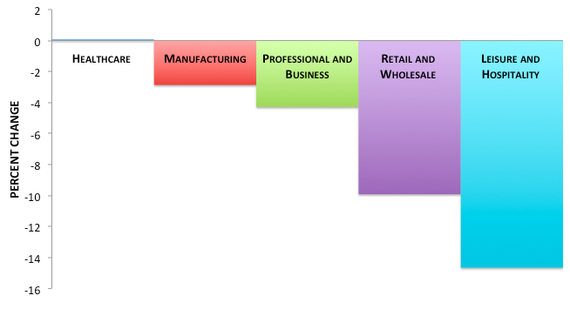
Should young Americans feel confident about their economic prospects?

Wages of Young Americans (Source: The Atlantic)

Graph: Young People’s Wages Have Fallen Across Industries Between 2007 and 2013.

Young Americans are taking longer to graduate and graduating with more debt, but that’s not all – they aren’t find jobs, and the jobs they do find typically don’t allow them to pay back their loans.

Here’s an article from The Atlantic, which leans left.

Excerpt:

American families are grappling with stagnant wage growth, as the costs of health care, education, and housing continue to climb. But for many of America’s younger workers, “stagnant” wages shouldn’t sound so bad. In fact, they might sound like a massive raise.

Since the Great Recession struck in 2007, the median wage for people between the ages of 25 and 34, adjusted for inflation, has fallen in every major industry except for health care.

These numbers come from an analysis of the Census Current Population Surveyby Konrad Mugglestone, an economist with Young Invincibles.

In retail, wholesale, leisure, and hospitality—which together employ more than one quarter of this age group—real wages have fallen more than 10 percent since 2007. To be clear, this doesn’t mean that most of this cohort are seeing their pay slashed, year after year. Instead it suggests that wage growth is failing to keep up with inflation, and that, as twentysomethings pass into their thirties, they are earning less than their older peers did before the recession.

The picture isn’t much better for the youngest group of workers between 18 and 24. Besides health care, the industries employing the vast majority of part-time students and recent graduates are also watching wages fall behind inflation. (40 percent of this group is enrolled in college.)

It’s not just that – the Democrats are doing a pretty good job of wrecking other parts of the economy, from energy development to health care to entitlement programs to college tuition, which rises higher as government throws more money into the system. They are doing everything they can to wreck the economy with higher taxes and burdensome regulations.

As a result of our headlong rush towards socialism, the U.S. economy has now fallen to number 2 in the worldbehind China.

Look:

We’re no longer No. 1. Today, we’re No. 2. Yes, it’s official. The Chinese economy just overtook the United States economy to become the largest in the world. For the first time since Ulysses S. Grant was president, America is not the leading economic power on the planet.

It just happened — and almost nobody noticed.

The International Monetary Fund recently released the latest numbers for the world economy. And when you measure national economic output in “real” terms of goods and services, China will this year produce $17.6 trillion — compared with $17.4 trillion for the U.S.A.

As recently as 2000, we produced nearly three times as much as the Chinese.

To put the numbers slightly differently, China now accounts for 16.5% of the global economy when measured in real purchasing-power terms, compared with 16.3% for the U.S.

This latest economic earthquake follows the development last year when China surpassed the U.S. for the first time in terms of global trade.

So things are bad for young people, and it’s going to get worse.

It’s important to check what major you are studying to make sure you get a return on your investment, and don’t be scared to study something you hate if it means that you can make your career work. Your education and career choices are not about fulfillment and thrills. You have to make hard choices in order to make ends meet so that you have freedom to do the things you ought to do, especially if you want to get married and start a family. Those marriage and family plans start the day you step into high school, in my opinion.

UPDATE: 17.7% Teen Unemployment in America – Still Above Rate of 6 Years Ago and Labor Force Participation Remains at 36-Year Low.

Harvard poll: majority of youth likely voters favor Republicans this election

I’m not sure if I really believe this Harvard Institute of Politics poll because young people seem to be so disinterested in moral issues, economics and national security these days. But I guess even young people know whether they have jobs, whether they like living with their parents and whether they want to have their heads chopped off. Right?

Right:

More than half – 51 percent – of America’s millennials who say they will “definitely be voting” in November prefer a Republican-run Congress, with only 47 percent favoring Democrat control, according to a Harvard Institute of Politics poll.

This marks a significant departure from the institute’s findings before the 2010 midterm elections, when America’s 18-29 year olds who were definitely voting favored Democrats 55 percent to 43 percent.

Institute director Maggie Williams described the youth vote as “politically up for grabs” and a potential “swing vote” for control of Congress in a conference call to announce the results.

“The message to political candidates is clear: Ignore millennial voters at your peril,” Williams said.

What’s more, the poll found that only 43 percent of millennials approve of President Obama’s job performance, while 53 percent disapprove. It is his second-lowest rating in the institute’s polls since he took office. The figures are only slightly worse for Obama among those who will “definitely be voting”: 42 percent approve, 56 percent disapprove.

The results showed a stark divide in presidential approval along racial and ethnic lines. Only three in 10 young whites approve of the president’s performance, while nearly eight in 10 young blacks approve. Hispanic youth approval fell to 49 percent, down from 60 percent just six months ago.

Director of Polling John Della Volpe described youth voters as “a little bit less Democratic” than during Obama’s first term, speaking on the conference call. Factoring in the voting likelihood of all millennials, more 18-29 year olds prefer a Democrat-controlled Congress than a Republican one (50 percent to 43 percent), Della Volpe said – but the age group has become less supportive of the party.

“A lot of it comes down to turnout,” Della Volpe said. “It seems that young Republicans are more likely to participate next week.”

And this, I really like:

The poll also surveyed voters about terrorism threats. More than six in 10 millennials say they are “a great deal” or “somewhat” worried about another terrorist attack, with young women (66 percent) more afraid than men (56 percent).

I guess my naive view of young, unmarried women is that they are all like the ones I see in my gym – watching the Bravo channel or game shows to see people with too much make say mean things to one another. But it turns out that they are actually concerned with the economy and national security, which is a very good thing. Welcome aboard, young ladies! It’s not a shame to have a fear of something if the fear is justified, and if you do something about it to make it go away.

And by the way, the men in the gym are just as bad about not paying attention to politics and the economy. The day of the terrorist attack in Ottawa, the men were all watching ESPN sports. Horrible! Even the muscle bound Christian guy changes the channel from Fox News to ESPN as soon as I leave. The only person who is responsible at all is the gay guy – he at least watches local news.